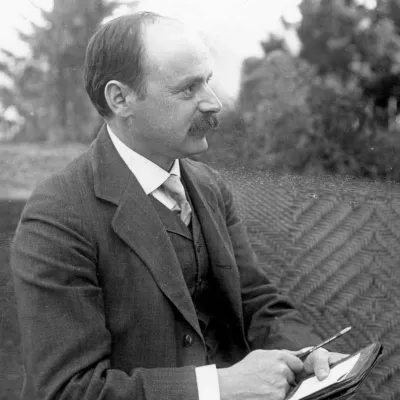
Karl Schwarzschild
Human Design Chart
Biography
Schwarzschild accomplished this while serving in the German army during World War I. He died the following year, on 11 May 1916, aged 42, in Potsdam, from the autoimmune disease pemphigus, which he developed while at the Russian front. Various forms of the disease particularly affect people of Ashkenazi Jewish origin.
He was the father of astrophysicist Martin Schwarzschild.
Asteroid 837 Schwarzschilda is named in his honour, as is the large crater Schwarzschild, on the far side of the moon.
Human Design Analysis: Karl Schwarzschild as Generator 2/4
Generator 2/4 — Design at a Glance
Karl Schwarzschild revealed himself as someone with immense inner endurance whose strength did not stem from arbitrary initiative. As a Generator, he possessed an abundance of sacral energy that drove him like a strong workhorse – provided he had the right task in front of him. His design suggested that his greatest strength lay in not taking the first step himself but waiting for signals from the environment and then reacting impulsively to them. The motto 'not initiate, but react' characterized his energetic dynamics: only when his sacral center gave a clear 'yes', did his full capacity unleash itself.
Living in harmony with this strategy by responding to inner impulses rewarded him with a deep sense of fulfillment and satisfaction. However, if he tried to fight against this mechanism – whether through completing tasks without internal resonance or interrupting his heart projects – he fell into the typical pitfalls of his type. Then frustration and a lack of energy threatened as he wasted his strength instead of using it purposefully. His effectiveness thus depended crucially on learning to respond from the gut to life's offers rather than letting himself be blocked by external expectations or self-imposed constraints.
Sacral Authority
Karl Schwarzschild lived as a Generator whose decision-making was shaped by sacral authority. This inner guidance did not represent an abstract reflection but an immediate physical reaction to external stimuli. His design required waiting for an impulse – often felt as gut feeling, a subtle grunting sound, or a sudden surge of energy – to know if something engaged his energy.
A prerequisite for this clear signal transmission was his open emotional center. Since emotions were not immediately accessible here, he could rely on the direct, physical feedback mechanism of the sacral center. When his sacral motor reacted to something, Karl Schwarzschild had vital energy and inexhaustible enthusiasm. He accomplished his work with joy and immersed himself in it without an external purpose or benefit needing to be at the forefront. The activity itself sufficed as reward.
Furthermore, his activated spleen center served as a supportive instance. This connection allowed him quick, spontaneous reactions and reliable access to his instinctive perception. He could rely on this physical well-being, which further strengthened his ability to make decisions. Waiting for the impulse strategy simplified his process considerably: acting according to the sacral response made him feel alive and fulfilled; ignoring it left him lacking the necessary strength. This mechanism significantly determined how Karl Schwarzschild navigated through life and utilized his energy.
The 2/4 Profile — Hermit / Opportunist
Karl Schwarzschild was marked by Profile 2/4, characterized by a fundamental tension between the urge for isolation and the desire for community. His design suggested that he oscillated between two poles: Line 2, the need to withdraw for inner clarification, and Line 4, the wish to spend time with familiar people. For him, it was crucial to create a safe environment where he could clearly communicate when he sought company and when he wanted solitude. During his 'me-time', he immersed himself in internal processes to calm down and gain clarity. Only after satisfying this need for solitude did he emerge from his 'cave' to reconnect with his network. This dynamic allowed him to reflect on the knowledge of his surroundings during alone time and develop new insights. Line 2 provided clarity through intuition about values that served survival, but also required determination to acknowledge these inner truths. Simultaneously, Line 4 offered assurance in crisis times; it indicated that everything has an end and experiences are part of a larger cycle. Even difficult or embarrassing situations became opportunities for development. Karl Schwarzschild used this alternation between withdrawal and connection to organize his intellectual resources and generate brilliant ideas based on the synthesis of inner insight and external exchange.
Split Definition — Defined & Open Centers
Karl Schwarzschild revealed himself as someone who constantly felt an internal pressure to ask questions and understand connections. His defined Head and Ajna centers generated a permanent mental activity: inspiration did not come to him as a complete solution but rather formed the question first. This state could lead to confusion or doubt, since there was no direct energy available to immediately turn these thoughts into action. Instead of trying to relieve this pressure through hasty actions, his mechanism was designed to wait for the right moment to inspire others with his concepts.
His voice and expression were reliable and clear, supported by a defined Throat Center. What he spoke aligned with what his mind conceptualized. Parallel to that, he had a firm identity and a clear sense of direction, conveyed through the defined G Center. This gave him the ability to love himself and show others new perspectives without being dependent on their approval. His vital energy came from the defined Sacral Center; it was a constant source but only available when reacting to external stimuli rather than initiating action itself. Through his also defined Spleen Center, he had a sharp instinct for what was healthy and correct in each moment.
In contrast, his Heart and Solar Plexus centers were open. The open Heart Center meant that he was not designed to hold willpower or promises; the attempt to prove his worth through performance often led into cycles of disappointment. He tended to question whether he performed enough to be recognized, although this energy source was not consistently present. The open Solar Plexus Center made him receptive to the emotions of his surroundings. He absorbed foreign feelings and amplified them, which could lead to experiencing emotional waves as his own or avoiding confrontations out of fear of emotional instability. This openness also served as a barometer to sense others' emotional climate so long as he did not identify with it.
Channel 64-47: Abstraction — Channels & Gates
Karl Schwarzschild was marked by sudden, profound transformation processes through his design. The Channel of Mutation 60-3 connected his Root Center with the Sacral and generated a pulsing energy that accepted limitation (Gate 60) to move beyond confusion and organize something new (Gate 3). This melancholic yet powerful pulse drove him to catalyze evolutionary change within himself and his environment.
Parallel to this, the Channel of Alpha Animal 7-31 between G Center and Throat Center gave him the ability for logical, collective leadership (Gate 31), grounded in the role of Self (Gate 7). His authority did not rest on coercion but rather on gaining trust and clearly outlining patterns of the future so others could follow.
His intuition found expression through the Channel of Brain Wave 57-20. Here intuitive knowledge flowed from the Spleen Center (Gate 57) directly into the Voice of Now (Gate 20). This allowed him to articulate existential truths spontaneously and precisely in the moment without prolonged thought.
In the mental realm, the Channel of Structuring 43-23 shaped his way of thinking. Insights from the Ajna Center (Gate 43) were processed through assimilation (Gate 23) and clearly communicated, enabling him to efficiently convey innovative perspectives. The Channel of Abstraction 64-47 in the Head-Ajna area ensured that he filtered experiences through a kaleidoscope of possible images (Gate 64), ultimately understanding a comprehensible story or perspective (Gate 47).
Additional Gates like Gate 51 (Willpower) and Gate 53 (Pioneer Spirit) underscored his adaptability to shocks and his drive to forge new paths.
Individual Circuitry — Circuit Signature
Karl Schwarzschild's design revealed a split energy architecture: two parallel, not directly connected power fields. One field linked the Sacral with the Root Center, indicating fundamental instinctive endurance. The other field encompassed Head, Ajna, Spleen, Throat, and Identity Centers, weaving together thinking, intuition, and expression closely.
In the Knowledge Circuit, he had two separate segments working. On one hand, Channel 3-60 (Mutation) connected Sacral with Root Center; this promoted innovative deviations from the known, supported by vital energy. On the other hand, Channels 20-57 (Flash of Insight) and 43-23 (Structuring) linked Ajna, Throat, and Spleen Centers. Here creative impulses emerged that were linguistically formulated through intuitive structuring to transform new knowledge.
The Understanding Circuit connected his Throat with the Identity Center via Channel 31-7 (Alpha Animal). This allowed him to share rational strategies and logical insights directly from his essence, free of emotional coloring.
The Meaning-Finding Circuit linked Head and Ajna Centers through Channel 64-47 (Abstraction). This connection served to reflect on past experiences abstractly and grasp their deeper meaning to learn together with others. Overall, he navigated between instinctive renewal, rational strategy, and emotional reflection – always acting separately but coherently within their respective groups.
Right Angle Cross of Penetration 3
Karl Schwarzschild's design indicated a tendency towards deep and often painful confrontation with his own essence. This configuration, known as the right cross of Permeation 3, did not describe an easy life path but rather a process of intense inner turmoil. The mechanics of this pattern were evident in a constant interplay between the desire for profound connection and the fear of its loss or disappointment.
This cross acted like a grindstone that shaped his personality through recurring crises. It was not about superficial conflicts, but fundamental questions of identity and trust in others. Karl Schwarzschild carried this energy as an inner compass, urging him to test relationships and experiences for their authenticity, often with harsh consequences for his own feelings.
Permeation 3 specified this process: it was a search for meaning and truth through suffering and loss. Each connection was then tested whether it would stand firm or break apart. This dynamic profoundly shaped his inner experience; it created a person who though vulnerable, developed an unusual depth and clarity in perceiving their own motives and those of others through these repeated trials. The energy of this cross demanded that he constantly rediscover himself after old certainties crumbled.
Saturn Return · Uranus Opposition — Life Cycles
Karl Schwarzschild showed a structure aimed at stable anchoring and clear authority. His design promoted a deep need for security through established positions and the building of responsibility in recognized institutions. This tendency towards institutional integration became visible in 1901 when he was 28 years old, becoming Professor and Director of the Göttingen Observatory. This marked his first Saturn Return, a cycle where long-term preparations often solidify into firm professional foundations. Taking on this leadership role corresponded exactly to the mechanical logic of this return: consolidation of status and establishment of a lasting role within an existing system.
However, his chart also contained tensions hinting at unexpected breaks. This instability surfaced in 1914 when he was 41 years old, enlisting voluntarily for military service as World War I began. This fell into the phase of Uranus Opposition, a mechanism often forcing or provoking sudden disruptive changes. Instead of continuing with previous stability, he responded to an external crisis with a radical realignment of his life path. The contrast between the stabilizing Saturn influence in 1901 and the disruptive Uranus dynamics in 1914 illustrates the inner pressure of his design: the search for security met unavoidable external upheavals requiring adaptation to entirely new, chaotic circumstances.
Generator · Sacral Authority — Synthesis
He was a Generator whose life was marked by deep, sacral energy. This driving force, combined with the ability to find clarity within his own internal processes (Profile 2/4), created a rhythm between intense engagement and the need for withdrawal. The defined Head Center provided constant mental pressure to question things and understand them – an inspiration he apparently passed on to others as well. However, this process was not without melancholy (Channel 3-60) since evolutionary change always involves letting go of the old.
A central paradox lay in the tension between his sacral drive and the demands of his mind. The energy flowed when he engaged with a task that truly attracted him, yet the defined Head Center demanded constant confrontation and inspiration. This led to an inner dance: the urge to create and transform (Knowledge Circuit) and the necessity to occasionally withdraw to balance the resulting mental strain. The documented events showed how this cycle guided him through career phases and crisis times.
5 Defined Channels
Incarnation Cross - Right Angle Cross of Penetration 3
Solar Return
The Solar Return shows the moment when the sun returns to its exact birth position - your personal solar year.
Life Cycles
Discover the life cycles with a detailed triple view (birth chart, cycle chart, composite).
Human Design Profile
- Type
- Generator
- Strategy
- To respond - wait for something to respond to
- Authority
- Sacral Authority
- Profile
- 2/4 - Hermit / Opportunist
- Definition
- Split Definition
- Incarnation Cross
- Right Angle Cross of Penetration 3
- Date of Birth
- 09.10.1873 18:00
- Place of Birth
- Frankfurt am Main, GER
Frequently Asked Questions
What was Karl Schwarzschild's Human Design type?
What Profile did Karl Schwarzschild have in Human Design?
What Authority did Karl Schwarzschild possess?
What incarnation cross did Karl Schwarzschild have?
When was Karl Schwarzschild born?
Discover your own Human Design
Are you also a Generator? Find out in a personal reading how to use your sacral energy correctly and discover deep satisfaction.
More Personalities
Back to overviewAaliyah

Alexia

Angèle

Anne-Marie

Arcángel

Arno