
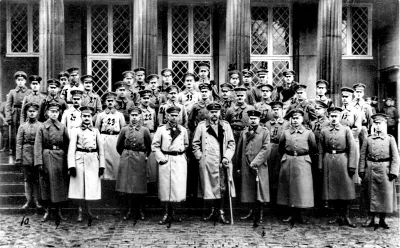
Kurt von Tippelskirch
Human Design Chart
Biography
In World War I he fought in the First Battle of the Marne; and in World War II he participated in the battles of the Eastern Front, Italian Campaign, Gothic Line Campaign and Battle of Berlin. He surrendered to the United States Army on 2 May 1945.
Tippelskirch wrote several books, such as History of the Second World War, 1951. He died on 10 May 1957, aged 65, in Lüneburg.
The Human Design of Kurt von Tippelskirch: Manifesting Generator 2/4
Manifesting Generator 2/4 — Design at a Glance
Kurt von Tippelskirch's design featured a tendency towards hybrid energy: He had the constant power of a Generator but also the ability to skip steps in action. This configuration marked him as someone who could quickly pull things into his life when responding to inner impulses.
The mechanics of the manifesting generator require not initiating oneself, but waiting for a clear 'yes' from the Sacral Center. Kurt von Tippelskirch often found himself in a play mode that brought deep satisfaction as long as he pursued several projects simultaneously and sought variety. The strategy was to start only after receiving this inner confirmation.
If this resonance did not occur or was ignored, his design tended to skip important steps. This led quickly to the need to backtrack and make up for missing elements – a source of frustration that touched on the non-self theme of this type. Additionally, his speed could lead him to attack too many things at once. Without constant checks by his inner authority, the joy of creation turned into exhaustion. His path was thus to consciously use parallel work as play and regularly check whether the Sacral Center still supported current activities. This transformed potential overextension into sustainable satisfaction.
Emotional Authority
Kurt von Tippelskirch moved through an emotional wave that profoundly shaped his judgment and perception. His inner authority lay in the defined Emotional Center; this was considered the highest instance for decisions, regardless of which other centers were also defined in his design. He experienced a constant up-and-down of feelings: The world appeared colored by the current mood. What excited him one moment could seem negative the next. This rapid fluctuation was merely an initial impression and not necessarily his deeper truth. Spontaneous decisions made from such emotional peaks often had negative consequences.
The mechanics of his authority required patience and time. Kurt von Tippelskirch needed to let decisions mature in order to gain a deeper understanding. This meant allowing himself to be properly delayed, asking multiple times, and letting important steps happen overnight. Over time, intense feelings subsided; emotional distance set in. Only then did clarity and calm appear, marking the process as complete. This path was especially significant for long-term decisions that profoundly influenced his life course. By waiting, he gained the necessary distance to not just follow momentary moods but adopt a more grounded perspective.
The 2/4 Profile — Hermit / Opportunist
Kurt von Tippelskirch's design featured a tendency towards a pendulum rhythm between deep withdrawal and social exchange. As someone with Profile 2/4, he constantly oscillated between two fundamental needs: Line 2 demanded solitude and internal processing, while Line 4 sought connection within a familiar community. This conflict was not a weakness but a structural requirement of his character.
The mechanics of this profile require clear communication outwardly: Kurt von Tippelskirch had to define his boundaries to signal when he needed company and when he wanted solitude. During his 'me-time', he immersed himself in internal processes to find peace and clarity. Only after satisfying the need of Line 2 did Line 4 become active; he left his 'cave' to spend time with his favorite people.
This structure allowed him to reflect on the knowledge of his network during alone times, developing new insights. The intuition of Line 2 helped him recognize values for survival, while the confidence of Line 4 gave assurance in crisis that difficult phases would end. By navigating this tension between isolation and integration, he could produce brilliant ideas based on a synthesis of personal insight and collective experience.
Triple Split Definition — Defined & Open Centers
Kurt von Tippelskirch's design was characterized by a comprehensive definition of all nine centers. This created a mechanical system based entirely on internal, fixed patterns without relying on external circumstances. His Head Center and Ajna Center were defined, which generated a constant mental pressure. This state continuously drove him to ask questions, form concepts, and understand connections. Since these centers did not have direct energy for implementation, his mental activity primarily served as inspiration and structuring of ideas while he waited for the right timing to apply them.
His defined G Center provided him with a stable self-identity and clear sense of direction. Kurt von Tippelskirch knew who he was and where his path led without restricting others' freedom. Simultaneously, his Heart Center stood ready to mobilize willpower. It allowed him to keep promises and use his resources autonomously, giving him natural authority in the material world.
The energy for his actions came from his defined Sacral Center. As a Generator, he responded to external stimuli to release his vital force. This strategy of waiting and responding protected him from exhaustion and ensured sustainable satisfaction in his activities. His communication occurred through his defined Throat Center, which served as a pivot point to carry the internal processes of other centers outward.
Emotionally, he guided himself through his Solar Plexus Center. He patiently waited for his emotional wave to clarify before making decisions, ensuring that his judgments were based on deep clarity rather than fleeting moods. His Spleen Center provided intuitive security in the moment, while his Root Center supplied the necessary pressure to move forward and master challenges in the world. Since no centers were open, Kurt von Tippelskirch was not susceptible to conditioning by the environment; his behavior consistently aligned with his own inner architecture.
Channels for intuitive integrity, powerful presence and deep connection.
Kurt von Tippelskirch demonstrated a deep intuitive connection to his survival and individual existence. His design was strongly influenced by the Awakening Channel 10-20, which connected his G Center with his Throat Center. This meant he had the ability to be present in the moment and accept himself, helping him deflect external resistance and not take criticism personally.
This attitude was reinforced by the Exploration Channel 34-10, linking his Sacral Center with his G Center. This resulted in inner strength that allowed him to follow his own convictions and act independently without disturbing others. He did not seek external validation but lived from a deep self-love that enabled him to express his uniqueness.
The Perfect Form Channel 57-10 connected his Spleen Center with his G Center, giving him intuitive insight that guided his behavior. This allowed him to act spontaneously and appropriately to secure his physical well-being without being burdened by future anxieties. His way of living in the moment was inspiring to others as it demonstrated how one can move through life existentially unburdened.
Additionally, the Charisma Channel 34-20 shaped his energy by directly transforming sacral power into expression. This gave him the ability to maintain prolonged activity and inspire others with his vitality as long as he oriented himself towards his inner guidance. The Flash of Insight Channel 57-20 supported this through intuitive insights that he could communicate in the moment, helping reduce misunderstandings.
The Transformation Channel 54-32 motivated him to continuously strive upward and improve his position in life driven by a desire to be seen. Finally, the Community Channel 37-40 promoted his need for belonging and loyal bonds while the Abstraction Channel 64-47 stimulated his mind to mentally process experiences and develop new perspectives.
Individual Circuitry — Circuit Signature
Kurt von Tippelskirch's design exhibited a complex, tripartite structure. Instead of a unified flow, three independent energetic islands operated parallel next to each other. This separation shaped his experiential world as a sequence of distinct, not directly connected energy fields.
The Knowledge Circuit in him linked Throat and Spleen Centers via the Flash of Insight Channel (20-57). This promoted spontaneous, innovative ideas that were immediately translated into language – a pulsating energy of creative intuition in the moment.
Independently, the Centering Circuit worked through the Exploration Channel (10-34) between Identity and Sacral Centers. Here emerged deep inner strength and self-affirmation, yet often difficult to communicate outwardly without direct connection to the Throat Center.
A third isolated area formed with the Sense of Purpose Circuit via the Abstraction Channel (64-47) between Head and Ajna Centers. This part of his design dealt with reflecting on past experiences and searching for their deeper meaning, separate from other energetic streams.
Additionally active were elements of the Ego Circuit (Community 40-37 between Heart and Solar Plexus; Transformation 32-54 between Spleen and Root) as well as the Integration Circuit connecting Throat, Sacral, Spleen, and Identity Centers. The latter integrated intuitive power with immediate expressive power in the moment. Overall, there was no cohesive whole but a mosaic of separate functions: inner strength, spontaneous creativity, and reflective sense-making existed as parallel, non-fusing forces in his system.
Right Angle Cross of Penetration 3
Kurt von Tippelskirch's design indicated a tendency towards profound and often painful inner transformation. This configuration, known as the right cross of penetration 3, did not describe an easy path but rather one through intense personal trials. It acted like a catalytic process that dissolved old structures and identities to make way for a new, more authentic form of being.
This pattern did not simply mean suffering but was a necessary tearing apart of the ego. It involved going through experiences of loss or deep crises without clinging to outdated beliefs. The energy of this cross promoted radical honesty with oneself. In this context, Kurt von Tippelskirch showed himself as someone who did not remain superficial but was ready to penetrate dark and challenging aspects of life to gain a stronger inner integrity from them.
The mechanics of this configuration emphasized the aspect of 'penetration': crossing barriers, whether emotional or spiritual. It was a process of purification where the old had to die so that new could be born. This shaped an attitude of resilience and the ability to rise again out of deepest valleys, changed and often with greater wisdom about human conditionality. It was a path of alchemical transformation through experience.
Saturn Return · Uranus Opposition · Chiron Return · 2nd Saturn Return — Life Cycles
Kurt von Tippelskirch's design was marked by clear life phases where external structures and internal tasks intersected. In 1920, at the age of 29, he married Elli Gallenkamp. This coincided with his first Saturn return, a cycle often marking the crystallization of long-term groundwork into stable, sustainable connections. The marriage signaled here the building of a firm foundation for further life.
A decade later in 1941 at age 50, Kurt von Tippelskirch took command over the 30th Infantry Division. This point marked his Chiron return, a fulfillment cycle of blossoming. In this phase, one's incarnation cross increasingly unfolds in everyday life; meaning and purpose become experiential. Taking command showed itself as a concrete manifestation of this process: A position of responsibility based on prior development leading the personal path into a new, mature dimension.
In 1948 at age 57, Kurt von Tippelskirch was released from British captivity. This corresponded to his second Saturn return. This cycle often brings renewed scrutiny of life structure and the necessity to dissolve or reorder old forms. The release stood for the end of a forced situation and the beginning of a necessary realignment in post-war times. These events illustrate how cyclical energies in Human Design can set concrete turning points in life.
Manifesting Generator · Emotional Authority — Synthesis
Kurt von Tippelskirch lived a life shaped by the dynamics of a Manifesting Generator – an ongoing movement between the impulse for rapid initiation and the need to wait on sacral responses. His defined Head Center (with Awakening Channel) indicates an unceasing drive to understand the world, ask questions, and turn inspirations into actions. This mental activity was amplified by the emotional wave pattern requiring deep engagement with themes before decisions could be made. The profile as a natural talent and networker revealed a dance between the need for withdrawal to inner clarity and the desire for exchange and community – a rhythm that shaped his interactions.
A central paradox in his design lay in the tension between the ability to quickly spark things (Manifestor aspect) and the underlying Generator need to respond to sacral impulses. This may have led him at times to miss important steps or find himself in a cycle of quick action followed by correction – a pattern visible also in documented events like taking responsibility (1941) and later release timing (1948). The ability to inspire, combined with emotional depth, points to a man who both developed innovative ideas and carefully weighed the consequences of his decisions.
9 Defined Channels
Incarnation Cross - Right Angle Cross of Penetration 3
Solar Return
The Solar Return shows the moment when the sun returns to its exact birth position - your personal solar year.
Life Cycles
Discover the life cycles with a detailed triple view (birth chart, cycle chart, composite).
Human Design Profile
- Strategy
- To respond - wait for something to respond to
- Authority
- Emotional Authority
- Profile
- 2/4 - Hermit / Opportunist
- Definition
- Triple Split
- Incarnation Cross
- Right Angle Cross of Penetration 3
- Date of Birth
- 09.10.1891 20:00
- Place of Birth
- Berlin, GER
Frequently Asked Questions
What was Kurt von Tippelskirch's Human Design type?
What Profile did Kurt von Tippelskirch have in Human Design?
Which Authority guided Kurt von Tippelskirch?
Which incarnation cross did Kurt von Tippelskirch carry?
When was Kurt von Tippelskirch born?
Discover your own Human Design
Are you also a Manifesting Generator? Find out in a personal reading how to unfold your multi-talents and direct your energy wisely.
More Personalities
Back to overviewAlain-Fournier

Aldair

Alizée

Angeli

Arletty

Artus
