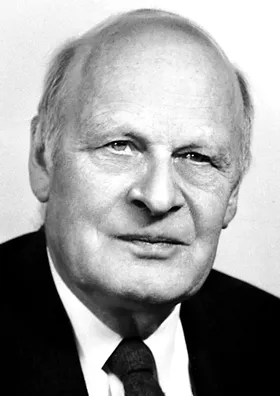
Lars Onsager
Human Design Chart
Biography
Onsager died from an aneurysm on 5 October 1976 in Coral Gables, Florida, at the age of 72.
Human Design Analysis: Lars Onsager as Manifesting Generator 5/1
Manifesting Generator 5/1 — Design at a Glance
Lars Onsager revealed himself as someone marked by a hybrid energy configuration: He possessed the constant power of a Generator, yet also had the ability to accelerate processes and skip steps. His design suggested that he could swiftly draw things into his life once he responded to an inner impulse. This speed was a double-edged sword; it allowed him efficient action but carried the risk of overlooking important stages or becoming distracted by parallel activities.
The mechanics of his type, the manifesting Generator, required him not to initiate himself but to wait for external stimuli and only act when his Sacral Center gave clear confirmation. Only then could he channel his creative power without falling into frustration over past mistakes or lost energy. When this strategy was followed, Lars Onsager found deep satisfaction in his work. He benefited from variety and a playful approach to tasks rather than focusing on one task alone. His strength lay in advancing multiple projects simultaneously as long as he remained in harmony with his inner authority and did not lose the joy of the process.
Emotional Authority
Lars Onsager showed a decision-making stance that didn't solidify at the moment of first excitement or rejection. His design carried emotional authority, meaning his defined Emotional Center formed the internal framework – regardless of which other Centers were also defined. This configuration subjected him to natural waves of emotional ups and downs. The world appeared colored by his current mood: A topic could seem absolutely fascinating one moment and completely unattractive the next.
For Lars Onsager, however, this initial emotional impression was only a snapshot, not yet the final truth. Quick, spontaneous decisions from such an emotional state often had negative consequences. Instead, his system required patience and time to let a choice mature. He needed to take his time, sleep on decisions multiple times, and go through the process of emotional condensation.
Only when intense feelings subsided and emotional distance was gained did clarity and calm set in for him. Only then was the inner process complete and a well-founded decision possible. This mechanism was especially important for long-term decisions with significant influence on his life course. Through waiting, he gained the necessary depth and overview to not be guided by passing moods but act from stable internal certainty.
The 5/1 Profile — Heretic / Investigator
Lars Onsager revealed himself as someone who used deep knowledge to offer solutions to others. His design as a 5/1 Profile gave him a magnetic presence; others actively sought his insights, which drew him into problem-solving for many people. This dynamic required clear boundaries, however, as constant demand could quickly lead to exhaustion if not consciously saying 'No'.
Line 5 projected a power presence especially in crisis times or resistance, creating discomfort through continuous power display and paranoia when questioned about his authority. Simultaneously, Line 1 formed his inner foundation: Willpower that could only be replenished by rest periods. Metaphors like moon phases highlighted that recovery preceded renewed work. Without these pauses, the ego suffered loneliness and difficulties in partnerships.
Onsager had to learn to balance research for himself (Line 1) with service to others (Line 5). Only then could he optimally utilize his gifts without burning out – like a scientist who rests after intense conferences rather than responding to endless inquiries. His design shapes this tension between deep reflection and external responsibility.
Split Definition — Defined & Open Centers
Lars Onsager's Human Design profile indicated a tendency towards persistent, powerful expression. His defined Throat Center served as a focal point, transforming messages from the entire system into clear communication and action. This voice did not speak arbitrarily but reliably from his inner sources.
His energy base was marked by the defined Sacral and Heart Centers. The Sacral generated a constant vital force that waited for correct reactions to find satisfaction. The defined Heart Center gave him willpower and the drive to determine his life himself as well as keep promises. Additionally, the defined Solar Plexus and Spleen Centers were at work: He had an emotional authority that required patience to find clarity in the wave, along with a intuitive Spleen authority for spontaneous existential decisions in the present moment. The defined Root Center provided the necessary pressure to move forward and manage stress.
At the same time, Lars Onsager was influenced by open centers. His open Head and Ajna Centers did not indicate a fixed mental understanding; he tended to take up inspiration or concepts from his environment and could become confused when trying to solve mental problems that were not his own. His open G Center lacked a firm identity and direction. He was prone to merging with others or seeking a 'borrowed' identity rather than waiting for external initiation. This openness allowed him to adopt many perspectives but also led to the risk of feeling lost if he wasn't in the right place and the correct environment.
Channels for intuitive power, focus and authentic connection.
Lars Onsager radiated an intense, almost meditative focus on details. This attitude resulted from Channel 52-9, connecting the Root Center with the Sacral Center. Gate 52 promoted passive non-action and stillness, while Gate 9 sharpened the focus on facts. Together they created a formative energy that allowed him to filter out distractions and refine logical patterns precisely.
At the same time, Lars Onsager had a powerful, charismatic presence shaped by Channel of Charisma 34-20. Here, sacral energy from Gate 34 (Power) propelled his Throat Center through Gate 20 (Now), giving him the ability to act in the moment and directly set his generative power into the world without hesitation.
This physical urgency was complemented by Channel of Brainwave 57-20. Intuitive insights from the Spleen Center (Gate 57) flowed immediately to the Throat Center (Gate 20), allowing him to articulate deep truths in the present and strengthen others in their own survival intelligence.
The connection between intuition and sacral power was found in Channel of Power 34-57. This archetype of the individualized person kept Lars Onsager alert to his environment, using instinctive reactions to navigate daily life safely. His independence and vitality were thus strengthened.
Social bonds formed through Channel of Community 37-40. He sought recognition (Gate 37) and a proper place in the whole but also needed breaks and rewards for his work (Gate 40). This fostered relationships based on mutual benefit and loyalty within a group.
Additionally, influences such as the drive towards worldly enlightenment (Gate 54), the ability to anchor innovations in the tribe (Gate 26) as well as an open attitude towards mutation (Gate 22) were at play. Corrective needs (Gate 18), evolutionary feeling sensations (Gate 41) and tribal hierarchies (Gate 45) rounded out his complex energetic profile.
Individual Circuitry — Circuit Signature
Lars Onsager's design indicated a tendency toward impulsive, creative insights that complemented logical structuring and collaborative effort. His chart showed a split definition: two independent energy blocks existed parallel without direct flow between them.
The first block connected the Throat Center with the Spleen through the Knowledge Circuit (Channel 20-57). This allowed intuitive flashes of insight and their acoustic expression in the present moment. Parallel to this, the Integration Circuit was at work, also involving the Spleen and linking it to the Sacral Center (Channels 20-34 and 34-57). Here, intuitive power and correct behavior created a self-reinforcing energy in the present. Additionally, the Understanding Circuit connected Channel of Concentration (9-52) between Sacral and Root Centers, promoting focused rational strategy without emotional influence. These two groups – Throat/Spleen on one hand, Sacral/Root on the other – together formed a continuous flow of intuition, expression, and logical endurance.
The second, separate block consisted of the Ego Circuit (Channel 37-40), linking Heart and Solar Plexus Centers. This created dynamics between emotional drive and the will to support in community contexts, yet isolated from the other energies. Lars Onsager thus moved in two parallel worlds: on one hand in impulsive creativity and rational strategy, on the other hand in emotional cooperation – without these areas directly merging.
Left Angle Cross of Duality 2
Lars Onsager's Human Design chart indicated a tendency towards deep and often painful confrontation with the theme of union. His chart contained the left cross of duality, a configuration that did not seek superficial harmony but rather aimed to recognize the true unity underlying life's apparent opposites. For him, this search was no abstract theory but a central, practical experiential principle. The left cross of duality demands going through conflict to find the underlying truth; it is the path of learning through suffering and overcoming separation. Lars Onsager thus showed himself as someone whose inner development was strongly shaped by understanding polarities not as enemies but as necessary poles of an integrated whole. This configuration created a life task in dissolving the illusion of duality and instead living the interconnected nature of all things. It was a process of integration, where he had to learn that true wholeness can only be achieved through accepting and penetrating pairs of opposites. His path was marked by the necessity not just to intellectually understand this insight but also to live it concretely in daily life and relationships to reach his own integrity and peace with himself.
Saturn Return · Uranus Opposition · Chiron Return · 2nd Saturn Return — Life Cycles
Lars Onsager's life journey followed the rhythmic cycles of planetary influences embedded in his design. His first Saturn Return marked a phase of consolidation, where early impulses towards structural stability coalesced. This was not a sudden break but a process of laying foundations, during which he learned to channel his energy into sustainable paths.
The subsequent Uranus Opposition brought about a necessary loosening of these structures. It challenged him to break rigid patterns and adopt new perspectives without entirely abandoning the previously established base. This tension cycle served adaptability and allowed him to flexibly adjust to changing circumstances.
With the Chiron Return, a phase of flourishing began. If he had followed his strategy, this marked the unfolding of his incarnation purpose. It was not healing in a therapeutic sense but rather an experience of meaning and fulfillment as his life task became increasingly tangible.
The second Saturn Return rounded off this process. It stood for maturity and integration of previously gathered experiences into a coherent whole. Lars Onsager used this time to solidify his achievements and create a sustainable structure for the rest of his journey, characterized by wisdom and enduring inner order.
Manifesting Generator · Emotional Authority — Synthesis
He lived deeply in the connection between doing and knowing. A central red thread of his design was the dynamic unity of sacral energy (defined Sacral Center) and manifesting power (connection to Throat Center). This combination allowed him to react swiftly to impulses and initiate things while simultaneously possessing a constant source of life energy. The Profile as Hero/Researcher (5/1) reinforced this trait: He actively sought solutions for complex problems (Line 5), supported by a deep need to learn and accumulate knowledge (Line 1). This knowledge he then shared willingly, leading him into the role of expertise and problem-solving – always driven by the format energy of the Channel of Concentration.
A central paradox lay in the tension between his emotional authority and the urge for quick initiation. Although he needed time to let decisions mature (emotional center), his design possessed the ability to act swiftly and skip steps. This likely led him into occasional internal conflict: between the need for emotional clarity and the temptation to act immediately. The constant emotional wave demanded patience, while manifesting energy called for swift action.
5 Defined Channels
Incarnation Cross - Left Angle Cross of Duality 2
Solar Return
The Solar Return shows the moment when the sun returns to its exact birth position - your personal solar year.
Life Cycles
Discover the life cycles with a detailed triple view (birth chart, cycle chart, composite).
Human Design Profile
- Strategy
- To respond - wait for something to respond to
- Authority
- Emotional Authority
- Profile
- 5/1 - Heretic / Investigator
- Definition
- Split Definition
- Incarnation Cross
- Left Angle Cross of Duality 2
- Date of Birth
- 27.11.1903 21:15
- Place of Birth
- Oslo, NOR
Frequently Asked Questions
What was Lars Onsager's Human Design type?
What Profile did Lars Onsager have in Human Design?
What Authority did Lars Onsager possess?
What incarnation cross was assigned to Lars Onsager?
When was Lars Onsager born?
Discover your own Human Design
Are you also a Manifesting Generator? Find out in a personal reading how to unfold your multi-talents and direct your energy wisely.
More Personalities
Back to overviewAldair

Alizée

Angeli

Arletty

Artus
Balthus