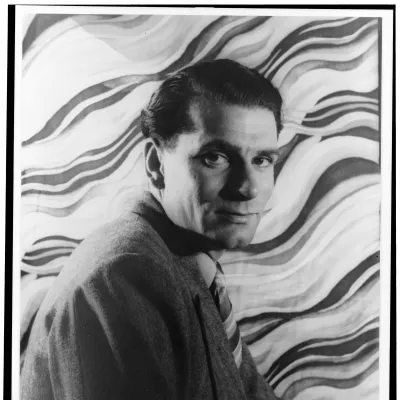
Laurence Olivier
Human Design Chart
Biography
The youngest of three children born to Parson Gerard Olivier and homemaker mother Agnes Crookenden, Olivier's early interest in acting began by imitating his father's melodramatic sermons in order to get his attention. Insightful Agnes recognized her delicate son's acting ability and encouraged him to recite monologues from plays, coaching him herself. While Olivier never did gain much of his taciturn father's attention, he became the center of his mother's world. She urged him to appear in plays at the boarding school he attended where, in his own words, he was a "muddled kind of boy, a weakling." Agnes was not alone in her praise of her son's talent. After watching young "Larry" appear as Brutus at age 12 in a school production of "Julius Caesar," actress Ellen Terry wrote in her diary "the boy who played Brutus is already a great actor."
The definitive blow of his life occurred the next year when his beloved mother died of a brain tumor.
Human Design Analysis: Laurence Olivier as Projector 6/2
Projector 6/2 — Design at a Glance
Laurence Olivier appeared as a Projector with a dense, focused aura. His design had a tendency to immediately spot problems in other systems – much like a bright flashlight directed at dark spots. This ability to find the error in a system could provoke resistance from his surroundings when he addressed these flaws directly. Instead of aggressively shining this light into others' faces, his most effective approach was through a pleasant glow: by embodying harmonious patterns himself. Others were then drawn to this aura and actively sought his advice.
His strategy involved waiting for a genuine invitation before taking on a leadership role. Without such invitations, he risked being perceived as unpleasant or intrusive. Since Projectors lack a defined Sacral Center, they do not have a constant intrinsic energy source. Laurence Olivier therefore went through phases of high activity and rapid productivity followed by necessary rest periods for regeneration. Ignoring this rhythm quickly led to exhaustion. Living according to the principle of patience and waiting for invitations rewarded him with success. If he missed this strategy, his theme of Non-Self surfaced – a feeling of injustice and disappointment towards the environment.
Emotional Authority
Laurence Olivier showed an inner orientation strongly influenced by emotional waves. His design carried emotional authority, meaning that his Solar Plexus Center was defined and thus always took precedence over all other defined centers. This held true regardless of which additional mechanics were active in his chart; the emotional level significantly shaped his decision-making process.
This configuration led him to perceive the world through the filter of his current mood. His feelings fluctuated constantly: he could be totally enthusiastic about something one moment and see it negatively the next. Since these immediate sensations were only snapshots, they did not necessarily represent his deeper truth. Quick, spontaneous decisions made directly from such emotional peaks often proved problematic or negative.
Instead, his system required patience and time. By letting decisions mature and sleeping on them multiple times, he could let intense initial feelings subside. This process created the necessary emotional distance until clarity and calmness set in. Only then, when the emotional storm had subsided, did true insight emerge. This need for delay was especially important for long-term decisions that would have a significant impact on his life course. His path involved consciously taking time to question himself multiple times before acting.
The 6/2 Profile — Role Model / Hermit
Laurence Olivier's design inclined towards intense experimentation in youth, followed by a phase of deep introspection. As a 6/2 Profile, the sixth line acted like a third before age thirty: trial and error characterized this period, with retreats after mistakes serving as driving principles. This reflects how young Six-Twos need to accumulate many personal experiences before maturing.
Around age thirty, the sixth line fully activated. Laurence Olivier metaphorically retreated into a 'cave' to reflect on earlier experiments from a distance. This phase served for healing and self-discovery. Only after completing this inner work did he emerge as a wise person whose introspective abilities attracted others.
The underlying dynamics of Gate 8 emphasized authenticity and correct timing in social contexts. After initial hypocrisy or uncertainty about the right moment to contribute, an attitude without falsehood developed. Simultaneously, Gate 55 with its second line: emotional projections outward and mood swings were present. Emotional balance depended heavily on others' trust, which often fluctuated. Attempts to prove reliability could even undermine this trust. Laurence Olivier learned that true stability arose not through external validation but through integrating these emotional fluctuations and returning to inner truth.
Single Definition — Defined & Open Centers
Laurence Olivier was marked by a design characterized by profound emotional intensity and persistent inner pressure. His defined Solar Plexus Center endowed him with an emotional authority that required patience: truth revealed itself to him over time, not in the immediate impulse. He was inclined to wait out the waves of his feelings—from passion to longing—to gain clarity. This mechanism protected against impulsive misjudgments and strategically leveraged the seductive aura of his emotions. Simultaneously, his defined Root Center acted as a motor for survival pressure. It provided the necessary stress impulse to move forward in the material world and master existential challenges. This pressure was not a burden but a fixed energy source that kept him grounded so long as he acted from inner peace.
In contrast, his design revealed several areas of receptivity and reflection. His open Head Center made him vulnerable to mental confusion and the pressure to find answers to questions that were not his own. He tended to be swayed by others' doubts rather than trusting his own inspiration. Similarly, his open Ajna Center allowed him to absorb concepts and opinions from his environment instead of generating them himself. This fostered a flexible mind but risked losing itself in foreign theories or pretending to possess certainties it did not have.
His open G Center lacked a firm identity or direction. Olivier was designed to be initiated through relationships and places. He reflected the energy of his surroundings; at the right place, he flourished, at the wrong one, he felt lost. This made him an ideal mirror for others since he did not impose his own rigid identity. His open Heart Center freed him from the need to prove willpower or keep promises to demonstrate value. He could perceive the egos of others without having to enter into competition himself.
His open Sacral Center lacked a constant energy flow. Olivier was receptive to the vital force of his environment, making him vulnerable to overexertion if he did not pause. He had to learn to set boundaries and rest before exhaustion set in. Finally, his open Spleen Center revealed a sensitivity for health and well-being. It was not a reliable source for spontaneous decisions since it could easily be conditioned by fears or the comfort feelings of others. Instead, he developed wisdom in distinguishing between his own needs and absorbed vibrations.
Channels for the expression of free emotions.
Laurence Olivier's emotional expression was marked by a pulsating wave of passion and melancholy. This dynamic stemmed from Channel 39-55 (Feelings Release), which connected the Root Center with the Solar Plexus. Through Gate 39 (Provocation) and Gate 55 (Mind), a mechanism emerged that did not use moodiness as weakness but as deep, creative power. Olivier lived in this alchemy between ecstatic joy and uncertain sadness without rationalizing it. Authenticity was key: only when he accepted his mood could he delve into the depths of his mind and reach others through this contagious, transformative quality. His impact depended on being in the right mood; forcing himself to act or interact lost this seductive warmth.
Additionally, Gate 8 (Contribution) carried the energy of individual promotion and identity expression, making him appear as a creative role model. Gate 14 (Power) supported this through skillful handling of influence and self-control while providing direction. In the background, Gates like 59 (genetic binding strategy), 36 (crisis as movement), and 41 (evolutionary feeling) played roles. Gate 54 connected worldly success with mystical insight, often with a supportive partner. Finally, Gate 38 provided resistance against harmful forces to preserve individual integrity. This configuration described someone who did not suppress emotional depth and power but used them as means to appear authentic and provoke and strengthen others in their own mental states.
Individual Circuitry — Circuit Signature
Laurence Olivier was marked by pulsating acoustic energy that adhered to his unique path. His design connected the Solar Plexus Center with the Root Center via Channel 'Feelings Release.' This connection created a direct flow between emotional depth and the ability for immediate, impulsive reaction.
The Knowledge Circuit emphasized in him the necessity of transforming new insights into change. While this circuit generally also includes creative flashes or inspiration, Olivier's specific expression focused on the emotional wave. The energy flowed directly from emotional processing in the Solar Plexus to the Root Center, generating intense, often melancholic intensity. This allowed him to not only feel emotions but use them as driving forces for immediate action or expression.
The simple definition of his design meant that these energetic forces worked clearly without internal fragmentation. He lived in the tension between emotional perception and a pressing need for change. The pulsating form-energy of this circuit demanded an authentic representation of his individuality. Through the connection of emotion and root power, he could trigger transformations that acted on a deep, often unconscious level. His expression was always acoustic and present-focused, carried by the emotional wave flowing through the channel. This shaped his way of interacting with the world: direct, emotionally charged, and intent on translating the new into reality.
Left Angle Cross of Uncertainty 1
Laurence Olivier carried the Human Design of the left cross of uncertainty. This configuration shaped a fundamental attitude characterized by deep skepticism towards prefabricated answers and an ongoing search for what is essential. His chart indicated an inner impulse to question existing structures, not out of doubt but because he sought higher authenticity.
In Human Design, this cross describes a specific life task: It involves seeing through the illusion of security and certainty. People with this expression often experience that external stability can be deceptive. The focus is on not getting lost in dogmas or rigid systems, but always being ready to let go of old beliefs when they no longer align with truth.
For Laurence Olivier, this meant he likely went against the flow where others showed conformity. He sought personal integrity beyond societal expectations. This dynamic fostered a kind of freedom that came with the responsibility to constantly re-found what one believes and does anew. It was not a state of chaos but a conscious stance of openness for the unexpected and readiness to continuously reorient oneself to follow their inner compass.
Saturn Return · Uranus Opposition · Chiron Return · 2nd Saturn Return — Life Cycles
Laurence Olivier's design was marked by precise synchronization between internal maturation and external success. His life phases, where recognition came his way, followed a clear rhythmic pattern reflecting his inner development.
At age 40 in 1947, he received the award for best actor for Henry V. This fell during the Uranus opposition, a phase of change when old structures often break to allow new expression. For him, this marked a breakthrough based on previous work.
Ten years later, in 1956 at age 49, he was honored as the best British actor for Richard III. This corresponded with the Chiron return, a fulfillment cycle between ages 49 and 51. During this time, one's incarnation cross unfolds increasingly; meaning becomes experiential if living according to strategy and authority. Olivier experienced here not healing of old wounds but blossoming of his purpose.
The third peak came in 1966 when he was honored at age 59 for Othello. This was the second Saturn return, a time of consolidation and adult self-understanding. These three milestones show how Olivier's design translated maturity, change, and fulfillment into concrete achievements without external factors being paramount. His successes were expressions of an inner rhythm that consistently showed over decades.
Projector · Emotional Authority — Synthesis
He was a projector distinguished by his ability to recognize the potential and weaknesses of others (Gate 39). This gift came with an internal emotional wave (defined Emotional Center) slowing decisions and requiring time for maturation. Thus, he lived in a constant tension field between immediate recognition of patterns and the necessity to filter these insights through the ups and downs of his emotions – a process leading him to withdraw after phases of intense activity (6/2 Profile).
This behavior reflected a central paradox: He projected light onto others' darkness, recognized flaws in systems, and could give transformative impulses (Knowledge Circuit), yet his emotional authority required distance and reflection. Successes tied with public recognition fell during deeper internal process phases – a pattern reinforced by recurring cycles making him an exemplary figure whose wisdom arose from experience and introspective confrontation.
1 Defined Channel
Incarnation Cross - Left Angle Cross of Uncertainty 1
Solar Return
The Solar Return shows the moment when the sun returns to its exact birth position - your personal solar year.
Life Cycles
Discover the life cycles with a detailed triple view (birth chart, cycle chart, composite).
Human Design Profile
- Type
- Projector
- Strategy
- Wait for the respectful invitation
- Authority
- Emotional Authority
- Profile
- 6/2 - Role Model / Hermit
- Definition
- Single Definition
- Incarnation Cross
- Left Angle Cross of Uncertainty 1
- Date of Birth
- 22.05.1907 05:00
- Place of Birth
- Dorking, UK
Frequently Asked Questions
What was Laurence Olivier's Human Design type?
Which Profile did Laurence Olivier have?
What Authority determined Laurence Olivier's decisions?
What incarnation cross did Laurence Olivier have?
When was Laurence Olivier born?
Discover your own Human Design
Are you also a Projector? Find out in a personal reading how to unfold your leadership qualities and recognize the right invitations.
More Personalities
Back to overviewSissy Spacek
Alain-Fournier
Anémone
Ann-Margret
Arletty
Arno