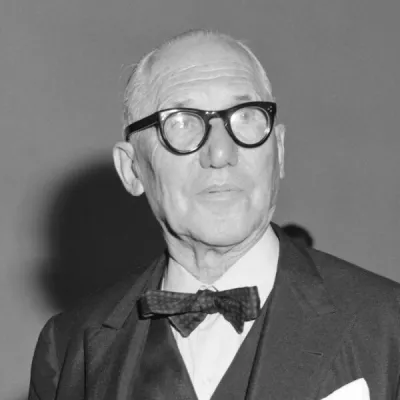
Le Corbusier
Human Design Chart
Biography
Dedicated to providing better living conditions for the residents of crowded cities, Le Corbusier was influential in urban planning, and was a founding member of the Congrès International d'Architecture Moderne (CIAM). Le Corbusier prepared the master plan for the city of Chandigarh in India, and contributed specific designs for several buildings there, especially the government buildings. In 2016, seventeen projects by Le Corbusier in seven countries were inscribed in the list of UNESCO World Heritage Sites as The Architectural Work of Le Corbusier, an Outstanding Contribution to the Modern Movement.
Le Corbusier remains a controversial figure. Some of his urban planning ideas have been criticized for their indifference to pre-existing cultural sites, societal expression and equality, and his alleged ties with fascism, antisemitism, eugenics, and the dictator Benito Mussolini have resulted in some continuing contention.
What does Projector 5/1 mean for Le Corbusier?
Projector 5/1 — Design at a Glance
Le Corbusier operated with a dense, focusing aura that immediately revealed systemic weaknesses. His Human Design as a Projector described him like a bright flashlight: He shone light directly on areas in his environment that were still in the dark or not functioning properly. This mechanism allowed him to identify errors in systems instantly.
The challenge lay in the nature of intervention. Direct criticism of these flaws often provoked resistance and rejection from others, comparable to a blinding beam of light into someone's face. The more effective strategy was to attract through his own harmonious glow. When he acted as an example, people sought him out for advice. His leadership only proved lasting when it rested on a respectful, honest invitation.
His undefined Sacral Center also meant that he lacked a constant source of intrinsic life energy. Instead, he experienced phases of high activity and rapid workability, which had to be followed by rest periods to prevent burnout. This rhythmic need stood in conflict with the demands for constant performance in society.
Living according to this design – through restraint, waiting for invitations, and respecting his energy cycles – Le Corbusier was rewarded with success. Deviations from this strategy sooner or later led to bitter experiences as an expression of his non-self. His strength therefore lay not in constant action but in precise, invited leadership.
Splenic Authority
Le Corbusier exhibited a fundamental attitude of radical spontaneity where long-term planning took second place to immediate impulse. His design dictated that decisions could only be made at the moment of first feeling, as this moment was the sole reliable source for physical well-being and the right environment. This mechanism stemmed from his inner authority in the Spleen, a defined center functioning as a health and alarm system. It endowed him with pronounced survival intelligence manifesting as spontaneous inner knowledge whether a situation or society was beneficial or not. Since this spleen voice was a very fine impulse appearing only once at the moment, its use required high vigilance; it could easily be drowned out by other influences. This made flexibility an imperative necessity since plans could change short-term and fixed commitments often did not exclude harmful influences. Le Corbusier therefore lived in constant readiness to draw boundaries against anything that threatened his health and sought space to follow these fleeting signals. The need for little commitment was no lack of resolve but a direct consequence of the fact that he only knew what was right for him at the moment of occurrence.
The 5/1 Profile — Heretic / Investigator
Le Corbusier appeared as someone who stood between the magnetic urge to offer collective solutions in crises and the necessity to withdraw to deepen knowledge through experience. His design as a 5/1 profile combined the energy of line 5 with the depth of line 1. Line five gave him almost an attractive aura, making others seek his solutions. This created a strong impulse to implement practical answers during difficult times. At the same time, line one required the laborious accumulation of experiences as a foundation for every development.
The tension lay in that this magnetic quality could easily lead to exhaustion if clear boundaries were not set. Le Corbusier had to learn to say no to maintain balance between research for himself and problem-solving for others. Without this protection, he risked collapsing like an overburdened expert model under the weight of endless inquiries and criticism. The central task was to preserve the beneficial dynamics from inner maturation and outer action. Only through setting boundaries could he optimally utilize his gifts without exhausting himself. This configuration shaped his life as a constant negotiation between the desire to serve others and the duty to conserve his own resources.
Split Definition — Defined & Open Centers
Le Corbusier revealed himself through a firm, magnetic self-identity and a clear sense of direction, independent of external influences. His design featured a tendency towards reliable, honest communication that felt like personal truth, stemming from his defined G Center, which gave him a consistent Higher Self connected with the defined Throat Center. This configuration ensured that his voice and actions always spoke from his inner identity, not fleeting thoughts or emotions.
Additionally, he possessed spontaneous, intuitive intelligence in the moment, provided by the defined Spleen Center. This offered a protective instinct and the ability to make trustworthy judgments for well-being. This existential clarity was enforced by the constant, adrenaline-driven pressure of the defined Root Center in the material world. The specific coupling of Root to Spleen pushed him to not only feel intuitive knowledge but actively correct it and implement it materially, which was relevant for his survival and thriving.
At the same time, Le Corbusier was vulnerable to mental confusion and the pressure to find answers because his Head and Ajna Centers were open. He tended to get entangled in intellectual puzzles of others or seek inspiration to fill this gap rather than trust his inner authority. His open Heart Center made him sensitive to the need to prove his worth, which could lead him into spirals of promises and disappointment if he did not stop trying to prove himself. Moreover, his open Solar Plexus absorbed the emotions of his environment, making him appear emotionally unstable when he personalized these foreign feelings. Additionally, his undefined Sacral Center meant that he lacked a consistent energy source and was dependent on borrowed energy, leading to exhaustion if he did not learn to set boundaries and rest.
Channels for logical leadership, reflection and ambitious transformation.
Le Corbusier showed a tension between the drive for collective recognition and the necessity of inner maturity. His design suggested that he gained leadership not through authority but through logical scrutiny and trust. Channel 21-7 connected the G Center with the Throat Center: Gate 7 provided the role as "power behind the throne," while Gate 31 represented the voice of the collective leader. Success depended on being invited by the majority to act within existing patterns.
At the same time, the Juxtaposition element Channel of the Lost Son 22-13-33 was at play. It brought together Gate 13 (the Listener) and Gate 33 (Withdrawal). This mechanism demanded reflection: information was gathered, secrets were kept, and only after a long withdrawal phase was wisdom passed on. This created an internal conflict between the active leadership claim of his personality and the passive, maturing stance of the Juxta-element. The timing of his actions became complex; he had to wait until the deeper truth revealed itself beneath the surface.
In his design, Channel of Transformation 35-54-32 supported this dynamic through ambition and continuity. Gate 54 (ambition) and Gate 32 (continuity) pushed him to improve his position through constant effort and support from the tribe. Additional gates like Gate 48 (pattern recognition) and Gate 62 (logical details) underscored the ability to understand complex structures logically and present them clearly. Le Corbusier lived in balance between the desire to be recognized as an Alpha and the deep necessity of listening and maturing before sharing his insights.
Collective Circuitry — Circuit Signature
Le Corbusier's design established a tendency towards dual work methods: on one hand, cool, strategic planning for the future, and on the other, emotional reflection of the past. Both streams converged in the Throat Center to share insights with others. This configuration stemmed from his Shared Definition, where two energetically separate systems existed parallelly.
His Understanding Circuit connected the Throat and Identity Centers via Channel "The Alpha Animal" (Gates 31-7), promoting a focused, logical approach aimed at initiating improvements for society through structure and intellect. It was rational energy, free from emotional influence, directed towards future goals.
Parallel to this, his Meaning Circuit also operated between the Throat and Identity Centers (Channel "The Lost Son," Gates 33-13). Here emotions and cyclical wave movements dominated. Le Corbusier reflected on past experiences to uncover their meaning and share these felt insights. The connection between these two circuits was not direct; they were separate forces that both utilized sharing knowledge as an expression.
A third, independent stream was the Ego Circuit, connecting the Spleen and Root Centers (Channel "Transformation," Gates 32-54). This area concerned cooperation and resource management within a community. Since there was no connection to the Sacral Center, constant life force was lacking. This required phases of rest and recovery to build energy for communal endeavors and maintain balance between giving and taking.
Left Angle Cross of Endeavour 2
Le Corbusier's design laid the foundation for a fundamental driving force characterized by the archetypal pattern of the left cross of Effort 2. This configuration determined the specific dynamics and orientation of his overall system. It described not just a temporary phase but a structural stance that profoundly shaped his actions and inner disposition.
In Human Design, a Cross Archetype marks a central life task or recurring focus created by the connection of several energy centers. The left cross of Effort 2 indicated an alignment towards sustained effort and the pursuit of a specific form of validation or structuring of the environment. It was not just present but required to be actively lived in order to align with his own design.
This mechanism worked as background noise influencing Le Corbusier's decisions and reactions. It created internal pressure driving him to continuously engage or optimize certain areas. The emphasis on this archetype within his overall system meant that this energy source was particularly accessible and influential, shaping how he approached challenges and perceived his role in relation to others. It was a driving force demanding persistence and endurance without necessarily seeking immediate recognition but rather the integrity of his own path.
Saturn Return · Uranus Opposition · Chiron Return · 2nd Saturn Return — Life Cycles
Le Corbusier's design structured his career phases through distinct astrological cycles that served as milestones for institutional anchoring and public recognition. These rhythmic transitions shaped his journey towards established authority.
The first Saturn Return around age 27 condensed years of groundwork into solid results. In 1914, Le Corbusier became head of a department at the École d’arts appliqués, a step that transformed his professional competence into a secure position.
The Uranus Opposition around age 40 often demanded a reorientation or public visibility. In 1927, this was evident in his participation in the competition for the League of Nations Palace in Geneva; his design received first prize, confirming his international relevance.
The Chiron Return between ages 49 and 51 marked a flourishing phase where his incarnation cross unfolded and meaning became tangible. In 1937, Le Corbusier was represented at the World's Fair with the Pavilion of Temps nouveaux; this moment of highest expression and fulfillment of purpose.
The second Saturn Return around age 57 solidified his achieved position definitively. In 1944, he became chairman of the urban planning commission of the French architects' association Front national des architectes, underlining his role as an institutional pillar whose influence was now structurally anchored. Each cycle contributed to step-by-step establishment, from professional leadership to strategic direction.
Projector · Splenic Authority — Synthesis
He was a projector whose life was marked by a deep-rooted drive to recognize patterns and make them accessible to others. The ability to identify system errors (Gate 11) went hand in hand with natural authority from the Spleen center, which gave him instinctive knowledge about the right measure of engagement. This combination led him always to seek deeper understanding (Line 1), then offer it as a problem solver and advisor (Line 5). The focus was on logical leadership (Channel of the Alpha) and sharing insights beneficial to society – an ongoing cycle of observation, analysis, and communication.
Simultaneously, an internal tension revealed itself between the desire for influence and the necessity to maintain boundaries. His magnetic presence (Line 5) attracted people seeking his expertise, yet a tendency towards direct address could provoke resistance. This led to a constant interplay between the need to share knowledge and the challenge of doing so in ways acceptable to others. Professional successes (documented events) showed how he repeatedly renegotiated this tension throughout his life – always striving to implement visions without overstepping others' needs and limits.
3 Defined Channels
Incarnation Cross - Left Angle Cross of Endeavour 2
Solar Return
The Solar Return shows the moment when the sun returns to its exact birth position - your personal solar year.
Life Cycles
Discover the life cycles with a detailed triple view (birth chart, cycle chart, composite).
Human Design Profile
- Type
- Projector
- Strategy
- Wait for the respectful invitation
- Authority
- Splenic Authority
- Profile
- 5/1 - Heretic / Investigator
- Definition
- Split Definition
- Incarnation Cross
- Left Angle Cross of Endeavour 2
- Date of Birth
- 06.10.1887 21:00
- Place of Birth
- La Chaux-de-Fonds, Switzerland
Frequently Asked Questions
What was Le Corbusier's Human Design type?
Which Profile did Le Corbusier have in Human Design?
What was Le Corbusier's Authority?
What incarnation cross did Le Corbusier have?
When was Le Corbusier born?
Discover your own Human Design
Are you also a Projector? Find out in a personal reading how to unfold your leadership qualities and recognize the right invitations.
More Personalities
Back to overviewSissy Spacek

Alain-Fournier

Anémone

Ann-Margret

Baekhyun

Balthus