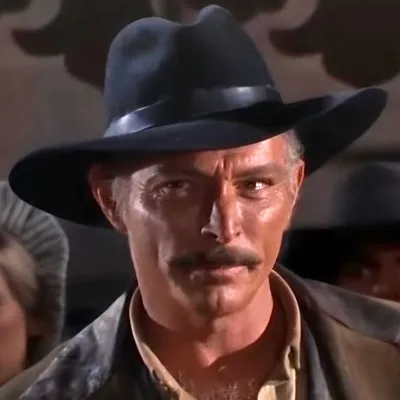
Lee Van Cleef
Human Design Chart
Biography
One of the great movie villains, Lee Van Cleef started out as an accountant. He served in the U.S. Navy aboard minesweepers and subchasers during World War II. After the war he worked as an office administrator, becoming involved in amateur theatrics in his spare time.
An audition for a professional role led to a touring company job in "Mr. Roberts". His performance was seen by Stanley Kramer, who cast him as henchman Jack Colby in High Noon (1952), a role that brought him great recognition despite the fact that he had no dialogue.
For the next decade he played a string of memorably villainous characters, primarily in westerns but also in crime dramas such as The Big Combo (1955). His hawk nose and steely, slit eyes seemed destined to keep him always in the realm of heavies, but in the mid-'60s Sergio Leone cast him as the tough but decent Col. Mortimer opposite Clint Eastwood in For a Few Dollars More (1965).
A new career as a western hero (or at least anti-hero) opened up, and Van Cleef became an international star, though in films of decreasing quality. In the 1980s he moved easily into action and martial-arts movies, and starred in The Master (1984), a TV series featuring almost non-stop martial arts action.
He was an alcoholic and was in a clinic for three years.
Van Cleef died of a heart attack on 16 December 1989, aged 64.
Human Design Analysis: Lee Van Cleef as Reflector 4/6
Reflector 4/6 — Design at a Glance
Lee Van Cleef's design established a fundamental disposition of deep receptivity. As a Reflector, he did not have any defined centers, meaning that he did not have constant, personal energies at his disposal. Instead, he acted as a mirror of his environment. He perceived the energy of his surroundings particularly strongly. This not only included the energies of other people but also the energy of nature. Seasons, planetary and stellar constellations shaped his perception.
Therefore, it was important for him to live in harmony with the cycles of nature. For important decisions, his strategy was to wait for at least a month. This period corresponded to a lunar cycle. If he followed this strategy and his authority, he would automatically find people and environments that were good for him. In these moments, he could observe the world completely free of any attachment or identification. As a reward, he experienced a feeling of joyful surprise.
If he lived against his design, he would likely feel a deep, persistent disappointment. This disappointment would be directed towards himself and/or the state of the world. His design thus described a way of life based on resonance and waiting, rather than on his own, firm drive.
No Inner Authority
Lee Van Cleef did not have an inner authority, a configuration that made him one of the rarest human designs. As a Reflector, he did not have a single defined center in his body graph. This complete openness meant that he did not find any fixed internal decision-making structures that would have given him immediate clarity. Instead, his orientation was inseparably linked to the lunar cycle. To make sound judgments, he needed a period of about 28 days. This duration corresponded to the time the moon needed to traverse its entire energy field structure once. In this rhythm, reliable conditioning patterns repeated themselves, which gave him orientation over his own identity and what fit him. Urging or accelerating these processes was fundamentally contrary to his nature. His path consisted of never putting himself under time pressure but waiting for the cyclical changes. Through this patience, he could recognize which environments and people fit him. The ability to withdraw during these 28 days and observe the recurring impulses formed his most important tool to find the right path in a complex world without relying on external pressures or internal moods that did not stem from his own, cyclical rhythm.
The 4/6 Profile — Opportunist / Role Model
Lee Van Cleef's design showed a tendency that changed radically over time. In his first thirty years, he acted like an experimentalist, intensely seeking relationships and friendships, driven by the energy of Line 4. This phase was characterized by the search for connection and the building of a network, often showing the mystical, praying quality of Gate 54, which sought recognition from higher powers.
With the return of Saturn, Line 6 was activated. Here, an inner conflict emerged: the desire to belong to a community clashed with the need to withdraw to think about the meaning of life. This contradiction between heart and head shaped his later years. He developed into a role model who spoke wisdom from experience. The intuition of Gate 57, combined with the hexagram of integration, helped him find clarity in difficult situations, even if it was not always perfect. He learned to make the best of survival situations without being blinded by intuition. His big heart remained cautious; he only opened it to those who proved themselves trustworthy to avoid being hurt. Thus, he became someone who acted through cooperation and wise distance simultaneously – a networker who took his role as a model seriously but always watched out not to be taken advantage of.
No Definition — Defined & Open Centers
Lee Van Cleef's design showed complete openness in all nine centers. This resulted in no fixed inner authority or consistent energy source, but rather extreme receptivity to external influences. He was designed to act as a mirror, taking in and reflecting the identity, emotions, and stress of his environment.
The open G Center meant that he did not have a fixed, rigid identity. Instead, he tended to lose himself in roles and relationships to understand who he was. This allowed for deep acting skills, as he could authentically embody foreign identities without mistaking them for his own. The open Ajna and Head Centers allowed him to take in mental inspirations and concepts from the outside. He was prone to mental confusion when trying to find answers that did not come from him, rather than acting as a neutral observer.
The open Heart Center lacked consistent willpower. He tended to want to prove his worth through achievement, which could lead to a cycle of promises and disappointments if he did not rely on his inner strategy. The open Sacral Center lacked a constant energy flow. He absorbed the vital energy of others, leading to overexertion and exhaustion if he did not pause and set boundaries.
The open Solar Plexus Center made him a barometer for the emotional climate. He amplified the feelings of his environment, making him vulnerable to emotional waves that were not his own. The open Spleen Center lacked spontaneous, healthy instinct. He tended to cling to uncertain situations to simulate a sense of well-being rather than trusting his intuition. The open Root Center absorbed external stress. He reacted to environmental pressure with adrenaline, which could lead to hyperactivity if he did not recognize this as foreign. The open Throat Center meant that he could not communicate consistently. He drew attention by waiting for an invitation rather than forcing it.
This design required him to break free from conditioning and trust his own strategy to not identify the absorbed energies as his own.
Channels & Gates
Lee Van Cleef's design was characterized by a strong tension between the drive for worldly success and the search for spiritual clarity. Gate 54 connected material triumph with mystical insight for him, with worldly success serving as a prerequisite for spiritual development. This ambition was supported by a Buddy or partner who promoted his development. Simultaneously, Gate 53 as a pioneer spirit urged him to forge new paths and leave old structures behind. This freedom for new experiences marked the beginning of development cycles; without the necessary conclusion, however, the lack of a goal could lead to depression, as human development follows abstract, unchangeable processes.
His inner orientation was significantly influenced by Gate 57, the Gate of intuitive clarity and the 'Gentle Wind'. As a complex Spleen Gate with six channels in the network, it functioned as an integration gate, sharpening consciousness for survival and intuition. It anchored him in the here and now, enabled individuation as self-awareness through clarity, and was also associated with a certain fear of tomorrow. This intuitive sharpness contrasted with the raw willpower of Gate 51, which operated without social bonds. Here, the ability to respond to shocks with insight was evident. Gate 51 offered two potentials: competition-oriented action or mystical depth. Adaptability depended strongly on whether the ego was defined; an undefined ego could develop problems here, while a defined one showed a strong adaptation drive. Lee Van Cleef thus moved in a field that united hard willpower, intuitive presence, and the pioneer spirit, always in the tension between material assertiveness and inner, mystical search for truth.
Circuit Signature
Lee Van Cleef's design was marked by a complete lack of defined energetic connections. His chart did not show any channels connecting centers; instead, all energetic poles existed isolated next to each other. This configuration, classified as 'No Definition', meant that he did not have any internal, automated reaction patterns guiding his actions or perception. Every situation met an open system that did not offer a pre-programmed response.
This structural openness required constant, conscious engagement with the immediate environment. As no centers were connected by channels, there was no continuous energetic flow structuring decisions or emotions. Instead, Lee Van Cleef had to process each experience anew and individually, without relying on stored, internal patterns. This created high flexibility, as he was not bound to fixed behavioral patterns, but also a constant need to focus on the here and now.
The absence of any defined groups or circuits underscored this total independence from internal constraints. There were no separate, parallel running energies acting as distinct forces; rather, the entire system was characterized by its non-connection. Lee Van Cleef thus lived in a state of maximum adaptability, compelled to respond to every new challenge with fresh attention, as his design did not offer automated solutions. This absolute openness shaped his way of experiencing and traversing the world.
Right Angle Cross of Penetration 4
Lee Van Cleef's Design indicated a tendency towards strategic, goal-oriented action based on the principle of penetration. He was someone who did not scatter his energy but focused it on a clear goal to overcome obstacles. This approach stemmed from the mechanics of the right penetration cross at Gate 4, a configuration that describes a specific kind of assertive power. In Human Design, this cross represents the ability to break through barriers through consistent, often persistent effort. It was not mere aggression but a precise, well-thought-out strategy to advance in life. Lee Van Cleef embodied this dynamic by clearly defining his intentions and then working towards them with relentless yet justified force. The energy of this cross helps to assert one's will without losing integrity. It enabled him to not give in during difficult situations but to take the necessary steps to achieve the desired outcome. This quality shaped his way of dealing with challenges: directly, efficiently, and without unnecessary detours. He used this inner structure to assert himself in his environment and achieve his goals, which gave him a special presence and impact.
Saturn Return · Uranus Opposition · Chiron Return · 2nd Saturn Return — Life Cycles
Lee Van Cleef's design indicated a tendency towards structural consolidation followed by a later radical reorientation. In 1952, at the age of 27, Stanley Kramer cast him as the henchman Jack Colby in "The Big Carnival." This marked his first Saturn Return, a cycle in Human Design often symbolizing the crystallization of years of groundwork into solid results. Here, the mechanics of stabilization were evident: a beginning that offered stability and definition.
However, his chart also contained the potential for disruptive turning points. In 1965, at the age of 40, Sergio Leone cast him as the tough but righteous Colonel Mortimer in "A Fistful of Dollars." This fell during his Uranus Opposition, a period in the design associated with breaking free from old structures and sudden, often unexpected change. Leone's casting of him was not mere coincidence but aligned with the energetic demand of this conjunction for renewal and breaking established patterns.
These two events illustrate the tension in his design between the necessity of laying foundations (Saturn) and the inner drive to potentially shatter them to become more authentic (Uranus). Lee Van Cleef did not experience this dynamic as a contradiction but as complementary forces: first anchoring in a role, then transforming and expanding it. His career development thus reflects the archetypal movement described by these planetary cycles in Human Design—from consolidation to revolutionary self-discovery.
Reflector · No Inner Authority — Synthesis
Lee Van Cleef was a mirror of his environment, a reflector without defined centers, absorbing the energies of others and nature intensely. This openness shaped his life, in which he constantly changed through relationships and experiences (Profile 4/6), until he took on the role of a role model. The lack of inner authority meant that decisions did not arise from an inner impulse but were made through exchanges with others and resonance in open centers. Thus, he lived a life characterized by adapting to external influences and seeking clarity through interaction.
A central paradox lay in the connection between worldly ambition and spiritual search (Gate 54). The right cross of penetration points to a person who moves through the world to gather experiences and go through developmental cycles (Gate 53). Career successes initiated by encounters with creative impulses were evident at certain moments, but the constant openness and lack of firm inner structures led to an ongoing search for meaning and orientation.
Incarnation Cross - Right Angle Cross of Penetration 4
Solar Return
The Solar Return shows the moment when the sun returns to its exact birth position - your personal solar year.
Life Cycles
Discover the life cycles with a detailed triple view (birth chart, cycle chart, composite).
Human Design Profile
- Type
- Reflector
- Strategy
- Wait a lunar cycle (approx. 28 days)
- Authority
- No inner authority - learn more
- Profile
- 4/6 - Opportunist / Role Model
- Definition
- No Definition
- Incarnation Cross
- Right Angle Cross of Penetration 4
- Date of Birth
- 09.01.1925 05:00
- Place of Birth
- Somerville, NJ, United States
Frequently Asked Questions
What was Lee Van Cleef's Human Design type?
What Profile did Lee Van Cleef have in Human Design?
What Authority did Lee Van Cleef have?
What incarnation cross did Lee Van Cleef have?
When was Lee Van Cleef born?
Discover your own Human Design
Are you also a Reflector? Find out in a personal reading how to find the right environment and understand your unique mirror effect.
More Personalities
Back to overviewSissy Spacek

Anémone

Ann-Margret

Arletty

Arno
Artus