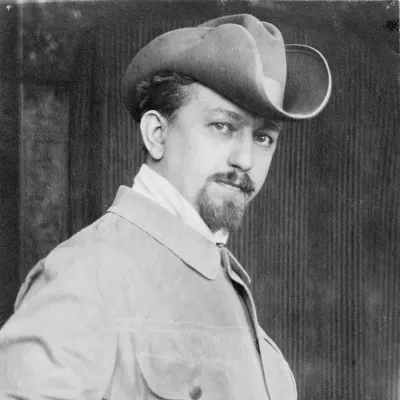
Leo Frobenius
Human Design Chart
Biography
He undertook his first expedition to Africa in 1904 to the Kasai district in Congo, formulating the African Atlantis theory during his travels.
During World War I, between 1916 and 1917, Leo Frobenius spent almost an entire year in Romania, travelling with the German Army for scientific purposes, as well as undertaking covert missions in Arabia and Ethiopia in 1914-1915. His team performed archaeological and ethnographic studies in the country, as well as documenting the day-to-day life of the ethnically diverse inmates of the Slobozia prisoner camp. Numerous photographic and drawing evidences of this period exist in the image archive of the Frobenius Institute.
Until 1918, he travelled in the western and central Sudan, and in northern and northeastern Africa. In 1920 he founded the Institute for Cultural Morphology in Munich.
Frobenius taught at the University of Frankfurt. In 1925, the city acquired his collection of about 4700 prehistorical African stone paintings, kept at the University's institute of ethnology, which was named the Frobenius Institute in his honour in 1946.
In 1932, he became honorary professor at the University of Frankfurt, and in 1935 director of the municipal ethnographic museum.
He died on 9 August 1938 at age 65 in Biganzolo, Lago Maggiore, Piedmont, Italy.
Human Design Analysis: Leo Frobenius as Generator 5/1
Generator 5/1 — Design at a Glance
Leo Frobenius revealed himself as someone with immense inner endurance, who primarily releases his strength through reactions to external impulses. As a Generator, he possessed a great deal of sacral energy that made him an extremely strong and enduring 'workhorse' – provided he acted in accordance with his design. His life force was not activated by self-initiative but rather by responding to signals from the environment. The motto was clear: Not initiate, but react.
This principle formed the basis for his effectiveness. When his sacral center gave a clear 'yes', he responded with action and could hardly be stopped. If he lived according to this pattern, his design rewarded him with a feeling of deep fulfillment. Conversely, two specific pitfalls threatened: First, wasting energy on tasks where he had no intrinsic interest, which tended towards burnout. Second, holding back from his heart project while still full of power to continue working. If Leo Frobenius initiated persistently without such internal impulse, sooner or later he would encounter persistent frustration and a lack of energy. His success therefore depended crucially on whether he reacted intuitively to what truly appealed to him.
Sacral Authority
Leo Frobenius lived as a Generator whose decision-making process was shaped by sacral authority. This inner leadership manifested not in the head but in the body: As a reaction to external stimuli, he felt an immediate gut feeling or surge of energy. His design required that his emotional center remain open to clearly hear these physical signals. When his sacral center showed interest – audible as grunting, humming, or a confirming 'mm-hm' – he felt vital and energized. In these moments, he approached his tasks with great enthusiasm without being rigidly goal-oriented. His life task was to walk through life with joy and satisfaction, fully immersed in what appealed to him.
Additionally, an activated spleen center supported this sacral leadership. This connection gave him the ability to react particularly quickly and spontaneously. He had direct access to his instinctive perception and physical well-being. These instincts could be reliably used as a guide, which accelerated his decision-making process. Since for the Generator the strategy – waiting for life to come knocking – is identical with inner authority, his path to correct decisions was significantly simplified. He did not need to think but only listen to his body to know where he could usefully apply his inexhaustible energy.
The 5/1 Profile — Heretic / Investigator
Leo Frobenius revealed himself as someone who utilized his deep knowledge base to provide solutions for others. As a 5/1 – the profile of the Hero and Explorer – he had almost magnetic charisma that drew people to him seeking answers to their problems. This design suggested that he loved the process of learning and new challenges, which helped him continuously expand his expertise.
His ability to convey clear positions during times of inactivity (Gate 52) allowed him to give precise explanations that were effective within the collective. Simultaneously, he carried the energy of guiding and leading (Gate 21), with respect and self-determination being central themes. Without this inner structure, requests for recognition could lead to tensions; with it, he became an authority on which others relied.
The risk of this design lay in overextension: Others often sought his advice, quickly exhausting him if clear boundaries were not set. Similar to a scientist who is drained after long conferences and inundated with further questions, Leo Frobenius had to learn to say no as well. Only then could he maintain the beneficial balance between his own research work (Line 1) and problem-solving for others (Line 5). His strength lay in uncovering hidden connections and conveying them so that they were actually accepted – provided he protected his energy from constant environmental demands.
Split Definition — Defined & Open Centers
Leo Frobenius revealed himself as someone with a consistent, trustworthy mental function and a clear sense of direction. His defined Ajna Center ensured that he created concepts in the same way every time; his mind was always active and served as an external authority to process data and inspire others to think. This mental structure flowed directly into his defined Throat Center, allowing him to articulate what his mind conceptualized – his voice was the reliable pivot point for these messages.
At the same time, Leo Frobenius possessed a tremendous power source through his defined Sacral Center. As a Generator, he generated vital energy daily, which felt like a constant hum and pushed him towards activity. His truth lay in reaction: He had to wait until life asked questions before checking from the gut whether there was available energy with a yes or no answer. Initiating actions without this sacral confirmation led to frustration and exhaustion for him because his generative power wasn't then available. His defined G Center also gave him a fixed self-identity; he knew who he was, and could love others without being dependent on them.
However, this stable inner core stood in contrast to his open centers, which made him vulnerable to conditioning. His open Head Center had no consistent way of processing inspiration; under pressure to find answers to questions that weren't his own, he tended to get stuck in mental monologues and doubts. The lack of a steady willpower in his open Heart Center meant he wasn't designed to give promises or prove his worth through competition, which could plunge him into spirals of self-disapproval if he tried this approach. Additionally, his open Solar Plexus absorbed the emotions of his surroundings and amplified them, putting him at risk of personalizing others' moods as his own instability. His open Spleen Center carried a fundamental fear of survival; sensitive to well-being but not designed for spontaneous decisions or holding onto things that didn't serve him just to feel false security.
Channels for inspiration, evolutionary change and structured insight.
Leo Frobenius revealed himself as someone who drew attention through his mere presence and authentic expression, an effect stemming from the Channel of Inspiration 1-8, which connects the G Center with the Throat Center. He was designed to live as an individual and inspire others to express their unique creativity – like a pianist whose playing inspires listeners. His leadership worked not through words but by demonstrating his own direction.
At the same time, he was shaped by the Channel of Mutation 60-3 between Root and Sacral Centers. This unpredictable current brought evolutionary change coupled with mechanical moodiness and melancholy when the pulse stopped. Frobenius had to learn to accept these inner shadow places and patiently wait for the correct reaction from his sacral center rather than dismissing the pressure for innovation through argument.
His thinking was determined by the Channel of Structuring 23-43, which links Ajna with Throat Centers. This allowed spontaneous insights (Gate 43), but he could only clearly and efficiently express them after a process of assimilation (Gate 23). His innovative knowledge often seemed light-years ahead; it took time for others to understand and accept these new perspectives.
Additionally, prioritized gates contributed to his mechanics: Gate 52 required strong concentration in silence for pattern correction, while Gate 58 provided pressure for experiments and perfection. In the material realm, Gate 21 helped overcome obstacles through control. Gate 48 enabled deep understanding of patterns but often led to frustration during implementation. On a personality level, Gate 59 steered genetic strategies of binding, while Gate 29 stood for persistent yes-saying. Gate 31 ensured energetic transmission in leadership. In his design, Gate 14 supported skillful handling of power and direction, Gate 24 mental renewal with the pulse, Gate 4 formulation of future-proof formulas, Gate 42 completion of processes through experience, and Gate 56 abstract narration of mental processes.
Individual Circuitry — Circuit Signature
Leo Frobenius revealed himself as someone who walked his own path and transformed new knowledge. His design set a tendency towards expressive strength through emotional waves. The Knowledge Circuit shaped this attitude: It connected two separate segments in Leo Frobenius. The first segment included the Ajna, Throat, and Identity Centers. Here, the channels Structuring (Gates 43–23) and Inspiration (Gates 8–1) worked to translate innovative flashes of insight and inspiring ideas directly into clear, audible expressions. His individuality was strengthened through this connection, with emotions from the Solar Plexus serving as driving force. The second, energetically separate segment linked the Sacral with Root Center via the Channel Mutation (Gates 3–60). This area provided pulsing energy for deviations from the known and created a basis for creative changes. As Leo Frobenius had a Shared Definition, these forces existed parallel: Intellectually-emotional expression structure on one hand and vital, mutative life force on the other were not directly fused but formed separate, adjacent potentials. This configuration promoted a life task of uncovering hidden connections and passing them on to others through authentic communication, with mutations from the Root-Sacral area providing the necessary dynamics for change.
Left Angle Cross of Demands 1
Leo Frobenius exhibited a fundamental disposition marked by profound inner tension between the desire for autonomy and the necessity of social integration. His Human Design profile featured the Left Cross of Requirements, often referred to as 'the Prophet’s Cross' or similar, but here it must be understood specifically as a structure that generates pressure to clearly articulate one's own needs while simultaneously fearing rejection from others. This mechanism created an ongoing struggle within him: on one hand, it urged him to go his own way and free himself from external expectations; on the other hand, he feared this detachment could lead to isolation. It was not a state of calm acceptance but rather an active, often arduous search for balance where he did not want to sacrifice his individuality nor completely lose connection with the community. This internal conflict significantly shaped his actions and relationships as he constantly oscillated between the impulse for self-assertion and the need for belonging. The energy of this cross challenged him to continuously grapple with how to remain true to himself without breaking contact with others. It was a lifelong task to harmonize these seemingly contradictory forces, risking either stubborn isolation or complete adaptation to find acceptance. Leo Frobenius had to learn that true freedom lies not in total withdrawal but in the ability to clearly set his own boundaries while remaining open for genuine encounters.
Saturn Return · Uranus Opposition · Chiron Return · 2nd Saturn Return — Life Cycles
Leo Frobenius’ Human Design profile indicated a tendency towards institutional anchoring of personal visions, which crystallized into distinct life phases. In 1901, at age 28, he married Editha Brandt. This coincided with his first Saturn Return, a cycle often serving to stabilize years of inner development and secure it through binding structures like partnership.
A decade later in 1916, aged 43, he spent almost an entire year in Romania with the German army conducting scientific studies. This aligned with his Uranus Opposition, a phase of sudden change that breaks old bonds and opens new, often unexpected paths – here utilized for intensive research under extreme conditions.
In 1920 at age 47, he founded the Research Institute for Cultural Morphology. This marked his Chiron Return, the cycle of bloom: here his true life mission came into full effect as theoretical insights were translated into a lasting institution. Finally, in 1932 at age 59, he was appointed Honorary Professor at Frankfurt University during his second Saturn Return, often leading to final recognition and consolidation of one’s life work by integrating it into established academic structures.
Generator · Sacral Authority — Synthesis
He was a Generator whose life was marked by deeply rooted sacral energy (sacral authority). This manifested in an unrelenting drive to pursue activities that truly fulfilled him – as long as they aligned with his inner 'yes'. The Profile of Hero and Researcher (5/1) amplified this aspect: he actively sought new insights and shared them willingly with others, offering solutions. His defined Ajna Center indicated a persistent form of thinking enabling him to develop and implement concepts while the Inspiration Channel (1-8) fueled the expression of his creative visions. Reoccurring events in career phases – from research trips to institute founding and honors – confirmed this process of knowledge building and its dissemination.
A central paradox lay in the combination of a deep, independent desire for learning (Line 1) and the magnetic attraction he exerted on others seeking his expertise (Line 5). This led to an ongoing tension between the wish for undisturbed research and the obligation to make his knowledge available to others. The cycles showed that this shift from focused work to public presentation was a defining pattern of his life, both inspiring him and pushing him repeatedly to his limits.
3 Defined Channels
Incarnation Cross - Left Angle Cross of Demands 1
Solar Return
The Solar Return shows the moment when the sun returns to its exact birth position - your personal solar year.
Life Cycles
Discover the life cycles with a detailed triple view (birth chart, cycle chart, composite).
Human Design Profile
- Type
- Generator
- Strategy
- To respond - wait for something to respond to
- Authority
- Sacral Authority
- Profile
- 5/1 - Heretic / Investigator
- Definition
- Split Definition
- Incarnation Cross
- Left Angle Cross of Demands 1
- Date of Birth
- 29.06.1873 21:15
- Place of Birth
- Berlin, Germany
Frequently Asked Questions
What was Leo Frobenius' Human Design type?
What Profile did Leo Frobenius have in Human Design?
Which Authority guided Leo Frobenius?
What incarnation cross characterized Leo Frobenius?
When was Leo Frobenius born?
Discover your own Human Design
Are you also a Generator? Find out in a personal reading how to use your sacral energy correctly and discover deep satisfaction.
More Personalities
Back to overviewAaliyah

Alexia

Angèle

Anne-Marie

Arcángel

Arno