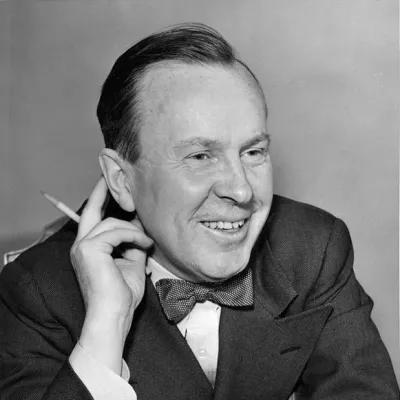
Lester Pearson
Human Design Chart
Biography
Pearson died December 27, 1972 in Ottawa, Canada..
The Human Design of Lester Pearson: Projector 2/4
Projector 2/4 — Design at a Glance
Lester Pearson revealed himself as a person with a dense, focused aura that directly engaged his surroundings. His Human Design type was the Projector, meaning he did not have constant intrinsic life energy but rather received and processed energy in phases. This structure marked him as someone who could immediately identify weaknesses or errors in other systems – similar to a bright flashlight shining into darkness.
However, this ability to see through to the essence was only effective when he followed his strategy: waiting for a respectful and sincerely meant invitation from his environment. If he jumped in without such an invitation to solve problems, his direct approach often met resistance or was perceived as unpleasant. Instead, he worked best by attracting others through living harmoniously himself; then people would come to him of their own accord to seek advice.
Since his Sacral Center was undefined, he lacked the constant power source of a Generator. Therefore, he needed regular rest phases to avoid burning out, as modern work life often ignored this need for pauses. Living in alignment with this design and waiting for recognition and invitations rewarded him with success. If he deviated from this path and acted on his own initiative, it eventually led to his non-self theme: bitterness over the lack of appreciation for his insights.
Self-Projected Authority
Lester Pearson's design featured a rare inner structure unique to Projectors: Authority in Self. This configuration marked him by a special openness that always carried the risk of losing himself in external influences and motoric energies. The central challenge was not constantly chasing energy but using his identity as a compass.
His decision-making process took place along two paths. One through internal or external conversations, where he learned to distinguish between spontaneous expressions of his true self and considerations of reason. What came without thinking was authentic and made his uniqueness recognizable to others. The other path followed a physical sensation that guided him geographically or thematically in a specific direction. By remaining loyal to this inner orientation, he could become a guide – there lay his specific potential for success. This mechanism required him not to act but to wait for an invitation and listen to himself to recognize his truth.
The 2/4 Profile — Hermit / Opportunist
Lester Pearson revealed himself through Profile 2/4 as someone who oscillated between the deep need for withdrawal and the desire for social connection. This design created a tension: on one hand, he withdrew to gain inner clarity in his 'cave' (Line 2), while on the other, he sought exchange with his closest circle to share and process experiences (Line 4). For him, it was crucial to create a safe environment where he could clearly communicate when he needed company and when he wanted solitude. Only when the need for alone time was fulfilled did he re-emerge to maintain his network. In this isolation, he reflected on the insights gained, enabling him to develop brilliant ideas. Line 2 projected a caring aura, although he often didn't know how strong this effect was. At the same time, Line 4 externalized his fantasies in a fixed manner; friendships were indispensable for his success as experiences only gained value through sharing. Lester Pearson thus used his network not just for maintaining contacts but as a tool to filter collective influences and structure them within the solitude of isolation. This interplay between isolation and community shaped his work approach: he gathered impulses in groups, but condensed them into viable concepts in silence.
Split Definition — Defined & Open Centers
Lester Pearson showed himself to be someone whose thinking was a continuous process of question and answer. His design marked him with defined Head and Ajna centers, creating a constant mental pressure to understand things and form concepts. This internal thought process was translated into clear communication through his defined Throat Center; he spoke out what his mind processed. Additionally, he had a defined G Center, which gave him a firm sense of self-identity and direction. He knew who he was and could carry this identity outwardly in a stable manner without being dependent on the environment.
At the same time, the mechanics of his undefined centers revealed themselves as sources for specific challenges. His open Heart Center lacked consistent willpower; he tended to question himself in an internal monologue about whether he had enough worth or needed to make promises to prove his worthiness, which could lead him into spirals of self-doubt. His open Sacral Center did not have a steady energy flow. He was prone to absorbing and amplifying the vital energy of others, often leading to overloading himself because he didn't know when it was enough, and exhausting himself rather than trusting his own responsiveness.
His open Solar Plexus also absorbed the emotional field of his environment. He tended to personalize foreign emotions as his own, which made him emotionally vulnerable and led him to avoid confrontation to prevent negative reactions. His open Spleen Center carried a fundamental fear of survival; he instinctively sought safety from others and tended to cling to unhealthy situations simply because they provided a sense of comfort or familiarity. Finally, his open Root Center took on the stress of the environment. He often felt an adrenalized pressure that did not come from him and reacted with restlessness rather than recognizing that this pressure was external and did not need to drive him. This constellation formed a life between clear intellectual orientation and the constant challenge of separating himself from foreign energy and emotional noise.
Channels for clarity, logical leadership and quiet reflection.
Lester Pearson showed himself as a figure who combined logical leadership with deep reflection. His design carried the Alpha Animal channel 7-31, linking his G Center with his Throat Center. Through Gate 7, the role of self, and Gate 31, leading, he developed an ability for collective guidance. This configuration required that leadership not be through coercion but rather through trust and invitation from the community. Pearson acted as someone who understood patterns and trends to guide others safely into the future, always dependent on majority consent.
At the same time, he was marked by the Lost Son channel 13-33. Here Gate 13 listened and gathered information while Gate 33 withdrew to reflect upon these experiences. This gave him patience to extract lessons from the past and share them only when they were ripe. It was a process of listening, storing, and later sharing wisdom, which brought continuity into his actions.
On an intellectual level, the Channel of Awareness 61-24 worked. Gate 61 brought inspiration from the Head Center, which was rationalized in the Ajna Center through Gate 24. This allowed for sudden insights and a mutative knowledge that broke old thought patterns. Pearson had to learn to accept this spontaneous knowledge without wanting to control it.
Additionally, he carried Gates of Care and Risk (27, 28), evolutionary development (41) as well as aspects of communication (23), tribal energy (45) and change through interaction (35). These elements underscored his role as a caring actor who took risks to enable collective progress.
Collective Circuitry — Circuit Signature
Lester Pearson's design laid out a tendency towards isolated, non-interconnected energetic focal points. As someone with split definition, he had two separate energy fields: one in the Head and Ajna centers and another connecting the Throat and Identity centers. These groups worked parallel alongside each other without direct energetic exchange between the upper thinking centers and the lower expression area.
In the Knowledge Circuit, he activated the Channel of Awareness (Gates 24–61). This directly connected his Head and Ajna Centers in him. This configuration promoted innovative, creative flashes of insight and the ability to transform new knowledge by translating abstract inspiration into concrete thinking.
At the same time, two other circuits worked within Throat and Identity centers. The Understanding Circuit (Channel 31–7, 'The Alpha Animal') linked these centers through logical strategy and focus, driven by a desire to rationally lead society towards a better future. Parallel to this, the Meaning-Finding Circuit (Channel 33-13, 'The Lost Son') used the same centers to reflect on emotional experiences from the past and find their meaning.
Since Throat and Identity Centers were involved in both lower circuits, Lester Pearson showed a complex dynamic: he could express and share both cool, future-oriented logic as well as cyclical, reflective emotions about the past. These energies remained energetically separated from the creative impulses in the Head-Ajna area, leading to a clear separation between inspiring thought and strategic or reflective expression.
Right Angle Cross of the Unexpected 1
Lester Pearson's design carried the signature of the right cross of the Unexpected. This configuration shaped a lifestyle where spontaneous turns and unforeseen events were not disturbances but natural, even desired elements perceived as opportunities. Instead of striving for strict planning or controlled predictability, Pearson was open to the unexpected. His system responded to external impulses with an inner readiness to embrace the moment without having to analyze or evaluate it beforehand.
In Human Design, this cross describes a specific energy: the ability to act in the present and use surprises as opportunities. It is not about chaos but a deep resonance with what is happening right now. Those who possess this structure often lose control over their schedule in favor of a more authentic interaction with reality. For Pearson, this meant that his most effective moments lay beyond scripts. He did not act out of compulsion but because the unfolding events invited him to do so. This openness created a dynamic where he could react flexibly to changes without losing touch with his inner self. The unexpected was no enemy for him but an ally helping him find and affirm himself in new contexts.
Saturn Return · Uranus Opposition · Chiron Return · 2nd Saturn Return — Life Cycles
Lester Pearson's design showed a tendency towards structural condensation and public service, evident in clear career steps. His second Saturn return, a cycle of maturation and responsibility, occurred in 1952 when he became President of the General Assembly of the United Nations at age 55. This moment marked a phase where years of groundwork condensed into a solid position for international representation – typical of Saturn energy establishing stability and authority in public space.
Before this, his Chiron return had unfolded, a fulfillment cycle where one's life purpose increasingly crystallized. In 1948 at age 51, Lester Pearson became Canada's Minister of External Affairs. This step reflected the flowering of the incarnation cross: if he had acted according to his strategy and authority previously, now the meaning of his design came into tangible proximity. The role as Minister was no coincidence but an expression of this inner alignment towards diplomatic structure and global networking. Both events – the ministerial position and UN presidency – illustrate how Pearson translated his energetic configuration into concrete political offices without being driven by external pressures but through a natural development toward greater responsibility and visibility on the world stage.
Projector · Self-Projected Authority — Synthesis
Lester Pearson was a projector whose life was marked by a deep ability to recognize patterns and point out potential in others (Gate 7/31). This recognition always came with an inner pressure to question things and understand them (defined Head Center), which constantly set him into a process of mental confrontation. His authority in self required internal dialogues and listening to his own inner voice to make authentic decisions – a necessity that was amplified by his open nature, making him vulnerable to external influences. He lived in a constant tension between the need for withdrawal for inner clarification (Line 2) and the desire for connection with selected people (Line 4), which shaped his work style.
A central paradox lay in Pearson's design enabling him to identify weaknesses and offer leadership (Channel of Alpha Animal) while his profile and authority required a subtle approach. He could recognize potential in systems, but how he shared this knowledge had to be carefully calibrated to avoid resistance. Key moments in his professional career path (1948, 1952) suggest that the expression of his unique identity and transformation through new knowledge (Knowledge Circuit) in conjunction with the right timing were crucial for his success.
3 Defined Channels
Incarnation Cross - Right Angle Cross of the Unexpected 1
Solar Return
The Solar Return shows the moment when the sun returns to its exact birth position - your personal solar year.
Life Cycles
Discover the life cycles with a detailed triple view (birth chart, cycle chart, composite).
Human Design Profile
- Type
- Projector
- Strategy
- Wait for the respectful invitation
- Authority
- Self-Projected Authority
- Profile
- 2/4 - Hermit / Opportunist
- Definition
- Split Definition
- Incarnation Cross
- Right Angle Cross of the Unexpected 1
- Date of Birth
- 23.04.1897 00:05
- Place of Birth
- Toronto, CAN
Frequently Asked Questions
What is Lester Pearson's Human Design type?
What Profile did Lester Pearson have in Human Design?
Which Authority guided Lester Pearson?
What incarnation cross did Lester Pearson have?
When was Lester Pearson born?
Discover your own Human Design
Are you also a Projector? Find out in a personal reading how to unfold your leadership qualities and recognize the right invitations.
More Personalities
Back to overviewSissy Spacek

Alain-Fournier

Anémone

Ann-Margret

Bourvil
Hergé