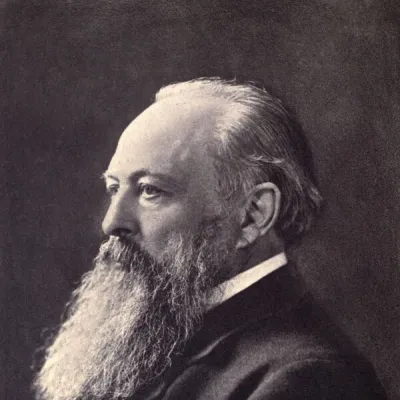
Lord Acton
Human Design Chart
Biography
On 1 August 1865, Acton married Countess Marie Anna Ludomilla Euphrosina von Arco auf Valley (1841–1923), daughter of the Bavarian Count Maximilian von Arco auf Valley, with whom he had six children.
After his health began to fail in 1901, Acton died on 19 June 1902, aged 68, at his wife's family home in the spa town of Tegernsee, Bavaria, Germany.
The Human Design of Lord Acton: Generator 6/2
Generator 6/2 — Design at a Glance
Lord Acton had a high, enduring sacral energy. His design predisposed him to operate as a Generator: extremely strong and resilient, comparable to an workhorse, provided he found the right task. This configuration suggested that his effectiveness did not depend on active initiation but rather on reacting to external impulses. The central life strategy was to wait for signals from life and then act only when the Sacral Center gave a clear "yes" as confirmation.
This mechanism presented two significant risks. If Lord Acton acted against his inner signal or suppressed the urge to work on his heart project, frustration loomed. Equally dangerous was investing energy in tasks that did not resonate internally; this often led Generators to burnout, as their "creative potential" would then be wasted. Living in harmony with this design, no one could stop him. Utilizing this specific amount of energy resulted in deep satisfaction and a sense of fulfillment. However, if he ignored the strategy of reacting and instead tried to force things or initiate without inner confirmation, he faced persistent frustration and a lack of energy. His design thus demanded a discipline of waiting for the internal impulse to effectively deploy his enduring strength.
Sacral Authority
Lord Acton's decision-making did not come through rational analysis but as a direct physical resonance to external stimuli. His design featured the sacral authority, an inner instance exclusive to generators and whose strategy is identical to inner guidance. This fundamentally simplified his process: he didn't need prolonged deliberation but reacted to what spoke to him.
This authority manifested as a tangible "gut feeling" or sudden surge of energy. Lord Acton had to learn to read the subtle signals of his body – grunts, hums, or a quiet hmm. These sounds marked the authentic energy resonance with a topic. Once his sacral motor kicked in, vital aliveness entered the scene. He then possessed inexhaustible energy and tackled his tasks with great enthusiasm. His actions were free from purposefulness; he simply did them because they fulfilled him.
Crucial was distinguishing himself from rational or emotional delays. Only by listening during these physical moments did he identify the areas that fed his true strength. Thus, he moved through life joyfully and contentedly, fully immersed in his activities, guided by this immediate, instinctive perception rather than external expectations or intellectual constructs.
The 6/2 Profile — Role Model / Hermit
Lord Acton's Human Design profile featured a clear two-phase developmental trajectory. In his youth, before the age of 30, the Natural Talent line of Profile 6/2 dominated. This phase was characterized by intense experimentation and the principle of trial and error. After making mistakes, he withdrew to learn from them. His design also indicated a tendency towards selectivity and ambition, supported by Saturn's awareness of responsibility in elevation. This fostered the ability to carefully gather information for wise decisions while simultaneously posing a risk of Jupiterian energy waste.
After turning 30, the Role Model line activated. Lord Acton then entered a phase of distancing and intense reflection. He metaphorically withdrew to heal his earlier experiences and gain deep self-knowledge. Only once this inner maturity was achieved did he re-emerge publicly as a wise advisor, ready to share his life lessons with others. The second line of his design emphasized aspects of projection and control, particularly in the realm of finances. Without sufficient maturity, this could lead to frustration since the projections were often misguided. With increasing experience, however, he learned to manage these control needs and transform them into transformative power that served as an example for others.
Single Definition — Defined & Open Centers
Lord Acton's design shows a tendency towards constant vital energy. His defined Sacral Center generated daily power that manifested as restlessness or the need for activity. The strategy was to react: Only responding to inquiries instead of initiating secured this energy. His inner authority came from his defined Spleen Center, which provided intuition and instinct for well-being in the present moment. This bodily instinct was more reliable than reason. Additionally, a defined Root Center propelled him forward through constant pressure and stress management, fostering existential awareness.
In contrast, Head, Ajna, Throat, G, Heart, and Solar Plexus Centers were open. Lord Acton tended to absorb mental inspiration or confusion from the environment without owning it. He might wonder if he must find answers that are not his own. His open Ajna Center reflected concepts while the open Throat Center did not offer a constant communication flow; attention came only when waiting. The lack of a fixed identity in the open G Center led him to collect directions from the environment rather than determining them himself. In the open Heart Center, he might seek validation of his worth through promises he could not keep. The open Solar Plexus Center absorbed foreign emotions, making him vulnerable to emotional waves of others. This openness required distance from conditioned reactions to avoid resistance in these areas and allow the power of defined centers to work uninterrupted.
Channels for change, ambition and mature growth.
Lord Acton's design was characterized by three dominant format channels that generated a cyclical pulse of change, experience, and ambition. The mutation channel 60-3 connected the Root Center with the Sacral through the Gate of Limitation (60) and Order (3). This configuration brought about evolutionary change accompanied by melancholy and inner tension until the energy was activated. Lord Acton had to learn to accept this limitation and patiently wait for the next impulse rather than filling the silence with arguments.
Parallel to this, the maturation channel 53-42 worked through connecting the Gate of Beginnings (53) with that of Growth (42). This mechanism required a complete cycle of experience until reflection was reached to gain wisdom. An early termination inevitably led to repeating the same pattern; only by completing the closed loop could Lord Acton develop depth and share insights.
The transformation channel 54-32 finally drove his ambition, motivated by the Gate of Ambition (54) and Continuity (32). This was about social ascent and improving one's position in life always serving the tribe. Lord Acton sought recognition to prove his talents and ensure that his environment could survive. These three streams – melancholic change, cyclical maturation, and ambitious transformation – deeply conditioned his personality.
Additionally, Gates like 48 (Pattern Recognition), 50 (Conservative Values), 52 (Focused Pause), and 58 (Perfection through Pressure) worked in the background supporting his ability to analyze and adapt without overshadowing the dominant rhythm of main channels.
Individual Circuitry — Circuit Signature
Lord Acton's design inclined towards collective transformation, driven by the channel 32-54 in the ego circuit. This channel connected his Spleen Center with the Root Center creating a driving force for change within shared resource structures. Since this circuit did not connect to the Sacral Center, constant life force was lacking; thus, strategic rest periods were necessary to maintain timeless-conservative energy.
Parallel to this, two more separate groups of simple definition worked in his design. The Knowledge Circuit connected the Sacral with the Root Center via channel 3-60 (Mutation). This was about taking new paths and expressing unique identity through deviation from existing norms. This pulsating energy promoted the emergence of entirely new knowledge.
The Meaning-Finding Circuit also linked the Sacral with the Root Center, but via channel 42-53 (Maturation). This area focused on emotions and experiences from the past. The cyclical energy served to reflect past events, find their meaning, and share these felt insights with the collective to learn together.
Although all three circuits touched upon either the Root or Sacral Center, they did not form a continuous connection between Spleen and other centers due to separate groups. Lord Acton thus moved within parallel existing forces: on one hand traditional resource conservation in the tribe, on the other individual knowledge mutation and emotional meaning-making from the past.
Left Angle Cross of Cycles 2
Lord Acton's design carried the signature of the left cross of Cycles 2. This configuration marked him as someone whose inner compass was aligned with a specific kind of development and transformation. It wasn't about random fluctuations but rather a deeply rooted rhythm that structured his experience.
In Human Design, this cross describes a particular dynamic in the flow of life. It's about how cycles begin, unfold, and eventually come to an end. Lord Acton was embedded within this pattern; his experiences followed this logic. He learned through going through these phases, not just through abstract theory alone. The mechanics of this design suggested that growth for him often came with a certain restlessness or sense of transition.
There was no static peace in this aspect of his character. Instead, there was a tendency towards movement within specific boundaries. The left cross of Cycles 2 implies a connection between the beginning of a process and its later maturity. For Lord Acton, this meant that his identity and understanding of himself were shaped through these cyclical experiences. He was part of this larger pattern shared by many people with similar design characteristics but which worked individually for him. This structure offered no fixed hold in terms of stability, but rather a direction for his personal evolution. It determined how he responded to changes and which themes repeatedly gained significance in his life.
Saturn Return · Uranus Opposition · Chiron Return · 2nd Saturn Return — Life Cycles
Lord Acton's career followed a clear rhythmic pattern of structural anchoring, punctuated by breakthroughs in public discourse. His design suggested that his role in the public sphere was defined through cyclical phases of consolidation and eruption. In 1859, he entered the House of Commons and withdrew to Aldenham – marking the first Saturn return cycle. During this phase, years of groundwork often condensed into a solid result; Lord Acton established his political base.
Ten years later in 1874, he published public letters to The Times on papal infallibility. This fell during the Uranus opposition period. This configuration often describes a point where internal tension breaks outwards and new perspectives are forced; Lord Acton used this impulse for clear public positioning.
In 1890, he became a Fellow of All Souls College at Oxford. This marked his second Saturn return cycle, which typically brings renewed affirmation or deepening of one's structure. For Lord Acton, it meant anchoring in an institution of the highest academic rank. His career did not show as linear progression but rather as a sequence of milestones: first political establishment, then ideological sharpening through publication, finally academic legitimization. Each step corresponded to the respective planetary dynamics – Saturn offered the structure for long-term positions, Uranus the push for public interventions. Lord Acton lived this mechanism out by precisely timing his role changes within these windows, leading to a stable yet dynamic life course.
Generator · Sacral Authority — Synthesis
Lord Acton's life was marked by a deep inner dynamic between exploring new experiences and the necessity of processing them into coherent understanding. As a Generator with sacral authority, he primarily responded to impulses from the outside, an energy source amplified through his defined Sacral, Root, and Spleen centers. This responsiveness, coupled with openness to emotions and identity, led to a life of constant experimentation (Line 6/2), followed by phases of intense reflection and wisdom acquisition. The Channel of Maturation (53/42) underscored this cyclical process where experiences were gathered, lived through, and ultimately passed on as insight – a pattern that repeated across his life cycles.
A central paradox lay in the tension between his need for stimulation and his ability to focus deeply. His open Heart and G centers made him receptive to external influences, while the Channel of Transformation (58/52) intensified the drive towards perfection and pattern recognition. This combination led to an internal conflict: the desire for new experiences and the need to integrate them into a coherent system, which caused him to oscillate repeatedly between engagement and withdrawal. This shift between involvement and distance shaped his approach to the world and his contribution to knowledge generation.
3 Defined Channels
Incarnation Cross - Left Angle Cross of Cycles 2
Solar Return
The Solar Return shows the moment when the sun returns to its exact birth position - your personal solar year.
Life Cycles
Discover the life cycles with a detailed triple view (birth chart, cycle chart, composite).
Human Design Profile
- Type
- Generator
- Strategy
- To respond - wait for something to respond to
- Authority
- Sacral Authority
- Profile
- 6/2 - Role Model / Hermit
- Definition
- Single Definition
- Incarnation Cross
- Left Angle Cross of Cycles 2
- Date of Birth
- 10.01.1834 18:00
- Place of Birth
- Naples, Italy
Frequently Asked Questions
What is Lord Acton's Human Design type?
What Profile did Lord Acton have?
Which authority guided Lord Acton?
What incarnation cross did Lord Acton have?
When was Lord Acton born?
Discover your own Human Design
Are you also a Generator? Find out in a personal reading how to use your sacral energy correctly and discover deep satisfaction.
More Personalities
Back to overviewAaliyah

Alexia

Angèle

Anne-Marie

Arcángel

Arno