
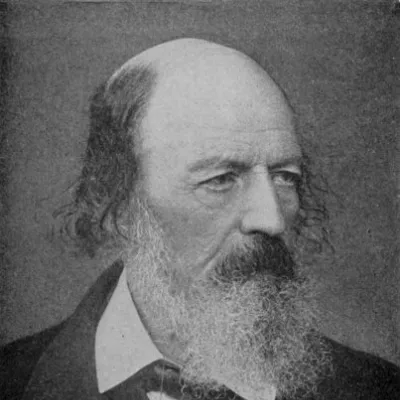
Lord Alfred Tennyson
Human Design Chart
Biography
Tennyson was born at Somersby, Lincolnshire, the fourth of twelve children of George and Elizabeth Tennyson. His family environment would be the cause of his worries about money and mental illness well into his adulthood. His grandfather had designated that one of his sons would be his heir, while the other - Tennyson’s father - would enter the ministry. The stark contrast of circumstances between the two families would haunt him. His father became mentally ill, and in 1827, Tennyson managed to escape his difficult home atmosphere when he enrolled in Trinity College in Cambridge, which his older brothers were already attending.
In 1827, he and his brother published "Poems by Two Brothers" which won university prizes for poetry, and Tennyson went on to win the Chancellor’s Gold Medal in 1828 for "Timbuctoo." In 1829, he joined an undergraduate club where he met Arthur Henry Hallam, an important figure who had already been recognized as having great literary promise. Hallam became Tennyson’s friend, and though they knew each other only four years, Hallam’s death in 1833 at age 22 shocked Tennyson deeply and led to some of his most celebrated poetry, including "In Memoriam," 1850, written to Hallam’s memory.
Tennyson left Cambridge in 1831, the same year that his father died. In 1833 he published "Poems" which met with mixed reception. After he re-published it in 1842, his fame was established.
In 1850, he published "In Memoriam" and, the same year, Queen Victoria appointed him poet laureate of England.
The Human Design of Lord Alfred Tennyson: Manifesting Generator 6/2
Manifesting Generator 6/2 — Design at a Glance
Lord Alfred Tennyson exhibited hybrid energy: the constant power of a Generator paired with the lightning-fast impact of a Manifestor. His design suggested that he could draw things into his life by skipping steps and pursuing multiple projects simultaneously. However, this speed was a double-edged sword; it often led to important phases being overlooked, forcing him to backtrack later and make up for lost ground. Such setbacks could lead to frustration as his internal system fell out of alignment.
Lord Alfred Tennyson's strategy involved not initiating himself but responding to impulses from his environment. Only when his Sacral Center – his energy source – gave a clear “yes” should he act. This was especially true during the simultaneous handling of various tasks. If he followed this strategy and regularly checked whether projects were still enjoyable, deep satisfaction would ensue. Then, his work transformed into a playful mode where variety served not as distraction but as a source of strength. Without this inner confirmation, however, his natural dynamism quickly shifted from creative joy to exhaustion and dissatisfaction.
Sacral Authority
Lord Alfred Tennyson's design inclined towards decision-making driven purely by the body. As a Generator, he possessed sacral authority, meaning that his strategy and internal guidance were identical: waiting for an inner impulse. This structure greatly simplified his process as no cognitive analysis was required to find the right path. A prerequisite for this was an open Emotional Center so that he wasn't misled by short-term mood swings. His responses came from the gut, felt as a surge of energy or sounds like grunts or hums in response to external stimuli. When his sacral motor kicked in, he felt vital and alive with inexhaustible energy for his tasks. He was born to go through life with joy, fully immersed in his duties without seeking an external purpose. Additionally, his activated Spleen Center worked as a supportive authority alongside the Sacral Center, enabling him to react quickly and spontaneously. This combination allowed him to make intuitive decisions at the right moment, guided by a deep physical resonance with the environment.
The 6/2 Profile — Role Model / Hermit
Lord Alfred Tennyson's design inclined towards profound introspection that matured from experimental searching to wise detachment over his lifetime. As a 6/2 Profile – role model and natural talent – he underwent a characteristic transformation: before age thirty, trial and error dominated. He gathered experiences, withdrew after setbacks, learned through personal mistakes without the pressure of immediate results.
Around age thirty, the sixth line activated. Tennyson then showed a need for withdrawal, akin to ascending into a cave on the mountain. There he reflected on his past experiments with great distance. This phase served healing and deeper self-knowledge, supported by Gate 33 (Line 6), which requires reflection over the entire human experience. He sought no external pressure but focused on rekindling and letting go of old patterns.
Simultaneously, the second line as a natural talent gave him an intuitive directional sense without conscious control. Tennyson was often unaware of this gift; it had to be “called” to become effective. A defined ego supported this natural orientation better than constant doubt. Ultimately, he emerged from his reflective phase as a wise person. Others sought his counsel to partake in his life wisdom and learn the ability for deep introspection from him. His role was to promote his talent through proper calling and non-interference, serving as an example of authentic living.
Single Definition — Defined & Open Centers
Lord Alfred Tennyson's design inclined him towards clear, authentic communication that sprang from a deeply rooted inner identity and vital energy. His defined G Center gave him a reliable sense of self and direction; he knew who he was without needing to prove it to others. This inner security flowed into his defined Throat Center so that his voice served as an expression of his true identity – not merely a repetition of thoughts or emotions.
As a Generator with a defined Sacral Center, he possessed an enormous source of generative energy. His path involved reacting to life and only acting when his body signaled a clear “Yes.” This ensured him the necessary endurance for his tasks. Supported by his defined Spleen Center, which gave him spontaneous intuition, he trusted momentary perceptions of health and well-being, enabling him to act in the present and make intuitive judgments without rationalizing them.
At the same time, Lord Alfred Tennyson was vulnerable to external influences through several open centers. His open Head and Ajna Centers meant that he did not have a constant mental inspiration. He tended to identify with foreign questions or doubts rather than observing these as transient mental waves. Often, he sought answers in his mind though his truth lay in the physical reaction.
His open Heart Center made him sensitive to the play of ego and willpower. He was not designed to give promises or prove his worth through performance; when he did so, he fell into a cycle of disappointment and self-doubt. Additionally, his open Solar Plexus absorbed the emotions of his surroundings, making him emotionally vulnerable and prone to personalizing foreign moods as his own. His open Root Center also took on external stress, often feeling pressured though this was not from himself. His challenge lay in not personalizing these open fields but using them as mirrors for the world around him while relying on his sacral response and spleen-based intuition.
Channels for power, intuitive precision and nurturing preservation.
Lord Alfred Tennyson's design inclined him towards innovative, mutative creative power characterized by intuitive depth and technical perfection. The channel of Beat 14-2 connected the Sacral Center with the G Center. Gate 14 focused on material resources for driving mutation, while Gate 2 served as a driver for higher knowledge and movement through space and time. This configuration allowed Lord Alfred Tennyson to initiate new directions by trusting his reaction from his sacral center and thus encouraging others in their creative development.
Parallel to this, the channel of Wavelength 48-16 between Spleen and Throat Centers was active. Gate 48 sought life-critical information through inner intelligence that could not be grasped by the mind. Gate 16 considered new possibilities for experimentation and perfected skills. Lord Alfred Tennyson combined intuitive depth with repeated trial, transforming dexterity into talent. This process required engagement and repetition, often serving a deeper purpose and improving others' lives.
The channel of Conservation 27-50 connected the Sacral Center to the Spleen Center. Gate 27 brought care and selfless interest in others, while Gate 50 provided traditional values and laws for maintaining order. Lord Alfred Tennyson naturally attracted trust and took responsibility for the tribe. He supported and protected creative enterprises, understanding that provision starts with one's own health. Only through his sacral response did he know if his energy was available and it was correct to give it.
Additionally, Gates 33 (Reflection), 19 (Resources/Spirituality) and 1 (Uniqueness) contributed to his individual perspective. Lord Alfred Tennyson reflected experiences, sought safe environments for spirituality and created new things without limitations at the right time.
Individual Circuitry — Circuit Signature
Lord Alfred Tennyson's design inclined him towards pulsating, rhythmic energy that emanated from within. His simple definition connected Identity, Sacral, Spleen, and Throat Centers into a cohesive flow. The Knowledge Circuit acted through the channel “The Beat” (Gates 2–14), linking the Identity with the Sacral Center. This promoted unique individuality supported by creative impulses and emotional waves that manifested as an acoustic rhythm. Parallel to this, the Understanding Circuit shaped his mode of expression. Through the channel “The Wavelength” (Gates 16–48) he connected Throat with Spleen Centers, enabling logical and strategic insights to be visually focused and free from distracting emotions to keep the future in sight. Additionally, the Protector Circuit worked through the channel “Conservation” (Gates 27–50), linking Sacral and Spleen Centers. This primordial energy served for protection and preservation of what exists, supported by instinctive perception and life force. Together these circuits formed a system that united creative identity with strategic communication and instinctive care. Lord Alfred Tennyson emerged as someone who charted new paths by translating inner rhythms into structured statements while preserving the essence. The connection of all four centers in a group created a coherent aura where creativity, logic, and instinct did not operate separately but interwove.
Left Angle Cross of Refinement 1
Lord Alfred Tennyson's design indicated a tendency towards precise differentiation. He was someone who transformed the everyday through careful selection and refinement into something of higher quality. This attitude stemmed from his left Refinement 1 cross, a configuration that did not seek wild growth or expansive spread but clarity and excellence in detail. For Lord Alfred Tennyson, this meant focusing on filtering and polishing raw materials—whether thoughts, words, or situations—to reveal their true essence. It was a process of reducing to the essential by removing the unnecessary so that remaining elements could work at full strength. This mechanism shaped his approach to challenges: rather than convincing through mass, he relied on targeted refinement of fewer but more impactful points. His inner programming was geared towards creating order from chaos by sharpening structures and eliminating fuzziness. This gave him a specific authority in areas where precision and aesthetic or functional perfection were required. Lord Alfred Tennyson lived this dynamic by continuously working to refine his environment and creations, driven by an internal compass seeking purity and high quality without slipping into excessive complexity.
Saturn Return · Uranus Opposition · Chiron Return · 2nd Saturn Return — Life Cycles
Lord Alfred Tennyson's design indicated profound inner upheavals that often manifested in confrontation with the unknown or loss. This structure shaped his ability to transform personal grief into universal art. The Uranus opposition marks a cycle of radical change and awakening from old patterns; it forces a re-evaluation of identity and belonging. For Tennyson, this transformative pressure was particularly evident when he grappled with the death of his friend Arthur Hallam in 1850 at age 41, publishing “In Memoriam,” an elegiac lament on this loss. This event illustrates the mechanics of the Uranus opposition: the external shock or internal rift did not lead to destruction but a painful yet necessary restructuring of self. The publication was not merely documentation but the result of a process where old bonds were dissolved and new meaning structures discovered. Through this configuration, Tennyson emerged as someone who not only endured crises but used them as catalysts for deep creative and spiritual insights. The opposition acted here as an engine of necessary evolution, bringing personal experience into a form that transcended the individual and thus embodied the core of this planetary dynamic—the liberation through rupture.
Manifesting Generator · Sacral Authority — Synthesis
Lord Alfred Tennyson lived a life marked by a constant flow of sacral energy and a drive towards transformation. As an Manifesting Generator, he had the ability to quickly initiate things (Sacral Center), yet his Profile as Role Model points to a later phase of intense reflection. This combination led to a pattern of quick action followed by evaluation—a dance between experiencing many different experiences in youth and the later need to impart this wisdom. The Beat Channel (Gate 14-2) reinforced this rhythm, pushing him to explore new paths and find his identity through constant mutation.
A central paradox in his design lay in the interplay of speed and the need for deep reflection. He was destined to lead with energy and innovation (Knowledge Circuit), yet the defining Sacral Center required a response to the moment and trust in one's inner impulse. This led to a tension between wanting to quickly realize things and needing to process the consequences of his actions—a cycle of action followed by refinement (left Refinement 1 cross), as evidenced by an event related to a work.
3 Defined Channels
Incarnation Cross - Left Angle Cross of Refinement 1
Solar Return
The Solar Return shows the moment when the sun returns to its exact birth position - your personal solar year.
Life Cycles
Discover the life cycles with a detailed triple view (birth chart, cycle chart, composite).
Human Design Profile
- Strategy
- To respond - wait for something to respond to
- Authority
- Sacral Authority
- Profile
- 6/2 - Role Model / Hermit
- Definition
- Single Definition
- Incarnation Cross
- Left Angle Cross of Refinement 1
- Date of Birth
- 06.08.1809 00:05
- Place of Birth
- Somersby, UK
Frequently Asked Questions
What was Lord Alfred Tennyson's Human Design type?
Which Profile did Lord Alfred Tennyson have?
What Authority did Lord Alfred Tennyson have?
What incarnation cross did Lord Alfred Tennyson have?
When was Lord Alfred Tennyson born?
Discover your own Human Design
Are you also a Manifesting Generator? Find out in a personal reading how to unfold your multi-talents and direct your energy wisely.
More Personalities
Back to overviewAlain-Fournier

Aldair

Alizée

Angeli

Arletty

Artus
