
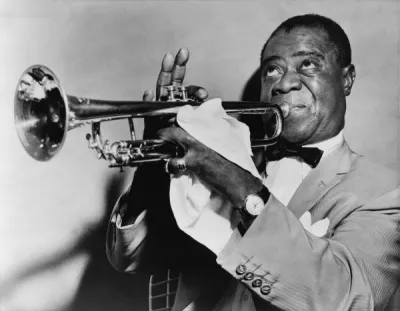
Louis Armstrong
Human Design Chart
Biography
Armstrong grew up poor among prostitutes and lowlifes in New Orleans, working from the time he was a kid to help his family. He sang on the street corners in the Old Quarter and taught himself to play the cornet, quickly becoming acquainted with the culture of music that could be heard on every street. He rose from a rough and tumble childhood to become one of the first black men in America who had the courage and clout to say, "I wouldn't play no place I couldn't stay." At age 21, he was the talk of South Side Chicago, playing in his mentor's band, Joe "King" Oliver's Creole Jazz Band. So popular were the trademark two-cornet breaks he and Oliver worked out, that they would perform with handkerchiefs over their hands to hide their fingering from imitators. At age 41, his records and movie appearances had made him world famous. He had a rigorous schedule of touring, recording and performing, gradually adding films and TV.
Somehow, Armstrong stayed down to earth, never moving any further into drugs than his daily hits of marijuana, which never seemed to hurt his playing. He was, however, known as a world-class eccentric, his own man, brash and irreverent.
Louis Armstrong as a Manifesting Generator 5/1 in Human Design
Manifesting Generator 5/1 — Design at a Glance
Louis Armstrong's design manifests as a hybrid Projector-Generator, combining constant sacral energy with the ability to leap steps in implementing ideas and achieve results quickly. This configuration creates tension between the need to respond to external impulses rather than initiating action himself and his inner drive for rapid movement.
Without this responsiveness to life, he tended to move too fast or skip important stages, often necessitating compulsive return and rework, leading frequently to frustration, his specific non-self theme. Additionally, his speed drew him into taking on multiple projects simultaneously. If he did not heed the approval of his sacral center in these endeavors, his creative enthusiasm quickly turned to dissatisfaction.
Deep satisfaction arose for him only in "play mode." Here, he combined variety with clear inner affirmation: "Yes! I love this!" Only under these conditions was it beneficial to work on multiple tasks simultaneously. The advice to focus strictly on one thing would have slowed rather than strengthened his energy. His design required a balance between quick implementation and disciplined scrutiny of each new idea through the internal "yes" to avoid frustration and productively harness his hybrid power.
Sacral Authority
Louis Armstrong's decision-making relied on his sacral authority, which served as the primary instance. His design indicated that he did not initiate but rather reacted: He waited for external stimuli to elicit an internal response. This reaction was physical, such as a surge of energy or auditory signals like grunts and mhm from the abdominal area. Such sounds served him as a reliable compass for spontaneous decisions.
Sacral authority is specific to the Generator type. Since Louis Armstrong was this type, his process simplified: Strategy and inner authority merged. A prerequisite for this was an open Emotional Center. Once his sacral motor responded to a stimulus, vitality kicked in. He seemed to have inexhaustible energy and approached activities with great enthusiasm. In doing so, he acted without aimlessness; the joy of the activity itself took precedence.
Furthermore, a supportive authority through the Spleen Center was at work. This center was activated and possibly directly connected to the Sacral Center. This allowed him quick, spontaneous reactions. He had immediate access to his physical well-being and instinctive perception. This connection enabled him to reliably guide himself by these inner signals rather than rational deliberation. The necessity of waiting for this internal response shaped how he structured his life.
The 5/1 Profile — Heretic / Investigator
Louis Armstrong's Human Design presents a tension between the magnetic need to offer solutions as a Hero (Line 5) and the deep need for withdrawal, privacy, and reflection before publication (Line 1). The risk lay in exhaustion from lacking boundaries; success came from balancing research for himself and service to others.
The Profile Hero/Researcher describes individuals who use their profound knowledge base to help others solve problems. Line 5 drew questions; others instinctively sought answers from him. Without clear boundaries, this attraction quickly led to overexertion. Much like an expert who exhausts themselves answering questions at conferences and is bombarded with new inquiries in the evening, Louis Armstrong faced confusion through premature revelation.
Line 1 emphasized timing, reflection, and confidentiality. It required time for inner clarification before sharing knowledge. Early involvement of others in these processes led to ambiguity. At the same time, Line 1 aimed towards harmony and aesthetics, away from disharmony. The urge to act without regard for wisdom could disrupt his evolutionary direction.
Louis Armstrong showed himself as someone who had to learn to say no to optimally use his gifts. The balance between the private researcher (Line 1) and the public problem solver (Line 5) was crucial. Only by respecting his need for privacy could he utilize the magnetic attraction of Line 5 without exhausting himself. His Mechanics required restraint before publication to maintain clarity and effectiveness.
Split Definition — Defined & Open Centers
Louis Armstrong's design featured five defined centers that produced a massive, constant presence: Ajna (mental concept formation), Throat (communication), G-Center (identity), Heart (willpower) and Sacral (vital energy). These functions were always active regardless of the environment. Notably, the connection between Ajna and Throat allowed for consistent articulation of thoughts, while Heart to Sacral linked willful action with vital force. This created a profile of high internal stability and radiance.
At the same time, four open centers existed: Head, Solar Plexus, Spleen and Root. These lacked their own constant energy in areas like inspiration, emotions, health/intuition, and stress; instead, they absorbed these from the environment situationally. The challenge was not to be overwhelmed by absorbed emotions or stress. The open Head Center tended to interpret mental pressure from others as its own questions, causing confusion. The open Solar Plexus Center absorbed and amplified environmental feelings; Louis Armstrong was prone to experiencing other people's moods as his own and identifying with them rather than observing them.
The open Spleen Center carried a fundamental fear of survival and sought instinctively for security through others, which could lead to unhealthy dependencies if not guided by one's own authority. Spontaneous decisions here were risky. The open Root Center absorbed stress from the environment; Louis Armstrong amplified this adrenalized pressure but was not designed to withstand it long-term, potentially leading to exhaustion when trying to rid himself of foreign pressure through hyperactivity. Mechanically, using his own authority to interpret and depersonalize the conditioning influences of these open centers was necessary.
Channels for willpower, life rhythm and clear structure.
Louis Armstrong's design inclined towards mutative innovation, manifesting through authentic living and trusting inner impulses. This configuration marked him as someone who generated new directions for himself and his environment, with an aura that encouraged others.
The Beat Channel 14-2 was dominant here. It connected the Sacral Center to the G-Center via Gate 14, adeptly handling power, and Gate 2 of higher knowledge. Gate 14 focused on material resource availability to drive mutation, while Gate 2 as driver directed movement through space and time. As one of three tantric channels, this connection brought characteristics like uniqueness and melancholy. Louis Armstrong was authorized as a key holder to transform the mutative impulse into a material direction. His task was to be true to his own identity and trust reactions from his Sacral rather than follow intellect. By openly reacting to life, he encouraged people passing through his aura to find their own path.
The Rhythm Channel 5-15 supported this flow. It connected Gate 5 of fixed rhythms with Gate 15 of extremes. While Gate 5 held onto habits, Gate 15 leveled the playing field by integrating societal diversity into life's flow. This channel served as a pillar for biological processes and tied Louis Armstrong closely to natural flow. His timing was determined by this inner rhythm; trusting it made everything feel effortless and benefited those around him when they were brought into their own rhythms.
The Money Line Channel 21-45 connected the Heart Center with the Throat Center via Gate 21 of the Hunter and Gate 45 of the Gatherer. This expressed the will to master the material plane and take responsibility. Louis Armstrong worked best when he maintained control over his actions and followed his own rhythm, as dependence on others burdened his heart.
The Structuring Channel 23-43 connected the Ajna Center with the Throat Center via Gate 43 of insight and Gate 23 of assimilation. This allowed him to receive spontaneous breakthroughs and express them clearly. His challenge was letting go of control and allowing his mind to process knowledge at its own pace to articulate innovative perspectives.
Additionally, gates like 33 (Reflection), 19 (Resources/Spirituality) and 62 (Logic/Details) worked in the background, with priority on channels structuring his generative power and expression.
Individual Circuitry — Circuit Signature
Louis Armstrong moved between individual transformation and rational structuring. His design showed a dynamic where pulsating acoustics met focused visibility. The Knowledge Circuit marked his unique path: Channels 'Structuring' (Ajna-Throat) and 'The Beat' (Identity-Sacral) formed two separate segments. This linked logical planning with deep, rhythmic life force expressing emotional waves acoustically. Parallel, the Understanding Circuit worked through the channel 'Rhythm', directly connecting Identity and Sacral centers. Here, an emotionless ratio dominated, wanting to share logical insights for future improvement – visually focused and strategically clear. This rational structure contrasted the impulsive creativity of the Knowledge Circuit. Complementarily, the Ego Circuit called for cooperation. The channel 'The Money Line' connected Throat with Heart Center, enabling resource management through word and contract. Since this circuit lacked a connection to Sacral center, it lacked a constant energy source; rest periods were necessary to build strength for the root. Thus, Louis Armstrong's design required an interplay: acoustic individuality from Knowledge Circuit, visual rationality from Understanding Circuit, traditional support via Ego Circuit, always interrupted by essential breaks without continuous Sacral support.
Left Angle Cross of Refinement 1
Louis Armstrong's design was characterized by the dynamic left Refinement Cross. This configuration established a foundational stance where the goal wasn't merely functioning but continuous optimization and precision. His inner drive pushed him to sharpen processes, ideas, or expressions repeatedly, removing unnecessary elements. It was a mechanism of purification: raw material passed through internal filters until only the essential remained.
This structure acted as an ongoing impulse for improvement. It demanded attention to details and nuances that might otherwise be overlooked. For Louis Armstrong, this meant his life's path was marked by a drive not just to do things but to realize them in their highest form. The energy of this cross supported him in transforming complexity into clarity and confusion through focused direction. It wasn't a passive trait but an active life task: constant refinement of his work and way of being. Through this dynamic, he learned that true mastery lies in the details and that the path to excellence is an ongoing process of distillation and enhancement. His nature sought the purest expression of what he was or created without compromise.
Manifesting Generator · Sacral Authority — Synthesis
A central red thread runs through this design: the dynamic connection between inner power and the need to manifest it in the world. The defined sacral energy (Sacral Center) forms the foundation, a constant source for engagement and vitality. However, this isn't experienced in isolation; it is inseparable from the defined G-Center, implying strong self-understanding and the ability to give direction – both to oneself and others. Connections through channels like Beats (14/2) and Structuring (43/23) suggest that this energy flows most effectively when channeled into creative processes enabling innovation and transformation. The defined Throat Center further amplifies this expression.
A central paradox lies in the tension between a need for personal rhythm and a tendency to be swept along by external influences. The undefined Spleen Center makes one vulnerable to others' fears, while an open Root Center intensifies pressure. Simultaneously, this design is destined to act authentically through sacral responses and forge new paths – a capability that only fully comes into play when inner authority (sacral center) is respected and the impulse isn't bypassed.
4 Defined Channels
Incarnation Cross - Left Angle Cross of Refinement 1
Solar Return
The Solar Return shows the moment when the sun returns to its exact birth position - your personal solar year.
Life Cycles
Discover the life cycles with a detailed triple view (birth chart, cycle chart, composite).
Human Design Profile
- Strategy
- To respond - wait for something to respond to
- Authority
- Sacral Authority
- Profile
- 5/1 - Heretic / Investigator
- Definition
- Split Definition
- Incarnation Cross
- Left Angle Cross of Refinement 1
- Date of Birth
- 04.08.1901 22:00
- Place of Birth
- New Orleans, LA, United States
Frequently Asked Questions
What was Louis Armstrong's Human Design type?
What profile did Louis Armstrong have in Human Design?
What authority did Louis Armstrong have?
What incarnation cross did Louis Armstrong have?
When was Louis Armstrong born?
Discover your own Human Design
Are you also a Manifesting Generator? Find out in a personal reading how to unfold your multi-talents and direct your energy wisely.
More Personalities
Back to overviewAaliyah

Aldair

Alexia

Alizée

Angèle

Angeli
