
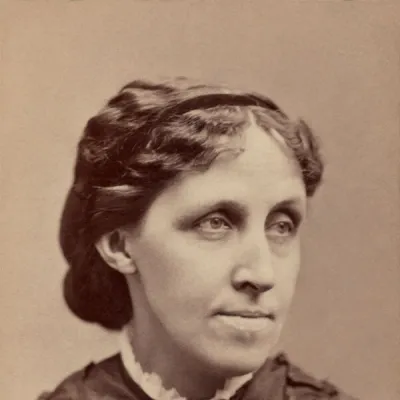
Louisa May Alcott
Human Design Chart
Biography
Alcott's family experienced financial hardship, and while Alcott took on various jobs to help support the family from an early age, they also sought to earn money by writing. In the 1860s they began to achieve critical success for their writing with the publication of Hospital Sketches, a book based on their service as a nurse in the American Civil War. Early in their career, they sometimes used pen names such as A. M. Barnard, under which they wrote lurid short stories and sensation novels for adults. Little Women was one of their first successful novels and has been adapted for film and television. It is loosely based on Alcott's childhood experiences with their three sisters, Abigail May Alcott Nieriker, Elizabeth Sewall Alcott, and Anna Alcott Pratt.
Alcott was an abolitionist and a feminist and remained unmarried throughout their life.
Human Design Analysis: Louisa May Alcott as Projector 2/4
Projector 2/4 — Design at a Glance
Louisa May Alcott's design inclined her towards a focused perception that immediately recognized system errors in her environment. As a Projector, she had an aura that behaved like a bright flashlight, illuminating areas where others were still in the dark or not functioning properly. However, this ability to identify flaws instantly came with a specific challenge: directly addressing these weak points was often perceived as unpleasant by those around her, much like shining a bright light directly into someone's face.
The most effective strategy for Louisa May Alcott did not involve direct criticism but rather attracting others through her own harmonious glow. By being an example herself, she invited others to ask about her insights and be guided by her. Her best approach was to wait for a respectful and sincerely meant invitation from others before deploying her focused energy.
Since Louisa May Alcott as a Projector did not have a defined Sacral Center, she lacked a constant intrinsic source of life energy. Instead, she experienced phases of high activity followed by urgent periods of rest to avoid burnout. Living according to this design and respecting these rhythms along with the invitation strategy rewarded her with success. Deviating from it led to experiences of bitterness as an expression of her non-self.
Emotional Authority
Louisa May Alcott's inner decision-making authority was the defined Emotional Center. This shaped her way of gaining clarity: not through spontaneous impulses, but through patiently waiting for emotional waves to pass. Her design dictated that she would experience constant fluctuations in feelings – moments of intense enthusiasm would alternate with phases of rejection. These emotional waves colored her perception; what seemed right at one moment could be experienced as wrong the next. Consequently, decisions made from this immediate mood were often misleading and not lasting.
The mechanics of her emotional authority therefore required time. Louisa May Alcott had to learn to hesitate and consciously delay decisions. Only after she had mulled over an issue multiple times or "slept on it" did the intense feelings subside. This process of cooling down created the necessary emotional distance to break free from the current mood and reach her true inner truth. Clarity and calmness only set in after this maturation process. This strategy was especially essential for long-term life decisions, as it neutralized the influence of fleeting moods and enabled a deeper, more comprehensive understanding. Through accepting this rhythm of upswings and downswings, Louisa May Alcott could distinguish her inner truth from transient emotional fluctuations.
The 2/4 Profile — Hermit / Opportunist
Louisa May Alcott's design indicated a tendency for cyclical movement between deep withdrawal experiences and active network engagement. She was someone who needed to constantly switch between the desire for solitude and the longing for community. This tension was characteristic of her Profile 2/4: Line 2 functioned as the "Hermit," while Line 4 represented the "Networker."
For Louisa May Alcott, it was crucial to create a safe environment where she could clearly communicate when she sought company and when she needed solitude. During her withdrawal phases, she immersed herself in internal processes to find peace and clarity. Once this need for alone time was satisfied, she would leave her "cave" again to spend time with her favorite people.
This rhythm allowed her to reflect on and evaluate the knowledge from her network in the stillness of her solitude. Often brilliant ideas emerged from this synthesis. Line 2 contributed problem-solving competence that could be strengthened through collaboration, while Line 4 focused on appropriate opportunities within the network. A balance between willpower and necessary rest periods was essential for her to avoid burnout and maintain a harmonious state. Thus, Louisa May Alcott did not use her solitude as an escape but rather as a productive space for condensing her experiences before the next phase of exchange.
Single Definition — Defined & Open Centers
Louisa May Alcott's design endowed her with a strong, self-determined will coupled with the necessity to find emotional clarity through patient waiting. Her defined Heart Center gave her constant strength for self-determination and protection of her resources; she recognized her worth and preferred following her own inner rhythm rather than being guided by external expectations. This created natural authority in dealing with work and commitments.
At the same time, her defined Solar Plexus acted as emotional authority. The mechanics of this center require waiting out waves of feelings and moods before making decisions. Louisa May Alcott tended to ride through her emotional wave to reach the deep truth of a situation rather than reacting impulsively to the first surge of excitement or depression. This combination of strong-willed structure and emotional depth required discipline to avoid falling into spontaneous actions.
Her open centers shaped her vulnerabilities. The open Head Center made her susceptible to mental confusion and pressure to answer questions that were not her own concern; she tended to get lost in other people's mental monologues or seek inspiration where none was needed. Similarly, the open Ajna Center fostered flexible but unstable conceptual thinking, causing her to adopt concepts from the environment rather than having firm theories of her own.
The open G Center meant a lack of fixed identity; Louisa May Alcott reflected the directions and energies of her surroundings, leading her to feel uncertain in relationships or places when they were not correctly aligned for her vehicle. She often sought the right love and direction by accumulating experiences with others rather than having a firm inner compass.
Furthermore, her open Sacral Center made her vulnerable to taking on foreign energy. She tended to feel overburdened by strengthening other people's vitality and forgetting when it was time to stop. The open Spleen Center led to a fundamental fear of survival and health, causing her to mistrust spontaneous decisions and often cling to unhealthy situations for a sense of security. Finally, her open Root Center absorbed stress from the environment, leading to cycles of adrenalized pressure waves that she did not recognize as her own and thus found difficult to dissipate.
Channels for community as a path to human liberation.
Louisa May Alcott's design inclined her towards bridge-building actions based on fair agreements and mutual benefit. She sought her honorable place in the whole, not through hierarchy but through direct personal connection. This attitude was primarily shaped by Channel 37-40, which links the emotional intuition of the Solar Plexus with the will of the Heart. It requires time to formulate good deals – "I do this for you if you do that for me" – as spontaneous agreements often remain unstable. The connection is guaranteed through willpower and needs a kind of personal "touch" to become authentic.
In addition to this central dynamic, other energies were at play. Gate 9 in the Sacral Center promoted detailed work and the ability to reach perfection through repeated experimentation; without adequate energy fulfillment, however, this could lead to depression. Gate 16 enabled her to master skills through mutative experimenting and identifying with them. On the personality side, Gate 49 offered a sensitive reaction to principles within family or clan, coupled with readiness for sacrifice in the name of community welfare. Gate 22 supported these processes through openness and the graceful ability to listen calmly until mutations in the social environment became clear.
Additionally, Gate 36 with its cyclical crisis experience and Gate 6 as an elemental building block for emotional friction and further development contributed. Gate 21 directed material affairs and sought recognition in service to the community, overcoming intentional hindrances through power. Together, these configurations created a Profile oriented towards cooperation, careful negotiation of relationships, and preservation of individual integrity within the collective.
Tribal Circuitry — Circuit Signature
Louisa May Alcott revealed herself as someone who sought cooperation and the joint creation of resources. Her design indicated a tendency towards mutual support, characterized by Channel 37-40 "Community". This channel connected her Heart Center with her Solar Plexus Center and established an equitable relationship between giving and taking – the principle "Today I give to you, tomorrow you give to me".
This configuration belonged to the ego circuit of the Family Group. Although the name suggests individual self, this mechanism focused on collective action. Since Louisa May Alcott had no connection to her Sacral Center, the constant life force of that center was missing from the circuit. The energy was conservative and traditionally oriented. This required sufficient rest periods to regenerate resources for the family group. Without these pauses, the necessary support would not have been maintained.
Her simple definition meant that Heart and Solar Plexus Centers were directly connected. This connection created a clear flow between will (Heart) and emotional processing (Solar Plexus). Louisa May Alcott lived this dynamic as a separate power from other possible connections. The focus was always on balance in the exchange, not individual dominance. The emotional wave acted like a ratchet, carefully advancing forward. She used her energy purposefully for joint creation, always mindful of the necessity of rest and traditional structure.
Right Angle Cross of Planning 4
Louisa May Alcott's design inclined towards strategic alignment and long-term vision. She was someone who planned actions not impulsively but within the context of a larger whole. This attitude stemmed from her Planning 4 incarnation cross, located in the right side of her Human Design. This configuration links background energy with that of strategic orientation, fostering an inner voice guiding careful weighing of steps and focusing on long-term goals. Instead of being driven by external circumstances, Louisa May Alcott sought a clear direction reflecting her deepest values. The mechanics of this cross emphasized the need to take pauses and maintain perspective before making important decisions. It was about seeing beyond immediate concerns to understand far-reaching consequences of actions. Thus, she led a life based on thoroughness and constancy. Louisa May Alcott lived this ability to recognize the big picture in small details and align her steps accordingly. Her design supported her in penetrating complex situations and finding a path that was both practical and visionary. This combination of groundedness and foresight characterized her unique approach to facing challenges and pursuing goals.
Saturn Return · Uranus Opposition · Chiron Return — Life Cycles
Louisa May Alcott's design inclined towards structured self-reflection, which intensified in her early thirties. She showed herself as someone who brought inner experiences into an orderly form to make them accessible. This attitude stemmed from her internal architecture: the first Saturn return marks the transition from experimental youth to conscious responsibility for one’s own creation. In this cycle, beginning around age 29 and completing by about 31, the design tests which foundations are sustainable. It is not just about external success but about integrating experience into a stable life structure.
Louisa May Alcott published “Hospital Sketches” in 1863 at the age of 31. This work was based on her service as a nurse during the American Civil War. For her design, this marked a typical moment of Saturn completion: years of often hard preparatory work and direct life experience coalesced into a coherent expression. The publication signaled not only a career decision but also the establishment of a personal voice grounded in lived reality. The Saturn return acts here as a catalyst for authenticity; it filters out the non-essential, leaving the core message clear. Louisa May Alcott used this phase to pour her observations from the war hospital into literary form that was both personally and socially relevant. This process underscores how the Saturn cycle helps translate individual experiences into universally understandable structures without losing depth.
Projector · Emotional Authority — Synthesis
Louisa May Alcott lived a life marked by the tension between inner observation and the need for community. Her design as a projector with emotional authority and a profile of natural talent/networker points to someone who could gain deep insights into others (Gate 9) while simultaneously holding a strong desire for authentic connections and recognition of her abilities (Channel 37-40). This combination led to an ability to perceive subtle dynamics and reflect them in her storytelling, always waiting for emotional maturity to gain clarity about her own values and priorities.
A central paradox lay in how Alcott received and processed energy. With open centers for identity (G Center), emotions (Solar Plexus) and vitality (Sacral Center), she was particularly susceptible to the energies of her environment but lacked a constant internal source to manage them. This led to an interplay between the need for withdrawal and solitude to find herself (Line 2) and the desire for exchange and belonging (Line 4) – a cycle that shaped her creative work and interactions with others.
1 Defined Channel
Incarnation Cross - Right Angle Cross of Planning 4
Solar Return
The Solar Return shows the moment when the sun returns to its exact birth position - your personal solar year.
Life Cycles
Discover the life cycles with a detailed triple view (birth chart, cycle chart, composite).
Human Design Profile
- Type
- Projector
- Strategy
- Wait for the respectful invitation
- Authority
- Emotional Authority
- Profile
- 2/4 - Hermit / Opportunist
- Definition
- Single Definition
- Incarnation Cross
- Right Angle Cross of Planning 4
- Date of Birth
- 29.11.1832 00:30
- Place of Birth
- Philadelphia, Pennsylvania, United States
Frequently Asked Questions
What was Louisa May Alcott's Human Design type?
What Profile did Louisa May Alcott have?
What Authority did Louisa May Alcott possess?
What incarnation cross did Louisa May Alcott have?
When was Louisa May Alcott born?
Discover your own Human Design
Are you also a Projector? Find out in a personal reading how to unfold your leadership qualities and recognize the right invitations.
More Personalities
Back to overviewSissy Spacek

Alain-Fournier

Anémone

Angeli

Ann-Margret

Bourvil
