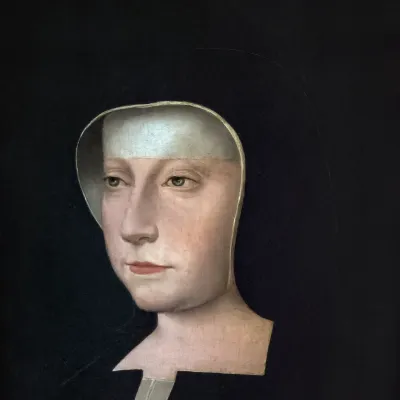
Luise von Savoyen
Human Design Chart
Biography
In 1490, at the age of thirteen, she was married to Charles de Valois-Orléans, Count of Angoulême, a great-grandson of Charles V of France. When the count died in 1496, he left Luise with two children, Margaret (1492-1549) and Francis (1494-1547). The accession of the childless Louis XII made Francis the likely successor to the French throne.
Finally, after the death of Louis XII, her son became king on January 1, 1515. From him, Louise received the county of Angoulême, which was elevated to the rank of a duchy. She also received the Duchy of Anjou and the County of Maine. From 1515 until her death, she exercised considerable influence over the government.
She died on 22 September 1531 in Grez-sur-Loing, France.
The Human Design of Luise von Savoyen: Projector 3/5
Projector 3/5 — Design at a Glance
Louise of Savoy appeared as someone with a dense, focused aura that immediately touched her surroundings. As a projector, she did not have a constant, intrinsic source of life energy, which shaped her existence through phases of high activity and necessary rest periods. Her design inclined her to immediately identify the flaw in the system – similar to a bright flashlight that directly illuminates dark spots. However, this ability to bring 'light into the dark' for others was effective only when she did not communicate directly and insistently, as this provoked resistance. Instead, she was most effective through her own harmonious example, attracting others who sought her insights and guidance. The strategy involved waiting for a respectful, sincerely meant invitation before taking on a leadership role. If Louise of Savoy lived by this pattern, she was rewarded with success. If she deviated from this alignment and ignored the need for pauses to avoid burnout, this led sooner or later to her non-self theme of bitterness. Her influence thus depended less on constant actionability and more on the quality of her perception and the way she engaged in relationships.
Self-Projected Authority
Louise of Savoy was a projector with the rare authority in self. This design marked her with extreme openness, making her vulnerable to distraction by external, motoric energies. The greatest danger lay in losing herself in this irritability and constantly chasing after energy. Her inner truth lay in her identity. She made decisions in two ways: through self-dialogues or dialogues when invited. Crucial was that she listened to herself and distinguished whether her self or her mind was speaking. Spontaneous, unconsidered statements expressed her true essence and made her uniqueness recognizable to others. Alternatively, she followed a physical feeling that drew her geographically or thematically in a specific direction. By following this inner pull, she became a directional guide for others. There lay her specific potential for success. This mechanism required her to not react to external impulses but to listen to the silent voice of self or follow the physical pull to find her true alignment.
The 3/5 Profile — Martyr / Heretic
Louise of Savoy appeared as someone who learned through personal experimentation to later solve the problems of others with this practical knowledge. Her design as an experimenter and hero (Profile 3/5) shaped this attitude: she initially believed little in given truths but gathered through her own experiences – and also failures – a rich treasure of life wisdom. This self-earned knowledge made her attractive to her environment; others sought her proximity to benefit from her insights. This role as an advisor flattered her self-image but could be painful when she failed in front of others while exploring new paths.
Her inner processing followed the logic of the third line (Gate 47), which requires adaptation to emotional waves. This was about dealing with the past and overcoming unfounded self-blame. The crucial step for Louise of Savoy was to gain the insight that she was okay and to free herself from the immature tendency towards self-destruction. Externally, she acted according to the pattern of the fifth line (Gate 45), emphasizing leadership and crisis resolution. She functioned as a respected guiding figure who offered practical solutions in difficult times. Her intuitive intellect helped her recognize innovations and hold the 'tribe' – her community or family – together. Thus, she united the inner work of emotional maturation with the outer task of standing as a genetic leader in crises.
Split Definition — Defined & Open Centers
Louise of Savoy revealed a design that combined constant mental pressure with a firm inner direction. Her defined Head and Ajna Centers generated a continuous inspiration that shaped questions and created concepts. This mental process was her constant companion, often accompanied by confusion or doubt until clarity emerged. She did not have the direct energy to immediately implement these thoughts into action but acted as a source that inspired others to think.
Her defined G Center gave her a reliable sense of self-identity and a clear sense of personal direction. She knew where she belonged and could show others new perspectives without losing her own love for herself. The connection between Ajna and her defined Throat Center allowed her to express clearly and consistently what her mind conceptualized. Her communication was thus a direct reflection of her mental processes.
However, this stable inner world stood in contrast to her open centers. Her open Heart Center made her vulnerable to the pressure of proving her worth through willpower or promises. She tended to question whether she was doing enough to be competitive, which could lead to a cycle of self-doubt if she did not trust her inner authority.
Similarly, her open Sacral Center received the vital energy of the environment, which could lead to overexertion and exhaustion as she did not have a constant flow of her own energy. She had to learn to set boundaries and not rely on the borrowed energy of others. Additionally, her open Solar Plexus absorbed the emotions of her environment, making her emotionally vulnerable and prone to personalizing others' feelings as her own. Her open Spleen Center amplified fears of survival and health, while her open Root Center took on external stress, leading to a feeling of inner unrest and an attempt to escape this pressure.
Channels for inspiration, logical leadership and mental abstraction.
Louise of Savoyen revealed herself as a personality that influenced her environment through her blores existence and individual radiance. Her design included the Channel of Inspiration 1-8, connecting the G Center with the Throat Center. This configuration did not provide guidance through explicit instructions but through the bold living of her creative identity. She was designed to attract attention by showcasing her uniqueness, which in others awakened the potential to explore their individual direction.
Parallel to this, she possessed the structure of the Alpha Animal Channel 7-31, also between G and Throat Centers. This gave her the ability to lead logically and collectively. Unlike the purely individual inspiration, this side of her design required that she be actively invited and recognized by the community to exercise her role as a leader. She could understand patterns and anticipate trends to guide a group into the future, as long as she had the trust of the majority.
Her inner process was shaped by the Channel of Abstraction 47-64, connecting the Head Center with the Ajna Center. This channel generated a constant mental pressure to filter experiences through a kaleidoscope of images and possibilities. Louise of Savoyen had to practice patience until a clear, inspiring story or perspective emerged from the initial confusion, which she could then share. Here, the mind served not as an inner authority but as a tool to distill meaning from the chaos of experience.
Additionally, pivotal Gates were active in her design: Gate 45 brought in the energy of royal hierarchy and tribal connection, while Gate 26 conveyed the ability to establish innovations within conservative structures. Gate 22 promoted a calm openness to mutations, and Gate 62 ensured a patient, detail-oriented logic. Gate 63 drove the process of doubt and improvement, and Gate 43 enabled spontaneous insights, though it brought the fear of rejection in communication.
Collective Circuitry — Circuit Signature
Louise of Savoyen's design tended towards a dual expression: on the one hand, impulsively inspired, on the other hand, strategically calculated. These separate forces existed in parallel, as her definition was divided and there was no direct connection between the different energy groups.
The Knowledge Circuit connected her Throat with her Identity Center. Through the Channel of Inspiration (Gates 8 and 1), she received sudden insights. This energy was pulsating and acoustic, driven by the need to express her unique individuality through new, transformative ideas. She acted in the moment, motivated by the vision of the new.
Parallel to this, the Understanding Circuit also connected her Throat and Identity Centers. Here, the Alpha Animal Channel (Gates 31 and 7) dominated. This energy was focused, visual, and future-oriented. It used logic, strategy, and structure to share rational insights free from conditioning. Unlike the emotional wave of the Knowledge Circuit, this was a cool, analytical ratio aimed at guiding society towards a better future.
A third, completely isolated stream existed in the Meaning Circuit. Here, Head and Ajna Centers were connected through the Channel of Abstraction (Gates 64 and 47). This energy was cyclical, visual, and past-oriented. It served to reflect on past experiences and find the meaning behind events. This abstract, emotional processing stood in no direct exchange with the other two expression streams but formed its own, closed process of meaning-making.
Right Angle Cross of Rulership 3
Louise of Savoy had the right ruling cross 3 in Human Design. This configuration pointed her towards a specific life path characterized by the interplay of inner intuition and external authority. In Human Design, such a cross describes a deeply rooted ability to take on leadership roles not out of duty alone, but from an authentic, inner source.
For Louise of Savoy, this meant that her actions and decisions were often guided by a clear, almost instinctive certainty. She was someone who could see through complex situations and act with a calmness that reassured others. The right ruling cross 3 typically connects the energy of assertiveness with that of trust in one's own process. It was not about imposing authority, but about a gentle yet unshakable leadership based on resonance and inner truth.
Her design suggested that she listened to her inner voice in moments of uncertainty to find the right direction. This ability helped her remain stable in her role as a regent or leader, even when external circumstances were turbulent. The mechanics of this cross emphasize that true authority is not imposed but emanates from a deep connection to one's essence. Louise of Savoy lived this dynamic by making decisions based on inner clarity, allowing her to act with dignity and constancy.
Saturn Return · Uranus Opposition · Chiron Return — Life Cycles
Louise of Savoy was a figure whose life was marked by sudden, profound turning points that redefined her role in the world. Her design contained the dynamics of the Uranus opposition, an aspect often associated with unexpected breaks or revolutionary changes in life's path. This configuration signaled a tendency for external circumstances to abruptly change, breaking old structures and creating new, often unexpected responsibilities.
In 1515, at the age of 39, such a pivotal event occurred: Louise became Duchess of Angoulême and gained significant influence over the government. This moment not only marked a social ascent but also the concrete manifestation of the tension embedded in her design. The Uranus opposition often acts as a catalyst that pulls the individual out of an established position and into a new, often challenging function. For Louise of Savoy, this meant that she did not ascend gradually but through an external shock or a sudden opportunity into a position of power. The mechanics of this aspect describe less a gentle development and more a jolt that radically expands or changes the person's consciousness and possibilities for action. In this case, the jolt led to the assumption of political responsibility, showing how the astrological dynamics were effective in her biography: through a sudden change that broke her previous boundaries and placed her at the center of historical processes.
Projector · Self-Projected Authority — Synthesis
Louise of Savoy lived an existence marked by a constant desire to recognize and highlight patterns where improvements could be made (Channel Inspiration). Her Projector design implied a natural ability to see potential in others but also to recognize their blind spots. This gift, combined with the profile of the experimenter and helper, led her to learn through experience and then share this knowledge with others. The defined connection between Head and Ajna centers strengthened this drive to understand and question, further fueling her ability to bring 'light into the dark' for others.
A central paradox in her design lay in the tension between the openness of her authority in herself and the need to find her own inner truth. While she constantly sought inspiration and new perspectives, there was a risk of losing herself in external influences. This led to an internal dynamic where she, on one hand, inspired the world through her defined mental presence, while on the other hand, she was also mindful of staying true to herself and not being led by others' expectations – a balancing act that was evident in an event where she exerted influence over the government.
3 Defined Channels
Incarnation Cross - Right Angle Cross of Rulership 3
Solar Return
The Solar Return shows the moment when the sun returns to its exact birth position - your personal solar year.
Life Cycles
Discover the life cycles with a detailed triple view (birth chart, cycle chart, composite).
Human Design Profile
- Type
- Projector
- Strategy
- Wait for the respectful invitation
- Authority
- Self-Projected Authority
- Profile
- 3/5 - Martyr / Heretic
- Definition
- Split Definition
- Incarnation Cross
- Right Angle Cross of Rulership 3
- Date of Birth
- 11.09.1476 17:24
- Place of Birth
- Pont d'Ain, France
Frequently Asked Questions
What was Luise von Savoyen's Human Design type?
What Profile did Luise von Savoyen have?
What was Luise von Savoyen's Authority?
What incarnation cross did Louise of Savoy have?
When was Louise of Savoy born?
Discover your own Human Design
Are you also a Projector? Find out in a personal reading how to unfold your leadership qualities and recognize the right invitations.
More Personalities
Back to overviewSissy Spacek
Alain-Fournier

Anémone
Ann-Margret
Bourvil
Hergé