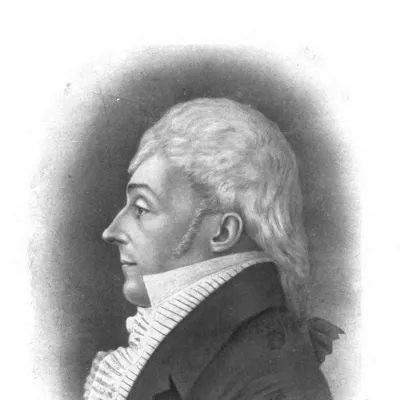
Maine de Biran
Human Design Chart
Biography
A treatise on the analysis of thought (Sur la décomposition de la pensée, "On the Decomposition of Thought") was never printed. In 1834 these writings, together with the essay entitled Nouvelles considérations sur les rapports du physique et du moral de l'homme, were published by Victor Cousin, who in 1841 added three volumes, under the title Œuvres philosophiques de Maine de Biran. But the publication (in 1859) by Édouard Naville (from manuscripts placed at his father's disposal by Biran's son) of the Œuvres inédites de Maine de Biran, in three volumes, first rendered possible a connected view of his philosophical development.
He died on 20 July 1824, aged 57, in Paris.
Maine de Biran — Generator with Profile 3/5
Generator 3/5 — Design at a Glance
Maine de Biran had a high and enduring sacral energy that enabled him to achieve remarkable consistency. His design dictated that this power would only be activated in response to external impulses, not through spontaneous initiatives. The strategic necessity was to wait for life signals and respond with action. This ensured deep satisfaction and protected against burnout.
Two specific pitfalls shaped his dynamics. First, he tended to waste energy on tasks that did not stir inner enthusiasm – a path that quickly leads Generators to burnout. Second, he suffered when prevented from pursuing his heart's project despite still having an internal drive. The motto 'react, don’t initiate' was central: His energy unfolded only when the sacral center gave a clear 'yes', and he acted accordingly.
Living in harmony with this principle made him unstoppable; he was rewarded with deep fulfillment. Initiating against his design led to persistent frustration or energy loss. Thus, his strength lay not in anticipation but in powerful, gut-driven responses to what life offered. This reactivity was the key to his materialization power and inner balance.
Emotional Authority
Maine de Biran exhibited an internal decision-making structure that did not reveal itself at the moment of first reaction but only after a phase of emotional cooling down. His design indicated that the defined solar plexus center carried his inner authority. This meant Maine de Biran was subject to permanent emotional waves coloring his perception of the world through current mood swings. In one moment, he could be enthusiastic about something; in the next, view the same situation negatively. This up-and-down pattern was not a mistake but the mechanism of his authority: The immediate feeling was merely a snapshot, an initial impression, not yet his deep truth.
Quick, spontaneous decisions from this emotional heat would often have negative consequences for Maine de Biran. His strategy involved allowing time and patience to prevail. He needed to let decisions mature, hesitate, and practice multiple overnights. Only when the intense feelings subsided did he gain the necessary emotional distance. Then clarity and calm set in – a sign that the process was complete. This approach was particularly relevant for long-term decisions with significant influence on his life course. Emotional authority always took precedence over other defined centers in his chart, regardless of their content. Maine de Biran learned to seek his truth not in the storm of emotions but in the calm after.
The 3/5 Profile — Martyr / Heretic
Maine de Biran's design inclined him to act as a heroic adventurer who gathered knowledge through self-imposed, often painful experiments and then applied it to solve others' problems. As someone with Profile 3/5, he initially believed nothing given; instead, he had to test everything himself to learn from mistakes. This process along Line 3 was essential for his later authority. The resulting practical experience made him attractive to those who wanted to benefit from his insights. This heroic role flattered him but became painful when he failed in public – a necessary part of the learning.
The mechanics of his design showed duality: Failure was indispensable for knowledge acquisition, yet it faced the public pressure of Line 5 to be successful. Maine de Biran had to learn to push back negative forces and take breaks to maintain his stubborn ego. His logical tolerance for errors was low as he sought security for the future. Sometimes he resorted to violence to temporarily overcome obstacles, driven by details that pushed the process over the edge. His life consisted of holding this tension between private experimentation and public heroism without external validation dictating his strong ego. He presented his rich treasure trove of life experiences humorously and rebelliously, always ready to take on the role of savior after internalizing the tough lessons of Line 3.
Triple Split Definition — Defined & Open Centers
Maine de Birans Human-Design shows a massive, constant internal structure: nine out of ten centers are defined. This does not create situational dependency but shapes the environment through the continuous emission of defined energies. He had persistent mental pressure and inspiration (Head Center and Ajna Center), a firm identity and direction (G Center) as well as willpower (Heart Center). Additionally, he possessed vital energy for reaction (Sacral Center), emotional wave movement (Solar Plexus Center) and constant stress pressure (Root Center). His communication took place through a defined Throat Center.
Only the Spleen Center was open. Here intuition, health sense, and spontaneous values were not available as a constant internal source but were situationally taken in or reflected from the environment. This created dynamics between a strong deterministic inner machine and a specific opening for external conditioning influences in the realm of well-being. Maine de Biran tended to question whether he was viable for survival or held onto things that harmed him to gain a sense of security through others. Spontaneous decisions were risky for him, as his undefined Spleen Center was vulnerable to conditioned fears. The challenge lay in distinguishing between his own intuition and absorbed values while using his defined willpower and vital energy to express mental pressure and emotional depth without falling into unhealthy stress due to constant Root pressure.
Channels for logic, intimacy, reflection, principles and community.
Maine de Biran's design revealed a mind deeply marked by intelligent skepticism. His design tended towards not simply accepting information but rigorously testing it for consistency. This attitude stemmed from the Logic Channel 63-4. He connected the Gate of Doubt (63) in the Head Center with the Gate of Formulation (4) in the Ajna Center, creating an internal mechanism that continuously filtered patterns. As long as a pattern was recognized as inconsistent, mental pressure intensified until a logically verifiable answer was found. This process served primarily not his personal well-being but collective understanding; the challenge lay in releasing this pressure without falling into personal insecurity.
Alongside this analytical sharpness, Maine de Biran possessed a powerful ability for intimacy and merging rooted in the Channel of Union 59-6. Through the Gate of Sexuality (59) in the Sacral Center and the Gate of Friction (6) in the Solar Plexus Center, he sought connections that were personal, penetrating, and potentially fruitful. His emotional wave determined the timing of these approaches; he needed time to gain clarity about the depth of a relationship.
Another essential aspect of his design was the reflective nature of the Channel of the Lost Son 13-33. Here, the Gate of Listener (13) in the G Center connected with the Gate of Withdrawal (33) in the Throat Center. Maine de Biran gathered experiences and secrets but then withdrew to process them. Only after this patient maturation did he share his insights, which helped him create continuity in his development.
Additionally, the Channel of Synthesis 19-49 as well as the Channel of Community 37-40 were at work within him. The first connected the Root Center (Gate 19) with the Solar Plexus (Gate 49), making him sensitive to the needs and principles of his tribe. The latter linked the Solar Plexus Center (Gate 37) with the Heart Center (Gate 40), driving him to seek recognition in the community and fair agreements to secure belonging. This combination of logical scrutiny, emotional depth, and social cohesion shaped his work profoundly.
Tribal Circuitry — Circuit Signature
Maine de Birans design presented itself as a web of three separate yet parallel acting energetic strands. The Understanding Circuit connected the Head with the Ajna Center through the Logic Channel (Gates 63-4). This created a cool, future-oriented ratio aimed at structuring and conveying logical insights free from emotional conditioning.
The Finding Meaning Circuit worked quite differently. It linked the Throat with the Identity Center via the 'Lost Son' Channel (Gates 33-13). Here it was not about future strategies but about cyclical, wave-like processing of past experiences. Emotional waves rose and fell to draw meaning from history and share these felt insights with the collective.
The Ego Circuit formed a third independent block. It connected Heart, Solar Plexus, and Root Centers via the Channels Community (37-40) and Synthesis (49-19). Without direct connection to the Sacral life force, this strand focused on tribal cooperation and balance of giving and taking. It required pauses for resource management driven by a conservative, traditional attitude.
Finally, the Archer Circuit connected the Sacral with the Solar Plexus Center through the Union Channel (59-6). This created a primordial energy to protect genetics and family. It united instinctive survival forces with emotional intensity to ensure preservation of the self. These four circuits did not act as one unit but as distinct roles: rational future shaping, emotional past reflection, tribal resource care, and genetic protection.
Right Angle Cross of Planning 4
Maine de Birans Human Design showed a tendency towards strategic alignment and long-term vision. He was someone who not only analyzed complex connections but actively transformed them into coherent future perspectives. This planning ability was more than just an intellectual game; it was a deeply rooted need to bring structure to the chaos of everyday life and align actions with clear goals.
This orientation stemmed from the configuration 'The right cross of Planning 4'. In Human Design, this specific combination describes an energy aimed at precisely charting the path from the current state to the desired outcome. For Maine de Biran, it was not just about dreaming but defining concrete steps that would make these dreams a reality. His inner self demanded a roadmap that minimized uncertainties and provided action certainty.
This mechanism shaped his approach to problems: instead of reacting impulsively, he first sought out the optimal strategy. He understood how to condense various information into a meaningful whole serving as a guide. This ability for forward-looking planning allowed him to maintain long-term goals despite short-term obstacles and work consistently towards them. His design thus fostered an attitude of patient but goal-oriented preparation, where every action was part of a larger, thought-out plan.
Saturn Return · Uranus Opposition · Chiron Return · 2nd Saturn Return — Life Cycles
Maine de Birans life followed a clear cyclical structure marked by three decisive astrological points. These phases each signified specific milestones or the end of his active period. In 1803, at age 37, he published an essay on habit. This occurred during the Uranus opposition, a moment often heralding sudden changes and new directions. For Maine de Biran, this was a moment of success when his intellectual approaches became public.
Another peak came in 1817 when, at age 51, he published a critical review of Pierre Laromiguières lectures. This timing coincided with his Chiron return. In Human Design mechanics, this is a fulfillment cycle: if one lives according to their strategy and authority, the incarnation cross unfolds here. Meaning and purpose become tangible. Maine de Birans publication was an expression of this flourishing period when his deeper life mission came into prominence.
The last notable event occurred in 1824. At the time of his second Saturn return, Maine de Biran died in Paris at age 57. The second Saturn return often marks the end of a major life phase and brings final consolidation or conclusion. His three main events – the publication on habit, the critical review, and his death – correlated exactly with these astrological cycles. They show how his external successes and life's end were connected to the inner rhythmic structures of his design. Each of these points was a concrete expression of the underlying mechanics.
Generator · Emotional Authority — Synthesis
Maine de Biran was a Generator whose life was marked by profound internal dynamics. The combination of emotional authority, the Profile of the Explorer and Hero (3/5), and the defined Centers Head, Ajna, Heart, Root, and Throat indicates someone who tirelessly sought knowledge and brought it to the world – yet always through cyclical phases of intense experience and reflection. Sacral energy, linked with the Channel of Union (59/6), revealed a deep capacity for connection and intimacy that only became clear after waiting out the emotional wave. The defined Head and Ajna indicated a constant mental pressure to question things and understand them, while the Heart Center endowed him with strong self-awareness.
A central paradox in his design lay in the interplay between inner depth and the urge towards external manifestation. Emotional authority demanded he let decisions ripen, while Sacral energy called for reaction. This internal conflict between waiting and acting, amplified by the Explorer Profile, led him repeatedly into new situations from which he gained valuable insights – insights that he then shared with the world through his defined Throat Channel. The connection of Root Center and Solar Plexus (Channel 19/49) pointed to deep loyalty that always had to be filtered through emotional clarity.
5 Defined Channels
Incarnation Cross - Right Angle Cross of Planning 4
Solar Return
The Solar Return shows the moment when the sun returns to its exact birth position - your personal solar year.
Life Cycles
Discover the life cycles with a detailed triple view (birth chart, cycle chart, composite).
Human Design Profile
- Type
- Generator
- Strategy
- To respond - wait for something to respond to
- Authority
- Emotional Authority
- Profile
- 3/5 - Martyr / Heretic
- Definition
- Triple Split
- Incarnation Cross
- Right Angle Cross of Planning 4
- Date of Birth
- 29.11.1766 21:00
- Place of Birth
- Bergerac, France
Frequently Asked Questions
What was Maine de Biran's Human Design type?
What Profile did Maine de Biran have in Human Design?
Which Authority guided Maine de Biran's decisions?
Which incarnation cross characterized the life of Maine de Birans?
Discover your own Human Design
Are you also a Generator? Find out in a personal reading how to use your sacral energy correctly and discover deep satisfaction.
More Personalities
Back to overviewAaliyah

Alexia

Angèle

Anne-Marie

Arcángel

Arno