
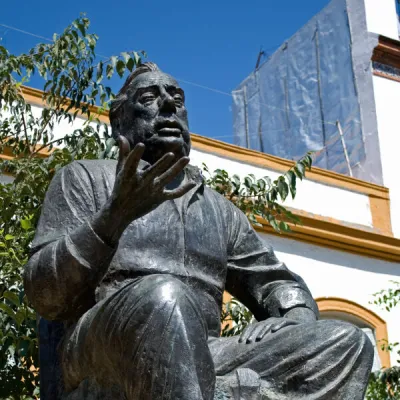
Manolo Caracol
Human Design Chart
Biography
In 1922 as a youth, he had been awarded the first prize (shared with El Tenazas) at the Concurso de Cante Jondo de Granada, organized by intellectuals like Manuel de Falla and Federico García Lorca. However, in the first stage of his career, he made a living singing mostly at private parties, which at the time, were, together with cafés, the usual stages for flamenco artists.
he is usually considered as one of the singers that better represent 'Duende' (a typical flamenco term which basically means "inspiration"). He possessed a deep, earthy, yet warm voice, and delivered the flamenco cantes (songs) with passion, originality, and extremely personal phrasing. He excelled in a wide variety of flamenco styles, including Martinetes, Seguiriyas, Soleá, Malagueñas (especially in the style of el Mellizo), Bulerías and Fandangos, among others. His renderings of Fandangos, in particular, were so personal that they have come to be known as Fandangos Caracoleros.
Caracol died on 24 February 1973 in a road accident in Madrid, Spain.
The Human Design of Manolo Caracol: Manifesting Generator 6/2
Manifesting Generator 6/2 — Design at a Glance
Manolo Caracol revealed himself as a Hybrid being, combining the constant energy of a Generator with the lightning-fast effect of a Manifestor. His design pointed towards extreme speed; he could skip steps and draw things into his life rapidly. This ability, however, carried risks: Often, he was too quick, skipped necessary phases, and had to return later to fill gaps. This led to frustration, his specific Non-Self theme. Additionally, he tended to pursue multiple projects simultaneously, driven by different impulses. Without inner alignment, this creative drive quickly turned into exhaustion.
The strategy for his design was to not initiate but to react to life. Only when his defined Sacral Center gave a clear “yes” did he act. Regular checks to see if the projects still had his approval were essential. With correct application of this strategy, Manolo Caracol drew deep satisfaction from his work. Parallelism was then not a hindrance but a source of energy. He needed variety and a playful mode to maintain his strength. The advice to focus on one thing only would have harmed him. Instead, he flourished in diversity as long as he listened to his inner resonance and did not fight against the current of his own nature.
Emotional Authority
Manolo Caracol carried emotional authority, meaning his defined Emotional Center was the decisive instance for all life decisions. This configuration held regardless of other defined Centers in his design; the emotional wave always took precedence. He moved in a permanent up and down of feelings, coloring his perception of the world always through the current mood. What had excited him in one moment could appear negative in the next. These fleeting impressions, however, were not the final truth but only snapshots. Quick, spontaneous decisions that arose directly from this emotional heat often risked negative consequences, as they were based on incomplete information.
The mechanics of his inner authority required patience and time. To gain clarity, Manolo Caracol had to let decisions mature, ideally through multiple sleepovers. Only when the intense feelings subsided and emotional distance arose did calmness set in. This process was particularly essential for long-term, life-defining decisions. He showed himself as someone who could not immediately commit but had to hesitate to recognize the true depth of a situation. Only through this waiting and distancing from the immediate emotional reaction could he distinguish his inner truth from transient mood swings and take grounded steps in his life.
The 6/2 Profile — Role Model / Hermit
Manolo Caracol's design laid out a development that divided into two clearly distinct phases. In the early years, before the 30th year of life, the 6/2 line primarily acted as a 3-line. This created a tendency towards experimenting and learning through trial and error. Manolo Caracol appeared in this time as someone who gathered life experiences, with retreat after mistakes being the driving principle.
With the entry of the 6-line, typically after the 30th birthday, this dynamic fundamentally changed. The mechanics of line 6 promoted a phase of intense reflection and distancing from the earlier experiments. Manolo Caracol withdrew in this time to heal and gain deep self-awareness. This retreat, supported by the willpower of Gate 51 (line 2), served for recovery and ego protection. Only correct calls were responded to, which required courage and ego strength.
Simultaneously, the altruistic problem-solving power of line 6 was at work. This gift was designed to enable the right spirit in others, even though it was often not yet accepted in his current mutation state, as its effectiveness required time. After the phase of introspection, Manolo Caracol emerged again as a wise person. Others recognized this wisdom and sought him out to partake in his life wisdom and learn the ability for deep self-reflection. Thus, early uncertainty transformed into an authoritative presence marked by distance and clarity.
Split Definition — Defined & Open Centers
Manolo Caracol revealed himself as someone with a clear, unmistakable identity and a deep sense of direction. His defined G Center endowed him with a constant self-love and the ability to guide others onto new paths without being dependent on them. This inner alignment was supported by his defined Throat Center, which served as a pivot point to translate messages from his inner self into the world. His voice was reliable and honest, shaped by the connection to his motor centers, allowing him to express his truth with ease and clarity.
As a Generator, Manolo Caracol possessed a vast reservoir of vital energy, steered by his defined Sacral Center. His strategy was not to initiate but to wait for life to unfold and then respond to the sacral answer. This ensured satisfaction and prevented frustration that arises when working against the natural flow of energy. However, his decisions were not made impulsively but filtered through his defined Solar Plexus Center, which acted as an emotional authority. He learned to wait out the waves of his emotions until emotional clarity emerged before taking action. This protected him from impulsive misjudgments and leveraged the seductive depth of his emotional intelligence.
Additionally, he possessed willpower and ego strength through his defined Heart Center, which helped him keep promises and determine his own resources. His defined Spleen Center provided spontaneous intuition and well-being in the present moment, while the defined Root Center supplied the necessary pressure to move forward in the world and cope with stress.
In contrast, his Head and Ajna Centers were open. This meant that he did not have a constant mental inspiration or conceptual truth. Instead, he tended to absorb mental pressure waves from the outside and get entangled in questions or doubts that were not his own. His challenge was to not accept this mental noise as his own truth but to rely on his emotional and sacral authority to find clarity, rather than seeking answers in his mind.
Channels for meaning, community, growth and authentic expression.
Manolo Caracol revealed himself as someone who took on material responsibility through willpower to secure resources. This stemmed from the Money Line 21-45, connecting Heart and Throat. Here, the hunting instinct of Gate 21 met the authoritative voice of Gate 45, creating a constant struggle between the need for control and service to the community. Success lay in acting independently while simultaneously providing for the community.
Simultaneously, a deep competitive drive led to individualization. The Initiation 51-25 connected the shock of Gate 51 with the universal love of Gate 25. Manolo Caracol did not seek initiation but allowed it to find him. Through authentic living and surviving shocks, he became a role model that inspired others to develop their own spirit.
His life was also marked by a stubborn struggle to find meaning. The Life Struggle 38-28 connected the resistance of Gate 38 with the intuitive assessment of Gate 28. He fought against external forces that distracted him from his true nature and found meaning only in struggles he deemed valuable. This determination served individualization and inspired others to walk their own path.
Emotionally, Manolo Caracol sought new experiences to gain wisdom. The Transience 35-36 connected the desire for change of Gate 35 with the crisis experience of Gate 36. He learned through life that feelings are transient and used this insight to encourage others to enjoy the moment.
In relationships, he sought community and fair agreements. The Community 37-40 connected the friendship of Gate 37 with the need for peace of Gate 40. He built bridges between individuals based on mutual respect and emotional clarity, rather than hierarchy.
Finally, he went through complete life cycles to learn from them. The Maturation 52-43 connected the beginning of Gate 53 with the growth of Gate 42. Only by completing experiences could he start new cycles and share the wisdom gained.
Collective Circuitry — Circuit Signature
Manolo Caracol's design inclined towards inner strength and pragmatic endurance. His split definition consisted of two non-directly connected energetic blocks: One block connected Heart, Throat, Solar Plexus, and G Center; the other Spleen, Root, and Sacral Center. This created parallel existing forces without a common flow between the groups.
The Knowledge Circuit worked through the Channel Life Struggle, connecting Spleen and Root Center. This promoted an instinctive, survival-oriented intuition. The Centering Circuit connected through the Channel Initiation the Identity with the Heart Center. This endowed a fortified, courageous personality with strong convictions, lacking, however, the direct connection to the Throat Center, which made the expression of this strength difficult.
The Meaning-Finding Circuit consisted of two separate parts. The first connected Throat and Solar Plexus Center (Channel Transience), the second Sacral and Root Center (Channel Maturation). This directed energy towards the emotional processing of past experiences and their cyclical nature. Finally, the Ego Circuit connected Throat, Heart, and Solar Plexus Center (Channels The Money Line and Community). This supported cooperation and the exchange of resources in the collective, but required regular rest periods due to the lack of a Sacral connection for regeneration.
Left Angle Cross of Individualism 1
Manolo Caracol's design carried the imprint of the left cross of individualism. This placed him in an energetic configuration that fostered a deep connection to his unique, unrepeatable identity and personal expression. His chart described a nature designed to not blend into the masses but to follow a clear, independent path.
In Human Design mechanics, this cross represents the power of individuality. It is not about negative egoism but about the necessity to live one's own truth and carry this authenticity outward. Manolo Caracol was shown through this structure as someone whose energy aimed to break free from collective expectations. The mechanics of this design suggested that his actions and being were strongly driven by the need to preserve and make visible his specific, individual signature.
This configuration acted as an inner compass guiding him to make decisions that aligned with his personal essence rather than orienting himself to external norms. His design thus described a lifestyle based on the integrity of the self. The energy of this cross supported him in using his uniqueness as a source of strength rather than suppressing it. It was a structure that encouraged him to walk his own path and take responsibility for his individual form of expression.
Saturn Return · Uranus Opposition · Chiron Return · 2nd Saturn Return — Life Cycles
Manolo Caracol's design laid a tendency towards cyclical maturation processes characterized by clear phases of structuring and detachment. His first Saturn return marked the beginning of a phase where years of groundwork often condensed into a solid result and initial stable structures of his life work emerged. This period was marked by the necessity to take responsibility and recognize personal boundaries.
Later came the Uranus opposition, a period typically marked by internal tensions and a drive for change. Here, a conflict between established duties and the need for individual freedom often led to sudden insights or necessary breaks in old patterns. This phase served the detachment from bonds that no longer aligned with the true self.
The Chiron return, which occurred in middle age, was not a healing process in the traditional sense but a fulfillment cycle. During this time, his incarnation cross unfolded increasingly; if Manolo Caracol had lived according to his strategy and authority, the meaning and purpose of his life became experiential. It was a time of bloom, in which the deepest life task unfolded its full effect.
The second Saturn return rounded off this cycle. It brought a deeper wisdom and a final clarification of what truly mattered in life. This last great cycle solidified the achievements of the previous phases and laid the groundwork for further development in later life by cementing the essential structures of existence.
Manifesting Generator · Emotional Authority — Synthesis
Manolo Caracol lived a life path marked by a profound inner dynamism. As a Manifesting Generator, he possessed the ability to quickly initiate and realize things, fueled by a constant sacral energy. This energy, combined with emotional authority, led him to make decisions not out of the moment but to let them ripen in an internal wave. The profile as a role model and natural talent suggests that he first gathered experiences to later act as a wise advisor—a process marked by the Saturn return. The connection of Throat and Heart Center (Channel 21-45) strengthened the drive to take responsibility and express his own authority.
A central paradox in his design lay in the tension between the impulsive action of the Manifesting Generator and the need for emotional maturation. He could set things in motion quickly, yet simultaneously, his emotional authority required time and distance to ensure the correctness of his decisions. This dynamic led him to possibly miss important steps or revise decisions while simultaneously embodying the wisdom and leadership that others sought. The left cross of individualism underscored this inner conflict between the desire for autonomy and responsibility towards others.
6 Defined Channels
Incarnation Cross - Left Angle Cross of Individualism 1
Solar Return
The Solar Return shows the moment when the sun returns to its exact birth position - your personal solar year.
Life Cycles
Discover the life cycles with a detailed triple view (birth chart, cycle chart, composite).
Human Design Profile
- Strategy
- To respond - wait for something to respond to
- Authority
- Emotional Authority
- Profile
- 6/2 - Role Model / Hermit
- Definition
- Split Definition
- Incarnation Cross
- Left Angle Cross of Individualism 1
- Date of Birth
- 07.07.1909 15:00
- Place of Birth
- Sevilla, Spain
Frequently Asked Questions
What was Manolo Caracol's Human Design type?
What profile did Manolo Caracol have?
Which authority guided Manolo Caracol?
What incarnation cross did Manolo Caracol have?
When was Manolo Caracol born?
Discover your own Human Design
Are you also a Manifesting Generator? Find out in a personal reading how to unfold your multi-talents and direct your energy wisely.
More Personalities
Back to overviewAaliyah

Aldair

Alexia

Alizée

Angèle

Angeli
