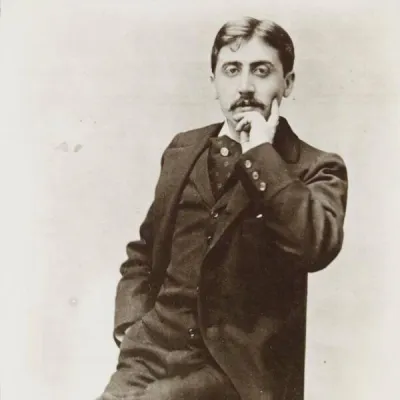
Marcel Proust
Human Design Chart
Biography
Proust was born in the Auteuil quarter of Paris, to a wealthy bourgeois family. His father, Adrien Proust, was a prominent pathologist and epidemiologist who studied cholera. His mother, Jeanne Clémence Weil, was from a prosperous Jewish family. Proust was raised in his father's Catholic faith, though he later became an atheist. From a young age, he struggled with severe asthma attacks which caused him to have a disrupted education. As a young man, Proust cultivated interests in literature and writing while moving in elite Parisian high society salons frequented by aristocrats and the upper bourgeoisie. These social connections provided inspiration and material for his later novel. His first works, including the collection of stories Les plaisirs et les jours, were published in the 1890s to little public success.
In 1908, Proust began work on À la recherche du temps perdu. The novel consists of seven volumes totaling around 1.25 million words.
Marcel Proust — Generator with Profile 4/6
Generator 4/6 — Design at a Glance
Marcel Proust had immense and enduring sacral energy. His design characterized him as someone with the strength of a workhorse: strong and steady, provided he pursued tasks that resonated internally. However, this high capacity for materializing projects was contingent upon a specific condition. The strategy of his design did not lie in initiating actions but rather in responding to them. Only through reacting to impulses from life could this energy unfold effectively and become productive.
This mechanism entailed two central risks. If Marcel Proust expended his strength on tasks without inner consent, an energetic collapse threatened him. Conversely, he suffered frustration and a lack of energy when external circumstances prevented him from working on his heart project, even though his internal signal to continue was loud. The motto of his design was to wait for signals and then act only when the sacral center gave a clear "yes."
Living in harmony with this response rather than under constant initiative pressure led to deep satisfaction and a sense of fulfillment. Deviations from it—especially the temptation to start independently instead of responding to life impulses—resulted in persistent frustration. His endurance was thus not blind perseverance but a powerful reaction to what spoke to him externally and internally confirmed.
Sacral Authority
Marcel Proust did not base his decisions on cognitive analysis but rather on an inner, physical resonance. His Generator design determined both his strategy and his inner authority: Sacral Authority. This only worked because his Emotional Center was open; emotional clarity was therefore not immediately available to him, making it necessary for him to directly query his body.
Confirmation of the right direction showed up as a gut feeling or a noticeable surge of energy in response to external stimuli. Marcel Proust had to listen to bodily signals – sounds like grunts, hums, or a clear "Mhm" versus a dismissive "Hmm". These sounds distinguished real energy from mere reaction. When his sacral motor kicked in, he felt vital and alive. Then he was endowed with seemingly inexhaustible energy that allowed him to accomplish tasks with great enthusiasm. He was born to go through life with joy and satisfaction, fully immersed in his pursuits without the need for any sense of purpose.
Moreover, his activated Spleen Center acted as a supporting authority to his Sacral Center. This gave him the ability to react particularly quickly and spontaneously. He had immediate access to his physical well-being and instinctive perception, which he could rely on confidently. This configuration fundamentally simplified his decision-making process: instead of thinking things through, he reacted to what energized him.
The 4/6 Profile — Opportunist / Role Model
Marcel Proust's design set a life movement leading from experimental optimism to wise detachment. In the first thirty years, he acted through Profile 4/6 like an eager experimenter who actively sought relationships and friendships. This corresponded to the early phase of Line 6, which still behaved similarly to a Line 3. Marcel Proust showed the typical optimism of Line 4: He assumed that crises would have an end, which helped him endure social setbacks. However, he cautiously opened his heart to avoid being hurt by false people.
Over time, his attitude changed fundamentally. The inner conflict between the desire for community (Line 4) and the need for reflective distance (Line 6) became central. Marcel Proust increasingly sought separation to overcome shocks and wait for spiritual signs. Instead of blindly throwing himself into competition, he withdrew to observe the meaning of things from a higher perspective. This separation was necessary to maintain his willpower.
In his later years, his environment expected him to play the role of a wise mentor. Marcel Proust should stand out through cooperation with others while simultaneously holding the tension between belonging and solitude. His design thus described a path from social experimenting to a detached yet cooperative wisdom based on the certainty that everything has a natural limit.
Split Definition — Defined & Open Centers
Marcel Proust's design showed a tendency towards inner stability while maintaining situational openness. He was someone who possessed a stable foundation of defined identity (G Center), a reliable energy source through reaction rather than initiation (Sacral Center), moment-to-moment intuitive decisions for well-being (Spleen Center) as well as a specific way to handle stress to maintain the life impulse (Root Center). These defined centers formed the stable core: a firm self-identity and direction, vital energy that was activated only through invitation, spontaneous intuition for health, and a specific adrenaline pressure mechanism.
In contrast, Head-, Ajna-, Throat-, Heart-, and Solar Plexus Centers were open. These centers acted as mirrors reflecting mental inspiration, concepts, communication triggers, willpower pressure, and emotional waves from the environment without reinforcing them as constant personal traits. The mechanical challenge was to use the defined inner authority to avoid falling into non-self states like mental confusion (open Head Center), forced speaking for attention generation (open Throat Center) or emotional identification with foreign moods (open Solar Plexus). Instead of exhausting mental pressure waves or proving himself through promises (open Heart Center), he tended to merely perceive these external influences informatively. The wisdom of his design lay in using the constant inner structure of G-, Sacral-, Spleen- and Root Centers as a compass, while open centers reacted flexibly to their respective environment without identifying with it or falling into conditioned patterns of inadequacy or emotional overload.
Channels for intuitive elegance and the process of growth.
Marcel Proust's design inclined towards intuitive, spontaneous action characterized by deep self-love and acoustic sensitivity. This attitude was shaped through Channel of Perfect Form 57-10 connecting Spleen and G Centers. Rather than being guided by future fears, he responded to the pitch of his environment’s voice and acted appropriately in the present moment. This enabled an existential lightness: He loved himself enough to remain true, creating something healthy and beautiful through this authenticity without it being a goal. His behavior unconsciously served as an example that left his surroundings healthier and more beautiful.
Parallelly, Channel of Maturation 53-42 propelled a cyclical process. This channel between Root and Sacral Center required experiences to be fully lived through and reflected upon before starting a new cycle. It was not about quick results but accumulating wisdom for collective history. Marcel Proust had to bring each experience to a satisfying conclusion to learn from it. Expectations were hindering here; instead, he needed to simply let himself into the process.
Additionally, Gates like 54 (Ambition and Spirituality) as well as 51 (Willpower) promoted a drive for development and adaptation. Gate 59 in Sacral Center supported genetic strategies of bonding while Gate 48 enabled pattern recognition and correction. These configurations together formed a life based on empirical learning: Through completing cycles and trusting moment-to-moment intuitive wisdom, he created a unique, healthy presence.
Individual Circuitry — Circuit Signature
Marcel Proust's design inclined towards cyclical emotional processing of the past. This energy flows in waves – with beginning, middle, and end – rather than linear or logical progression. The Meaning-Finding Circuit (Perceiving) dominated: It directed focus on feelings and experiences from the past to gain insights. In Marcel Proust, this circuit was activated through his own maturation channel between Gate 42 and 53 connecting Sacral with Root Center directly. This energy flow served to ripen felt insights and then share them with the collective to learn together from history.
Parallelly existed a separate energetic group: Integration. Here Channel of Perfect Form (Gates 10 and 57) connected Identity Center with Spleen. This area stood for individual self-empowerment in the present, guided by intuitive knowledge and proper behavior. As Marcel Proust had a split definition, these two systems – emotional past processing (Sacral/Root) and intuitive identity guidance (Identity/Spleen) – were not directly connected. They worked as coexisting independent forces. The right chart side (past/emotions) thus did not have any direct energetic flow to the left side (future/logic or here: identity). Marcel Proust was marked by this configuration of needing to fully run emotional waves from experience before they became shared insights.
Right Angle Cross of Penetration 2
Marcel Proust's Human Design carried the signature of the right cross of penetration. This configuration set a fundamental orientation that was not defined by individual, isolated traits but rather as an overall pattern. Since no specific Gates or Channels were active and the description remained neutral, the impact focused on the abstract concept of this cross itself. It was a structure that promoted penetration – a process of entering into essences to grasp deeper connections. Proust lived this mechanism not as a conscious strategy but as an inherent way of perceiving and interacting with his environment. The energy of this cross shaped his existence through constant movement of penetration, without concrete action impulses or emotional fix points from other design elements distracting him. It was a state of pure permeation and understanding of structures that otherwise remained hidden. This form of penetration occurred independently of external validations or internal urges, as the design here did not offer further specific drives. Proust thus appeared as someone whose essence was defined by this particular cross configuration: a focus on entering into the matter of life to touch and understand its hidden layers.
Saturn Return · Uranus Opposition · Chiron Return — Life Cycles
Marcel Proust's development unfolded in three marked phases that carried his inner structure outward. In 1900, at age 29, he experienced his first Saturn Return. This cycle closed the youth phase and anchored him in existing authorities. As evidence of this, he published an obituary for John Ruskin in Mercure, emphasizing his bond with established figures.
Following that, in 1909 at age 38, came the Uranus Opposition. This point often forces a radical break from the known to free autonomy and creative power. Proust used this turning point to begin work on his main work, “À la recherche du temps perdu”. The pressure for release was here creatively channeled.
The third pivotal moment was in 1920 when he was 49 years old and experienced his Chiron Return. This cycle marks not a healing of wounds but a blooming phase: the incarnation cross unfolds increasingly, so that meaning and purpose become experiential. Proust integrated his experiences into a new identity. As a reflection of this inner condensation, Montesquiou now called him “Montesproust”. This renaming showed the complete differentiation of his personality, separate from earlier roles or dependencies. The three cycles thus shaped the path from binding through creative rupture to self-determined identity.
Generator · Sacral Authority — Synthesis
Marcel Proust lived as a Generator with sacral authority, deeply marked by the search for fulfilling activity. His energy flowed best when he was drawn into a task that truly engaged him – a state signaled by an inner surge of power (sacral authority). The profile as a networker and role model indicates that throughout his life, he oscillated between the desire for community and the need for introspective reflection. This internal conflict between heart and head shaped his interactions and the expectations placed on him. His defined G Center gave him strong self-confidence and direction, which he did not always align with external pressure.
A central paradox in his design lay in the tension between his generative energy and the pitfalls of this type. On one hand, he possessed immense endurance and creative power (sacral center), on the other, he was prone to burnout if he devoted himself to tasks that did not bring him joy or hindered his heart projects. The recurring cycles – Saturn Return with the death of an important person and the start of his main work (Uranus Opposition) as well as grappling with his public perception (Chiron Return) – showed how he tried to navigate these internal contradictions and live out his unique form of creative integration (Channel 57/10).
2 Defined Channels
Incarnation Cross - Right Angle Cross of Penetration 2
Solar Return
The Solar Return shows the moment when the sun returns to its exact birth position - your personal solar year.
Life Cycles
Discover the life cycles with a detailed triple view (birth chart, cycle chart, composite).
Human Design Profile
- Type
- Generator
- Strategy
- To respond - wait for something to respond to
- Authority
- Sacral Authority
- Profile
- 4/6 - Opportunist / Role Model
- Definition
- Split Definition
- Incarnation Cross
- Right Angle Cross of Penetration 2
- Date of Birth
- 10.07.1871 23:30
- Place of Birth
- Paris, France
Frequently Asked Questions
What was Marcel Proust's Human Design type?
Which Profile did Marcel Proust have?
What Authority did Marcel Proust have?
What incarnation cross did Marcel Proust have?
When was Marcel Proust born?
Discover your own Human Design
Are you also a Generator? Find out in a personal reading how to use your sacral energy correctly and discover deep satisfaction.
More Personalities
Back to overviewAaliyah

Alain-Fournier

Alexia

Angèle

Angeli

Anne-Marie