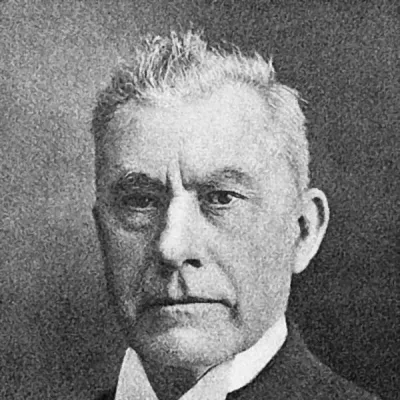
Martinus Beijerinck
Human Design Chart
Biography
He died 1 January 1931, aged 79, Gorssel, Netherland.
Martinus Beijerinck — Projector with Profile 3/5
Projector 3/5 — Design at a Glance
Martinus Beijerinck revealed himself as a system diagnostician with a focusing aura that worked like a bright flashlight, quickly identifying weaknesses in his surroundings. His design inclined him to swiftly recognize errors in others or structures. However, directly addressing these deficiencies often led to rejection, akin to shining bright light into another's face. Instead, Beijerinck was effective by radiating harmony through his own balance; this aura attracted others and invited them to inquire about his insights. His strategy involved waiting for an honest, respectful invitation rather than taking the initiative himself. As a Projector, he lacked a defined Sacral Center, meaning he had no constant intrinsic energy source available. This resulted in phases of high activity followed by necessary rest periods to prevent burnout. Living according to this mechanism rewarded him with success; deviations led sooner or later to his non-self theme of bitterness. Thus, his work was characterized by the balance between sharp diagnosis and patient expectation, supported by respectful pauses for energy conservation.
Emotional Authority
Martinus Beijerinck exhibited an internal decision-making structure that did not solidify at the moment of initial excitement or rejection. His design carried Emotional Authority, meaning his Solar Plexus Center was defined and served as the primary instance for crucial decisions - independent of all other defined areas in his chart.
This configuration marked him by a rhythmic emotional wave pattern. His perception of the world was always colored by his current mood state, which showed constant ups and downs. What appeared at one moment as profound insight or passionate conviction could look entirely different in the next with a change in vibration. Therefore, his immediate feeling was only a provisional snapshot, not yet the final truth.
Quick, spontaneous reactions to these initial impulses would often lead him astray. Instead, his mechanism required patience and conscious reflection on decisions. Only when the intense initial feelings subsided and an emotional distance set in did clarity arise for him. This process of maturation allowed him to look beyond the first impression and gain composure before initiating long-term steps that influenced his life course.
The 3/5 Profile — Martyr / Heretic
Martinus Beijerinck revealed himself as someone who acquired knowledge exclusively through personal experimentation. His design inclined him towards initially believing nothing, but testing everything himself. This attitude stemmed from his inner line of the experimenter, driving him to constant questioning and learning from failures. He not only accepted changes and crises as necessities but embraced them joyfully because he understood that decline often preceded a new rise.
This process of trial and error formed the basis for his role as hero and saviour in the outer line. His knowledge gained through experience attracted others; they sought him out to learn from his practical insights. Yet, this heroic role carried a specific dynamic: His ideas were only accepted if perceived as philanthropic or generally useful. If he failed publicly, it was painful because expectations of the perfect expert were high.
Thus, his design described a path from private experimentation to public service. He had to learn not to get stuck in old feelings or guilt but to react flexibly to crises. Only then could he develop philosophical and humanitarian ideas that served others. The tension between necessary failure in the private sphere and public expectations of the saviour shaped his essence significantly. He was a storyteller who presented rich practical experiences to solve other people's problems, always dependent on whether these solutions were deemed valuable for the general good.
Single Definition — Defined & Open Centers
Martinus Beijerinck revealed himself as someone with constant willpower and emotional depth who shaped his life self-determinedly. His defined Heart Center gave him the ability to control resources and reliably keep promises, creating trust. He preferred following his own rhythm rather than being guided by external expectations. This inner strength required discipline: impulsiveness could endanger his self-esteem, so he learned to use his power consciously and thoughtfully.
His actions were marked by emotional authority. The defined Solar Plexus Center meant that truth for him became visible only over time. He waited patiently until the emotional wave had run its course before making decisions. This pause allowed deep insights and prevented chaotic reactions to highs and lows of his mood. His emotions served as a compass for what was right, not as an immediate trigger.
Another driver was the pressure from his defined Root Center in conjunction with the Spleen Center (Root-Spleen Channel). This channel generated a constant survival and correction pressure driving him to rise materially and correct what did not work. It was existential energy preserving the life impulse.
At the same time, central areas were open and thus mirrors for the environment. The open G Center meant no fixed identity; he took directions from his surroundings and learned to be in the right place rather than imposing it himself. His open Sacral Center lacked a constant flow of energy making him vulnerable to exhaustion when taking on borrowed energy from others. Additionally, Head, Ajna, and Throat were open: He absorbed mental concepts and communication pressure from the environment instead of generating them himself. This required vigilance against conditioning influences on his health (open Spleen) and mental well-being.
Channels for community spirit and emotional clarity.
Martinus Beijerinck showed a dialectic between the urge for immediate experience and the need for emotional clarity. His design combined the impulsive desire to experience new things with the strategic ability to wait for the right invitation to engage in communities.
The channel of Recognition 41-30 drove him through restlessness and emotional waves. The pressure from the Root Center (Gate 41) generated fantasies about what could be, while the Solar Plexus Center (Gate 30) emotionally heated these desires. This created a strong desire for new experiences that had to be balanced with patience and waiting for his own emotional wave to make clear decisions.
At the same time, the channel of Community 37-40 shaped his social actions. He sought recognition in groups (Gate 37) and was ready to work but needed breaks and rewards (Gate 40). This channel required carefully tuned agreements; good deals did not happen spontaneously but through direct personal contacts and waiting for the right invitation. Thus, he built bridges between individuals to find an honorable place in the community based on mutual benefit rather than hierarchy.
Additionally, Gates like 36 (Crisis as Development), 11 (Visual Remembrance), and 58 (Joy of Experimentation) influenced him. This configuration promoted a stance using crises as cyclical movements for maturing through experience while visual analyses and experimental approaches perfected life. Martinus Beijerinck lived this balance: he let himself be guided by the desire for new things but acted only when emotional clarity and appropriate social embedding were given.
Tribal Circuitry — Circuit Signature
Martinus Beijerinck revealed a cyclical, wave-like energy reflecting on the past. His design connected Solar Plexus with Root Center through Channel 30-41 (Recognition) in the Sense-Making Circuit. This did not produce cold logic but emotional insights from past events. The intensity of this perception rose and fell like a wave; each cycle had a clear beginning, peak, and end. The goal was to find meaning behind occurrences and share these felt insights with the collective to learn together.
Parallel to this, the Ego Circuit worked through Channel 37-40 (Community). This connected Heart with Solar Plexus Center. Here it was not about individual identity but tribal dynamics: mutual support and a balanced give-and-take relationship (
Right Angle Cross of Eden 1
Martinus Beijerinck's design carried the signature of the Eden 1 Right Cross. This configuration established a specific inner dynamics that did not aim for external success or material validation, but rather towards a deep, often silent transformation through suffering and loss. The Eden 1 Right Cross describes a life path marked by the principle of 'losing' – not in the sense of failure, but as a necessary purification and liberation from what does not belong to one's true essence.
For Martinus Beijerinck, this meant that his design urged him to free himself from external bindings, illusions or unnecessary burdens to achieve a higher state of inner clarity and mental freedom. The path often led through phases of apparent loss, where the old died away so space could be made for something more authentic. It was not a battle against the world but rather a process of internal purification.
This mechanism worked as an ongoing background: every challenge or retreat served to detach him from the surface of everyday life and lead him into deeper levels of existence. His design did not demand holding onto possessions or status, but the ability to let go in order to find himself in his purest form. The focus was on inner transformation through letting go of the insignificant, which allowed him to develop a deep spiritual resilience that stood independent of external circumstances.
Saturn Return · Uranus Opposition · Chiron Return · 2nd Saturn Return — Life Cycles
Martinus Beijerinck's design could not be specifically characterized by the provided data as there were no Human-Design mechanics such as Gates, Channels or Centers present. The necessary structural information was missing to derive an inner orientation or typical behavioral patterns. Instead, only general astronomical transits were available: two Saturn returns, a Uranus opposition and a Chiron return. These cyclic markers are relevant for everyone but do not provide a statement about the unique functioning of an individual design without this context. The first Saturn return traditionally marked the transition into full responsibility while the second often coincided with a redefinition of structure. The Uranus opposition signaled a turning point of liberation or sudden change. The Chiron Return, which occurred roughly between the 49th and 51st year of life, did not represent in Human-Design terms a healing process of old wounds but rather a fulfillment cycle. During this phase, the incarnation cross unfolds increasingly if the person follows their strategy and authority. Meaning and purpose became experiential, not through overcoming pain but through the blooming of one's design. However, without specific HD elements present, this potential unfolding remained theoretical. Thus, Martinus Beijerinck was shown in this context as someone whose inner mechanism remained undetermined while external cyclic events marked the framework of his life.
Projector · Emotional Authority — Synthesis
Martinus Beijerinck was an observer whose strength lay in recognizing the potential and flaws in existing systems (Gate 11). This did not manifest as a direct drive for change but rather as a deep ability to perceive patterns and understand their effects – especially within the context of relationships and community (Channel 37-40). He was designed to act upon invitation, offering his knowledge when drawn into the right space. This passive stance allowed him to sense the dynamics of others and effectively communicate his insights without exerting active pressure.
A central paradox in his design lies in the interplay between emotional authority and an open G Center. While he underwent profound emotional processes to gain clarity (Solar Plexus), his identity was always malleable and open to external influences. This likely led to internal tension between a desire for emotional maturity and constant adaptation to the environment. He could form deep connections and foster community but remained an observer who did not fully fit into a fixed role.
2 Defined Channels
Incarnation Cross - Right Angle Cross of Eden 1
Solar Return
The Solar Return shows the moment when the sun returns to its exact birth position - your personal solar year.
Life Cycles
Discover the life cycles with a detailed triple view (birth chart, cycle chart, composite).
Human Design Profile
- Type
- Projector
- Strategy
- Wait for the respectful invitation
- Authority
- Emotional Authority
- Profile
- 3/5 - Martyr / Heretic
- Definition
- Single Definition
- Incarnation Cross
- Right Angle Cross of Eden 1
- Date of Birth
- 16.03.1851 10:00
- Place of Birth
- Amsterdam, Netherlands
Frequently Asked Questions
What is Martinus Beijerinck's Human Design type?
What Profile did Martinus Beijerinck have?
What Authority did Martinus Beijerinck have?
What incarnation cross did Martinus Beijerinck have?
When was Martinus Beijerinck born?
Discover your own Human Design
Are you also a Projector? Find out in a personal reading how to unfold your leadership qualities and recognize the right invitations.
More Personalities
Back to overviewSissy Spacek

Alain-Fournier

Anémone

Ann-Margret

Bourvil
Hergé