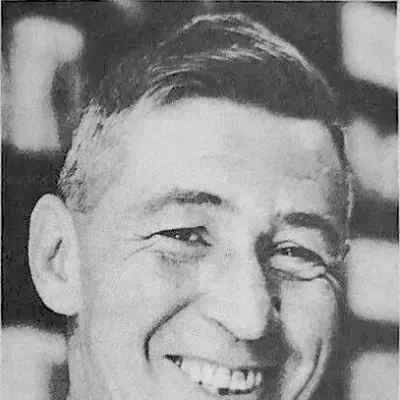
Maurice Ewing
Human Design Chart
Biography
During his career he published over 340 scientific papers. He served as president of the American Geophysical Union and the Seismological Society of America. He led over 50 oceanic expeditions. He made many contributions to oceanography, including the discovery of the SOFAR Channel, the invention of the sofar bomb, and did much fundamental work on plate tectonics.
Maurice Ewing married three times and had five children. He died of a stroke on 4 May 1974 at age 67 in Galveston, Texas.
Maurice Ewing — Projector with Profile 3/5
Projector 3/5 — Design at a Glance
Maurice Ewing revealed himself as someone who could immediately identify weaknesses in systems and relationships. His Projector design gave him a dense, focused aura that acted like a bright flashlight: it illuminated precisely those areas in his surroundings that were still in the dark or not functioning optimally. This ability to pinpoint errors in the system was his natural drive.
However, this sharpness required a specific approach. If he addressed his observations directly and abruptly, he often met resistance, as if he were shining a light directly into someone's face. A more effective strategy involved attracting others through his own harmony and competence. When he set a functioning example, people sought him out for advice. His main task was therefore to wait for a respectful and honest invitation before bringing his leadership skills into play.
Since his Sacral Center was undefined, he lacked a constant, intrinsic energy source. Instead, he went through phases of high activity followed by necessary rest periods to avoid burnout. The traditional work model, which demands constant performance, conflicted with his need for recovery. Living by this rhythm and waiting for the invitation led to success. Ignoring this dynamic and acting on his own initiative without an invitation eventually led to his Non-Self theme: bitterness.
Splenic Authority
Maurice Ewing relied on his fine, spontaneous inner knowledge for orientation. His inner authority lay in the Spleen Center, which functions as a health and alarm system. For this authority to be effective, his Emotional and Sacral Centers needed to be open. This configuration gave him a pronounced survival intelligence that showed as immediate intuition whether a situation, environment, or society was suitable for him.
His decisions arose in the moment. The first impulse was the reliable indicator of his physical well-being and health. This allowed Maurice Ewing to rigorously take care of himself and effectively shield himself from harmful influences. Since this Spleen impulse was very subtle and only occurred once in the moment, his lifestyle required high vigilance to not miss it. A short retreat often helped him to hear this fine voice clearly.
Since he only knew what was right in the moment, his plans changed frequently. Long-term commitments were challenging for his design. He needed a lot of freedom and flexibility to do justice to this spontaneous nature. Rather than setting himself, he preferred to act situationally, which allowed him to always adapt to the current circumstances and protect his health.
The 3/5 Profile — Martyr / Heretic
Maurice Ewing was someone who learned through personal experimentation and later provided this practical knowledge to others. His 3/5 Profile, the 'Explorer/Hero', established an initial skepticism towards pre-fabricated doctrines. Line 3 of the Explorer drove him to experience things firsthand and make mistakes to gain real insights. This process of trial and error was essential for him, as it was the only way to build credibility.
Later, Line 5, the Hero Line, came into play as he presented these accumulated experiences as practical solutions. Others saw him as an authority capable of taking action in crisis situations. Particularly relevant was the theme of organization and distribution of resources, as suggested by the specific themes of Line 5. Maurice Ewing learned that his attractiveness to others was strongly linked to his ability to solve complex problems through personal experience. Failure was not an end but a necessary step in the learning process, which later enabled him to act as a rescuer or advisor. His path was marked by the necessity to prove himself through his actions before being recognized as competent by others.
Single Definition — Defined & Open Centers
Maurice Ewing was characterized by a persistent, specific mental function resulting from the definition between Head and Ajna Centers. This channel created a constant pressure to ask questions and form concepts, making him a source of inspiration for others. However, since Head and Ajna do not have direct energy for implementation, it was crucial for him not to transform this mental pressure into hasty actions but to exercise patience until ideas met a receptive environment. His defined Throat Center allowed him to articulate these mental concepts reliably and clearly.
At the same time, his defined Spleen Center acted as an intuitive authority in the here and now. It provided spontaneous, non-rational signals and judgments about health and well-being, which he had to trust without intellectual questioning. This created a balance between the loud, constant mental activity and the quiet, momentary body intelligence.
In contrast, Maurice Ewing was vulnerable to external conditioning through several open centers. His open G Center meant that he did not have a fixed, unchanging identity but reflected in relationships and environments. He tended to question whether he was in the right place and sought security through the reflection of others' identities. A wrong place or an unsuitable environment could deeply unsettle him, as he could not serve as a stable anchor for himself.
Furthermore, his open Solar Plexus absorbed the emotions of his surroundings. He amplified foreign feelings and could experience them as his own, leading to inner confusion if he did not let these waves go. His open Heart Center made him sensitive to the pressure to prove his worth. He was not designed to possess willpower in the sense of assertive ego but learned to avoid promises given out of the need to be recognized. Finally, his open Root Center took on the stress and adrenalized pressure of the world, which could make him overly active to escape this pressure rather than recognizing it as an external factor.
Channels for structure, logical doubt and intuitive experiments.
Maurice Ewing was characterized by a mind that used skepticism as an essential tool to filter patterns and seek verifiable truths. This attitude was shaped by the Logic Channel 63-4, which combined doubt with the ability to formulate. For him, an answer was only valid if it was logically consistent and practically applicable; unfounded belief had no place here. His mental work served the collective by asking questions that demanded answers and always oscillating between question and solution.
Alongside this analytical sharpness, Maurice Ewing possessed the capacity to translate intuitive depth into precise skills. The Wave Channel 48-16 connected his inner, mind-unfathomable intelligence with the dexterity to perfect techniques through repeated practice. This was not a superficial talent but a process of refinement that required recognition and resources to express his unique wavelength. He sought life-critical information and transformed it into mastery through dedication.
Furthermore, Maurice Ewing had the gift of clearly and efficiently communicating innovative perspectives. The Structure Channel 23-43 enabled him to formulate spontaneous insights in a way that changed others' thinking. His challenge lay in letting go of control and allowing his mind to process knowledge at its own pace rather than planning it in advance. When his timing was right, his unique knowledge was accepted and contributed to evolutionary development.
Additionally, Gate 49 with its emotional wave and the principle of sacrifice, Gate 61 with the pressure for individual, mutative truth, and Gate 35 with the drive for change through experience were at work. Gate 17 promoted logical teaching for the future, Gate 8 the contribution to the group, and Gate 45 the expression of hierarchy and possession at the tribal level. These configurations together shaped his specific potential for synthesizing logic, intuition, and innovative communication.
Collective Circuitry — Circuit Signature
Maurice Ewing was characterized by a clear, structured way of translating complex thoughts into understandable language. His design connected the Ajna Center with the Throat Center through the Structure Channel. This allowed him to precisely formulate inner concepts and carry them outward.
In the Understanding Circuit, two separate segments were at work. On one hand, the Logic Channel connected the Head Center with the Ajna Center. Here, a direct connection arose between spontaneous impulses and analytical processing. Maurice Ewing used this energy to logically order information and think strategically. On the other hand, the Wave Channel connected the Throat Center with the Spleen Center. This linked his expression with the ability to recognize the essential and practical. He could thus not only theorize but also share applicable knowledge.
As a simple definition, these energies worked together. The connection of Head, Ajna, Throat, and Spleen created a continuous flow from inspiration through analysis to practical expression. Maurice Ewing lived this tendency to communicate rational insights clearly and focused. His structuring ability helped him not only to understand new connections but also to make them accessible to others.
Right Angle Cross of Explanation 2
Maurice Ewing revealed himself through a profound inclination to unravel complex connections and share this clarity with others. His design was marked by the dynamics of the right cross of the explanation, a configuration suggesting a strong ability to analyze and penetrate illusions. This did not merely imply passive understanding but an active impulse to pour learned knowledge into understandable forms.
This mechanism links intellectual sharpness with the gift of communication. Those who carry this structure tend to organize confusion and prepare insights in such a way that they become accessible to their environment. It was a life task to uncover hidden truths and pass them on to others without falling into pure theory. The energy of this configuration demanded a synthesis of deep reflection and clear communication. Maurice Ewing lived this tension between recognizing and explaining, focusing on transforming complex realities into tangible insights. This shaped his way of handling information: not as isolated knowledge but as a tool for shared orientation. The structure of his design suggested that his greatest impact was achieved when he made the invisible visible and the hidden understandable.
Saturn Return · Uranus Opposition · Chiron Return · 2nd Saturn Return — Life Cycles
Maurice Ewing showed himself as someone who experienced his professional positioning and recognition in clear, cyclical phases that corresponded with his planetary transits.
In 1947, at the age of 41, Ewing became a professor. This fell during the Uranus opposition, a point where sudden changes or new freedoms often manifest in life paths. For him, it marked the transition into higher academic responsibility, driven by an inner urge for expansion and redefinition of his role.
Ten years later, in 1957, he received the William Bowie Medal. At 51 years old, he was in his Chiron return, a fulfillment cycle where the personal incarnation cross unfolds. This recognition was no coincidence but an expression of his life purpose increasingly finding meaning and recognition. It was a blooming period when his work reached its full significance.
In 1963, at 57 years old, the John J. Carty Award followed. This occurred during the second Saturn return, a phase of consolidation and serious reflection on one's path. The award confirmed the sustainability of his previous achievements and anchored his reputation sustainably. Maurice Ewing lived this mechanism: Through structure and time, his work matured into recognized results that found their visible form in these specific life phases.
Projector · Splenic Authority — Synthesis
Maurice Ewing was a projector, whose life was marked by a deep drive to recognize and question patterns (Channel 63-4). This ability to see what is not functioning was, however, always accompanied by an inner pressure to find answers and formulate them – a constant struggle between doubt and clarity that shaped his mental focus. Through the line 3 in the profile, he experimented, tested, and gathered life experiences to later, as a hero and savior (line 5), share his knowledge and help others.
A central paradox lay in the way he perceived and interacted with his environment. On one hand, he possessed the ability to shed light into the dark through his focusing aura and reveal weaknesses, on the other hand, his Spleen authority required an instinctive boundary setting and the preservation of his own well-being. This led to a tension between the desire to serve others and protect his own health, which manifested in recurring successes and recognitions, but also in cycles of Uranus oppositions and Saturn returns.
3 Defined Channels
Incarnation Cross - Right Angle Cross of Explanation 2
Solar Return
The Solar Return shows the moment when the sun returns to its exact birth position - your personal solar year.
Life Cycles
Discover the life cycles with a detailed triple view (birth chart, cycle chart, composite).
Human Design Profile
- Type
- Projector
- Strategy
- Wait for the respectful invitation
- Authority
- Splenic Authority
- Profile
- 3/5 - Martyr / Heretic
- Definition
- Single Definition
- Incarnation Cross
- Right Angle Cross of Explanation 2
- Date of Birth
- 12.05.1906 21:00
- Place of Birth
- Lockney, TX, United States
Frequently Asked Questions
What was Maurice Ewing's Human Design type?
What Profile did Maurice Ewing have in Human Design?
What Authority did Maurice Ewing have?
What incarnation cross did Maurice Ewing have?
When was Maurice Ewing born?
Discover your own Human Design
Are you also a Projector? Find out in a personal reading how to unfold your leadership qualities and recognize the right invitations.
More Personalities
Back to overviewSissy Spacek

Alain-Fournier

Anémone

Ann-Margret

Bourvil
Hergé