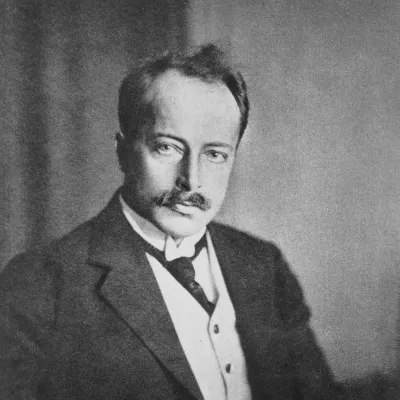
Max von Laue
Human Design Chart
Biography
Died on 24 April 1960 Berlin, Germany.
What does Generator 1/3 mean for Max von Laue?
Generator 1/3 — Design at a Glance
Max von Laue revealed himself as someone with immense endurance whose strength came from within. As a Generator, he had abundant sacral energy that made him extremely strong and resilient – provided he had the energy for his task. However, his design was marked by two specific pitfalls: He tended to burn out when doing things he didn't enjoy, thus wasting his power. Equally frustrating was being prevented from working on his heart project despite still having plenty of power left.
The way his energy worked differed fundamentally from mere initiating. His sacral center's energy became free mainly when reacting to impulses. Not initiating but responding was the motto for him. His most successful strategy involved waiting for a signal from life and then, when his inner voice said “Yes! Let’s go!” he would act accordingly. When Max von Laue used his energy in harmony with this design, nothing could stop him. He was rewarded with a deep sense of fulfillment. If he didn’t live by this principle – such as constantly initiating himself – he sooner or later faced persistent frustration and a lack of energy. His path therefore led through waiting for the inner impulse to then act powerfully.
Emotional Authority
Max von Laue lived with an emotional authority, meaning his defined Emotional Center carried his internal decision-making power. This configuration was subject to a constant wave of emotions; the world appeared colored by the current mood state. A momentary state of enthusiasm could turn into deep skepticism in the next instant as feelings were merely provisional snapshots and not necessarily reflecting deeper truths.
Quick, spontaneous decisions based on such emotional impulsivity often had negative effects for him. Instead, his mechanics required patience and time. He let decisions mature, slept over them multiple times, and sought emotional distance. Only when intense emotions subsided did clarity and calm set in. This process was especially crucial for long-term life decisions.
A key mechanism of his inner authority was its absolute priority: Whenever the Emotional Center was activated, it exercised decision-making power – regardless of which other centers were also defined in his design. This prioritization rule protected him from impulsive mistakes and promoted a deeper, time-matured understanding before acting.
The 1/3 Profile — Investigator / Martyr
Max von Laue's design tended towards a dual approach: he was a Researcher who combined theoretical knowledge with practical application. His Profile 1/3 described him as someone who both wanted to learn (Line 1) and experiment (Line 3). This pattern characterizes people who advance through trial and error.
Line 1 brings deep intuition but can also lead to confusion if one feels they don’t know enough yet. This uncertainty might have prompted Max von Laue to carefully plan before acting. Simultaneously, Line 3 drove him to try things out and learn from mistakes. For him, it was important to test insights both theoretically and practically.
When Max von Laue deemed something right, he had thoroughly investigated it beforehand. His judgment was based on a combination of intuition and experience. Line 3 learns through conflicts and challenges while Line 1 seeks clarity. This dynamic led him to carefully weigh his insights before sharing them.
Max von Laue's path was marked by the search for hidden connections and the need to convey these in ways others could understand. His ability to make complex topics accessible stemmed from his own experience with learning and experimenting. Through this process, he developed a deep understanding of the subject matter based on solid foundations of theory and practice.
Split Definition — Defined & Open Centers
Max von Laue was marked by a design that combined mental intensity with vital endurance. His defined Head and Ajna Centers generated a constant internal pressure to question, understand conceptual connections, and develop ideas. This continuous thought process was not a choice but a mechanical given: He lived in a state of ongoing inspiration, which often felt like mental worry or confusion as ideas constantly formed questions before providing answers. This intellectual energy flowed directly into his defined Throat Center, enabling him to articulate his thoughts and theories reliably. His voice served as the transmission organ for what his mind conceptualized.
At the same time, Max von Laue had a defined Sacral Center, the motor of his generative energy. As a Generator, his strategy was not to initiate but to wait for environmental stimuli and react accordingly. Only through an affirming sacral response – that inner "Mmmh" or "Hmmm" – did he have the necessary strength to turn his mental concepts into action. Without this reaction, every action led to frustration and exhaustion. His defined Solar Plexus Center functioned as internal authority; he needed time to gain emotional clarity before making important decisions. Impulsive reactions to the highs or lows of his emotional wave would be misleading.
In contrast, his G-, Heart, and Spleen Centers were open. The open G Center meant that he did not have a fixed, unchanging identity but changed according to environment and relationship partners. He tended to question whether he was in the right place or who he actually was when not initiated by the correct environment. His open Heart Center made him vulnerable to the urge to prove his worth through willpower – a trap he had to avoid by not giving promises out of pure egoism. His open Spleen Center left him sensitive to health and well-being but also vulnerable to fears about survival or inadequacy. Spontaneous decisions were risky here; he learned to use his intuition without misusing it as the sole basis for decision-making. This configuration prompted him to let patience prevail: enduring mental pressure, waiting for the right reaction, and awaiting emotional clarity rather than losing himself in a search for identity or recognition.
Channels for intimacy, acceptance, clarity and maturation.
Max von Laue revealed himself through a deep connection with the process of experiencing and the wisdom that results from it. His design was marked by the Channel of Maturation 53-42, which propelled him to complete experiences and then reflect on them in order to uncover their value for the collective. This cyclical nature of his energy required patience; he did not seek quick results but rather the depth that only comes with completing cycles.
Parallel to this, the Channel of Awareness 61-24 influenced his mental structure. This channel connected Gate of Secrets (61) in the Head Center with Gate of Rationalizing (24) in the Ajna Center. He received spontaneous inspirations or "Satori" moments that he could not control but rather surrendered to. His mind worked on translating these sudden insights into rational answers, often accompanied by a need for silence to filter out the mental noise of inspiration.
In interpersonal relationships, the Channel of Pairing 59-6 shaped his interactions. Through the connection between the Sacral Center (Gate 59) and the Solar Plexus Center (Gate 6), he sought intimacy that required time to develop. His emotional wave determined the timing of his closeness; he had to wait until clarity about relationships emerged, as premature approaches often led to misunderstandings. True connections arose for him only through patience and nurturing friendships before deeper intimacy.
Furthermore, the Channel of Accepting 17-62 organized his thought world. Gate of Opinions (17) visualized patterns while Gate of Details (62) translated these into language and logic. Max von Laue had a constant need to mentally organize information and logically present it. He found satisfaction in explaining complex connections in detail, provided he was invited or if his timing aligned with the receptiveness of his listeners.
Individual Gates like 57 (intuitive clarity), 51 (willpower) and 54 (ambition/spirituality) rounded out this picture by giving him intuitive certainty in the present moment as well as the potential to connect worldly success with mystical insight. Gate 33 furthered the necessary reflection after each cycle, while Gate 63 utilized doubt as a driver for logical improvement.
Collective Circuitry — Circuit Signature
Max von Laue's Human Design shows itself through separate, parallel operating energetic poles. One group connected the Solar Plexus, Sacral, and Root Centers; the other connected the Head, Ajna, and Throat Centers. These areas did not flow into one another but existed as independent energy fields.
In the Knowledge Circuit, Channel 24-61 (Awareness) linked the Head Center with the Ajna Center, promoting innovative flashes of insight and the search for hidden truth. Parallel to this, in the Understanding Circuit, Channel 17-62 (Acceptance) connected Ajna and Throat Centers. This was about logical, rational thinking and sharing these insights free from conditioning. Both circuits utilized the same Head-Ajna-Throat axis but with different focuses: once inspired-creative, once structured-rational.
Completely separate from this, the Purpose Circuit operated. Channel 42-53 (Maturation) connected Sacral and Root Centers. This energy was cyclical and dealt with emotions from the past to learn collectively from them. Finally, the Protector Circuit acted through Channel 6-59 (Coupling), linking the Sacral Center with the Solar Plexus Center. This involved primal instincts for protecting and preserving family and one's own genetics.
Thus, Max von Laue lived with two clearly separated systems: a rational-creative Head area and an emotional-instinct-driven body area that coexisted side by side without directly merging.
Right Angle Cross of Penetration 3
Max von Laues Human-Design profile was characterized by the presence of the right cross of penetration. This configuration connected logical thinking energy with the power of emotional intuition and a drive for deep transformation in his system. It was a rare arrangement that fostered a specific kind of clarity: the ability to penetrate complex relationships not just intellectually, but also experience these insights with a certain inner certainty and emotional depth.
This cross acted as an integrative principle in his psyche. It allowed him to connect rational structures with intuitive leaps, often leading to a unique understanding of problems that went beyond pure analysis. The energy of this configuration promoted a stance of deep penetration, where superficial explanations were not enough. Instead, his mind sought the underlying patterns and essences of things. This inner dynamic shaped how he understood the world: less through mere fact collection, but by recognizing connecting lines between seemingly separate areas. It was a structure that aimed at quality of insight rather than quantity and helped him maintain an internal orientation in moments of uncertainty based on a synthesis of mind and feeling.
Saturn Return · Uranus Opposition · Chiron Return · 2nd Saturn Return — Life Cycles
Max von Laue showed himself to be someone whose inner structure sought a deep connection with scientific communities and intellectual networks. His design suggested that recognition by established institutions was not just prestige for him, but also a moment of validation of his own authority. This became evident in 1926 when he joined the Leopoldina. At age 47, he entered the period of his Chiron Return (around ages 49–51), a cycle where one's incarnation cross unfolds and meaning becomes tangible. His acceptance into this ancient academy marked the beginning of this flourishing phase, in which his life purpose increasingly took visible form.
Later, at age 59 in 1938, he began exchanging letters with Lise Meitner. This fell during his second Saturn Return (around ages 57–60). This cycle often condenses years of groundwork into solid results and demands a reordering of one's position. The contact with Meitner was not an accidental event but corresponded to the mechanical necessity of this phase: deepening specific relationships based on shared intellectual grounds provided him with the stability required for this life stage. His interactions were marked by a search for resonance in professional circles, reflecting his inner architecture—a focus on structured exchange and recognized expertise.
Generator · Emotional Authority — Synthesis
He was a Generator whose life was marked by profound, sacral energy. This force fueled an unceasing quest for knowledge and experience—a Research-Experimentor Profile (1/3), driven constantly to inspiration through the defined Head Center (Channel 1-8). He lived out the necessity of not just grasping things theoretically but validating them through his own actions and experimentation, committing himself to always forging new paths (Knowledge Circuit). Emotional authority also required time for decision maturation, an inner process that interacted with sacral energy and helped him find authentic answers to his internal question about the right path.
A central tension field lay in the combination of his investigative nature and emotional wave. While the profile pushed him towards experimentation, emotional authority demanded patience and waiting for clarity. This dynamic led him to oscillate between the need for immediate exploration and the necessity of letting decisions mature—a interplay that through the Channel of Union (59/6) gained intense emotional depth and brought him into relationships marked by personal significance.
4 Defined Channels
Incarnation Cross - Right Angle Cross of Penetration 3
Solar Return
The Solar Return shows the moment when the sun returns to its exact birth position - your personal solar year.
Life Cycles
Discover the life cycles with a detailed triple view (birth chart, cycle chart, composite).
Human Design Profile
- Type
- Generator
- Strategy
- To respond - wait for something to respond to
- Authority
- Emotional Authority
- Profile
- 1/3 - Investigator / Martyr
- Definition
- Split Definition
- Incarnation Cross
- Right Angle Cross of Penetration 3
- Date of Birth
- 09.10.1879 09:30
- Place of Birth
- Pfaffendorf (Koblenz), Germany
Frequently Asked Questions
What was Max von Laue's Human Design type?
What Profile did Max von Laue have?
What Authority did Max von Laue possess?
What incarnation cross was assigned to Max von Laue?
When was Max von Laue born?
Discover your own Human Design
Are you also a Generator? Find out in a personal reading how to use your sacral energy correctly and discover deep satisfaction.
More Personalities
Back to overviewAaliyah

Alexia

Angèle

Anne-Marie

Arcángel
Arno