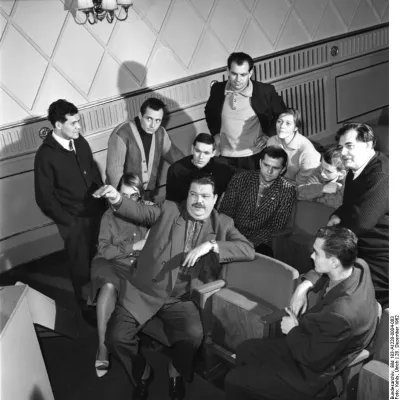
Maxim Vallentin
Human Design Chart
Biography
Maxim Vallentin was a son of the actor Richard Vallentin (1874-1908) and the actress Elise Zachow-Vallentin (1876-1923). Ruth Cidor-Citroën (1906-2002), a textile artist trained at the Bauhaus, was a cousin. He took acting lessons at a Berlin drama school in 1921, then worked as an actor at the theatre under well-known directors such as Leopold Jeßner and Max Reinhardt.
Maxim Vallentin died in Berlin on 2 September 1987 at age 82.
Maxim Vallentin — Projector with Profile 1/3
Projector 1/3 — Design at a Glance
Maxim Vallentin revealed himself as someone who appeared with an intense, focused aura, directing it like a bright flashlight onto weaknesses in his surroundings. His Projector design marked him by his ability to instantly recognize where systems or people were not functioning optimally. This sharp perception could, however, be uncomfortable when he addressed these flaws directly, often triggering resistance. Instead, he was most effective by setting a harmonious example himself; his radiant example drew others to seek his advice. His strategy was to wait for an honest invitation before sharing his knowledge. With his undefined Sacral Center, Maxim Vallentin lacked constant life energy. He experienced phases of high productivity, followed by necessary rest periods to avoid burnout. The conventional work life rarely fit this rhythm. Living by this pattern rewarded him with success. Ignoring his nature and acting without invitation or pause led to bitterness as an expression of his non-self. His path lay in shining patiently and guiding others rather than instructing them.
Splenic Authority
Maxim Vallentin revealed himself as someone who did not make decisions through prolonged thought or emotional deliberation but through an immediate, physical impulse. His design inclined him towards spontaneous, instinctive orientation, closely linked to his well-being. This resulted from his inner authority in the Spleen Center, a center that functions as a health and alarm system. With his open Emotional and Sacral Centers, he possessed this specific survival intelligence, allowing him to instantly sense whether a situation or environment was right for him.
This first, spontaneous impulse served directly his health and enabled him to rigorously shield himself against harmful influences. However, this Spleen voice was a very fine impulse that only appeared once in the moment and could easily be drowned out by other influences. Therefore, his decision-making required high vigilance; a brief retreat could be helpful to listen to these subtle signals. Only in the moment did he know what was right for him, making his plans often change at short notice. This made long-term commitments difficult, so he needed much space and flexibility in his life to accommodate this spontaneous nature.
The 1/3 Profile — Investigator / Martyr
Maxim Vallentin revealed himself as someone who did not just collect knowledge theoretically but validated it through direct practical experience. His design as Profile 1/3, the Researcher and Experimenter, established a fundamental approach based on the principle of trial and error. Line 1 drove him to initially delve deeply into learning and intuitively orient himself, with confusion often serving as a necessary precursor for clear insights. However, this preparatory phase could become a block if the fear of insufficient knowledge prevented implementation. Here came the energy of Line 3 into play, forcing him to act and learn through mistakes. For Maxim Vallentin, the combination of theoretical examination and practical experimentation was crucial. Only through this process of self-examination did reliable judgments emerge. If he valued something as good, he had previously tested it both intellectually and physically. His path lay in holding the tension between the need for complete information and the urge for experimental action to arrive at an authentic, tested clarity.
Single Definition — Defined & Open Centers
Maxim Vallentin revealed himself through a consistent, reliable expression and a deep trust in his momentary intuition. His defined Throat Center allowed him to communicate clearly and authentically, while his defined Spleen Center gave him a fine sense of health and well-being. This configuration allowed him to make spontaneous judgments and live in the present without being distracted by excessive rationality.
At the same time, Maxim Vallentin was exposed to several open centers, making him vulnerable to external influences. His open Head Center occasionally overwhelmed him with mental pressure and doubts that did not originate from his own thoughts. He tended to question whether he had the right answers, although this uncertainty often only reflected what others were seeking. His open Ajna Center reinforced this tendency by allowing him to take in concepts and theories without identifying them as personal truth. This sometimes led to confusion when he tried to solve problems that were not his own.
His open G Center meant that he did not have a fixed identity or direction but oriented himself in his environment. He sought places and relationships that gave him a sense of belonging and avoided getting stuck in false environments. His open Heart Center made him sensitive to questions of self-worth and willpower, where he had learned not to prove himself through promises. His open Sacral Center led to him taking in energy from his environment, which sometimes left him exhausted if he did not pay attention to his limits. Finally, his open Solar Plexus absorbed the emotions of others, making him vulnerable to emotional waves that he did not always recognize as foreign. His open Root Center also absorbed external stress, which he often misinterpreted as his own pressure. Through recognizing these mechanisms, Maxim Vallentin learned to free himself from conditioned reactions and trust his inner authority.
Channels for intuitive perception and skillful expression.
Maxim Vallentin revealed himself through a deep, instinctive search for the essential, paired with the drive to master skills through constant practice. This resulted from the Channel of Wave Length 48-16, which connected the Spleen Center with the Throat Center. Gate 48, the Gate of Depth, provided an inner intelligence that could not be grasped by the mind but was only accessible through tuning into the natural instincts of the body. Gate 16, the Gate of Dexterity, attracted new possibilities for experimentation and perfected them step by step. Through the combination of intuitive depth and technical mastery, Maxim Vallentin transformed mere dexterity into talent. This process, however, required engagement and repetition; mastery was achieved through refining a pattern, which often took a lifetime to express one's unique wave length.
Additionally, Gate 57, the Gate of Intuitive Clarity, shaped his consciousness. As a complex Spleen Gate with six channels in the network, it promoted survival and intuition through clarity in the here and now, acted as an integration gate, and connected to the perception of the right ear. Gate 51 gave him a strong will without social ties, enabled reactions to shocks through insight, and offered a potential between competitive and mystical action. Gate 53 drove him as a pioneer to take new paths and leave old ones behind, where the lack of a conclusion could lead to depression. Gate 54 linked worldly success with spiritual development, where a partner or 'buddy' supported this development. Gate 44 ensured awareness and readiness in dealing with resources, while Gate 45 gathered energy at the tribal level and expressed willpower in material life.
Collective Circuitry — Circuit Signature
Maxim Vallentin revealed himself through a precise, rational thought process aimed at improving things and guiding society towards a better future. His design was marked by a 'Simple Definition', meaning his energetic forces worked in a coherent flow without internal contradictions or separate poles.
This flow ran exclusively through the Understanding Circuit. In Maxim Vallentin's case, the specific 'Wave Length' (Channel 16-48) was active. This channel connected his Throat Center with the Spleen. The Throat Center stood for the ability to communicate thoughts and strategies outward and put them into action. The Spleen represented intuitive perception, detailed knowledge, and the ability to filter the essential from chaos.
Through this connection, Maxim Vallentin could share logical, rational insights free from emotional conditioning. It was an 'emotionless ratio' based on focus, structure, and strategy. The energy flowed directly from the intuitive perception in the Spleen to the expressive capability in the Throat Center. This allowed him to formulate and share clear visual and strategic concepts with others. Since no other centers or circuits were defined, his entire energetic orientation focused on this one coherent line of understanding and sharing.
Right Angle Cross of Penetration 3
Maxim Vallentin revealed himself through a profound, often unconscious urgency to bring things to a point. His design was marked by the energy of the right cross of penetration 3, a configuration aiming for direct, cutting clarity. This mechanism acted like an inner compass, urging him to not only see through complex situations but to penetrate them with precise, almost surgical accuracy. It was not about superficial speed but the ability to grasp the core of an issue immediately and address it without delay.
This energy fostered a kind of intuition that did not rely on logical reasoning but on an immediate, almost visual understanding of the truth. Maxim Vallentin lived with the inclination to break through obstacles or confusion rather than circumvent them. This could be perceived in his environment as decisive, sometimes sharp presence. The underlying dynamics of this cross configuration supported him in drawing a clear line in moments of uncertainty and initiating actions focused on the essential. His way of encountering the world was thus defined by this specific penetration force, allowing him to act quickly and accurately rather than getting stuck in endless deliberations.
Saturn Return · Uranus Opposition · Chiron Return · 2nd Saturn Return — Life Cycles
Maxim Vallentin showed himself as someone who sought structural clarity under extreme pressure. His design inclined him to use crises as catalysts for necessary decisions. This became evident in 1933, at the age of 29, when he left Germany and fled to the Soviet Union. This first Saturn Return marked the transition from theoretical confrontation to existential reality; years of groundwork condensed here into a viable, though painful, life decision.
Later, a new pattern emerged: taking responsibility for cultural spaces. In 1952, at 48 years old, during his Chiron Return, he took over the leadership of the East Berlin Maxim Gorki Theater. This cycle, which unfolded between the ages of 49 and 51, is not a process of wound healing but of fulfillment. If Maxim Vallentin had lived according to his strategy and authority up to this point, his incarnation purpose now became experiential. The theater leadership was no coincidence but the concrete embodiment of his life's meaning: creating a place where artistic visions were structurally anchored. The Chiron Return thus confirmed that his previous steps did not stand in isolation but led to this point of flourishing and purpose.
Projector · Splenic Authority — Synthesis
Maxim Vallentin was a projector whose life was marked by a deep drive for knowledge and the ability to recognize hidden patterns. His profile as a researcher and experimenter (1/3) points to a person who did not passively absorb knowledge but validated it through personal experiences and trials. This curiosity was combined with the inner authority of the Spleen Center, which gave him a fine instinct for recognizing healthy or harmful environments – an inner navigation system that helped him orient himself in complex situations. The defined Throat Channel, particularly the Channel of the Wave Length (16/48), enhanced this ability by allowing him to communicate deep insights and point out opportunities for improvement.
A central paradox in his design lay in the combination of the projection power and the need to listen to the Spleen intuition. As a projector, he possessed the gift of recognizing the potential and weaknesses of others, yet the spontaneous impulse of the Spleen Center urged him to not speak these insights recklessly. Instead, he lived a tension between the desire to share his knowledge and the wisdom of waiting for the right moment – a dance between pointing out solutions and protecting his own energy. The crises and career peaks marked by the Saturn Return and Chiron Return underscore this dynamic.
1 Defined Channel
Incarnation Cross - Right Angle Cross of Penetration 3
Solar Return
The Solar Return shows the moment when the sun returns to its exact birth position - your personal solar year.
Life Cycles
Discover the life cycles with a detailed triple view (birth chart, cycle chart, composite).
Human Design Profile
- Type
- Projector
- Strategy
- Wait for the respectful invitation
- Authority
- Splenic Authority
- Profile
- 1/3 - Investigator / Martyr
- Definition
- Single Definition
- Incarnation Cross
- Right Angle Cross of Penetration 3
- Date of Birth
- 09.10.1904 05:30
- Place of Birth
- Berlin-Wilmersdorf, GER
Frequently Asked Questions
What was Maxim Vallentin's Human Design type?
What profile did Maxim Vallentin have?
What authority did Maxim Vallentin have?
What incarnation cross did Maxim Vallentin have?
When was Maxim Vallentin born?
Discover your own Human Design
Are you also a Projector? Find out in a personal reading how to unfold your leadership qualities and recognize the right invitations.
More Personalities
Back to overviewSissy Spacek

Alain-Fournier

Anémone

Ann-Margret

Arletty

Arno