
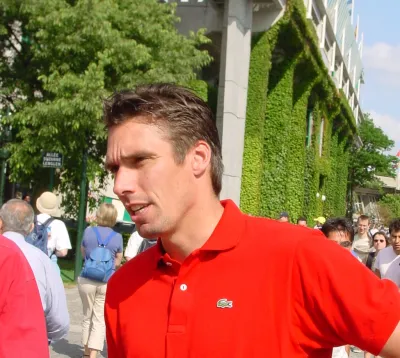
Michael Stich
Human Design Chart
Biography
The Human Design of Michael Stich: Generator 5/2
Generator 5/2 — Design at a Glance
Michael Stich's design showed a tendency towards great endurance and almost inexhaustible work capacity. As a Generator, he had plenty of sacral energy that made him seem like a strong working horse – provided this power was used for tasks he truly enjoyed. His system was designed to function not through spontaneous initiative but by reacting to external impulses. The motto 'Not initiate, but react' defined his optimal approach: He waited for a signal from the environment and then responded with action as soon as his inner self sent out a clear 'Yes! Let's get started!' message.
This strategy was crucial for his well-being. If he followed this inner guidance, his design rewarded him with deep feelings of satisfaction and fulfillment. Conversely, two specific pitfalls threatened: Either he spent energy on things without internal desire, leading to burnout, or he was prevented from continuing work on his heart project despite still having plenty of power left. If he did not live by this pattern and instead constantly tried to initiate himself, sooner or later he would encounter persistent frustration and a lack of energy. His success therefore directly depended on how well he learned to react instinctively to life.
Sacral Authority
Michael Stich's design showed a tendency towards making decisions through immediate physical resonance with external stimuli rather than planning in the head. As a Generator, he had sacral authority, meaning his strategy and inner guidance were identical: waiting for the right impulse. This configuration fundamentally simplifies the decision-making process as no intellectual weighing is necessary; only the perception of bodily signals is required.
A prerequisite for this clear guidance was an open emotional center, ensuring that no emotional waves overlapped with the sacral response. His authority manifested as a gut feeling or surge of energy – audible through sounds like 'Mhm' or 'Hmm', felt as sudden vitality and inexhaustible power. If the impulse was positive, he dove into activity with great enthusiasm without needing an external goal; the joy in doing sufficed.
Additionally, activated spleen center authority supported him. This gave him the ability to react extremely quickly and spontaneously. He had direct access to his instinctive perception and physical well-being, guiding him reliably. This combination of sacral endurance and spleen-induced speed characterized his actions as someone who reacts to life rather than anticipating it, always driven by a deep inner vitality.
The 5/2 Profile — Heretic / Hermit
Michael Stich's design showed a tendency towards restraint: He first sought the protection of his own 'cave' to sharpen his gifts undisturbed. As a 5/2 profile, considered both a Hero and a Natural Talent, he carried an internal contradiction. On one hand, he longed for others' admiration, characteristic of Line 5; on the other, the need of Line 2 to be left alone and spend time with himself dominated. While the world had yet to discover his talents, he worked hard at his development, isolated from outside influences.
This preparatory phase was marked by specific energies. Gate 32 brought flexibility and adaptability; here, the instinct showed itself as effortlessly adapting to changes rather than stubbornly resisting them. Simultaneously, Gate 56 acted as a channel of genius and connection. This energy radiated inspiration but could initially seem isolated without external support or recognition. The challenge lay in not just waiting for passive discovery by others – often leading to frustration – but actively embracing confidence in his presence. Once he showed himself, his clearly articulated insights and natural charisma were appreciated by his surroundings, provided he maintained the necessary boundaries for his recovery phases.
Split Definition — Defined & Open Centers
Michael Stich's design is characterized by constant mental pressure and vital energy. The definition between the Head Center and Ajna Center created a permanent inspiration: asking questions, understanding things, and questioning consciousness itself. This process was not a choice but a mechanical given that drove him to create concepts in the same way repeatedly. At the same time, he had a defined Sacral Center, the motor for vital energy and fertility. This power was available to him daily, but only through reactions to life, not through initiatives from the mind. A confirming sacral response guaranteed the necessary endurance; mental decisions without this confirmation led to exhaustion.
The open centers revealed his vulnerabilities. The undefined Throat Center tended to feel pressure, forcing attention through speaking rather than waiting for invitations. Without a fixed identity in the open G Center, he often sought direction and love from his surroundings instead of defining them himself. The open Heart Center lacked consistent willpower; he tended to want to prove his worth through promises, which lowered self-worth when failing. Additionally, the undefined Solar Plexus Center absorbed foreign emotions, putting him at risk of identifying with others' moods and making emotional decisions that were later regretted. His open Spleen Center was also vulnerable to survival fears and spontaneous impulses that often did not serve his long-term well-being. Therefore, his design required patience: enduring mental pressure, listening to sacral reactions, and freeing himself from the conditioning of open centers.
Channels for inner maturation and mental abstraction.
Michael Stich's design tends to process experiences not just by collecting them but through an intense mental filter and passing on narrative wisdom. This attitude was particularly shaped by two central channels. The channel of maturation 53-42 connects the Root Center with the Sacral Center, driving him to enter new cycles, complete them fully, and only then reflect upon them. This process required patience: without preconceived expectations, he could gain deep wisdom from an experience and make it useful for others as a collective learning process. Prematurely breaking off would have repeated the cycle; completing it was essential for his inner satisfaction.
Parallel to this, the channel of abstraction 64-47, connecting the Head Center with the Ajna Center, created constant mental pressure to filter every life situation through a kaleidoscope of images. Michael Stich often found himself in a phase of confusion, which was necessary to uncover hidden patterns and stories behind superficial facts. His mind sought the mysterious meaning behind events. The reward for this patient mental work was a sudden
Collective Circuitry — Circuit Signature
Michael Stich's design tends towards emotional processing of past experiences that flow in waves. This configuration shaped him as someone who draws meaning from the past to share insights with others. The Sense-Making Circuit steers this process: it connects two separate energetic parts in him – the Head and Ajna Centers on one side, and the Sacral and Root Centers on the other side. As a Shared Definition exists, these forces operate parallel without directly flowing into each other.
In the first part (Head-Ajna), the channel of abstraction (Gates 64–47) allowed visual, often illogical insights from earlier events. In the second part (Sacral-Root), the maturation channel (Gates 42–53) activated cyclical emotional waves in the Solar Plexus rhythm: each emotional current had a clear beginning, peak, and end. These emotions served not only personal experience but were meant to be shared with the collective – learning from the past together.
The right chart side focused on the past while the left side was future-oriented. Stich's design utilized this separation: visual abstractions in the Head-Ajna area provided raw data of past events; Sacral-Root transformed them into felt, maturing cycles. Neither group directly influenced the other – they worked alongside each other. The result was a characteristic way of condensing experiences: not through rational analysis but emotional reprocessing and subsequent sharing. This created a rhythmic flow where inner wave movements prepared external action without logical planning taking precedence.
Left Angle Cross of Limitation 2
Michael Stich's design showed a tendency towards clear, often hard boundaries. This structure did not appear as arbitrary harshness but rather as necessary demarcation against excessive external influence. The left cross of limitation 2 describes a process in which the self is defined by setting and maintaining these lines. It's about the ability to say no when something overtaxes one's integrity or energy. Without this limitation, there is a risk of diffuse expansion where Michael Stich might lose himself or be overwhelmed by others' expectations. The mechanics of this cross show that strength does not arise from constant adaptation but through the courageous retreat to the essential. It is a protective mechanism preventing one's substance from flowing into endless compromises. Those who accept and use this limitation gain clarity about their own needs. Thus, Michael Stich was shown as someone who protected his identity through consistent demarcation. This was no sign of coldness but a deeply rooted necessity to maintain balance. The energy of this design demands respect for these boundaries; those who ignore them face insurmountable resistance. So the limitation became the foundation of his inner stability and a filter for all external influences.
Saturn Return · Uranus Opposition · Chiron Return · 2nd Saturn Return — Life Cycles
Michael Stich's design showed a tendency towards profound structural breaks, followed by a redefinition of one's role. In 1995, at age 27, he experienced his lowest point as a professional tennis player in the Davis Cup semi-final against Russia. This first Saturn return marked a crisis where years of groundwork was put to the test and old identities shattered to make way for more sustainable structures.
His path did not follow linear progress but rather radical reorientation. The Uranus opposition became apparent in 2007, when at age 39, he was awarded Hamburg Citizen of the Year for his exemplary social engagement. This cycle often promoted a desire for freedom and innovation; here, the energy shifted from pure competition to societal responsibility and new self-understanding beyond the sporting arena.
The peak of this development occurred with the Chiron return in 2018, when at age 50, Michael Stich was inducted into the International Tennis Hall of Fame. This fulfillment cycle confirmed that his incarnation purpose had increasingly unfolded: not only as an athlete but also as a person transforming experiences into enduring recognition and appreciation. The mechanics show an arc from necessary destruction of old patterns through building new values to final confirmation of the lived life path.
Generator · Sacral Authority — Synthesis
Michael Stich's life seems marked by a deep interaction between inner drive and the need for maturation. As a Generator, he possesses immense sacral energy (Design) that compels him to engage in activities with joy – as long as they follow his inner authority (Authority). This energy is amplified through the channel of maturation (Channels/Gates), emphasizing a cyclical process of immersion, living through experiences, and reflecting on them. The profile as Hero/Natural Talent (Profile Role) suggests that while he tends to withdraw and work in silence, there is also a deep need to contribute his gifts and experience recognition.
A central paradox lies in the tension between the impulsive, reactive sacral center and the defined head center (Centers). While the sacral center urges him to immediately engage with opportunities, the head center creates constant mental pressure to understand things and answer questions. This leads to an internal rhythm of action and reflection, where experiences are not simply lived but run through and transformed into wisdom (Circuit). The placement of crises and successes in specific cycles (Cycles) underscores this shift between challenge and growth.
2 Defined Channels
Incarnation Cross - Left Angle Cross of Limitation 2
Solar Return
The Solar Return shows the moment when the sun returns to its exact birth position - your personal solar year.
Life Cycles
Discover the life cycles with a detailed triple view (birth chart, cycle chart, composite).
Human Design Profile
- Type
- Generator
- Strategy
- To respond - wait for something to respond to
- Authority
- Sacral Authority
- Profile
- 5/2 - Heretic / Hermit
- Definition
- Split Definition
- Incarnation Cross
- Left Angle Cross of Limitation 2
- Date of Birth
- 18.10.1968 18:30
- Place of Birth
- Elmshorn, GER
Frequently Asked Questions
What is Michael Stich's Human Design type?
What profile does Michael Stich have in Human Design?
Which authority determines Michael Stich's decision-making?
Which incarnation cross is assigned to Michael Stich?
When was Michael Stich born?
Discover your own Human Design
Are you also a Generator? Find out in a personal reading how to use your sacral energy correctly and discover deep satisfaction.
More Personalities
Back to overviewAaliyah

Aldair

Alexia

Angèle

Anne-Marie

Arcángel
