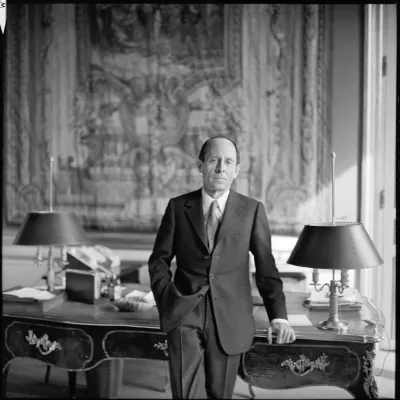
Michel Jobert
Human Design Chart
Biography
The Human Design of Michel Jobert: Manifestor 2/4
Manifestor 2/4 — Design at a Glance
Michel Jobert's design established him as a pioneer and visionary whose role was to lead the world into a new future. He appeared like an emperor in ancient Rome: With the vision of a great empire, he sent others out to achieve his goals instead of fighting battles himself. This leadership position inevitably led to misunderstandings because his thinking often exceeded that of those around him. This created polarization; some followed him enthusiastically due to his big dreams while others rejected or even hated him for it.
This conflict between vision and rejection was central to his experience. To find the right followers and resolve these tensions, it was essential that he informed his environment about his intentions in a timely and precise manner. This strategy of informing served to transform anger into inner peace. When Michel Jobert followed this strategy and oriented himself towards his authority, he was rewarded with a feeling of inner peace. If he lived against his design without informing or acknowledging his nature, he instead felt a persistent deep anger within him. His path therefore consisted in winning the right people for his vision through clear communication and thus maintaining the state of inner peace.
Emotional Authority
Michel Jobert showed a decision-making structure that required emotional clarity through time distance; spontaneous reactions were unreliable with him. His design carried Emotional Authority, meaning that the defined Solar Plexus Center determined his internal guidance. Independent of other defined centers, this authority always took precedence. He was subject to an emotional wave with permanent ups and downs in feelings. The world appeared colored by the current mood: totally enthusiastic at one moment, negatively surprised the next. This feeling was only a snapshot, a first impression, not necessarily his truth. Quick decisions based on emotion could therefore have negative consequences. The more time Michel Jobert took to let a decision mature, the deeper he recognized the connections. This required patience and repeatedly 'sleeping over' questions. By delaying, he gained emotional distance. Over time, intense feelings subsided, clarity and calmness set in. Only then was the process complete. This mechanism was particularly important for long-term decisions that significantly influenced his life course. His strategy consisted of not acting immediately but waiting for the emotional wave to pass, thereby moving from momentary mood to true clarity.
The 2/4 Profile — Hermit / Opportunist
Michel Jobert's design laid a tendency towards a rhythmic alternation between withdrawal and connection. As a person with Profile 2/4 (Natural Talent/Networker), there was a tension in him between the need for hermitage for inner clarity and the desire to spend time within the familiar circle of his 'tribe'. This configuration required clear communication about his availability limits: He signaled externally when he sought company and when he wanted to retreat undisturbed into his cave.
In isolation, Michel Jobert reflected on external inputs from his network to develop new ideas. Line 2 of the profile promoted a maturation process; it projected ambition outward but helped him free himself through internal processing from distress and find peace. Once this need for solitude was satisfied, he returned to the community. Here, line 4 worked towards transpersonal direction-giving and benefitting the tribe. Through this conscious sequence – withdrawal for synthesis, then engagement in the network – he could initiate material actions serving the common good. His effectiveness did not arise from constant presence or permanent retreat but through targeted navigation between these two poles and the ability to seize favorable opportunities in service of higher principles.
Split Definition — Defined & Open Centers
Michel Jobert's Human Design profile indicated a tendency towards consistent internal structure and reliable presence. His defined Heart Center endowed him with clear willpower; he kept his promises and sought recognition for his contributions, though sometimes at the expense of respecting others' boundaries. This material strength worked in tandem with his defined Solar Plexus: He had deep emotional authority but needed to learn patience with the wave-like movement of his feelings to achieve clarity rather than impulsive reactions. His voice was a stable anchor point. Through his defined Throat Center, he articulated a consistent message that sprang from his will and emotions – not as fleeting thoughts, but as reliable manifestations of his inner states.
This constant presence was complemented by his defined Spleen Center, which gave him intuitive security in the present moment. He responded spontaneously to what felt healthy and right, trusted his body awareness, and maintained a strong immune system. Simultaneously, he carried the persistent pressure of his defined Root Center, driving him forward in the world and helping him master existential challenges.
However, this firm internal architecture contrasted with his open centers. His open Head and Ajna Centers meant that he lacked a consistent mental focus; mental inspiration came situational from outside. He tended to get entangled in others' questions or seek answers not his own, rather than using his mind as a flexible tool. Particularly defining was his open G Center: Michel Jobert had no fixed identity or direction. His personality reflected the environment; he found himself through external initiation and intuitively sensed whether a place or relationship was right for him. Attempts to impose this direction actively led to resistance.
His open Sacral Center completed this picture of context-dependency. He lacked consistent generative energy and was prone to absorbing and amplifying others' vitality, often leading to overexertion and exhaustion as he did not naturally know when enough was enough. His health depended on not taking foreign energy as his own responsibility and withdrawing in time for regeneration.
Channels for emotional depth, ambition and communal connection.
Michel Jobert's social presence was strongly determined by his inner emotional wave. His communication wasn't just information transfer but an expression of his current mood state. This resulted from the Openness Channel 22-12, connecting Solar Plexus to Throat Center. Through this connection, he translated moods, passions, and melancholy directly into articulated words. His voice had a transformative quality that could emotionally touch others, yet only when his inner readiness aligned. Forced social interaction often led him to be abrupt or misunderstood; he needed the right moment to effectively deploy his warmth and social skills.
Parallel to this, an instinct-driven ambition drove him towards social positioning and tribal support. The Transformation Channel 54-32 linked Root Center with Spleen Center, creating a drive to secure his existence through talent and hard work while strengthening the tribe. This channel motivated him to climb up through competence, driven by fear of failure and desire for recognition. His efforts were never purely selfish but served tribal continuity; he sought confirmation from the tribe as reward for loyalty and commitment.
This dynamic was deepened by further personality aspects. Gate 47 contributed to processing past experiences and instilling collective meaning, expanding his emotional depth. Simultaneously, Gate 51 with its strong willpower and adaptability dealt with shocks, while Gate 26 possessed the ability to introduce innovations in a conservative tribe. The combination of emotional authenticity through Openness Channel 22-12 and the strategic survival instinct of Transformation Channel 54-32 shaped Michel Jobert's life as a balance between spontaneous expression and calculated, tribal-oriented action. He did not act impulsively but was guided by his emotional authority while his Spleen intuition chose directions for long-term success.
Tribal Circuitry — Circuit Signature
Michel Jobert's design featured a dual tension field: on one hand, the pulsating search for individual identity; on the other, traditional duty to tribal support. This split definition created two parallel, non-directly connected energy flows.
The Knowledge Circuit in him linked Throat and Solar Plexus Centers via Openness Channel (Gates 12/22). This promoted an acoustic, creative expression based on 'now'. New insights were transformed and articulated through emotional waves, imprinting a unique, often melancholic individuality.
Simultaneously, the Ego Circuit acted as a conservative counterbalance. It consisted of two separate parts: Heart and Solar Plexus Centers (Channel 37/40) along with Spleen and Root Centers (Channel 32/54). The channel between Heart and Solar Plexus regulated traditional give-and-take in the tribe – 'today I give, tomorrow you give'. As this circuit lacked a connection to Sacral Center, it lacked constant life force. This necessitated mandatory pauses for community resource regeneration.
The tension lay in Michel Jobert's need to connect his innovative, impulsive impulses of the Knowledge Circuit with the timeless structural responsibility of the Ego Circuit. While one field pressed for immediate creative expression, the other demanded patient cooperation and rest to secure material foundations for the tribe.
Right Angle Cross of Rulership 3
Michel Joberts design carried the imprint of the right cross of Governing. This configuration established a foundational stance aimed at leadership and setting standards. It was not merely an urge for power in a negative sense, but rather a structural tendency to create order and guide others with clear direction.
In Human Design, this cross describes a specific energy distribution that combines authority with the ability to control processes. The person tended to take responsibility for the overall picture and make decisions that had an impact beyond their own horizon. This often happened intuitively, driven by an inner compass that wanted to know how things should be properly governed.
Michel Jobert was seen in this light as someone who influenced his environment through clear structures. He did not seek consensus at any cost but rather what was functional and stable. This energy shaped his actions: it challenged him to establish himself as a leader figure without losing sight of his own intuition. It was about having a vision and translating it into reality with the necessary decisiveness, always ensuring that his authority rested on a solid foundation.
Saturn Return · Uranus Opposition · Chiron Return · 2nd Saturn Return — Life Cycles
Michel Joberts design indicated a tendency towards structural turning points marked by specific astrological cycles. These phases served as moments of maturation and letting go of old patterns, coupled with the assumption of new responsibility. The Chiron Return, a fulfillment cycle between the ages of 49 and 51 – slightly delayed or extended in Joberts case – signaled the flowering of his incarnation purpose. Here meaning was experienced if he had lived according to his strategy. This was concretely shown in 1973: at age 52, Michel Jobert became Minister for Foreign Affairs. This career step marked the peak of this unfolding phase, where his inner alignment manifested outwardly and a new level of responsibility set in.
Later followed the second Saturn Return, a cycle of consolidation and letting go of outdated structures. This period often calls for a redefinition of ones role in the larger whole based on years of experience. For Michel Jobert this effect came to light in 1981: at age 60 he was appointed Minister for Foreign Trade. This appointment was no coincidence but aligned with the mechanical logic of his design, which in this life stage promoted a focus on concrete responsibility and the manifestation of acquired wisdom. Both events underlined how his chart dynamics shaped career phases not as linear advancement but as cyclical deepening and recalibration of his public role.
Manifestor · Emotional Authority — Synthesis
Michel Jobert was a Manifestor whose life was marked by an inner tension between the urge to initiate and the need for emotional clarity. His design points towards a visionary pioneer (Manifestor type) who, through open Throat Center (Channel 22-12), authentically expressed his feelings while always taking into account the influence of his emotional wave – a quality that showed in his professional decisions. The profile as a natural talent and networker reinforced this inclination towards individuality and the need for exchange with selected reference persons, while the right cross of Governing pointed to a natural authority and the desire to take on responsibility.
A central paradox in his chart lay in the interplay between initiatory power and emotional maturity. As a Manifestor he possessed the energy to initiate things and bring about change, yet his emotional authority required time for decision-making. The cycles confirmed this: career events occurred after phases of internal struggle had been traversed. This dynamic led to a life marked by strong visions and the need for authentic emotional validation.
3 Defined Channels
Incarnation Cross - Right Angle Cross of Rulership 3
Solar Return
The Solar Return shows the moment when the sun returns to its exact birth position - your personal solar year.
Life Cycles
Discover the life cycles with a detailed triple view (birth chart, cycle chart, composite).
Human Design Profile
- Type
- Manifestor
- Strategy
- To inform others before acting
- Authority
- Emotional Authority
- Profile
- 2/4 - Hermit / Opportunist
- Definition
- Split Definition
- Incarnation Cross
- Right Angle Cross of Rulership 3
- Date of Birth
- 11.09.1921 16:00
- Place of Birth
- Meknès, Morocco
Frequently Asked Questions
What was Michel Jobert's Human Design type?
What Profile did Michel Jobert have in Human Design?
Which Authority guided Michel Jobert?
What incarnation cross did Michel Jobert have?
When was Michel Jobert born?
Discover your own Human Design
Are you also a Manifestor? Find out in a personal reading how to use your initiation power peacefully and dissolve resistance.
More Personalities
Back to overviewChristian-Jaque

Kesha

Laurent-Eynac
Lucebert

Masaccio

Papus