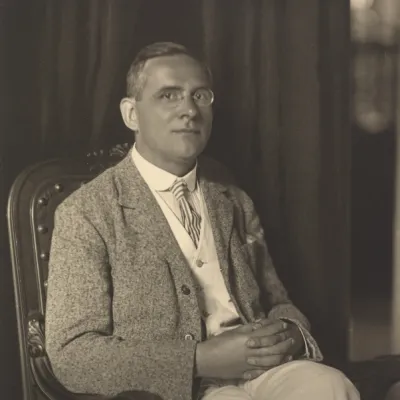
Moritz Schlick
Human Design Chart
Biography
With the rise of the Nazis in Germany and Austrofascism in Austria, many of the Vienna Circle's members left for the United States and the United Kingdom. Schlick, however, stayed on at the University of Vienna. When visited by Feigl in 1935, he expressed dismay at events in Germany. On 22 June 1936, Schlick was ascending the steps of the University for a class when he was confronted by a former student, Johann Nelböck, who killed him with a pistol. After the annexation of Austria into Nazi Germany in 1938 the assassin was released on probation after serving two years of a 10-year sentence.
Moritz Schlick as a Manifesting Generator 5/1 in Human Design
Manifesting Generator 5/1 — Design at a Glance
Moritz Schlick's design shows a tendency towards hybrid action: As an Manifesting Generator, he had the constant, sacral energy of a generator but also possessed through his active connection between Motor Centers and Throat Center the ability to quickly draw things into his life. This configuration created a tension field between the necessity to react to impulses rather than initiate himself and the capability to skip steps in action.
The mechanics of this type harbor two specific risks: On one hand, the speed tended to omit important stages which required backtracking and quickly led to frustration – the non-self theme of this configuration. On the other hand, this dynamic pulled towards pursuing multiple projects simultaneously by reacting to various impulses at once. Without constant verification through the sacral center ("Yes! I love it!") or inner authority, his creative joy easily tipped into negativity.
With proper application – that is, waiting for an internal signal before starting and regularly confirming ongoing endeavors – Moritz Schlick could draw deep satisfaction from his work. In this state, parallel working was no obstacle but a source of vitality. The pressure to finish one thing before beginning another contradicted his nature; instead, variety and playful engagement fostered his true creative power. His design thus required a balance between reactive patience and the freedom to stay in flow.
Sacral Authority
Moritz Schlick's design set a tendency towards intuitive, body-based decision-making. As a Generator, he had sacral authority – the only type whose strategy and inner authority are identical. This simplified his process: He did not react through planned thinking but to external stimuli with an immediate "gut feeling". This showed as a surge of energy or bodily sounds like grunting or a confirming hmm. Such signals marked topics that activated his inexhaustible energy, allowing him to dive into activities with great enthusiasm – without inevitable purposefulness.
Central was the condition of his open Emotional Center. Since emotions require time for clarity, Moritz Schlick could not immediately implement sacral impulses in emotional high but had to wait until feelings clarified themselves. Additionally, his activated Spleen Center acted as a supportive instance. It gave him quick, instinctive access to his physical well-being and enabled spontaneous reactions to dangers or opportunities. This combination of sacral life force and spleen-based intuition shaped his way through life: vital, reactive, and deeply rooted in the body.
The 5/1 Profile — Heretic / Investigator
Moritz Schlick's design set a fundamental tendency: the connection of deeper, individual research with the urge to derive practical solutions for others from it. As a 5/1 (Hero/Researcher), he showed himself as someone who used his specific knowledge to solve problems, which often triggered magnetic attraction in others. Others sought answers from him, similar to an expert at a conference being flooded with questions after answering them. This dynamic could lead to exhaustion if clear boundaries were not set. His design required learning to say "no" to maintain the balance between retreating into inner work (Line 1) and external problem-solving (Line 5). Line 1 emphasized accepting limitations as a foundation, while Line 5 pointed towards maturity and self-actualization. In crisis times, he was sought after but then withdrew again to conserve his energy. This structure shaped him as someone who, despite his abilities, often wore a mask or appeared withdrawn to maintain inner harmony amidst external demands. Restlessness could arise if these limitations were not accepted, emphasizing the need to protect personal space for research and recovery.
Split Definition — Defined & Open Centers
Moritz Schlick was someone whose mind was in constant, productive motion. His defined Head and Ajna centers created a perpetual mental pressure to question and form concepts. This process was not a choice for him but a mechanical given: he thought continuously, processed data, and sought answers. With his Throat also defined, he could directly translate these mental structures into the world. His language served as a channel to articulate what his mind comprehended – a reliable yet limited way of communication.
This intellectual stability contrasted with his open centers. His open G Center meant that he did not carry a fixed, unchanging identity. Instead, he adapted to environments and took on directions from others. He tended to wonder if a place or relationship was “the right” one rather than knowing it from himself. His open Heart Center made him vulnerable to attempts to prove his worth through performance – a trap since he did not possess the constant willpower to keep such promises long-term. Furthermore, his open Solar Plexus absorbed the emotions of his surroundings, leading to foreign moods being experienced as his own.
Despite these open areas, Moritz Schlick possessed immense inner strength. His defined Sacral Center generated daily vital energy that was only activated through reaction. Initiatives from the mind often led to resistance; it was only waiting for a question or opportunity that allowed access to his full power. This was supported by his defined Spleen Center, which gave him spontaneous, intuitive judgments in the present – a protective mechanism for health and well-being. His defined Root pressure also provided the necessary endurance to advance in the material world. Thus, his design combined relentless intellectual sharpness with reactive, instinct-driven life energy.
Channels for powerful execution, maturation and mental clarity.
Moritz Schlick was characterized by an energetic, often restless presence that had the urge to immediately translate inner impulses into external action. This dynamism came from Channel Charisma 34-20, which linked raw physiological power with the need to express oneself in the present moment. Without this sacral guidance, energy threatened to become chaotic; with it, it manifested as a powerful, inspiring life force.
Parallel to this, he was driven by a deep ambition to secure his position and value through constant effort. Channel Transformation 54-32 connected the desire for advancement with an instinctive recognition of talents and support opportunities within a community. This was not just about personal success but establishing oneself in social structures through competence and ensuring both individual existence security as well as that of the “tribe.”
His mental work was marked by a continuous search for meaning and connections. Channel Abstraction 64-47 ensured he filtered experiences through kaleidoscopic mental images to develop coherent narratives or perspectives from them. This mind constantly sought the mysterious core behind facts, often leading to inner confusion but maturing into clear, shareable insights in ideal cases.
Additionally, he underwent a process of maturity 53-42 that allowed him to fully experience cycles and gain wisdom before starting new ones. This created a cyclical depth in his understanding of life and learning. Further influences like Gate Doubt (63) or the detail-oriented energy of Gate 9 supported this analytical and experiential stance by driving him to question uncertainties and correct patterns precisely.
Collective Circuitry — Circuit Signature
Moritz Schlick's design tended towards cyclic emotional waves nourished by reflection on the past. The Meaning-Finding Circuit connected his Head and Ajna Centers as well as Sacral and Root Centers in two separate segments, generating energy that flowed not linearly but wave-like: emotions and insights from the past were processed to share later with others. Parallel to this, the Ego Circuit operated through Channel Transformation between Spleen and Root Centers. Here it was about intuitive knowledge for survival and resource building within cooperation contexts, yet without direct connection to the constant life force of the Sacral Center – requiring phases of rest for regeneration. Additionally, the Integration Circuit linked Throat and Sacral Centers via Channel Charisma. This enabled him to draw strength from reacting to life and express it authentically in the present moment. As Moritz Schlick had a split definition, these energies existed as parallel, non-directly connected streams: on one hand, intellectual-emotional reflection (Head/Ajna), on the other, physical-intuitive action capability (Spleen/Root/Throat/Sacral). This configuration marked him as someone who oscillated between pondering past experiences and immediate, charismatic expression in the here and now.
Left Angle Cross of Limitation 1
Moritz Schlick's design indicated a tendency towards inner discipline and clear boundaries. He was someone who channeled his energy through structured limits rather than letting it flow unchecked. This attitude stemmed from the left cross of Limitation 1, a configuration aimed at self-control and precise definition of one's space.
In Human Design, this pattern describes a specific way of managing energy: it is not about suppression but conscious focus. Moritz Schlick used this mechanism to filter out distractions and concentrate on what was essential. The limitation acted as a filter that helped set priorities and maintain inner clarity. Instead of being driven by external pressure, he created his own conditions for action and thought.
This structure fostered a calm yet decisive presence. Moritz Schlick learned that true strength often lies in the ability to say no or draw boundaries before energy is lost. The left cross of Limitation 1 supported him in using his resources purposefully without dissipating through diffuse demands. It was an internal architecture offering stability through control over one's impulses. Moritz Schlick lived this dynamic by protecting his attention and allowing only what fit into his defined order, thus building a foundation of self-confidence based on clear, self-imposed standards.
Saturn Return · Uranus Opposition · Chiron Return — Life Cycles
Moritz Schlick's design indicated a tendency towards structural anchoring followed by later radical realignment. His first Saturn return around the age of 29 marked the transition from education to established authority. This cycle condensed years of groundwork into a solid foundation crucial for his further career path. Indeed, Schlick habilitated in philosophy at the University of Rostock in 1911 at the age of 29 – a clear expression of this saturnine stabilization securing him a firm position within the academic system.
Later, the Uranus opposition cycle, often coinciding with the 40th year of life and demanding deep changes or breaking away from old structures, came into play. This energy pushed for freedom from conventional ties towards an independent form of expression. Schlick took over the chair of natural philosophy at the University of Vienna in 1922 at age 40. This change was not merely a career step but the implementation of the uranian impulse: he left the established environment and positioned himself in a new center where his unique philosophical voice could resonate undisturbed. Both events show how Schlick's chart concretely manifested through planetary cycles – first by anchoring, then through transformative expansion.
Manifesting Generator · Sacral Authority — Synthesis
Moritz Schlick lived a life marked deeply by a drive for understanding and the need to share this knowledge. As an Manifesting Generator (with defined sacral authority), he had a constant energy source and the ability to quickly respond to external stimuli – a blend of initiating power and responsive adaptation. His profile as Hero/Researcher (5/1) amplified this impulse by placing him in the role of the knower, seeking solutions for others while continuously learning himself. The defined mental pressure (Head-Ajna Center) points towards an ongoing confrontation with questions and concepts that he then carried into the world through the channel of charisma (Sacral-Throat Center).
A central paradox in his design lay in the tension between sacral reaction and mental pressure. On one hand, his authority demanded him to *respond* to impulses rather than initiate them; on the other, the defined Head Center urged him constantly to ask questions and seek answers – a cycle of stimulation and response. This dynamic was evident in documented career events where he both reacted to opportunities (habilitation, chair) and set new impulses through his work.
4 Defined Channels
Incarnation Cross - Left Angle Cross of Limitation 1
Solar Return
The Solar Return shows the moment when the sun returns to its exact birth position - your personal solar year.
Life Cycles
Discover the life cycles with a detailed triple view (birth chart, cycle chart, composite).
Human Design Profile
- Strategy
- To respond - wait for something to respond to
- Authority
- Sacral Authority
- Profile
- 5/1 - Heretic / Investigator
- Definition
- Split Definition
- Incarnation Cross
- Left Angle Cross of Limitation 1
- Date of Birth
- 14.04.1882 23:00
- Place of Birth
- Berlin, GER
Frequently Asked Questions
What was Moritz Schlick's Human Design type?
What Profile did Moritz Schlick have in Human Design?
What Authority did Moritz Schlick have?
What incarnation cross did Moritz Schlick have?
When was Moritz Schlick born?
Discover your own Human Design
Are you also a Manifesting Generator? Find out in a personal reading how to unfold your multi-talents and direct your energy wisely.
More Personalities
Back to overviewAldair

Alizée

Angeli
Arletty
Artus

Balthus