
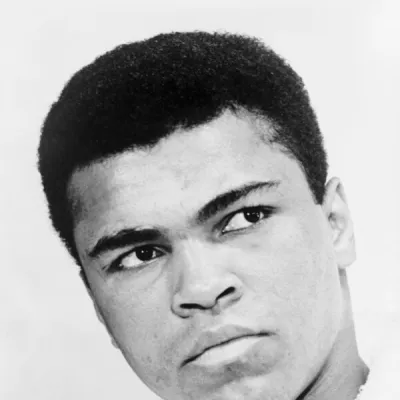
Muhammad Ali
Human Design Chart
Biography
He began boxing professionally on 29 October 1960 and became world champ in 1964 by knocking out Sonny Liston. His title was declared vacant after he refused military obligation as a Muslim and a conscientious objector. He later changed his name and reentered the ring in 1970, fighting with singular grace and beauty for 25 years. Muhammad Ali earned a reputation as a man dedicated to his goals and beliefs. A consummate showman, he used to call himself "the Greatest," and many of his fans believe that the nickname fits.
Clay’s great grandfather was an Irishman who had married a black girl. Ali was raised in a middle-class neighbourhood, the eldest of two sons born to Cassius Marcellus Clay Sr. and Odessa (Grady) Clay. Ali's father supported his family as a sign and mural painter, while his mother worked as a domestic. Ali worshiped with his family on Sundays at Mount Zion Baptists Church and attended school with brother Rudolph. He was a rather poor student, which he blamed on his preoccupation with boxing as a boy. Ali confessed that he wished he had put forth more effort academically, because he struggled as a slow reader his entire life.
It was due to a stolen bicycle that Ali began to box, at age 12. When he reported the theft, Policeman Joe Martin invited the boy to train with Fred Stoner, who taught him to move with the speed and grace of a dancer. While still in high school, he won 100 out of 108 matches and earned six Kentucky and two national Golden Glove championships, as well as two Amateur Athletic Union Championships.
Muhammad Ali as a Manifesting Generator 1/4 in Human Design
Manifesting Generator 1/4 — Design at a Glance
Muhammad Ali's design established a hybrid nature that combined the speed of a Manifestor with the constant energy of a Generator. He was someone who could skip steps and achieve results quickly. This configuration described a Manifesting Generator: a type that belonged to the family of Generators and had a defined Sacral Center, which provided constant life energy, but also possessed initiating power through a connection between a Motor Center and the Throat Center.
Muhammad Ali's strategy was not to initiate himself but to react to impulses from his environment. He should only act when his Sacral Center responded with a clear "yes." This feedback loop was crucial for avoiding frustration that often arose from hasty action or multitasking without inner consent. His speed carried the risk of skipping important steps, leading to backlogs and dissatisfaction. Additionally, he tended to pursue multiple projects simultaneously. Success came when he exercised this parallelism in a "play mode" while always checking sacral validation. When this inner approval was given, Muhammad Ali derived deep satisfaction from his work. The requirement to focus on one thing alone contradicted his nature; variety and fun were instead the key to his sustained energy and contentment.
Emotional Authority
Muhammad Ali's decision-making required emotional detachment and time; spontaneous impulses proved to be misleading. His design was marked by an emotional wave that culminated in a constant up-and-down of feelings. The world always appeared colored by his current mood: one moment total enthusiasm, the next deep negativity about the same thing. However, this feeling was merely a snapshot, a first impression, not necessarily his truth yet. Therefore, quick and spontaneous decisions based on emotion often had negative consequences.
His inner authority resided in the defined emotional center. This authority always took precedence over other defined centers, regardless of further configurations in the chart. The more time Muhammad Ali took to let a decision mature, the deeper and more comprehensive his understanding became. This process required patience and repeatedly sleeping on a choice. He should hesitate and ask himself again and again. Over time, intense feelings subsided, emotional distance gained strength, clarity emerged, and calmness set in. Only then had he gone through the process. This mechanism was particularly relevant for long-term decisions that could have a significant impact on his life course. Through waiting, the initial impulse transformed into a well-founded, clear stance.
The 1/4 Profile — Investigator / Opportunist
Muhammad Ali's Design indicated a tendency towards deep inner exploration while simultaneously being dependent on a familiar environment. As a 1/4 Profile (Researcher/Networker), he combined the intense thirst for knowledge of Line 1 with the need for a community that shared this knowledge. The energy flowed from thorough, internal work to externalization into a network of trusted individuals.
A central aspect was the fear of Line 4, being exposed as lacking in knowledge before loved ones. This created a strong need for a loving environment as a prerequisite for his deep knowledge to come to light and build authority. Without this trusting foundation, the potential remained limited; only in safety could he work through his network.
Line 1 brought from birth the handling of limitations and the preservation of inner harmony despite external constraints. At the same time, there was an increased vulnerability to corruption in Line 4 if values were lacking or laws weak. Here it was about bringing enriching values outward. If these were absent, there was a risk that selfish actions could lead to success even with mediocre value materials – a harmful gift of Saturn's elevation. Muhammad Ali’s structure therefore required clear inner values to shape the network healthily and enrichingly rather than endangering it through weak laws or a lack of integrity.
Triple Split Definition — Defined & Open Centers
Muhammad Ali's design presented a rare mechanical fortress: nearly all internal processes were set in stone, only the search for identity remained situational. He had defined Head and Ajna centers, which created constant mental pressure towards inspiration and questioning; he thought independently of external confirmation. His willpower (defined Heart Center) and vital energy (defined Sacral Center) were autonomously available, as was his emotional depth (defined Solar Plexus), intuition (defined Spleen), and stress management (defined Root). This configuration created immense inner self-sufficiency. He was a “machine” full of defined energies that generated its own reality.
The only open point was the G Center. Here, he lacked a fixed internal identity or life direction. His direction and his “who to be” were not dictated internally but initiated by the environment. This created a fundamental tension: while he was internally complete and powerful, his external alignment depended on being in the right place. If the environment was wrong, he felt lost or adapted to false identities. Only in correct contexts could he utilize the potential of his many defined centers. The challenge lay in not channeling this immense inner power into false directions but waiting for initiation by the right place and people. Without this external anchor, his internal completeness went unused or misdirected. He tended to question whether he was at the wrong place when nothing felt right, as his open G Center reacted to environmental quality rather than an internal compass.
Channels for mystical pressure, change, value and abstraction.
Muhammad Ali's design leaned towards evolutionary transformation processes characterized by accepted limitations and patient waiting for inner signals. This structure did not manifest as constant activity but as pulsating energy that alternated phases of intense change with periods of stillness.
The Mutation Channel 60-3 connected the Root Center to the Sacral Center through the Gate of Limitation (60) and the Gate of Order (3). This connection generated a powerful yet unpredictable on/off energy in the body's circuit. The potential for transformation depended on accepting limitation – not knowing when the next impulse would come – and moving beyond the confusion of a new beginning. The accompanying melancholy during pauses was not a defect but a mechanical indicator that new possibilities were developing beneath the surface. Instead of intellectually combating these moods, the design required attention and patience until the sacral response.
The Synthesis Channel 19-49 connected the Root Center to the Solar Plexus Center through the Gate of Claims (19) and the Gate of Principles (49). This created an emotional sensitivity for belonging and tribal connection based on the principle “love, honor, and obedience.” It involved the intuitive ability to recognize who belongs to the community and who does not, as well as protecting shared resources and territories.
The Money Line Channel 21-45 connected the Heart Center to the Throat Center through the Gate of the Hunter (21) and the Gate of the Gatherer (45). This structure propelled the material plane forward, tied to the need for control over one's own rhythm and responsibility for resources. It was about acting with willpower while maintaining balance between work and rest to avoid being controlled.
The Preservation Channel 27-50 connected the Sacral Center to the Spleen Center through the Gate of Care (27) and the Gate of Values (50). This promoted a natural ability for provision and protection of the tribe based on traditional values and laws. The aura attracted trust but required the sacral response to know if energy was available for others.
The Abstraction Channel 64-47 connected the Head Center to the Ajna Center through the Gate of Confusion (64) and the Gate of Understanding (47). This generated an active, experience-based mind that constantly sought meaning. Clarity did not arise immediately but through patient waiting until a coherent picture or story formed from mental unrest.
Additionally, gates like 56 (Inspiration/Storytelling), 63 (Doubt/Improvement), and 35 (Change Through Interaction) worked in the background to support mental processes and the drive for progress.
Tribal Circuitry — Circuit Signature
Muhammad Ali's design leaned towards pulsating acoustic energy aimed at transforming his unique identity through deviation from the norm. This was evident in the Knowledge Circuit: The Mutation Channel (3-60) connected his Sacral Center with his Root Center, creating a rhythmic life force that initiated change through new knowledge and carried acoustically out of the Throat Center – always within the emotional pulse of the Solar Plexus.
Parallel to this, the Meaning Finding Circuit existed as separate power. Here, the Abstraction Channel (64-47) connected his Head Center with his Ajna Center, allowing for reflection on past experiences and their meaning in a wave-like manner visually and emotionally to share insights from the past.
The Ego Circuit also worked independently as two separate pieces. One part linked the Throat Center with the Heart Center (Channel 45-21), concerning communication of resources and material well-being. The other piece connected Solar Plexus and Root Centers (Channel 49-19) for synthesis of feelings and instincts. As there was no direct connection to the Sacral Center, this required rest pauses for regeneration of tribal resources.
Finally, the energies of the Archer Circuit shaped survival. The Preservation Channel (27-50) connected his Sacral Center with his Spleen Center, ensuring instinctive care, preservation, and protection of one's genetics and family, tied to the constant life force of the Sacral.
Right Angle Cross of Laws 4
Muhammad Ali's Human Design profile featured the archetypal structure of the Right Cross of Laws. This configuration formed the fundamental background code of his character, a deeply rooted dynamic that often worked unconsciously and significantly shaped his life path. It defined not just superficial actions but set the ultimate driving force against which all other activations in his system had to align to understand the overall picture of his existence.
This cross functioned as an internal compass needle. It created a constant tension between personal will and a larger, often spiritual or lawful order. Those who carry this structure do not simply move through life but are driven by a deep need to embody or fulfill certain laws. For Muhammad Ali, this was no minor trait but the central mechanism that structured his identity and actions. Without this perspective, many of his decisions remained incompletely explainable; with it, it became clear that he constantly sought higher coherence beyond the everyday. This dynamic was silent yet omnipresent, a quiet director in the background of his fate.
Saturn Return · Uranus Opposition · Chiron Return · 2nd Saturn Return — Life Cycles
Muhammad Ali's life followed a clear cyclical structure marked by two decisive turning points: a phase of return and one of completion. In 1970, at age 28, the ban on Ali was lifted; he could step back into the ring again. This marked his first Saturn Return, a time when years of groundwork often condenses into a solid result and old structures are re-established. The resumption of his career showed itself as a moment of restoration after a long interruption.
A decade later, the Uranus Opposition became active. In 1981, at age 39, Ali lost his last fight against Trevor Berbick on the Bahamas. This configuration often signals a phase of letting go and final dissolution of old patterns. The loss of this match was not only a sporting event but also corresponded to the mechanical pressure to end a life stage. While the Saturn Return enabled the return, the Uranus Opposition ushered in the definitive exit from active competition. These two astrologically-Human-Design-specific points thus defined the arc from rebirth in the ring to the necessary end of his sporting era, driven by internal and external pressures of these cycles.
Manifesting Generator · Emotional Authority — Synthesis
Muhammad Ali's life was marked by a deep inner dynamic between the need for authentic expression and the ability to adapt to the demands of the moment. His profile as an Manifesting Generator with emotional authority points to a person who not only had the energy to set things in motion but also needed to run these impulses through careful emotional scrutiny. This combination manifested in a personality that was equally impulsive and strategic – a dynamic shift between quick action and waiting for the right opportunity (Sacral Center, Manifesting Generator). The Investigator/Networker profile type amplifies this aspect by combining deep curiosity with the desire to share knowledge and make connections. This is evident in his ability to inspire people and communicate his convictions powerfully (Throat Center).
A central paradox in Ali's design lies in the interplay of spontaneity and emotional clarity. As a Manifesting Generator, he had the energy to react quickly to impulses; yet his emotional authority required him to run these impulses through a longer phase of emotional maturation (emotional center). This led to a tension between the desire for immediate action and the necessity to wait until clarity prevailed. The recurring cycles – especially the event in 1970 when he returned to the ring after a ban, as well as the crisis of 1981 – illustrate this dynamic: moments of quick action and manifestation alternated with phases of reflection and adaptation.
5 Defined Channels
Incarnation Cross - Right Angle Cross of Laws 4
Solar Return
The Solar Return shows the moment when the sun returns to its exact birth position - your personal solar year.
Life Cycles
Discover the life cycles with a detailed triple view (birth chart, cycle chart, composite).
Human Design Profile
- Strategy
- To respond - wait for something to respond to
- Authority
- Emotional Authority
- Profile
- 1/4 - Investigator / Opportunist
- Definition
- Triple Split
- Incarnation Cross
- Right Angle Cross of Laws 4
- Date of Birth
- 17.01.1942 18:35
- Place of Birth
- Louisville, KY, United States
Frequently Asked Questions
What was Muhammad Ali's Human Design type?
What Profile did Muhammad Ali have in Human Design?
What Authority did Muhammad Ali have?
What incarnation cross did Muhammad Ali have?
When was Muhammad Ali born?
Discover your own Human Design
Are you also a Manifesting Generator? Find out in a personal reading how to unfold your multi-talents and direct your energy wisely.
More Personalities
Back to overviewSissy Spacek

Aldair

Alizée

Anémone

Angeli

Ann-Margret
