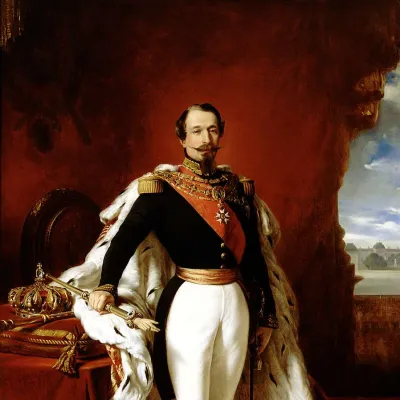
Napoléon III
Human Design Chart
Biography
In July 1870, Napoleon III reluctantly declared war on Prussia after pressure from the general public. The French Army was rapidly defeated and Napoleon III was captured at Sedan. He was swiftly dethroned and the Third Republic was proclaimed in Paris. After he was released from German custody, he went into exile in England, where he died on 9 January 1873 at age 64 in Chislehurst, London.
The Human Design of Napoléon III: Generator 4/6
Generator 4/6 — Design at a Glance
Napoleon III possessed immense endurance and strength, which made him seem like a workhorse. His energy, however, was not an unlimited resource to be freely tapped into; instead, it depended on a specific condition: the reaction to external impulses. His design as a Generator determined that his enormous capacity for materializing things only became effective when he did not initiate actions himself but responded to signals from life.
This mechanism of the sacral center required a clear strategy: Reacting rather than initiating. When Napoleon III encountered an impulse and received a clear "yes" internally, he could act with full power. In these moments of resonance, he was invulnerable and experienced deep satisfaction as well as a sense of true fulfillment.
Deviation from this path led to two serious pitfalls, however. If he acted against his inner signal or forced himself to do things that did not receive internal approval, he wasted his energy. This often resulted in burnout and persistent frustration. Equally problematic was being prevented from working on his heart project when his inner drive was still fully present. Both scenarios—the forced and the suppressed—blocked the natural flow of his power. His success therefore did not depend on constant activity but rather on learning to respond instinctively to what truly confronted him, instead of fighting against the current of his design.
Sacral Authority
Napoleon III’s decision-making was based on an inner resonance as a direct reaction to external stimuli. His design indicated that he did not act through logical analysis but waited for physical signals. This was an expression of his sacral authority, which is exclusive to the Generator type and whose strategy aligns with authority, simplifying the process. A prerequisite for this was an open emotional center. The answer manifested as a gut feeling or surge of energy. Napoleon III had to listen to sounds like grunts, hums, or a “Mhm” to distinguish real vitality from false engagement. When his sacral motor kicked in, he possessed inexhaustible energy and great enthusiasm. He was born to immerse himself joyfully in activities without being goal-oriented. Additionally, an activated spleen center acted as supportive authority. This configuration allowed for quick, spontaneous reactions and immediate access to instinctive perception of physical well-being. Napoleon III reliably followed this inner voice, which helped him differentiate between authentic drive and mere tension. His life energy only fully ignited when he listened to these specific physiological responses, allowing him to move through life with satisfaction.
The 4/6 Profile — Opportunist / Role Model
Napoleon III's Design was characterized by a fundamental inner conflict: the struggle between emotional belonging needs and strict, rational distance. In his first half of life, he intensely experimented with social bonds and relationships, driven by a magnetic attraction that relied on confusion and transpersonal qualities. This phase served as an exploration period before his essence transformed.
With the entry into the second half of life, his dynamics fundamentally changed. The desire for community now met the need for isolated wisdom and harsh judgmental power. This contradiction between heart and head shaped his existence. He was expected to function as a wise role model, which required inflexibility and acceptance of strict limitations. His intuitive judgment sharpened, and compromises receded into the background.
The Profile 4/6, the Networker/Role Model type, describes precisely this development: from chaotic experimenter to disciplined mentor. Line 4 drew people in through charisma and a nearly extrasensory attraction for external guidance (Guidance), while Line 6 demanded hardness and order. Napoleon III had to learn to integrate these forces. His great warmth always remained cautious to avoid opening up to the wrong people and getting hurt. The profound changes in his life often resulted from this long phase of inflexibility and waiting for the right application of harshness.
Split Definition — Defined & Open Centers
Napoléon III had a design with a clear inner structure: defined Ajna, Throat, Sacral, and Root Centers formed the constant foundation. This gave him a steady mental clarity, the ability to reliably articulate his concepts, as well as a vital energy source that was activated by reacting to external stimuli. His stress management was specific and set in stone. At the same time, Head, G, Heart, Solar Plexus, and Spleen Centers were open. This openness did not indicate deficiency but rather situational dependence on the environment for inspiration, identity, emotional stability, and intuitive security.
The defined connection between Ajna (mental thinking) and Throat (communication) allowed Napoléon III to translate his thoughts directly into words or actions. He had a reliable mental function that was effective only when he responded to questions rather than initiating himself – in accordance with the strategy of his defined Sacral Center. This center generated daily vital energy, which was available from the gut upon correct “yes” responses. Initiated actions without prior inquiry often led to frustration and exhaustion as the sacral power did not support the decision.
The open Centers shaped his vulnerabilities. The open G Center meant that identity and direction were not internally set but had to be found through the "right place" and fitting relationships. At wrong places, he felt lost; at right ones, he flourished. The open Heart Center led to a lack of consistent willpower to keep promises or prove value – attempts often ended in self-doubt. The open Solar Plexus Center absorbed foreign emotions, making him vulnerable to emotional waves from others; he had to learn not to personalize these as his own. The open Head Center left him without steady inspiration, so he could easily be overwhelmed by doubts or the questions of others. The open Spleen Center carried a fundamental survival fear and made spontaneous decisions risky since intuition was conditioned here.
The tension lay between the inner, mechanical availability of his energy and opinion (defined) and the outer necessity to find context for identity and emotional calmness (open). His strength showed when he reacted and was in the right place; his weakness when he initiated or lingered in unsuitable environments.
Channels for evolutionary change and structured insight.
Napoleon III exhibited a fundamental disposition characterized by an unpredictable, pulsating rhythm: periods of intense creative productivity alternated with phases of melancholy and inner tension. This dynamic stemmed from Channel 60-3, which connected the Root Center to the Sacral Center. Gate 60, the Gate of Limitation, served as a pivot point for evolutionary possibilities, while Gate 3, the Gate of Order, attempted to realize new values. This channel generated a powerful on/off energy that urged Napoleon III to push forward innovations, but only successfully when he accepted limitations and waited for the correct response from his Sacral Center rather than rationalizing mechanical mood swings.
Parallel to this, Napoleon III possessed the ability to express inspired insights clearly and efficiently to change perspectives. This occurred through Channel 43-23, which linked the Ajna Center with the Throat Center. Gate 43 received spontaneous breakthroughs as insight, while Gate 23 processed and articulated these through assimilation. This combination enabled him to formulate complex ideas in a way that could be embraced by the collective – provided he exercised patience with timing. Without strategy and inner authority, however, he risked being rejected or feeling alienated, as his innovative thinking often seemed light-years ahead.
Additional nuances were provided by individual gates: Gate 50 fostered a conservative protective reflex and awareness of traditions, while Gate 56 translated mental processes into vivid narratives. Gate 14 contributed to the adept handling of power, Gate 8 promoted the individual's contribution to the group, Gate 5 established a fundamental life rhythm, and Gate 34 supported the integration of his personal strength into the whole.
Individual Circuitry — Circuit Signature
Napoléon III was marked by two separate, parallel operating energy blocks. His design consisted of a connection between the Ajna and Throat Centers as well as a separate connection from the Sacral to the Root Center; these groups were not directly linked to each other. The first block, Channel 43-23 (Definition), gave him the ability to translate inner concepts into clear, structured expressions. This created a foundation for expressing his individual identity through words and actions.
The second independent block included Channel 3-60 (Mutation). This channel drove fundamental deviation from the existing order. It promoted radical innovations and the need to replace old structures with new, mutative impulses. This energy was pulsing and acoustically driven by creative flashes of insight aimed at change.
Together, these elements formed Napoléon III’s Knowledge Circuit. Although the Centers were in two isolated groups, the overall pattern worked towards generating new knowledge and conveying it into the world through emotional waves – anchored in the Solar Plexus Center, which was not directly channeled here but served as a source of emotional coloring to the expression – via the Throat Center. The combination of structured communication (Ajna-Throat) and disruptive innovation (Sacral-Root) shaped his way of initiating transformation. He did not act through one continuous flow, but rather through the interplay of these two distinct forces: the clear structuring of the message on one hand and the mutative impulse towards change on the other. This resulted in an expression that was both uniquely individual and transformative for his environment.
Right Angle Cross of Laws 1
Napoleon III's Human Design was marked by the 'Right Cross of Laws 1', a configuration that emphasized a profound focus on structure and order. This archetypal orientation created an internal framework in which understanding laws was not just an abstract concept but a fundamental reality of life. The cross linked various energetic aspects into a coherent whole, seeking stability and clarity. It aimed to translate chaos into orderly patterns. For Napoleon III, this meant that his actions and perceptions were strongly influenced by the need to recognize, respect, or redefine existing orders. The energy of this cross acted as an ongoing background process filtering decisions and attitudes. It promoted a stance that sought the underlying rules holding a system together. This was less about individual whim and more about embedding oneself in larger structural contexts. This configuration did not offer quick fixes but demanded patience and precision in building foundations. Napoleon III thus moved within a field where authority was defined by consistency and reliability. The mechanics of the cross ensured that every action was evaluated within this legal framework. It was a design seeking constancy, putting transient impulses aside for long-term stability.
Saturn Return · Uranus Opposition · Chiron Return · 2nd Saturn Return — Life Cycles
Napoleon III's life followed a marked cyclical structure characterized by phases of limitation and breakthrough. His design showed a tendency towards recurring testing situations structured around planetary cycles. The first Saturn return around the age of 28 often marked the beginning of a phase of responsibility and hardship. This was reflected in 1836 when, after an unsuccessful coup attempt, he was captured and sent into exile to the USA – a clear crisis that fundamentally questioned his position.
Ten years later, at the Uranus opposition around age 40, a turning point occurred. This cycle often brings sudden changes or liberation from old structures. In 1848, during the Second Republic, he was elected President of France, marking a political breakthrough after years of exile.
The Chiron return around age 49 represents in Human Design mechanics a point of fulfillment and unfolding. Here it is shown whether one's own strategy has been lived out. For Napoleon III, this peak coincided with the year 1856: The Peace Treaty of Paris and the birth of his son Napoleon Eugène Louis Bonaparte marked a phase of confirmation and personal as well as political success.
The second Saturn return around age 60 brought structure and limits again. In 1867, this led to the Luxembourg Crisis, where he was forced to abandon his plans. This cycle underscored the necessity of adapting to external realities after the bloom phase had passed. The sequence of these events illustrated the rhythmic nature of his design: from crisis through ascent to fulfillment and back to a necessary reflection on limits.
Generator · Sacral Authority — Synthesis
He was a Generator with sacral authority, whose life was marked by a deep-rooted drive to set energy in motion. The connection of the Sacral Center through Channel Mutation (3-60) indicates an ability to change existing structures and create new ones – a process that is always accompanied by melancholy and acceptance of limitations. This fundamental need for activity and transformation was reinforced by his defined mental center, which created concepts and encouraged others to adopt new ways of thinking. The Profile role as Networker/Role Model showed in the tendency to form connections while maintaining a certain distance for inner reflection (Line 6).
A central paradox lay in the tension between the need for belonging (Line 4 in the profile) and the desire for independent knowledge acquisition (Line 6). While he longed to be part of a community and achieve something through cooperation, it constantly pulled him back into isolation to ponder the meaning of life. The cycles confirm this pattern: Phases of success and public role alternated with moments of crisis and withdrawal, with his life marked by an ongoing shift between activity and reflection.
2 Defined Channels
Incarnation Cross - Right Angle Cross of Laws 1
Solar Return
The Solar Return shows the moment when the sun returns to its exact birth position - your personal solar year.
Life Cycles
Discover the life cycles with a detailed triple view (birth chart, cycle chart, composite).
Human Design Profile
- Type
- Generator
- Strategy
- To respond - wait for something to respond to
- Authority
- Sacral Authority
- Profile
- 4/6 - Opportunist / Role Model
- Definition
- Split Definition
- Incarnation Cross
- Right Angle Cross of Laws 1
- Date of Birth
- 20.04.1808 01:00
- Place of Birth
- Paris, France
Frequently Asked Questions
What was Napoléon III's Human Design type?
What Profile did Napoléon III have?
What Authority did Napoléon III have?
What incarnation cross did Napoleon III have?
When was Napoleon III born?
Discover your own Human Design
Are you also a Generator? Find out in a personal reading how to use your sacral energy correctly and discover deep satisfaction.
More Personalities
Back to overviewAaliyah

Alexia

Angèle

Anne-Marie

Arcángel

Arno