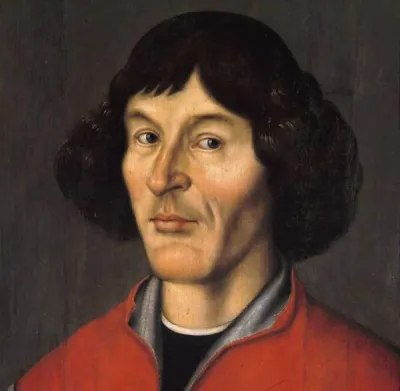
Nicolaus Copernicus
Human Design Chart
Biography
Died of apoplexy on 24 May 1543, in Frauenburg, East Prussia.
Nicolaus Copernicus — Manifesting Generator with Profile 2/4
Manifesting Generator 2/4 — Design at a Glance
Nicolaus Copernicus revealed himself as someone who embodied a hybrid nature: the constant energy of a Generator paired with the ability to skip steps. His design suggested that while he had a steady power source, he could only use it effectively when responding to external impulses rather than initiating independently. This configuration described an internal mechanism that allowed him to quickly draw things into his life but also carried specific risks.
The mechanics of his design warned against the possibility that this speed could lead to skipping important steps. If Nicolaus Copernicus acted too quickly, he often had to backtrack and make up for missed steps, which quickly led to frustration – the typical non-self experience for this type. Additionally, his design tended to tackle multiple projects simultaneously, driven by responding to various impulses. Without clear approval from his inner center, however, this creative drive could quickly turn into its opposite.
For Nicolaus Copernicus, it was crucial to start only when his inner center gave a clear “yes.” Only under these conditions could he draw deep satisfaction from his work. Then the parallel handling of different tasks was no longer an obstacle but rather promoted his creativity. His design benefited from variety and a playful approach to work, provided that he remained in the strategy of responding and regularly checked whether his projects still aligned with his inner approval.
Emotional Authority
Nicolaus Copernicus demonstrated decision-making that required emotional distance and time; spontaneous impulses were deceptive in his design. This resulted from his emotional authority: With his Emotions Center defined, he was subject to a permanent wave of feeling ups and downs. The world appeared colored by the current mood – sometimes enthusiastic, sometimes negative. A feeling at any moment only captured a snapshot, not necessarily his truth. Quick, spontaneous decisions based on this emotion often had negative consequences.
The mechanics of his inner authority demanded patience: The more time he took, the deeper he could see. This meant consciously “sleeping over” decisions to let emotional waves subside. He should hesitate and ask himself multiple times. Over time, intense feelings subsided; emotional distance gained strength, bringing clarity and calmness. Only then had he gone through the process. This rule applied regardless of other defined centers in his chart – emotional authority always took precedence. It primarily served long-term decisions with significant influence on his life course by filtering momentary snapshots and enabling lasting clarity rather than fleeting moods.
The 2/4 Profile — Hermit / Opportunist
Nicolaus Copernicus revealed a constant interplay between the deep need for withdrawal and the simultaneous attraction of his social network. His design, Profile 2/4, established an inner tension: On one hand, he sought the solitude of the “cave,” on the other, he relied on exchanges with familiar people. This dynamic required him to communicate clear boundaries – he had to make it clear when he wanted company and when he needed to be left alone.
In his phases of isolation, marked by Line 2, Nicolaus Copernicus immersed himself in internal processes. There, he could find peace and carefully evaluate the knowledge he had absorbed from his environment. Line 4 brought him transpersonal intuition and an intuitive connection to the here and now. When his need for alone time was fulfilled, he returned to his “favorite people” to pick up new impulses.
This rhythm of withdrawal and connection was crucial for his intellectual work. In silence, he could reflect on the information from his network and develop brilliant ideas. Trust in his environment was central; without respected boundaries, suspicion or overstimulation by external influences threatened. Nicolaus Copernicus used this structure to filter external impressions and process them within his inner clarity before bringing them back out. His strength lay in maintaining a balance between his hermit nature and his networker role, allowing him to gain deep insights as well as anchor these in the context of his relationships.
Split Definition — Defined & Open Centers
Nicolaus Copernicus was marked by a design characterized by constant mental activity and clear but reactive energy. His defined Head and Ajna centers generated an ongoing internal pressure to question, form concepts, and understand connections. This mental process was inevitable for him; he thought continuously and was not easily influenced from the outside in his way of conceptualizing. At the same time, he had a defined G Center, which gave him a firm sense of self-identity and clarity about his direction without imposing it on others.
This mental and identity-related structure was energetically supported by his defined Sacral Center. As a Generator, Nicolaus Copernicus possessed an enormous vital energy source that could only be activated through reaction. His strategy involved not initiating but waiting for life to call him before responding with full energy and satisfaction. Simultaneously, his defined Solar Plexus served as internal authority: he had to go through his emotional wave before gaining clarity in decisions. Impulsive actions from emotional highs or lows were counterproductive for him; patience was the key to truth.
In contrast, challenges emerged in his undefined centers. His open Heart Center made him vulnerable to the pressure of proving his worth through promises and willpower – a trap he could only avoid by refraining from such commitments. The open Spleen Center led him to avoid spontaneous decisions as they often stemmed from conditioned fears or false security feelings. Additionally, his open Root Center absorbed external stress, causing him to overburden himself with hectic activity rather than recognizing the pressure as not his own and letting go. His mechanics therefore required discipline in waiting and trusting his sacral reaction as well as emotional clarity.
Channel 8-1: Inspiration — Channels & Gates
Nicolaus Copernicus showed that his very existence became an inspiration. His design tended to work through authentic individuality and mere presence, rather than verbal explanations. This attitude stemmed from the Inspiration Channel 1-8, connecting his G Center with his Throat Center. Gate 1 promoted a bold expression of creative perspective while Gate 8 enabled him to stand out publicly as an example. The effect was not achieved through social adaptation but by living his unique identity; this drew attention and indirectly inspired others to live their own uniqueness. It was a co-creation between his dedication to individual life and recognition from the environment.
Additionally, the Charisma Channel 34-20 shaped how he acted. Here, the physiological life force energy of Tor 34 in the Sacral Center connected with the Now Gate (20) in the Throat Center. This allowed him to direct generative power directly into the world upon reacting to external stimuli. His activity was quick and self-reinforcing, often so intense that it barely left room for reaction. He acted out of inner satisfaction, which gave him natural vitality to attract others without actively seeking attention.
His emotional expression followed the Openness Channel 22-12. This connected his Solar Plexus Center with his Throat Center and was subject to waves of mood and temperament. Gate 22 expressed passion and drama while Gate 12 added a cautious restraint, limiting his openness to people with great mutative potential. He communicated effectively only when he felt like it; his voice could emotionally move others but depended on his inner wave.
Mentally, the Abstraction Channel 64-47 worked. It connected his Head Center with his Ajna Center and forced him to filter every experience through a kaleidoscope of mental images. Gate 64 brought confusion while Gate 47 sought understanding. His mind constantly played with possibilities to find a story or perspective that made sense. This mental unrest was not a problem-solving tool but a process requiring patience until clarity and new insights emerged, which he could then share.
Individual Circuitry — Circuit Signature
Nicolaus Copernicus showed through a split definition creating two parallel, non-directly connected energetic streams in his design. The first stream united Throat, Solar Plexus, Identity Center, and Sacral Center. Here the Knowledge Circuit with Channels Inspiration (Gate 8-1) and Openness (Gate 12-22) worked to generate pulsating, acoustic energy for new knowledge and individual identity creation. Integration through the Charisma Channel (Gate 20-34) between Throat and Sacral Center manifested power in the Now, supported by the emotional wave of Solar Plexus.
The second, separate stream consisted of Head and Ajna Centers connected via the Meaning Circuit with the Abstraction Channel (Gate 64-47). This area provided cyclical visual reflection on past experiences. While the first stream created new insight and expressed it impulsively, the second served to draw meaning from past experiences. Both systems existed side by side without direct energetic flow between them: one driving force for transformation through new knowledge, the other silent wave-like processing of historical events. This configuration marked him as someone who set innovative impulses while deeply rooted in the past, with these two aspects not directly touching.
Right Angle Cross of the Sleeping Phoenix 1
Nicolaus Copernicus had the Human Design configuration of the Right Cross of the Sleeping Phoenix 1 in his design. This structure created a specific internal tension that could not be explained by everyday mechanics. It was a pattern of four channels that formed a deep, often unconscious dynamic. For him, this meant that certain topics or challenges were connected with a special intensity that went beyond normal life circumstances.
The term 'sleeping Phoenix' points to potential that initially remains latent. It wasn't energy that constantly and obviously showed itself but rather power working from the depths. Nicolaus Copernicus had to learn to deal with this silent presence. It shaped his experiential world through a kind of fate or recurring patterns he could not simply control.
Since no specific energetic effects were described in the raw content, the impact remains general: it was a background factor of his being. He lived with this configuration without it necessarily becoming visible outwardly. It formed his inner landscape by placing a certain weight or depth into certain life areas. For Nicolaus Copernicus, it was a given fact of his structure that he integrated, just as other people integrate their personality. There was no instruction for activation, only the presence of this specific geometric arrangement in the chart.
Saturn Return · Uranus Opposition · Chiron Return · 2nd Saturn Return — Life Cycles
Nicolaus Copernicus’ design structured his life through clear planetary cycles marking professional and existential turning points. These rhythms served as a framework for his development. The first Saturn Return around age 28 often promoted the building of solid foundations. In 1501, at the age of 28, Nicolaus Copernicus began studying medicine at the University of Padua, corresponding to this cycle of consolidation.
The Uranus Opposition around age 37 brought unexpected changes and new responsibilities. In 1510, Nicolaus Copernicus was elected Chancellor of the Warmia Chapter and undertook a journey to Allenstein, reflecting this dynamic shift.
The Chiron Return between ages 48 and 51 is an fulfillment cycle in which the inner purpose unfolds. In 1521, Nicolaus Copernicus returned to Frauenburg, understood as a moment of returning to his center and confirmation of his path.
The second Saturn Return around age 56 deepened the already established structures towards mastery or documentation. In 1529, Nicolaus Copernicus created a map of the Duchy of Prussia, an act of precise capture and consolidation of his work. This sequence shows how his life phases were shaped by these cyclical mechanisms: from building over expansion to confirmation and finally structural anchoring of his work.
Manifesting Generator · Emotional Authority — Synthesis
He lived as an Manifesting Generator with emotional authority and a profile as a natural talent and networker. This combination defined a character marked by constant sacral energy (Manifesting Generator) and the ability to quickly realize ideas. At the same time, however, his emotional authority required time for decision-making to verify the validity of his impulses. The defined Mental Center (Head Center) reinforced this process through constant mental pressure and the search for understanding – an inner drive that led him to question existing paradigms and develop new perspectives (Channel Inspiration).
A central paradox lay in the tension field between his need for isolation for internal clarification (Line 2) and the desire for exchange with a community (Line 4), reinforced by the energy of the Knowledge Circuit, which promotes individuality and creative expression. He seemed to constantly oscillate between retreating into his thought world and the urge to share his insights – an interplay that also showed in documented career events encompassing both phases of intense work as well as public responsibility.
4 Defined Channels
Incarnation Cross - Right Angle Cross of the Sleeping Phoenix 1
Solar Return
The Solar Return shows the moment when the sun returns to its exact birth position - your personal solar year.
Life Cycles
Discover the life cycles with a detailed triple view (birth chart, cycle chart, composite).
Human Design Profile
- Strategy
- To respond - wait for something to respond to
- Authority
- Emotional Authority
- Profile
- 2/4 - Hermit / Opportunist
- Definition
- Split Definition
- Incarnation Cross
- Right Angle Cross of the Sleeping Phoenix 1
- Date of Birth
- 19.02.1473 17:13
- Place of Birth
- Torun, Poland
Frequently Asked Questions
What was Nicolaus Copernicus' Human Design type?
Which Profile did Nicolaus Copernicus have in Human Design?
What Authority guided Nicolaus Copernicus?
What incarnation cross did Nicolaus Copernicus have?
When was Nicolaus Copernicus born?
Discover your own Human Design
Are you also a Manifesting Generator? Find out in a personal reading how to unfold your multi-talents and direct your energy wisely.
More Personalities
Back to overviewAldair

Alizée

Angeli

Arletty

Artus

Balthus