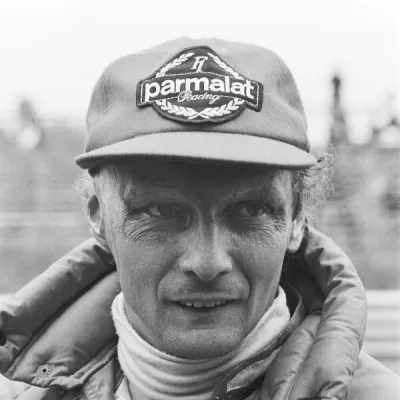
Niki Lauda
Human Design Chart
Biography
Born and raised in Vienna, Lauda was the grandson of local industrialist Hans Lauda. Starting his career in karting, he progressed to Formula Vee and privateer racing in the late 1960s. After his career stalled, Lauda took out a £30,000 bank loan and secured a place in European Formula Two with March Engineering in 1971, making his Formula One debut with the team at the Austrian Grand Prix. He was promoted to a full-time seat in 1972, ending the season with a non-classified championship finish, while winning the British Formula Two Championship. Lauda moved to BRM for the 1973 season, scoring his maiden points finish in Belgium and earning a seat with Ferrari the following year alongside Clay Regazzoni. Lauda took his maiden podium in his debut for Ferrari, and his maiden victory three races later at the Spanish Grand Prix. After winning five Grands Prix in his 1975 campaign, Lauda won his first title, becoming the first Ferrari-powered World Drivers' Champion in 11 years.
The Human Design of Niki Lauda: Manifesting Generator 4/6
Manifesting Generator 4/6 — Design at a Glance
Niki Lauda showed himself to be someone who quickly brought things into his life and pursued several projects simultaneously. As an Manifesting Generator, he had a hybrid configuration: He possessed the constant energy of the Sacral Center but was not only reactive; through additional connections to the Throat Center, he could skip steps. This speed significantly shaped his actions.
The challenge lay in the fact that this acceleration could lead to overlooking important stages. In such cases, he had to backtrack and make up for missed steps, which quickly led to frustration – the central non-self theme of this type. Additionally, he tended to respond to many different impulses simultaneously and handle multiple tasks at once.
To harness this creative power effectively, his strategy was that of Generators: He responded to life and checked whether his Sacral Center gave a clear "yes" to an initiative. Only when this inner agreement existed could he use his energy effectively. Under these conditions, he drew deep satisfaction from his work. The advice to finish one thing completely before starting the next did not suit his nature; instead, he needed variety and a playful mode to maintain his strength and prevent frustration.
Emotional Authority
Niki Lauda exhibited a decision-making structure that did not rely on spontaneous impulses but rather on an essential inner maturation process. His design featured Emotional Authority, meaning his defined Emotional Center was the sole authority for his internal guidance—regardless of all other defined centers in his chart. This configuration generated a natural emotional wave, a constant up and down of feelings that colored his perception of the world through his current mood. What appeared inspiring at one moment could become negative in the next; these fleeting impressions were not final truths but merely initial reactions.
Rapid decisions from such an emotional state would often have had negative consequences for him. Instead, his mechanics required patience and conscious hesitation. He needed to take time to let a decision mature, ideally by sleeping on it multiple times. Only when intense feelings subsided and emotional distance was gained did clarity and calmness set in for him. This process of waiting and internal condensation was not an obstacle but the essential mechanism for making long-term directional choices correctly and separating the influence of transient moods from the true essence of his choice.
The 4/6 Profile — Opportunist / Role Model
Niki Lauda revealed himself as someone whose early years were marked by an intense desire to experiment. His Profile 4/6 worked in the first three decades of his life similarly to a Line 3: He actively sought his place through diverse relationships and friendships, driven by the desire for happiness and alignment with stronger forces (Gate 55). This phase served as necessary experience gathering.
With the return of Saturn, his orientation fundamentally shifted. The Line 6 became active and brought an inner conflict between heart and head to light. On one hand, there remained a need to belong to a community (Line 4), while on the other hand, there arose a desire to withdraw in order to think about the meaning of life and take up a higher position. This contradiction between social connectedness and detached wisdom shaped his further development.
It was expected that he would assume the role of a wise role model. His authority no longer rested solely on raw energy or power but rather on sound reason (Gate 34). He learned that authenticity is possible without constant displays of power. At the same time, his big heart remained cautious; he opened up only to those who respected his integrity in order to avoid being hurt by false bonds. His life task was to master this balance between cooperation and inner independence.
Split Definition — Defined & Open Centers
Niki Lauda revealed himself as someone who possessed a consistent, reliable voice and spoke from a deep sense of his own identity. His design indicated a tendency towards clear communication that not only reflected thoughts but also conveyed willpower and vital energy directly into the world. This expressive ability stemmed from his defined Throat Center, which served as a pivot point to translate information from other parts of the body into concrete action and speech.
Additionally, Lauda had a defined G Center, giving him a fixed self-identity and a clear compass for his life direction. He knew who he was and could lead others on his path without losing his own love for himself. Parallel to this, he possessed a defined Heart Center, which gave him access to strong willpower. This allowed him to keep promises and be recognized for his contribution, while enjoying being his own boss and controlling resources. His energy source lay in the defined Sacral Center, an engine that generated immense vitality. Herein lay his strategy: not to initiate but to respond to questions or situations to ensure that the necessary energy was available.
Despite this inner stability, Lauda was vulnerable to external influences in certain areas. His open Head Center made him sensitive to mental pressure and inspiration from the environment; he tended to engage with questions that were not his own when he did not trust his inner authority. Similarly, his open Ajna Center gave him a flexible mind but could also lead him to adopt other people's concepts as his own truth or appear unsure in order to be accepted. Furthermore, his open Root Center absorbed stress and adrenal pressure from the environment, making him vulnerable in situations of high tension since he often amplified this foreign pressure rather than standing against it.
Channels for authentic action, care and deep connection.
Niki Lauda revealed himself as someone whose design anchored a deep rooting in his own existence and the present moment. This attitude stemmed from Channel of Awakening 10-20, which connected the G Center with the Throat Center. Through Gate 10 of Presence and Gate 20 of Now, he expressed clear self-affirmation: “I am”. His survival and presence were less a conscious act than the natural result of accepting and loving himself in every moment. This inner security influenced his environment without him actively leading; others felt his clarity and were inspired to be authentic as well.
This foundation of self-love was strengthened by Channel of Exploration 34-10. Here, energy flowed from the Sacral Center (Gate 34) into the G Center (Gate 10). Lauda followed his own convictions and reacted from his inner authority rather than being guided by external expectations. This promoted an independent stance that allowed him to swim against the tide of community or tradition as long as his reaction was appropriate.
The dynamics of his actions were determined by Channel of Charisma 34-20. As a classic channel for Manifesting Generators, it connected the generative power of the Sacral Center (Gate 34) directly with expression in the Throat Center (Gate 20). This gave him a rare ability to act quickly and forcefully once he had responded correctly. His energy was not meant to be tapped by others but served his own self-affirmation and vitality.
In interpersonal relationships, Channel of Community 37-40 linked the Solar Plexus Center with the Heart Center. Lauda sought fair agreements and a place within a group based on mutual benefit and emotional clarity over time. Additionally, Channel of Preservation 27-50 ensured instinctive care and the preservation of values, taking responsibility only when his own energy allowed.
Individual Circuitry — Circuit Signature
Niki Lauda's design indicated a tendency towards solidified individuality and inner stability, paired with a clear distinction between private identity and social interaction. As a Shared Definition, his energy field consisted of two non-directly connected groups: a complex connection of Throat, Sacral, Spleen, and G Centers as well as a separate axis from Heart and Solar Plexus Centers. This separation meant that his inner identity (G Center) was energetically isolated from his emotional reactions (Solar Plexus).
The F1 Circuit connected his Sacral with the Identity Center through Channel “Exploration”. This promoted pulsating, individualistic power and strong convictions, which often remained hard to verbalize without a direct connection to the Throat Center. Parallel to this, the Archer Circuit worked through Channel “Preservation”, linking Sacral and Spleen Centers. This gave him instinctive protective mechanisms and a primal concern for preservation that secured his survival.
In contrast stood the second group: The Ego Circuit connected Heart and Solar Plexus Centers via Channel “Community”. Here it was not about individual identity but reciprocal support in social contexts – an exchange of giving and taking, channeling emotional waves. Since this group was separated from the rest of the design, his social cooperation remained energetically detached from his deepest identity.
The Integration Circuit rounded out the picture: Through Channels “Awakening” and “Charisma”, it connected Throat, Sacral, and Identity Centers. This allowed him to draw power from reacting to life, lead through intuitive knowledge, and act effectively in the present – a high individuality that directly manifested in his expressiveness.
Right Angle Cross of the Sleeping Phoenix 1
Niki Lauda's design carried the signature of the right cross of the sleeping phoenix. This configuration set a specific life dynamics where profound transformations were triggered by extreme challenges or even physical threats. The term 'sleeping phoenix' points to a potential that re-emerges from a kind of resting state or defeat, often with improved clarity and strength. The right cross emphasized an active, outward engagement with these crisis moments. It was not about passive suffering but rather a mechanical necessity to break old structures to make way for higher consciousness or new abilities. For Niki Lauda, this meant that his greatest turning points were often connected to situations that questioned his survival or identity. From these moments of extreme testing, he developed further not despite the pressure but through it. The energy of this cross demanded a kind of rebirth from the ashes of earlier self-images. It was a pattern describing resilience and the ability for radical renewal when old paths became impassable. Niki Lauda lived this mechanism by using crises as catalysts for personal evolution.
Saturn Return · Uranus Opposition · Chiron Return · 2nd Saturn Return — Life Cycles
Niki Lauda's design set a tendency towards strategic realignment and the establishment of new structures, especially when external circumstances required fundamental changes. This configuration was evident in his ability to develop concrete, sustainable systems from crises or turning points rather than merely reacting.
In 1977, at age 28, Lauda became Formula-1 World Champion. This coincided with his first Saturn Return, a cycle often marking the condensation of years of groundwork into a viable result and solidifying initial major life structures. The recognition of his achievements here was less a sudden stroke of luck than visible confirmation of a long-term development line.
Ten years later in 1988 at age 39, he launched the first direct flights to Asia. This step correlated with the Uranus Opposition, a time when Human Design often shows a sudden need for horizon expansion or breaking old boundaries. Lauda used this energy not for chaotic rupture but for targeted expansion of his sphere of influence into new geographical and business dimensions.
In 1997 at age 48, Austrian Airlines acquired a 36% stake in Lauda Air. This marked the Chiron Return, a fulfillment cycle ('flowering') where living according to strategy and authority increasingly makes sense. Here his maturity of vision was evident: Integration into a larger whole confirmed the relevance of his life's work.
Finally, he founded again an independent airline under Niki Luftfahrt in 2003 at age 54. This corresponded with the second Saturn Return, often leading to final stabilization and redefinition of personal authority. Lauda returned to the roots of his independence now supported by previously acquired experience and structure. His path illustrated how cyclical energies can be translated into concrete, enduring achievements.
Manifesting Generator · Emotional Authority — Synthesis
He was a Manifesting Generator whose life was marked by constant readiness for action (sacral center, channel of awakening). This energetic endowment allowed him to seize opportunities quickly and set things in motion, yet his emotional design required careful consideration before decisions. The profile as Networker/Role Model suggests a person who increasingly perceived others' expectations over time and dealt with the desire for connection (line 4) alongside the need for independent reflection (line 6). This inner tension shaped his interactions and approach to responsibility.
A central paradox in his design lay in the interplay of quick action and emotional maturity. He could act swiftly, yet emotional authority required time for clarity. This led to a constant oscillation between the impulse for immediate implementation (Gate 10) and the necessity to fully experience feelings first to make authentic decisions. The connection of Heart Center to Throat Center pointed to strong self-definition, which continually clashed with expectations of a role model (Centering Circuit).
5 Defined Channels
Incarnation Cross - Right Angle Cross of the Sleeping Phoenix 1
Solar Return
The Solar Return shows the moment when the sun returns to its exact birth position - your personal solar year.
Life Cycles
Discover the life cycles with a detailed triple view (birth chart, cycle chart, composite).
Human Design Profile
- Strategy
- To respond - wait for something to respond to
- Authority
- Emotional Authority
- Profile
- 4/6 - Opportunist / Role Model
- Definition
- Split Definition
- Incarnation Cross
- Right Angle Cross of the Sleeping Phoenix 1
- Date of Birth
- 22.02.1949 11:02
- Place of Birth
- Vienna, Austria
Frequently Asked Questions
What was Niki Lauda's Human Design type?
What profile did Niki Lauda have in Human Design?
Which authority guided Niki Lauda?
What incarnation cross did Niki Lauda have?
When was Niki Lauda born?
Discover your own Human Design
Are you also a Manifesting Generator? Find out in a personal reading how to unfold your multi-talents and direct your energy wisely.
More Personalities
Back to overviewAldair

Alizée

Angeli

Arletty
Artus
Balthus