
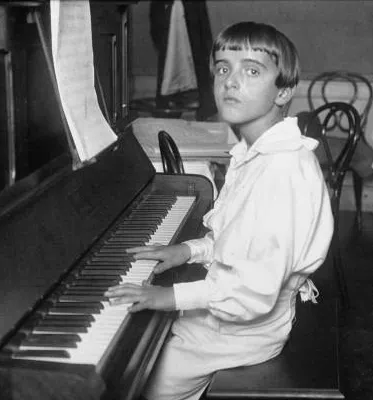
Nino Rota
Human Design Chart
Biography
Born into a family of musicians, Rota began playing the piano in 1919, studying with his mother about the same time he began to compose. In 1923, he entered the Milan Conservatory, studying with Orefice and Pizzetti. While still a child, his family moved to Rome, and he completed his studies at the Conservatory of Santa Cecilia in 1929-1930. Considered a musical prodigy, he was already gaining fame as both a composer and a conductor, and his first oratorio, "L'infanzia di San Giovanni Battista," was performed in 1923 in Milan and Paris. In 1926, he composed his lyrical comedy, "Il Principe Porcaro."
Rota won a scholarship to the Curtis Institute of Philadelphia, so from 1930-1932, he lived in the United States while attending classes in composition and orchestra. After completing his studies there, he returned to Italy and attended the University of Milan, getting his degree in literature. He began to teach in 1937, eventually becoming director of the Bari Conservatory, a title he held from 1950 until his death.
In the mid-1940s, Rota began writing film scores. He began an association with Fellini that ultimately lasted 25 years. They worked together on La Strada (1954) and La Dolce Vita (1959), among others. He worked with Visconti as well, on The Leopard (1963).
Nino Rota died from a coronary thrombosis on 10 April 1979 at age 67 in Rome, Italy.
Nino Rota as a Generator 5/1 in Human Design
Generator 5/1 — Design at a Glance
Nino Rota revealed himself as someone who possessed immense, enduring strength, comparable to a workhorse that unfolds its energy where it meets inner impulses. His design as a Generator suggested that he functioned best when he reacted rather than initiated. The strategy involved waiting for signals from the environment and then acting once the sacral center – the motor of his energy – gave a clear "yes." This gut reaction was the key to his effectiveness.
When he followed this strategy, nothing could stop him. His actions were then accompanied by a deep sense of fulfillment that served as a reward for living in harmony with his design. Conversely, two specific pitfalls threatened: If he undertook tasks that did not spark inner interest, he wasted his energy and tended towards exhaustion. Equally frustrating was being prevented from continuing his work when he was still full of energy. If he initiated actions against his inner compass, without reacting to a signal, this led to persistent frustration and a noticeable lack of energy. His path was thus marked by the necessity of deploying his great endurance only where an inner confirmation existed.
Sacral Authority
Nino Rota revealed himself as someone whose decision-making was based on a direct physical resonance. His design featured sacral authority, an inner guidance unique to the Generator type. This configuration simplified his process: the strategy of waiting for the right stimulus and his inner compass were identical. A prerequisite for this was his open Emotional Center, meaning he was not influenced by mood swings but listened to the immediate, physical response of his Sacral Center.
This response manifested as a gut feeling or surge of energy, often audible through grunting, humming, or a confirming "Mhm". Such signals marked the moment when his sacral motor kicked in. When he felt this vitality and enthusiasm, he had an inexhaustible supply of energy. He lived to lose himself in activities, driven by joy and satisfaction, without an external goal or sense of obligation being the primary focus.
Additionally, his activated Spleen Center served as a supportive instance. This connection allowed him quick, spontaneous reactions and decisions. He had immediate access to his physical well-being and instinctive perception. These instincts served as reliable guideposts, reinforcing his sacral response and helping him move confidently with the flow of life, without falling into excessive analysis or emotional delay.
The 5/1 Profile — Heretic / Investigator
Nino Rota revealed himself as someone who gathered deep, fundamental knowledge to offer others for problem-solving. His design as a Hero and Researcher (Profile 5/1) shaped this dynamic: Line 1 drove him to intensive research and the building of a solid knowledge base, while Line 5 gave him a nearly magnetic presence. Others sought him out for answers, sensing that he held solutions. This could, however, lead to overextension if he did not set clear boundaries and allowed himself to be drained by constant questioning from others.
His inner stance was marked by a specific belief: he assumed that certain patterns would recur in the future (Gate 9). This allowed him to focus intensely on details with high concentration, convinced that such effort would ultimately be rewarding. At the same time, he faced the challenge of finding the pivotal point in the confusion (Gate 64). Without this clear mental focus, no progress was possible. The internal pressure could lead to rash actions that intensified the confusion. Nino Rota learned to maintain a balance between his private research and the public use of his knowledge by setting boundaries, allowing him to use his gifts optimally without becoming exhausted.
Split Definition — Defined & Open Centers
Nino Rota was someone who stood under a constant, internal mental pressure to ask questions and understand connections. This tendency arose from his definition between Head and Ajna Centers: a permanent inspirational field, but without direct energy for implementation. Instead of acting himself, he acted as a trigger for the thinking of others, by forming concepts and theories.
At the same time, Nino Rota had a reliable, vital energy source through his defined Sacral Center. As a Generator, he was dependent on waiting for external stimuli to correctly use his energy. Initiated actions led to frustration and exhaustion, while reactive actions allowed for deep satisfaction and endurance. His defined G Center gave him a firm self-identity and a clear sense of direction, independent of others' approval. This was complemented by his defined Spleen Center, which gave him spontaneous, intuitive intelligence in the present moment, as well as his defined Root Center, which provided the necessary adrenalized pressure for survival and material existence.
In contrast, Nino Rota was open in emotional and will-related areas, thus vulnerable to conditioning. His open Solar Plexus absorbed the emotions of the environment, leading to a tendency to internalize foreign moods or to recoil from emotional confrontations. His open Heart Center lacked consistent willpower; he tended to want to prove his worth through promises or overcompensation, which often ended in a spiral of self-doubt. Additionally, his open Throat Center suffered from the pressure to gain attention by speaking or acting, rather than waiting for the natural invitation. These open areas meant that he could not rely on his own stable mechanism in these areas, but always reflected the fields of others.
Channels for change, values, rhythm and mental clarity.
Nino Rota was someone who could initiate profound direction changes by translating inner impulses into material reality. This ability stemmed from the channel of Beats 14-2, which connected the Sacral with the G Center. Gate 14 provided the necessary power competence and resources to drive mutation, while Gate 2 delivered the higher knowledge that directed movement through space and time. Together, they enabled him to pioneer innovative new paths simply by reacting trustingly to life, without predicting the outcome.
Parallel to this, the channel of Mutation 60-3 between Root and Sacral Centers worked. It connected the acceptance of limitation (Gate 60) with the attempt to create order out of confusion (Gate 3). This generated a pulsating, sometimes melancholic energy that brought evolutionary change but required patience, as mutations occurred unexpectedly and in waves. Nino Rota had to learn not to rationalize these inner fluctuations but to accept them as part of the creative process.
In Juxta-Design, the channel of Preservation 27-50 contributed to stability. It connected the caring energy of the Sacral Center (Gate 27) with the traditional values of the Spleen (Gate 50). This created a natural ability to take responsibility and nurture and protect communities or projects based on a deep instinct for what was necessary for the tribe's survival.
Mentally, the channel of Abstraction 47-64 in his design shaped his way of seeing the world. It connected the Head Center with the Ajna Center and filtered every experience through a kaleidoscope of mental images. Gate 64 brought confusion and the search for meaning, while Gate 47 promoted understanding. This led to a mind that constantly pieced together stories and sought a perspective that made the mysteriousness of life explainable, even if this often only provided clarity at a specific point in time.
Additionally, Gates like Gate 9 with its detailed work and perfection in the Sacral Center, as well as Gate 16, which promoted experimentation and mastery, were at work. Gate 63 drove the mental process through doubt and the quest for security, while Gate 10 in the G Center controlled complex integration processes and genetically determined behavioral rules. Gate 32 ensured continuity and material security, Gate 28 for decisions in the here and now. Gate 41 focused on evolutionary development and emotional depth, Gate 44 on awareness and transformation through relationships. Gate 61 sought inner truth and stillness, while Gate 15 supported collective behavior and natural rhythms.
Individual Circuitry — Circuit Signature
Nino Rota was someone whose inner identity was marked by a pulsating, acoustic rhythm. His design connected the Identity, Sacral, and Root Centers directly. This knowledge circuit gave him a unique individuality, reinforced by mutations – deviations from the known. New insights did not arise statically but in wave-like motion, directly impacting his life force and instinct.
Parallel to this, there was a separate, unconnected energy in the Head and Ajna Centers. This part of the Sense-making Circuit served abstraction. Here, Nino Rota visually and cyclically reflected past experiences. It was less about cool logic but about giving meaning to the experienced and sharing these emotional insights with others later. These two areas – the rhythmic expression of identity and abstract sense-making – existed side by side without directly flowing into each other.
A third, also separate aspect was the Archer Circuit. Through the channel of Preservation, it connected his Sacral Center with the Spleen. This gave him a primordial power of protection and nurturing. It was an ageless energy of preservation based on the instinctive knowledge of the Spleen. These three circuits formed in Nino Rota due to his split definition three parallel, independent energy fields: the pulsating expression of self, the abstract reflection of the past, and the instinctive care.
Left Angle Cross of Identification 2
Nino Rota revealed himself as someone with a profound, almost relentless curiosity about the true motives and structures of human action. His design inclined him not just to observe superficially, but to identify the essence of situations and people down to their roots. This aligned with the mechanics of the left cross of identification, a configuration marked by sharp, analytical intuition. This energy drove him to recognize patterns that remained hidden to others and to clearly articulate them. It was not merely a matter of gathering information, but an active process of penetrating and understanding. Nino Rota used this ability to decipher complex connections and translate them into tangible forms. His way of working was characterized by this clear, almost surgical precision in recognition. He sought the truth behind the facade and had the gift of revealing this truth in a way that was comprehensible to others. This power of identification was not a passive trait but an active motor of his creation and perception of the world. It enabled him to delve into the depths of topics and find answers that resonated on both a logical and emotional level.
Saturn Return · Uranus Opposition · Chiron Return · 2nd Saturn Return — Life Cycles
Nino Rota's life followed a clear rhythm of maturation and transformation, influenced by the cyclical impacts of the outer planets. His first Saturn return marked the transition into full responsibility, a phase where earlier impulses condensed into stable structures. Shortly after, the Uranus opposition occurred, a time often associated with deep inner tensions and the urge to break free from old constraints. This conflict between stability and change characterized his middle life phase.
With the Chiron return, between the ages of 49 and 51, Nino Rota reached a phase of bloom. In this fulfillment cycle, his purpose of incarnation unfolded increasingly; if he had previously followed his strategy and authority, his life's meaning became experiential and concrete here. It was not a time of healing old wounds but of realizing his potential.
The second Saturn return concluded this arc. It stood for the final consolidation of life's work, a reflection on the essential and the acceptance of one's limits. This sequence of cycles—from initial responsibility through transformative crisis to fulfillment and finally maturity—delineated Nino Rota's development as a process of continuous integration and deepening.
Generator · Sacral Authority — Synthesis
Nino Rota lived deeply rooted in his sacral energy (Generator type), which enabled him to sustain continuous activity and endurance. However, this energy was always intensified by an inner pressure towards problem-solving and knowledge dissemination (5/1 Profile, defined Head Center). He drew from a deep well of knowledge (Channel of Beats: Gate 14/2), which propelled him to learn continuously and to tread new paths—a process further fueled by the definition in the Head Center and the associated inspiration. This led to a natural tendency to find solutions for others and established him as a kind of knowledge source, yet also harbored the risk of overburdening himself.
A central paradox in Rota's design lay in the tension between his deep, sacral vitality and the constant mental pressure (Knowledge Circuit). While his sacral authority urged him to listen to his body and embrace the joy of work, the defined Head Center drove him to incessant questioning and understanding. This combination of physical energy and mental stimulation led to a life marked by creative productivity, but also carried the risk of getting lost in endless thought processes and neglecting immediate experience.
4 Defined Channels
Incarnation Cross - Left Angle Cross of Identification 2
Solar Return
The Solar Return shows the moment when the sun returns to its exact birth position - your personal solar year.
Life Cycles
Discover the life cycles with a detailed triple view (birth chart, cycle chart, composite).
Human Design Profile
- Type
- Generator
- Strategy
- To respond - wait for something to respond to
- Authority
- Sacral Authority
- Profile
- 5/1 - Heretic / Investigator
- Definition
- Split Definition
- Incarnation Cross
- Left Angle Cross of Identification 2
- Date of Birth
- 03.12.1911 07:30
- Place of Birth
- Milan, Italy
Frequently Asked Questions
What was Nino Rota's Human Design type?
What Profile did Nino Rota have in Human Design?
What Authority did Nino Rota have?
What incarnation cross was Nino Rota assigned to?
When was Nino Rota born?
Discover your own Human Design
Are you also a Generator? Find out in a personal reading how to use your sacral energy correctly and discover deep satisfaction.
More Personalities
Back to overviewAaliyah

Alexia

Alizée

Angèle

Anne-Marie

Arcángel
