
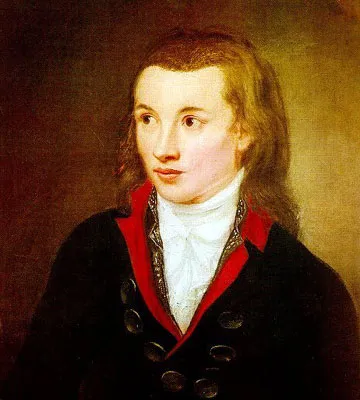
Novalis
Human Design Chart
Biography
His masterpiece is the Hymnen an die Nacht considered to be the climax of Novalis’ lyrical works and the most important poetry.
Novalis had great knowledge in science, law, philosophy, politics and political economy. His last years were astonishingly creative, filled with encyclopedic studies.
Suffered from tuberculosis, he died 25 March 1801, age 29.
The Human Design of Novalis: Generator 5/2
Generator 5/2 — Design at a Glance
Novalis has a high sacral energy that gives him great endurance. His design functions like that of a workhorse: strong and steady as long as he has energy for his tasks. This strength is only conditionally available to him; it unleashes itself primarily in reaction to external impulses, not through initiative. Therefore, the motto of his character is: react rather than initiate.
Here lie two central stumbling blocks. First, he tends to waste energy when engaging in activities that do not bring him inner joy. This leads quickly to burnout and a feeling of deep frustration or energy deficiency if he ignores his own signals. Second, he suffers from interruptions in his heart project even though his inner self wants to continue working with full power.
The successful strategy for Novalis is to wait for a signal from life and then act only when the sacral center gives a clear "Yes!" Through this reactive approach, he can use his energy efficiently. If he lives by this principle, his design rewards him with a feeling of deep satisfaction and fulfillment. On the other hand, ignoring this inner resonance or forcing himself to initiate inevitably leads to exhaustion. His nature as a Generator requires a life strategy based on intuition: only respond when there is an inner confirmation.
Sacral Authority
Novalis’ design inclines towards an inner response to external stimuli. His decision-making was characterized by sacral authority, a trait exclusive to the Generator type. This configuration simplified his process since strategy and inner authority were identical: he did not react from a planning mind but waited for a physical resonance.
This reaction manifested as gut feelings or physical impulses – a grunt, hum, or clear surge of energy. Such signals served him as a reliable source of vitality. When his sacral motor responded to a stimulus, he had inexhaustible energy and great enthusiasm. He lived to perform tasks with joy and satisfaction without having to view them as mere obligations.
A prerequisite for this clear guidance was an open emotional center. This ensured that the sacral response would not be overridden by short-term emotional waves. The mechanics described a lifestyle in which Novalis fully immersed himself in what physically appealed to him. He let himself be guided by this instinctive perception to stay in flow and complete his work with natural power.
The 5/2 Profile — Heretic / Hermit
Novalis carried an inner tension: the impulse to be admired as a hero paired with the need to retreat into his "cave" for self-strengthening. His design suggested that he liked to hide his gifts and worked hard on himself to prepare for his public role. This configuration corresponds to Profile 5/2, also known as Hero/Natural Talent. Here lies a contradiction: Line 5 demands the courage to admit mistakes and help others in times of crisis, while Line 2 harbours a selective attitude and a desire for undisturbed solitude.
As long as Novalis waited to be "discovered" by the world, bitterness and frustration threatened him because being a hero does not work as an "lone wolf". The mechanics show that success only began when he actively shared his clear insights. Once he stepped onto the stage, he was valued for his presence. Crucial however was balance: He had to set clear boundaries and ensure enough alone time to avoid failing due to overly high expectations of himself or others. His path involved stepping out of isolation without completely giving up his need for retreat.
Split Definition — Defined & Open Centers
Novalis lived under a constant internal mental pressure to inspire and form concepts. His defined Head Center and Ajna Center generated an ongoing questioning that included consciousness itself. This state was not a choice but a mechanical given: The mind was always active, processing data and forming theories. However, lacking direct energy for implementing these thoughts, attempts to act on them immediately often led to frustration or inner concern. The challenge lay in accepting this unresolved state without wanting to discharge it through hasty actions.
This mental tension contrasted with the source of his vitality: the defined Sacral Center. Here lay a tremendous power source that felt like a constant hum and generated restlessness or the need for activity. This energy was only available when Novalis responded to external impulses – not through his own initiatives. His Spleen Authority provided spontaneous, intuitive judgments in the present moment, securing health and well-being without needing rational justification.
Simultaneously, his open centers acted as mirrors of the environment. The open Throat Center tended to speak out or seek attention when it did not wait for the right timing. The open G Center had no fixed identity but reflected the direction and love from its surroundings; Novalis depended on others initiating him into the correct life path. The open Heart Center lacked consistent willpower, leading to giving promises to prove worth rather than trusting inner guidance. The open Solar Plexus Center absorbed foreign emotions, causing emotional confusion if these were not recognized as non-self. Finally, the open Root Center took in external stress, often misinterpreted as a drive for hyperactivity to relieve pressure.
Channels for mental clarity, care and traditional values.
Novalis appeared as an individual thinker whose mind did not serve logical prediction but sudden insight. His design set a foundational stance that sought silence to filter out the acoustic noise of inspiration and create space for spontaneous mutations of knowledge.
This trait was marked by the Channel of Awareness 61-24, connecting Gate of Secrets (61) in the Head Center with Gate of Rationalizing (24) in the Ajna Center. This configuration described a process where the pressure for knowledge was not resolved through abstract reflection or measurable patterns but as “Satori” – a sudden experience of inner truth. Novalis was designed to receive inspiration from the unconscious and process it mentally without exerting control over it. His mind broke old cycles and offered new perspectives by surrendering to the happy coincidence that knowledge happens in its own time. The task was to distinguish what is worth knowing from what isn’t, and not wanting to know everything.
Alongside this mental dynamics, the Channel of Preservation 27-50 worked. It connected Gate of Care (27) in the Sacral Center with Gate of Values (50) in the Spleen. This mechanism described a natural ability to inspire trust and take responsibility for the tribe or community based on a cool awareness of survival necessities. Novalis could carry much responsibility but had to learn to only assume those burdens for which he felt a sacral reaction, as his aura automatically attracted support-seeking people.
Additionally, Gates like 44 (Awareness and Transformation through Relationship) and 13 (Collective Memory and Continuity) contributed to the ability to store experiences and reflect on them in the context of time. Gate 7 projected patterns for the future while Gate 3 understood mutations as a necessary step from confusion to order. These elements formed a person standing between individual inspiration and communal responsibility, always ready to establish new orders through spontaneous insight and caring preservation.
Individual Circuitry — Circuit Signature
Novalis’ design set two parallel, energetically separated fields. On one hand, there was a pulsing acoustic drive for personal transformation in the mind; on the other, an ageless tangible necessity of genetic preservation in the body. This tension arose from his Split Definition: The energy flowed in two isolated channels without central integration.
The Knowledge Circuit connected Novalis’ Head and Ajna Centers via Channel 24-61 (Awareness). This drove the innate path to gain new knowledge and initiate change through creative intuition. The format energy was pulsing and acoustic, marked by melancholy and a drive for individuality. Here it was about expressing unique identity through innovative flashes of insight.
Simultaneously, the Archer Circuit secured the essential foundation for survival. It connected the Sacral and Spleen Centers via Channel 27-50 (Preservation). This represented instinctive protection, food, and family – the primordial care to preserve one’s genetics. The energy was timeless, rooted in touch and smell senses as well as the need to defend the core circle.
While the mental field strived for inspiration and world-bringing of new knowledge, the physical field focused purely on maintenance and preservation. Novalis lived this duality: Creative inspiration for transformation on one side, genetic preservation on the other – as two coexisting, non-fusing forces.
Left Angle Cross of Incarnation 1
Novalis carried the left Incarnation 1 Cross. This configuration established an archetypal structure that fundamentally shaped his existence. It was a specific pattern within Human-Design, understood as an 'incarnation theme' or life purpose. This cross did not determine his everyday character in a narrow sense but provided the deep, often unconscious framework for his entire existence.
The mechanics of this left Incarnation 1 Cross describe an archetypal structure that acts as a background compass determining the direction and essence of his life path. For Novalis, it meant that his experiences and developments occurred within these predefined paths. It was not a choice in the conventional sense but a given reality of his design. This structure offered support and orientation, even if it was not always consciously perceived. It shaped how he stood towards the world and what themes moved him internally. The left Incarnation 1 Cross is thus a central building block for understanding his entire life span and its underlying dynamics.
Saturn Return — Life Cycles
Around 1800, Novalis established the foundations of his social and professional identity. At age 28, he was appointed as Supernumerar-Amtshauptmann for the Thuringian Circle – a concrete milestone in this establishment.
This period coincided with his first Saturn Return. In Human-Design mechanics, this cycle marks the transition from youth to established adulthood. It is a phase where previous life work condenses and social identity consolidates. Novalis’ appointment illustrates this process: Inner maturity found its external expression in an official position that conveyed stability and responsibility.
The first Saturn Return acts like a test of previously lived strategies. Those who followed their strategy and authority now experience confirmation through structural anchoring in the societal framework. For Novalis, this meant not only a career step but also affirmation of his place in the world. The mechanics show here how inner development becomes visible through external events – not as coincidence but as a natural conclusion to a developmental phase leading to the next level.
Generator · Sacral Authority — Synthesis
Novaliss life was marked by a deep internal drive to perceive the world through a unique lens and express these insights (Channel 61-24). This ability to bring inspiration from Head and Ajna Centers into rational form seemed to propel him constantly in search of new truths. Parallel to this, there was a strong sense of responsibility for the well-being of his surroundings – an instinctive inclination towards care and value preservation (Channel 27-50). This combination of intellectual exploration and the need to preserve and nurture formed the red thread of his work. He responded to impulses from the world (sacral authority), yet processing these stimuli primarily occurred in the mental realm.
A central paradox in Novalis’ design lay in the tension between his desire for inner freedom and a strong urge to take responsibility. As a Hero type (Profile 5/2), he sought solitude to unfold his gifts, while simultaneously expecting recognition that did not automatically come to him. At the same time, his open Root Center made him vulnerable to stress and expectations from his environment, whereas his defined Sacral Center enabled him to respond with energy to what was truly right – a constant balancing act between inner drive and external pressure.
2 Defined Channels
Incarnation Cross - Left Angle Cross of Incarnation 1
Solar Return
The Solar Return shows the moment when the sun returns to its exact birth position - your personal solar year.
Life Cycles
Discover the life cycles with a detailed triple view (birth chart, cycle chart, composite).
Human Design Profile
- Type
- Generator
- Strategy
- To respond - wait for something to respond to
- Authority
- Sacral Authority
- Profile
- 5/2 - Heretic / Hermit
- Definition
- Split Definition
- Incarnation Cross
- Left Angle Cross of Incarnation 1
- Date of Birth
- 02.05.1772 06:00
- Place of Birth
- Hettstedt, GER
Frequently Asked Questions
What is Novalis' Human Design type?
What Profile did Novalis have in Human Design?
What Authority did Novalis have?
What incarnation cross did Novalis have?
When was Novalis born?
Discover your own Human Design
Are you also a Generator? Find out in a personal reading how to use your sacral energy correctly and discover deep satisfaction.
More Personalities
Back to overviewAaliyah

Alain-Fournier

Alexia

Angèle

Angeli

Anne-Marie
