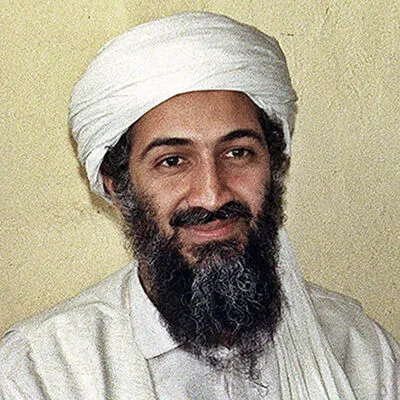
Osama Bin Laden
Human Design Chart
Biography
He aided the Afghan mujahideen in the Soviet–Afghan War (1979–1989), and then the Bosnian mujahideen in the Bosnian War (1992–1995). He played a role in starting both the Algerian Civil War (1992–2002), in which he aided the GSPC, and the War in Afghanistan (2001–2021), in which he aided the Taliban. Al-Qaeda in Iraq, later named the Islamic State of Iraq, fought in the Iraq War (2003–2011).
Bin Laden was raised into Sunni Islam in Saudi Arabia. His family was wealthy, having financial ties to the country's royal House of Saud. In 1979, he left to help mujahideen repel the Soviet Union's invasion of Afghanistan, and in 1984, co-founded Maktab al-Khidamat to recruit foreigners into the rebellion. In 1988, bin Laden founded al-Qaeda to enact violent jihad worldwide. The Soviets withdrew from Afghanistan in 1989, and he returned to Saudi Arabia. Bin Laden's public beliefs led to his expulsion from Saudi Arabia in 1991. He then moved with al-Qaeda to Sudan. In 1996, Sudan also expelled him, and he moved al-Qaeda to Afghanistan, which soon came under Taliban control.
Osama Bin Laden — Generator with Profile 3/5
Generator 3/5 — Design at a Glance
Osama Bin Laden possessed as a Generator enormous sacral endurance. His design functioned like that of a workhorse: extremely strong and durable if the energy for the task was available. This power, however, did not come from his own initiative but primarily through reacting to external impulses. The mechanics of his type required him to „react“ rather than „initiate“. Only when he responded to signals from his environment and confirmed his sacral center with a clear inner „yes“, could he effectively use this energy.
This system offered two specific dangers. The first stumbling block occurred if he focused on tasks that did not require internal consent for long periods. In such situations, he wasted his resources and was prone to burnout as the intrinsic creative force was blocked. The second danger lay in being held back from his heart project despite still having full power available. Here, suppressing the urge to work led to deep frustration.
If Osama Bin Laden did not live according to this design – especially by constantly initiating without reacting to external signals – he encountered a persistent feeling of energy shortage and frustration. Conversely, correctly applying his strategy, acting from the gut, rewarded him with profound satisfaction. His fundamental energy architecture allowed him to materialize things in life but only through consistently waiting for life signals and then acting accordingly.
Emotional Authority
Osama Bin Laden's inner authority was the defined Solar Plexus Center, which shaped an emotional decision-making process. His perception was subject to constant waves of ups and downs in his feelings; the current mood served as a filtered snapshot, not absolute truth. In one moment he could be enthusiastic about something, in the next view the same situation completely negatively. This fleeting emotional reaction was merely a first impression, not yet his deeper insight. Quick, spontaneous decisions stemming directly from this immediate emotion carried the risk of negative consequences due to lack of distance.
The mechanics of his emotional authority required time and patience to gain clarity. The longer he let a decision rest, the more comprehensive he could grasp the situation. This meant literally sleeping on decisions and asking himself multiple times – i.e., reviewing them several times. Over time, intense feelings subsided, creating an emotional distance. Only then did calmness set in and the process was complete. This approach was essential for long-term decisions with significant influence on his life course, ensuring that not just passing moods but actual emotional truth guided actions.
The 3/5 Profile — Martyr / Heretic
Osama Bin Laden's design was characterized by a fundamental stance of radical experimentation, acquiring knowledge exclusively through personal trial and error. He believed nothing given to him but had to test every strategy himself for its validity. This process of learning through trial and error formed the basis for his later role as a hero who fascinated others with practical experience.
Line 3 of his profile drove him to enter into and then break bonds, creating fleeting openness. Emotional energy and consciousness developed over time into complete grace, yet always connected with the risk of public failure. Simultaneously, he acted through Line 5 as an attractive figure whose authority was based on accumulated experience. This line gave him adaptability and skill in understanding and winning people over in crisis situations. His strong ego resisted fundamental changes since it felt uncomfortable learning new techniques. Instead, he used his memory and salesmanship to win others over for his perspective. The tension between the necessity of testing everything himself and the pressure to act as a heroic problem solver shaped his essence. Pain arose mainly when experiments failed before the eyes of others; success flattered his ego and strengthened his appeal to those who wanted to learn from his experiences.
Split Definition — Defined & Open Centers
Osama Bin Laden was marked by a design that combined persistent mental concepts with a firm identity and reactive life energy. His defined Ajna Center ensured constant, specific thinking; he was always caught in a mental process, which made meditation difficult but provided consistent theoretical structures. These thoughts flowed directly into his defined Throat Center, functioning as a reliable expression mechanism: He spoke out what his mind conceptualized, giving his communication a persistent yet limited clarity.
His defined G Center gave him a clear self-image and a firm sense of direction or mission. This created a magnetic presence that tended to draw others into this predetermined path without respecting their individual paths. The driving force behind this system was his defined Sacral Center. As a Generator, he had immense vital energy, but it only became accessible through correct reactions to external impulses. Initiating actions without prior questioning inevitably led to frustration and exhaustion as the sacral energy then wasn't available.
He also filtered decisions through his defined Solar Plexus Center, his emotional authority. Here, truth revealed itself over time. Impulsive reactions to emotional waves would have been counterproductive; instead, his design required patience to gain clarity before taking action.
At the same time, Osama Bin Laden was situationally vulnerable due to several open centers. His open Head Center made him susceptible to external mental pressure and confusion; he tended to identify with others' questions or seek inspiration from outside rather than trusting his inner authority. The lack of a constant willpower in his open Heart Center could trap him in cycles of self-proving – an attempt to demonstrate worth through performance, often failing and lowering self-esteem. Additionally, his open Root Center absorbed stress from the environment, leading to unbearable pressure and hyperactive behavior to get rid of this foreign adrenaline rush. His open Spleen Center also made him vulnerable to spontaneous, fear-driven decisions that were not based on his own intuition but rather conditioned uncertainty about health and survival.
Channels for rhythm, intimacy, insight and determination.
Osama Bin Laden was characterized by a dominant inner rhythm that enabled him to propel groups forward not through conscious planning but through his constant, vital presence. This natural authority resulted from the Rhythm Channel 5-15, connecting the Sacral Center with the G Center. Gate 5 held onto firm habits and rituals while Gate 15 integrated the diversity of society into life flow. This mechanism generated a magnetic energy flow that drew others impersonally into his rhythm, thus enabling collective movement without intellectual effort.
Additionally, the Pairing Channel 59-6 defined intimacy as a powerful connection between Sacral and Solar Plexus Centers. Through Gate 59 (Sexuality) and Gate 6 (emotional friction), there arose a drive for merging that intensified relationships and made them potentially fruitful. However, this energy required patience since the emotional wave of the Solar Plexus needed time to clarify; spontaneous actions without this waiting phase often led to confusion or complications in social dynamics.
In the mental realm, the Channel of Structuring 23-43 shaped his mode of expression. Gate 43 received spontaneous insights that were assimilated and communicated through Gate 23. This allowed him to formulate innovative perspectives that could change others' thinking, provided these expressions aligned with his inner timing. Without this timing, his unique knowledge was often rejected or misunderstood.
The Discovery Channel 29-46 underscored his persistence. Gate 29 offered access to the Sacral's endurance through positive affirmation while Gate 46 connected him with his life direction. This created a deep commitment to his experiences, requiring him to let go of expectations to gain insights at the end of a process. Additional gates like 22 (Openness), 47 (Purpose from Past) and 26 (Innovation in Clan) complemented this profile by adding listening skills, processing collective history, and convincing conservative surroundings for new paths.
Collective Circuitry — Circuit Signature
Osama Bin Laden's design revealed a deep inner split: intellectual structuring and emotional instinctive power existed as two separate, unconnected systems. His chart showed a Split Definition, meaning his energy did not radiate outward as an independent wave but was strongly dependent on external validation or specific environments to activate.
In the Knowledge Circuit, Channel 43-23 (Structuring) connected Ajna Center with Throat Center. This created a capacity for logical organization and verbal communication of concepts – isolated from any emotional coloring. It was pure information processing and expression.
Simultaneously, there existed a separate energetic network in the Understanding, Purpose, and Protector Circuits. Here, Channel 15-5 (Rhythm) connected Identity Center with Sacral Center, providing rhythmic, instinct-driven life force. Parallel to this, Channel 46-29 (Discovery) also linked Identity and Sacral Centers while Channel 59-6 (Pairing) connected the Sacral Center with Solar Plexus Center. This configuration generated a strong wave-like emotional intensity and deep protective instincts for his group or family.
Since Ajna/Throat and Sacral/Solar Plexus/Identity were not interconnected, there was no direct flow between strategic thinking and emotional action power. Osama Bin Laden thus operated with a mechanical separation: His mind structured and communicated rationally while his actions were driven by separate, instinctive and emotional waves – two parallel existing but not integrated forces.
Right Angle Cross of Rulership 1
Osama Bin Laden's design carried the signature of the right cross of governance, a configuration that anchored him deeply in responsibility for the collective. This structure marked him as someone whose actions did not primarily stem from individual ambition but rather from a strategic orientation towards the greater good. His motivation lay in protecting and leading the community, driven by the vision of a better, more just order.
In Human Design, this cross describes a specific energy aimed at creating or maintaining structures that serve the well-being of all. It is not about power for its own sake but rather about the burden and claim to care for the whole. Osama Bin Laden showed through this configuration as a figure who oriented their decisions around whether they contributed to stabilizing or improving societal structures. The emphasis was on collective security and building systems that, in his belief, offered protection. This energetic alignment led him to see himself as a guardian of a certain order whose preservation he deemed essential. His work was thus marked by the drive to take responsibility for the collective and implement a vision of structure and security into reality, independent of individual evaluations of this specific order.
Saturn Return · Uranus Opposition · Chiron Return — Life Cycles
Osama Bin Laden's life journey was marked by three significant turning points that shaped shifts in relationships, location, and strategic communication. In 1985, at age 28, he married his third wife Khairiah Sabar. This coincided with his first Saturn return, a cycle often condensing years of groundwork into stable structures and solidifying personal bonds.
Ten years later, in 1997 at the age of 40, he flew to Kandahar with family and entourage. This relocation marked the Uranus opposition, a phase of radical realignment where old location or status bindings are dissolved to make room for new freedom spaces.
In 2006, at the age of 49, he threatened new attacks in the USA while simultaneously offering a ceasefire. This aligned with his Chiron return, a fulfillment cycle between ages 49 and 51. During this phase, one's incarnation cross increasingly unfolds; the meaning and purpose of their design become experiential if they follow their strategy. Here, complex communication that combined threats and negotiation offers was an expression of this profound inner alignment manifesting outwardly.
Generator · Emotional Authority — Synthesis
Osama Bin Laden consistently showed himself to be someone deeply rooted in his reaction to the environment (Sacral Center), connected with a strong internal direction (G Center). This combination manifested in a life marked by intense experiences and the need to process these into clear personal truth (emotional center). The ability to learn from these experiences and integrate them into a coherent worldview formed the core of his actions. His energy seemed focused on structuring concepts and their dissemination (Ajna-Throat Channel), which endowed him with a certain persuasiveness.
A central paradox lay in the tension between his need for deep connection and intimacy (Pairing Channel) and his ability to emotionally distance himself and act from a detached perspective (open heart center). He seemed driven both by the desire to enter into and nurture relationships as well as by the necessity to dissolve or control these bonds. This dynamic led to a life marked by intense experiences but also emotional distancing.
4 Defined Channels
Incarnation Cross - Right Angle Cross of Rulership 1
Solar Return
The Solar Return shows the moment when the sun returns to its exact birth position - your personal solar year.
Life Cycles
Discover the life cycles with a detailed triple view (birth chart, cycle chart, composite).
Human Design Profile
- Type
- Generator
- Strategy
- To respond - wait for something to respond to
- Authority
- Emotional Authority
- Profile
- 3/5 - Martyr / Heretic
- Definition
- Split Definition
- Incarnation Cross
- Right Angle Cross of Rulership 1
- Date of Birth
- 10.03.1957 10:58
- Place of Birth
- Dschidda, السعودية
Frequently Asked Questions
What was Osama Bin Laden's Human Design type?
Which profile did Osama Bin Laden have?
What authority did Osama Bin Laden have?
What incarnation cross was active for Osama Bin Laden?
When was Osama Bin Laden born?
Discover your own Human Design
Are you also a Generator? Find out in a personal reading how to use your sacral energy correctly and discover deep satisfaction.
More Personalities
Back to overviewAaliyah

Alexia

Angèle

Anne-Marie

Arcángel

Arno