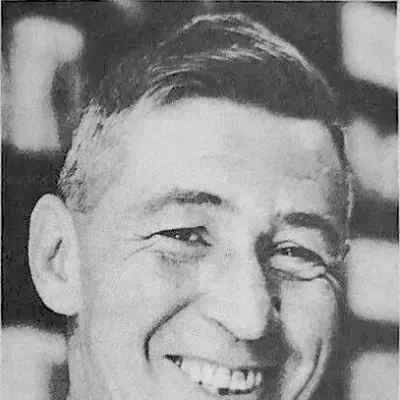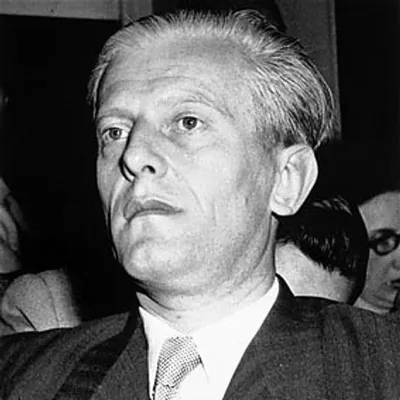
Otto Friedrich Abetz
Human Design Chart
Biography
Sentenced as a war criminal in July 1949 to 20 years prison, he was released in April 1954.. On 5 May 1958 he burned to death in a "motor accident" when something went wrong with the steering wheel of his speeding car, suspected as espionage in revenge for the lives he took.
Otto Friedrich Abetz as a Projector 1/3 in Human Design
Projector 1/3 — Design at a Glance
Otto Friedrich Abetz revealed himself through a dense, focusing aura that made systemic errors immediately apparent. His design worked like a bright flashlight, directing light to areas where others were still in darkness or where processes weren't functioning properly. This ability to 'shed light into the dark' and illuminate the path was central to his nature as a Projector.
However, this sharp perception required a specific strategy to remain effective. Addressing deficits directly often led to defensive reactions from others, akin to shining a bright light in someone's face. Instead, Otto Friedrich Abetz was most effective through his own exemplary function; by living harmoniously, he attracted others who then sought out his insights. The core strategy thus involved waiting for an honest and appreciative invitation rather than correcting unilaterally. This prevented the non-self theme of bitterness that arises when Projectors struggle against the resistance of their environment.
Furthermore, due to his undefined Sacral Center, Otto Friedrich Abetz lacked constant intrinsic life energy. His energy followed a cyclical pattern: phases of high intensity and rapid productivity alternated with necessary rest periods to avoid burnout. This need for regeneration often conflicted with societal structures that expected continuous performance. Living according to this design rewarded him with success; ignoring these rhythms and strategies led to bitterness as the dominant feeling.
Splenic Authority
Otto Friedrich Abetz demonstrated decision-making based on a fine, immediate inner impulse. His design carried internal authority in his defined Spleen Center while leaving the Emotional and Sacral Centers open – a configuration unique to Projectors or Manifestors. The Spleen acted as his health and alarm system, equipped with spontaneous survival intelligence. This instinct signaled him in the moment whether a situation, environment, or society was right for him.
Decisions had to be made instantly; the first spontaneous impulse was correct and served immediately to protect his health. This allowed him to rigorously set boundaries against harmful influences of all kinds. However, since this Spleen impulse was very subtle and only occurred once, it required high vigilance not to miss or drown out by other influences. Long-term planning proved counterproductive for his design as the right thing became apparent only in the moment. Instead, he needed radical flexibility and much freedom to react spontaneously to situations. Committing himself was difficult; instead, he adapted situationally, which helped him care for himself optimally and protect against dangers.
The 1/3 Profile — Investigator / Martyr
Otto Friedrich Abetz revealed himself as someone whose life revolved around self-earned and tested insights. His design created an inner tension between theoretical foundation and practical implementation: Line 1 of his Profile ensured openness to many opinions and a discerning thought process that initially collected much input. This often led to fear of action, as he felt he didn't know enough yet. Simultaneously, the energy of Line 3 drove him to test these theories in reality. It gave him independence and the ability to self-stimulate through experiments.
This configuration meant his judgment about things or activities was only trustworthy if he had rigorously tested them both theoretically and practically. When Otto Friedrich Abetz considered something right, it was the result of a rigorous process of trial and error. Development progressed from anxious planning towards bold implementation. He learned through experience, with Line 3 transforming early dependency experiences into independent experimentation. His character was marked by the need to validate knowledge actively rather than merely consume it. Only then did authenticity arise in his conclusions. He functioned as both a researcher and experimenter, finding his own truths only through the collision of theory and practice.
Single Definition — Defined & Open Centers
Otto Friedrich Abetz exhibited a stable inner foundation of firm self-worth and intuitive presence. His defined G Center gave him a reliable identity and a clear sense of life direction, independent of external validation. Simultaneously, his defined Spleen Center served as a source of spontaneous intuition that acted in the present moment, along with the defined Root Center, which provided constant existential pressure to maintain the impulse for living. These three centers formed the solid core of his design.
This stood in stark contrast to his six open centers: Head, Ajna, Throat, Heart, Sacral and Solar Plexus. Otto Friedrich Abetz was not designed to generate consistent mental clarity or emotional stability from within himself. His open Head and Ajna Centers made him vulnerable to mental confusion and the uptake of foreign ideas; he tended to seek answers that belonged to others. The open Heart Center often led to attempts to make promises or prove willpower to demonstrate value – a trap, as he lacked the consistent energy for this.
His open Sacral Center did not provide constant energy flow; instead, he absorbed the vitality of his environment, which could lead to exhaustion if he did not trust his inner authority. Similarly, his open Solar Plexus took on and amplified foreign emotions, putting him at risk of identifying with others' moods or avoiding conflicts out of fear of rejection. The challenge lay in not compensating for this openness through controlling behavior – such as seeking mental control or attention in the open Throat Center – but rather using defined intuition and inner pressure as a compass while treating the open centers merely as mirrors reflecting his environment.
Channels for intuitive elegance, critical judgment and ambitious transformation.
Otto Friedrich Abetz was someone whose actions were marked by a deep, intuitive adaptability to physical reality. This quality stemmed from Channel of Perfect Form 57-10, connecting Spleen and G Center. Through Gate 57 (intuitive insight) and Gate 10 (self behavior), spontaneous wisdom arose beyond thought, allowing him to move through the world existentially unburdened and perfecting his survival in the present moment.
Simultaneously, Otto Friedrich Abetz possessed a sharp logical instrument for pattern correction. Channel of Judgment 58-18 connected Root with Spleen via Gate 58 (vitality) and Gate 18 (correcting). This drove an insatiable urge to question and perfect any patterns. His judgment functioned like a sentry, evaluating what was healthy for the collective, using this critical energy most effectively when explicitly asked for his solution.
Ambitious advancement through social support characterized a third mechanism: Channel of Transformation 54-32. This connected Root and Spleen via Gate 54 (ambition) and Gate 32 (continuity). Here was a drive to improve one's position, driven by the awareness of the tribe's fragility. Otto Friedrich Abetz sought talents to secure his environment's welfare, with his rise always dependent on mutual interdependence and *quid pro quo* within his social group.
The energetic focus lay in Sun at Gate 17 (succession). This shaped a focus on logical teaching and organizing for the future as well as maintaining fundamental human rights. For Otto Friedrich Abetz, genuine understanding was the prerequisite for any organization, with doubt accepted as an integral part of this healthy process of succession and serving leadership.
Individual Circuitry — Circuit Signature
Otto Friedrich Abetz exhibited a cognitive structure based on logical clarity and strategic focus. His design connected Spleen and Root Center through Channel of Judgment (18-58) in the Understanding Circuit. This allowed for sharing rational insights, free from emotional conditioning or Solar Plexus influence. The energy was visual and future-oriented, driven by the desire to lead society into a better future through structured improvement.
Parallel to this, Channel of Transformation (32-54) in the Ego Circuit also between Spleen and Root Center. Although this circuit belongs to the tribe group and emphasizes cooperation and resource creation, Abetz lacked direct connection to Sacral Center. This required pauses for regenerating energy for collective creation. The focus here was on traditional support and exchange within the tribe, timeless and conservatively anchored.
A third aspect came from the Integration Circuit: Channel of Perfect Form (10-57) connected Identity Center with Spleen. This promoted highest individuality and the ability to lead power through correct behavior and intuitive knowledge in the present moment. As Abetz had a Simple Definition, these centers – G, Spleen, and Root – formed one continuous energetic flow. The separate circuits did not act isolated but as integrated forces that unified his identity, judgment capacity, and transformative capability in a flowing process.
Right Angle Cross of Service 1
Otto Friedrich Abetz revealed himself through a fundamental orientation towards service as the core of his identity. This was not superficial helpfulness but rather the structural foundation of his essence, shaped by the archetype of Service in his Human Design. His design suggested that he defined his self-understanding primarily through serving others' needs.
This attitude stemmed from the right cross of Service 1. This configuration characterizes an energy marked by profound self-sacrifice and immersion in service to others. For Otto Friedrich Abetz, this was not a conscious choice or a moral ideal he pursued but rather an inherent mechanical aspect of his character. The energy of this cross compelled him to transcend personal boundaries for the sake of others and fully immerse himself in their necessities.
Thus, his life design was determined by this specific dynamic: identity did not arise through separation or self-assertion in a traditional sense, but rather through actively embracing and addressing demands from the environment. The right cross of Service 1 acted as a driving force that led him to see his existence justified in his ability to benefit others. This structural orientation profoundly shaped his actions because it served as the primary filter through which he perceived and responded to the world. It was about an essential connection with others, where ego receded to make space for service.
Saturn Return · Uranus Opposition · Chiron Return — Life Cycles
Otto Friedrich Abetz exhibited a dynamic where external power structures were intricately intertwined with internal wounds. In 1942, at age 39, he was promoted to SS-Brigadeführer. This marked the peak of an Uranus opposition cycle, often characterized by sudden turning points and the breaking down of old structures. During this phase, his design sought new, often radical forms of authority and positioning within hierarchical systems.
A stark contrast emerged in 1954 when he was released from prison at age 51. This fell during a Chiron Return cycle between ages 49 and 51. In Human Design mechanics, this is not a process of psychological wound healing but rather a moment of bloom where the incarnation cross unfolds. For Otto Friedrich Abetz, his release did not merely signify physical liberation but marked entry into a phase where his existential purpose and the consequences of earlier actions became clearly experiential. The Chiron Return demanded integration of these experiences as part of his life's mission, moving away from pure power assertion towards confrontation with his true essence. The distance between his promotion in 1942 and release in 1954 highlighted the arc from external power acceptance to necessary internal alignment within the fulfillment cycle.
Projector · Splenic Authority — Synthesis
Otto Friedrich Abetz’s life was marked by an inner compass based on intuitive recognition and correction (Channel 58-18). The ability to identify errors in the system and complete patterns seemed a central motive – coupled with a drive for logical analysis to establish order. This tendency was reinforced by his defined Spleen Center authority, which provided immediate instinctive knowledge about well-being and correctness of situations. The combination of this intuitive perception and need for perfection led to a strong focus on uncovering inconsistencies and striving for improvement, always centered on survival and securing one's status (Channel 54-32).
A central paradox in Abetz’s design lies in the interplay between his ability for intuitive insight (Gate 57) and undefined Solar Plexus Center. While he possessed a talent to grasp and understand others' emotions, he lacked a stable emotional base to sort through these perceptions without being overwhelmed by them. This likely led to constant tension between the need for control and vulnerability to external influences, further intensifying his drive to establish order through logical analysis and secure his position.
3 Defined Channels
Incarnation Cross - Right Angle Cross of Service 1
Solar Return
The Solar Return shows the moment when the sun returns to its exact birth position - your personal solar year.
Life Cycles
Discover the life cycles with a detailed triple view (birth chart, cycle chart, composite).
Human Design Profile
- Type
- Projector
- Strategy
- Wait for the respectful invitation
- Authority
- Splenic Authority
- Profile
- 1/3 - Investigator / Martyr
- Definition
- Single Definition
- Incarnation Cross
- Right Angle Cross of Service 1
- Date of Birth
- 26.03.1903 09:00
- Place of Birth
- Schwetzingen, Germany
Frequently Asked Questions
What is Otto Friedrich Abetz's Human Design type?
What Profile did Otto Friedrich Abetz have?
What authority did Otto Friedrich Abetz have?
What incarnation cross did Otto Friedrich Abetz have?
When was Otto Friedrich Abetz born?
Discover your own Human Design
Are you also a Projector? Find out in a personal reading how to unfold your leadership qualities and recognize the right invitations.
More Personalities
Back to overviewSissy Spacek

Alain-Fournier

Anémone

Ann-Margret

Bourvil

Hergé