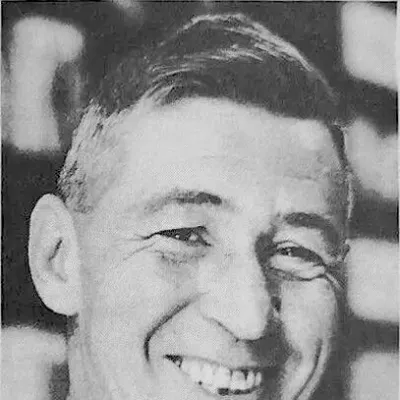
Photo: Wikimedia Commons
Otto Heinrich Warburg
Human Design Chart
Biography
He died 1 August 1970, Berlin, Germany.
Otto Heinrich Warburg as a Projector 6/3 in Human Design
Projector 6/3 — Design at a Glance
Otto Heinrich Warburg's Design inclined towards precise system analysis. As a Projector, he did not have an intrinsic energy source like a Generator but rather operated through a dense, focused aura that functioned similarly to a bright flashlight: it cast its beam directly onto areas in his surroundings that were "in the dark." This configuration gave him the ability to immediately identify errors within a system.
The challenge of this Design lay in interacting with others. When he addressed these deficits directly, it often felt like shining a harsh light into someone's face and provoked rejection. Therefore, the optimal strategy for his Design did not involve actively imposing his viewpoint but rather waiting for a genuine invitation from others that was valued and meant sincerely. By acting harmoniously himself, he became attractive; others then came to him voluntarily seeking advice.
This mechanism also explained his energy phases: Without a defined Sacral Center, he lacked consistent life energy and worked in intense phases quickly and efficiently, followed by necessary rest periods for regeneration. If he lived according to the strategy of invitation, he was rewarded with success. Ignoring it and instead trying to impose his insights resulted sooner or later in the non-self theme of bitterness – a feeling of injustice and not being understood, arising from the resistance of his environment against his direct "light."
Splenic Authority
Otto Heinrich Warburg's Design inclined towards impulsive, instinctive decision-making. His inner authority resided in the defined Spleen Center – the center for health and survival intelligence. This configuration required open Emotional and Sacral Centers; only Projectors or Manifestors could carry this specific authority.
The Spleen Center functioned as a fine alarm system. It provided spontaneous inner knowledge about whether a situation, environment, or society served well-being. The first impulse was the most reliable indicator of what was right. However, this impulse was fleeting and appeared only in the immediate moment. It could easily be ignored or overridden by external influences, requiring high vigilance. Decisions therefore had to be made in the present; hesitation led to the overlaying of the clear signal.
This mechanism shaped his lifestyle: Otto Heinrich Warburg demonstrated the ability to rigorously shield himself against harmful influences and independently care for his physical well-being. At the same time, this meant that long-term commitments were difficult, as the right choice was only recognizable in the current moment. His Design favored flexibility and freedom over rigid planning. A retreat for decision-making could be helpful to perceive the fine impulse before it faded. The authority of the Spleen Center took precedence over other defined Centers; it determined the direction of actions immediately here and now.
The 6/3 Profile — Role Model / Martyr
Otto Heinrich Warburg's design inclined towards persistent experimenting. As a person with the Profile 6/3, he primarily lived as a Three in his first three decades of life, which was evident through numerous self-experiments. This constant testing slowed down around the time Saturn returned at age thirty but never fully ceased because the Line of Adventure remained permanently present in his profile. Warburg felt internally restless and continuously sought after the extraordinary, far from standard solutions. His old soul propelled him not only to find the ordinary but also to shape an extraordinary life. While he loved adventures, responsibility and wisdom became natural for him after age thirty. He used his unusual experiences to become a visionary role model. The mechanics of his Line 48 promoted self-actualization and allowed him to share profound inspirations. Simultaneously, he learned through trial and error, often unconsciously provoking conflicts to spur development. This configuration marked him as someone who did not keep his insights solely for himself but shared them to affirm the value of others.
Single Definition — Defined & Open Centers
Otto Heinrich Warburg's Human Design profile indicated a tendency towards spontaneous, intuitive communication. His defined Spleen Center connected with his also defined Throat Center, meaning that his voice did not come from conceptual thinking or emotional waves but rather from an immediate, bodily instinct in the present moment. He was someone who articulated information directly and without much deliberation, guided by a deep perception of what was relevant for survival or health at any given moment. This configuration fostered an expression based on reliable, momentary insights instead of theoretical constructs.
At the same time, his chart revealed high susceptibility to external mental and emotional influences. His open Head Center made him vulnerable to mental pressure and the need to find answers to questions that were not his own; he tended to get lost in other people's thoughts when he did not follow his inner compass. The open Ajna Center amplified this by offering intellectual flexibility but also bringing the risk of adopting foreign concepts as personal truth or appearing uncertain where no firm opinion existed.
His open G Center meant that he did not carry a fixed identity, instead finding it through interaction and the right place; he reflected the environment rather than taking on a rigid role. The open Heart Center freed him from the compulsion to prove willpower or keep promises to demonstrate his worth – a protective mechanism against self-doubt. Additionally, his open Solar Plexus absorbed other people's emotions, making him sensitive to emotional climates but also prone to personalizing others' moods. His open Sacral Center lacked a constant energy flow; he worked in spurts and needed rest phases to avoid being exhausted by the generative energy of his surroundings. Finally, his open Root Center took on external stress, which made him vulnerable to adrenalized pressure that he could interpret as his own failure or lack of capability rather than recognizing it as external conditioning.
Channels for deep knowledge, experiments and intuitive clarity.
Otto Heinrich Warburg's Human Design profile indicated a tendency towards deep, instinctive insight coupled with the drive to refine this through precise repetition. The Channel of Wavelength 48-16 connected the intuitive depth of Gate 48 with the technical skill of Gate 16. This promoted a lifestyle where inner intelligence was not only sought but transformed into mastery through constant practice. Warburg showed himself as someone who perfected his skills to find solutions or correct patterns – a process that required recognition and resources to further develop talent.
At the same time, the Channel of Lightning Flash 57-20 worked. It connected the intuitive insight of Gate 57 with immediate expression through Gate 20. This gave him the ability to articulate spontaneous truths directly and clearly without much thought. This configuration supported an immediate self-awareness and the capacity to encourage others to awaken their own survival intelligence.
Additionally, further Gates shaped his profile: Gate 21 focused on material control and respect in the community, while Gate 53 as a pioneer spirit initiated new developmental cycles. Gate 54 linked worldly success with spiritual insight, supported by partnership dynamics. Gate 28 demanded decisions here and now under risk assessment, and Gate 56 enabled the figurative storytelling of complex mental processes. In his design, Gates 44 with awareness during transformations, 12 with creative restraint, and 8 as a driving force for individual contribution also played roles. Gate 23 rounded out the picture through amoral understanding and the ability to explain otherness and bring mutations into the world.
Collective Circuitry — Circuit Signature
Otto Heinrich Warburg's Human Design profile indicated a tendency towards impulsive, innovative communication. His chart was marked by the Knowledge Circuit, which specifically worked through Channel 20-57 in him. This channel connected the Throat Center with the Spleen Center and generated energetic lightning flashes – spontaneous, creative intuitions that were directly translated into words. This configuration promoted the ability to transform new knowledge through acoustic expression and carry individual identity pulsing outward. Parallel to this, the Understanding Circuit worked through Channel 16-48, also between Throat and Spleen Centers. This channel allowed for clear articulation of logical strategies and focused visual insights. As Otto Heinrich Warburg had a simple definition, these two circuits did not form separate systems but rather a continuous flow within the same center group (Throat and Spleen). This resulted in a direct connection between intuitive creativity and rational analysis: The lightning flashes from the Spleen were not only felt but structured through the logic of the mind channel and precisely shared through the Throat Center. His energy was thus both creatively and strategically focused, with both aspects utilizing the same expression pathway to initiate changes through clear, innovative messages.
Left Angle Cross of Endeavour 2
Otto Heinrich Warburg's Design indicated a tendency towards tireless, structured striving. He was someone whose energy was marked by the "left cross of Effort 2" – a configuration that aims at consistent, often laborious building and refinement. This mechanism did not describe spontaneous inspiration but rather a deep commitment to working on oneself and projects. For Otto Heinrich Warburg, this meant that progress did not come as sudden revelations but had to be worked out through gradual, disciplined effort. The Effort 2 cross emphasized the necessity of analyzing mistakes and learning from them instead of ignoring them. His life energy flowed into detail, precision, and perseverance. It was a path of "doing" where each step was consciously set to create a stable foundation. Otto Heinrich Warburg lived this dynamic as someone who knew that true mastery is only achieved through repeated practice and correction. His inner drive did not come from external recognition but from the internal satisfaction of improving something step by step. This attitude shaped his entire work: a quiet yet irresistible force of wanting and doing, which focused on durability rather than quick success.
Saturn Return · Uranus Opposition · Chiron Return · 2nd Saturn Return — Life Cycles
Otto Heinrich Warburg's design inclined towards structured and long-term work that condensed into clear milestones. This configuration often manifests as the ability to systematically build knowledge and lead it to a solid outcome. His first Saturn return marked such a turning point: in 1911, at age 28, he earned his Dr. med. degree from Heidelberg University. This step was typical of his design – a moment when years of groundwork transformed into a stable foundation enabling further developments.
Later, another dynamic of his design became apparent: the unfolding of one's life purpose. The Chiron return, which occurs roughly between ages 49 and 51, is an embodiment cycle in which the incarnation cross unfolds increasingly. For Otto Heinrich Warburg, this process began earlier: in 1931, at age 48, he was awarded the Nobel Prize for Physiology or Medicine "for his discovery of the nature and mode of action of the respiratory enzyme." This was no coincidence but a confirmation of his life's mission – uncovering hidden connections and communicating them to others. His design marked him as someone who not only gathered insights but also conveyed them in ways that made an impact.
Projector · Splenic Authority — Synthesis
He was a Projector whose life was marked by a deep drive to recognize and inspire the potential in others (Projector Type, Gate 16). This ability to identify flaws in the system (Gate 48) seemed inseparable from an inner wisdom drawn from the Spleen Center – a spontaneous knowledge of what was beneficial or harmful. Through the Channel of Wavelength, he constantly sought opportunities for refinement and perfection (Channel 48-16), with experimentation and the search for new paths continuing beyond his thirtieth year (Profile 6/3).
A central paradox lay in how he shared his insights. On one hand, he was destined to shed light into darkness and inspire others (Projector), while on the other hand, his Spleen authority required an instinctive boundary-setting and a cautious approach. The ability to generate profound knowledge (Knowledge Circuit) thus seemed connected with a delicate balance between the desire for influence and the necessity of self-protection, which was evident in documented events – both academic progress and success.
2 Defined Channels
Incarnation Cross - Left Angle Cross of Endeavour 2
Solar Return
The Solar Return shows the moment when the sun returns to its exact birth position - your personal solar year.
Life Cycles
Discover the life cycles with a detailed triple view (birth chart, cycle chart, composite).
Human Design Profile
- Type
- Projector
- Strategy
- Wait for the respectful invitation
- Authority
- Splenic Authority
- Profile
- 6/3 - Role Model / Martyr
- Definition
- Single Definition
- Incarnation Cross
- Left Angle Cross of Endeavour 2
- Date of Birth
- 08.10.1883 18:00
- Place of Birth
- Freiburg im Breisgau, GER
Frequently Asked Questions
What is Otto Heinrich Warburg's Human Design type?
What Profile did Otto Heinrich Warburg have in Human Design?
Which Authority determined Otto Heinrich Warburg's decisions?
What incarnation cross characterized Otto Heinrich Warburg?
When was Otto Heinrich Warburg born?
Discover your own Human Design
Are you also a Projector? Find out in a personal reading how to unfold your leadership qualities and recognize the right invitations.
More Personalities
Back to overviewSissy Spacek

Alain-Fournier
Anémone

Ann-Margret

Bourvil
Hergé