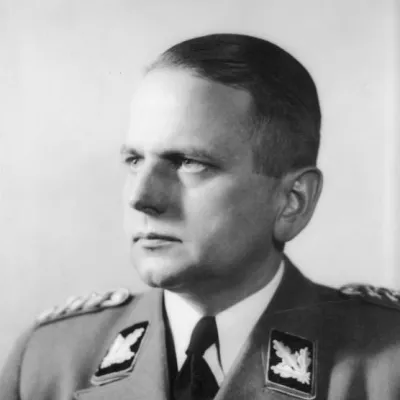
Otto Ohlendorf
Human Design Chart
Biography
He was sentenced to death in April 1948, and spent 3 1/2 years in detention before being hanged on 8 June 1951.
Otto Ohlendorf as a Manifesting Generator 1/4 in Human Design
Manifesting Generator 1/4 — Design at a Glance
Otto Ohlendorf revealed himself as a person with a hybrid energy configuration: He possessed the constant power of a Generator but also had Manifestor traits. This combination allowed him to quickly draw things into his life and skip steps, significantly increasing his speed of action.
This quickness was a double-edged sword. Often he acted too fast and skipped important intermediate steps, leading to the need to backtrack later to fill in gaps. Such detours created frustration as his internal system was designed for efficient execution. Additionally, he tended to tackle multiple projects simultaneously by reacting to various impulses. Without clear inner consent, this multitasking ability quickly led to overload and dissatisfaction.
His strategy involved initially waiting for external stimuli and seeing if his Sacral Center responded with a clear 'yes'. Only then would he invest his energy. When these conditions were met, he preferred working in the 'Play Mode', which offered variety. In this state, he could draw deep satisfaction from his work while simultaneously handling various tasks without being blocked. Thus, the structure of his design created a tension between high efficiency through speed and the need to use inner resonance as a filter for his numerous activities.
Sacral Authority
Otto Ohlendorf was a Generator whose decision-making was shaped by sacral authority. This internal leadership stemmed from his defined Sacral Center and functioned simultaneously as his strategy, simplifying his orientation process. Since his Emotional Center was open, he could not rely on emotional clarity; instead, he immediately responded to external stimuli with physical signals. These manifested as gut feelings or bursts of energy, audible through grunts, hums, or vocal affirmations like 'Mhm'. Such impulses signaled that his sacral motor had kicked in. In these moments, he felt vital and alive, powered by inexhaustible energy. He then tackled his tasks with great enthusiasm, fully immersed without a specific goal in mind. His nature was geared towards moving through life with joy and satisfaction. Additionally, his activated Spleen Center acted as supportive authority, enabling him to react quickly and make decisions spontaneously. He had an immediate connection to his physical well-being and instinctive perception, guiding him reliably. This configuration created a direct link between inner impulse and external action, independent of subsequent emotional evaluation or intellectual analysis.
The 1/4 Profile — Investigator / Opportunist
Otto Ohlendorf revealed himself through a rare profile that combined deep knowledge with the need for trusted networks. As a researcher and networker, he first sought thorough insights before sharing them within his closest community. However, this configuration created a specific vulnerability: The fear of being exposed to loved ones because one's knowledge was still insufficient caused him great heartache. A loving environment with a deep trust foundation was therefore crucial for his abilities to come into play and become an authority in his heart domains through expert knowledge and networking skills.
This dynamic drew from Line 1 of Gate 13, which promoted empathy and listening. It allowed him to engage indiscriminately with others and absorb secrets from various sources, though this could also be felt as a burden. The challenge was to transform this openness into a foundation for exchange. Simultaneously, Line 4 of Gate 1 emphasized solitude as a medium of creativity. Here, creativity had to arise independently of external interference to enable successful developments. This tension between the need for transpersonal harmony and the necessity to protect oneself from disruptive influences shaped his creative process throughout life.
Split Definition — Defined & Open Centers
Otto Ohlendorf's design inclined towards a clear, identity-driven expression style. His defined G-Center gave him a firm self-image and a sense of direction; he knew who he was and where he stood. This inner security manifested in his defined Throat Center: His voice served as a reliable channel to carry this identity outward. He did not speak out of momentary mood or intellectual doubt, but from the conviction provided by his G-definition.
As a Generator with a defined Sacral Center, he possessed an enormous vital energy source. This power drove him to be active and use his daily energy supply for tasks that he responded to. His defined Spleen Center ensured that he acted in the here and now; he followed spontaneous intuitions and instinctive warning signals without having to rationalize them. The also defined Root Center provided a constant pressure to move forward and master existential challenges.
At the same time, Otto Ohlendorf was vulnerable to conditioning through several open centers. His open Head and Ajna Centers meant that he absorbed mental inspirations and concepts from outside. He tended to identify with foreign ideas or doubts rather than seeing them as transient stimuli. The open Heart Center made him sensitive to questions of value and willpower; he might try to prove his worth through promises or performance, although the constant energy for this was not innate in him. Furthermore, his open Solar Plexus absorbed the emotions of his surroundings. He often reflected other people's moods, which led him to avoid emotional confrontations or interpret foreign feelings as his own. These opennesses stood in contrast to the inner firmness of his motor and voice, creating a tension field between clear action capability and external emotional-mental influence.
Channels for leadership, rhythm, resources and critical judgment.
Otto Ohlendorf was someone who could set new directions with a mix of innovative power and logical leadership. His design featured the Beat channel 14-2, connecting the Sacral Center (generative life energy) to the G-Center (identity, direction). Through Gate 14, he possessed the competence to use power and resources skillfully to drive mutation, while Gate 2 acted as a driver directing movement through space and time. This configuration allowed him to translate innovative impulses into material reality and give others a new orientation – provided that he responded authentically to his inner signal.
Parallel to this, the Rhythm channel 5-15 also connected Sacral and G-Center. Here, Gate 5 (firm habits, rituals) and Gate 15 (love for extremes, diversity) were at play. This channel bound him into the universal life flow and gave him an often magical sense of timing. He could lead groups through this rhythmic energy flow by connecting natural patterns with the need for change.
His leadership qualities were shaped by the Alpha Animal channel 7-31, linking the G-Center (role) to the Throat Center (expression/leadership). Gate 7 provided the logical role for collective leadership ("power behind the throne"), while Gate 31 represented the voice of a leader who had to win the trust of the community. Ohlendorf sought his sphere of influence and led more through authority and shared responsibility than absolute rule, always dependent on whether he was invited by the majority.
Furthermore, he possessed the Judgment channel 58-18 between Root Center (pressure/liveliness) and Spleen Center (intuition/correction). Gate 58 drove an insatiable urge for perfectionism, while Gate 18 ensured that patterns were critically reviewed and corrected. This gave him the ability to recognize imbalances and work out logical solutions – but only effectively if this correction was desired by others.
Individual gates like Gate 9 (detail work in Sacral) or Gate 45 (clan hierarchy in Throat) supported these structures through focused execution and the expression of willpower within collective orders.
Collective Circuitry — Circuit Signature
Otto Ohlendorf revealed himself through separate, parallel acting energetic poles. His design connected the identity with the sacral center via the Knowledge Circuit (Channel 2–14). This gave him a pulsating rhythm for finding an expression of his individual identity, supported by often deviating paths.
At the same time, there was a second independent connection consisting of two parts in the Understanding Circuit. Here, Throat-, Identity- and Sacral Center (Channels 31–7, 15–5) linked logical strategy with expressive ability, while Spleen- and Root Center (Channel 18–58) connected intuitive judgment with survival energy. This configuration promoted a rational, emotionless analysis for improving societal structures as well as sharing logical insights.
As it was a Shared Definition, these two systems – the creative rhythmic self-expression and strategic-analytical rationality – existed as parallel forces without direct energetic flow between them. Otto Ohlendorf thus moved in a tension field of individual pulsating transformation on one hand and focused visual future orientation through logic on the other. Both areas shaped his actions as independent, non-fusing driving systems.
Right Angle Cross of the Sphinx 1
Otto Ohlendorf revealed himself through the configuration 'The Right Sphinx Cross 1' as someone whose inner compass was aligned with a specific kind of spiritual clarity and moral decisiveness. This structure in the Human Design chart does not point to external actions themselves, but rather to a deeply rooted internal stance: the drive to order complex or contradictory situations through a clear, often radical perspective. It was a design characteristic that predisposed him to engage with questions of right and wrong, order and chaos – always from an extremely personal, non-universal perspective.
This Cross configuration arises from the connection of certain energies in the chart, which work together to form a kind of 'spiritual framework'. For Otto Ohlendorf, this meant that he often followed a strong inner logic in his decisions and convictions, which was convincing for him personally, even if it appeared rigid or extreme when viewed externally. The energy of this Cross did not promote flexible adaptation to circumstances but rather a consistent orientation towards his own understanding of structure and justice. Without further biographical details, it can be noted that this configuration made him into a person who lived their principles with great intensity – regardless of whether these principles were anchored in societal consensus or not. His design thus laid the groundwork for an inclination toward inner firmness and spiritual penetration, which significantly shaped his actions.
Saturn Return · Uranus Opposition — Life Cycles
Otto Ohlendorf's design showed a tendency to experience structural changes through external events. In 1936, at age 29, he became an economic advisor in the Reich Security Service (SD). This fell into his first Saturn Return, a cycle often marked by how years of groundwork and inner maturation condense into a solid position. The role as advisor corresponded to this phase of consolidation and entry into defined responsibility.
Sixteen years later, in 1947 at age 40, Ohlendorf was sentenced for his involvement in the Einsatzgruppen trial. This event correlated with an opposition to Uranus, an astrological aspect symbolizing deep ruptures and unexpected upheavals. While Saturn Return created stability, the Uranus Opposition led to the destruction of this order. The sentencing was not only a legal judgment but also the expression of a systemic collapse that his design processed as a crisis in this life phase. The contrast between establishment in 1936 and dismantling in 1947 underscores the dynamics of his chart development: from establishing a role to its radical questioning through external circumstances.
Manifesting Generator · Sacral Authority — Synthesis
Otto Ohlendorf lived a life marked by a strong drive for knowledge acquisition and its dissemination (Profile Researcher/Networker). This desire for deep understanding combined with an acute ability to utilize energy and quickly respond to external stimuli (Manifesting Generator with Sacral Authority). The defined Throat Channel enabled him to convey messages, while the Beat channel (14/2) directed him towards new possibilities – a constant striving for innovation and mutation. The sacral authority challenged him to follow inner impulses, which manifested in quick decisions and skipping steps that he occasionally had to correct later.
A central paradox lay in the combination of his need for deep knowledge and his ability for rapid implementation (Channel 14/2), with an internal fear of exposure through ignorance (Line 4). He sought validation through a network of familiar people, while simultaneously possessing pulsating energy that propelled him to explore new paths. This tension was evident during phases of ascent and recognition (1936), followed by crises necessitating re-evaluation (1947).
4 Defined Channels
Incarnation Cross - Right Angle Cross of the Sphinx 1
Solar Return
The Solar Return shows the moment when the sun returns to its exact birth position - your personal solar year.
Life Cycles
Discover the life cycles with a detailed triple view (birth chart, cycle chart, composite).
Human Design Profile
- Strategy
- To respond - wait for something to respond to
- Authority
- Sacral Authority
- Profile
- 1/4 - Investigator / Opportunist
- Definition
- Split Definition
- Incarnation Cross
- Right Angle Cross of the Sphinx 1
- Date of Birth
- 04.02.1907 03:30
- Place of Birth
- Hoheneggelsen, GER
Frequently Asked Questions
What was Otto Ohlendorf's Human Design type?
What Profile did Otto Ohlendorf have in Human Design?
What Authority did Otto Ohlendorf have?
What incarnation cross did Otto Ohlendorf have?
When was Otto Ohlendorf born?
Discover your own Human Design
Are you also a Manifesting Generator? Find out in a personal reading how to unfold your multi-talents and direct your energy wisely.
More Personalities
Back to overviewAldair

Alizée

Angeli

Arletty

Artus

Balthus