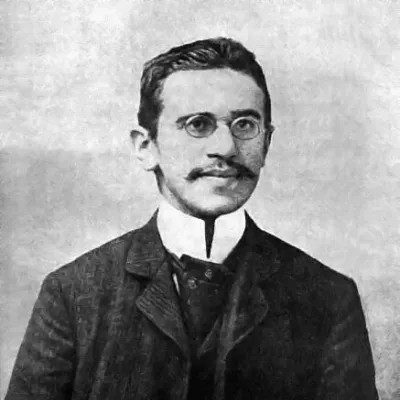
Otto Weininger
Human Design Chart
Biography
The Human Design of Otto Weininger: Manifestor 6/2
Manifestor 6/2 — Design at a Glance
Otto Weiningers design inclines him to set large undertakings in motion from within himself without waiting for approval. This disposition corresponds with the Manifestor type described in Human Design as a pioneer, leader and visionary - comparable to an emperor who designs a vision but does not fight battles themselves, instead sending others to carry it out. From this type emerges a characteristic pain point: feeling misunderstood. Thoughts and undertakings that reach further than what others can immediately grasp polarize - they attract some who want to follow such a vision while repelling others precisely because of its breadth. For this type, the appropriate strategy is to inform others sufficiently in advance before implementing their own plans so that the right followership can be found rather than being faced with accomplished facts. If Otto Weininger followed this strategy and his inner authority, it brought him a sense of internal peace - this was the reward embedded in his design. When he deviated from this approach, instead a persistent deep anger came to the fore, characteristic of the Manifestor when living against their design.
Emotional Authority
Otto Weiningers design shows an intense inner dependence on time: decisions made in the first moment did not carry the substance that he could rely upon. This fundamental tension arises from his inner authority located in the defined Emotional Center - emotional authority. It had precedence over everything else defined in his chart, this is the central rule of this mechanism. Otto Weininger was thus subject to a continuous emotional wave, an up and down of feelings through which every situation appeared differently colored depending on the time: what seemed clear and right at one moment could seem questionable or repulsive shortly after. A feeling in the moment was for him only a first impression, not a secure truth. Quick decisions made from acute emotion carried the risk of proving false later. Decisions became reliable for him only when he gave them time to sleep on it multiple times and let the initial wave subside - then clarity and calm could set in, especially regarding questions with long-term implications for his life path.
The 6/2 Profile — Role Model / Hermit
Otto Weiningers design sets a life movement in three phases: a period of experimentation and failure followed by a deep withdrawal from active life out of which, at best, a mature and effective capacity to act can develop. This was the signature of Profile 6/2, the role model and natural talent: before his Saturn return around age 30, the sixth line behaved like a third line, driven by trial and error with retreat after each failure. Only thereafter did the true sixth line become active: a withdrawal into an inner observer position from which the previous life could be viewed with distance - a time of reflection and self-knowledge, after which others sought out the wisdom gained.
This disposition was reinforced by Gate 21 in the sixth line: it described the same triad of experimentation, retreat, and re-entry and emphasized that ineffective action leads to disorder, a lesson effective throughout his life until effective action and inner order were found. Added to this was Gate 54 in the second line: a tendency towards restraint and discretion from which ambition fed, a quiet, calculated shrewdness that did not prematurely exploit earlier advantages.
Single Definition — Defined & Open Centers
256 words under the limit of 280. Here is the chapter:
Otto Weiningers Human Design laid out a personality that did not find its security in free thinking, but rather in feeling, wanting, and speaking what was firmly established within him - while his Head Center remained restless and questioning. His Solar Plexus Center was defined and formed his inner authority: Clarity for him did not set in at the moment but only after he waited out the rising and falling wave of emotion before making a decision - hasty judgments made during the high or low of the wave were traps that he avoided. Also, his Heart Center was defined: a reliable access to willpower and ego, which led him to make promises he wanted to keep and assert his own value confidently. This was complemented by a defined G Center, giving him a firm identity and an inner compass for his direction, coupled with the need to be loved and love in return.
Opposing this were open Head and Ajna Centers - mental pressure, questions, and doubts remained without constant form. The general mechanics of an open head involve taking on foreign questions and concepts and holding them as one's own until it becomes unclear what was really one's own thinking and what was taken from outside - a vulnerability to always seek new certainty or inspiration from the outside rather than trusting one's own authority. His Sacral Center was also open: the typical conditioning trap here is to take in and amplify foreign energy around availability and sexuality without having a reliable, personal boundary for it.
Channel 12-22: Openness — Channels & Gates
Otto Weiningers Human Design laid out a deep tension between mood-dependent openness and uncompromising self-competition that did not easily fit into ordinary sociality. This fundamental tension was shown in the Openness Channel 22-12, connecting his Solar Plexus Center to the Throat: Gate of Openness (22) carried socially expressive behavior entirely dependent on mood and timing while Gate of Caution (12) restrained this openness and limited it to encounters with real potential for change - sociability was never arbitrarily available but bound to an inner wave that had to be run through first.
A second force came from the Initiation Channel 51-25, which shaped his Heart Center via Shock Gate (51) and Self Spirit Gate (25): a competitive ego-energy constantly pushing forward here combined with the ability to recognize and love higher universal beauty in both animate and inanimate things. This combination drove breakthroughs at personal boundaries and fostered an uncompromising, almost mystical view of one's own essence.
Additionally, the Community Channel 37-40 worked, coupling his Solar Plexus Center with his Heart Center via Friendship Gate (37) and Solitude Gate (40): a readiness to act for others combined with the need for recognition, reward, and personal retreat times.
Individual Gates reinforced this picture: Gate 48 shaped a tendency towards depth and pattern recognition that could tip into frustration without implementation; Gate 54 linked worldly ambition with spiritual striving; Gate 53 drove starting new development cycles and leaving old ones behind; Gate 21 focused on control over personal material concerns; added to these was an instinct for the right alignment (Gate 2) and a drive to make one's contributions visible (Gate 8).
Individual Circuitry — Circuit Signature
Otto Weiningers Human Design connected feeling, self-worth, identity, and expression into a single cohesive whole. His design had a simple definition: All defined centers formed a single unified unit, not separate islands beside each other.
The core was the Openness Channel (Gate 12-22) from the Knowledge Circuit. It linked his Solar Plexus Center, seat of feelings, directly to his Throat Center, place of expression - feelings could thus become immediate speech. Typical for this circuit was a wave-like, pulsing energy bound to the moment, oriented towards bringing forth and communicating something entirely one's own and new.
From the Centering Circuit, he activated the Initiation Channel (Gate 25-51), linking his Identity Center directly with his Heart Center. This connection was inwardly directed and individualistic: it coupled self-worth to the core of one's identity and set a firm, convictional stance - an 'I am just as I am'.
From the Ego Circuit, which belonged to the tribal group, he carried the Community Channel (Gate 37-40): It linked Heart and Solar Plexus Centers and stood for a relationship of giving and taking - mutual support as a foundational principle that connected him with his environment.
Through these three channels, feeling, self-worth, identity, and expression ran in Weininger as one continuous interwoven fabric.
Left Angle Cross of Endeavour 1
Otto Weiningers Human Design charted a life direction that unfolded less from his own initiative than through what was conveyed to him by his environment and the people around him. This imprinting arose from the left cross of his chart - one of three fundamental categories into which every incarnation cross in Human Design falls. While a right-angled cross describes a primarily self-determined, self-initiated direction, the left cross shifted the action into the transpersonal: The life task appeared less as an individual plan than as a role that took shape through exchanges with others and external circumstances - something one grew into rather than chose for oneself.
The name suffix 'of effort' identified the concrete theme of this cross: a life direction revolving around sustained commitment, persistent work on a task that did not yield easily but had to be achieved. The number 1 in the name marked which of the possible line expressions of this cross was actually active in his chart.
In summary, this cross described for Otto Weininger a life task that did not arise purely from personal initiative but only became apparent through interaction with his environment - sustained by continuous, often arduous effort rather than effortless success.
Manifestor · Emotional Authority — Synthesis
Otto Weiningers Human Design design drew a constant struggle around a self-discovered misunderstood path as an example for others. As a Manifestor, he developed and pursued visions, which polarized him instead of uniting him. A defined G Center gave him clear direction and strong identity, while a defined Heart Center provided willpower, ego strength, and the desire for recognition. The Initiation Channel (Gate 25-51) added competitive sharpness to this drive - the urge to be first - whereas Gate 54 viewed worldly success as a stepping stone to deeper understanding. Even Profile 6/2 followed this pattern: After years of experimentation, he withdrew, matured through reflection, and returned as a wise advisor. The name of his life cross, 'The Cross of Effort', mirrored this will-driven struggle.
At the same time, there was a tension in his design between the urge for immediate action and the necessity to wait. As a Manifestor with a defined Throat Center coupled to Heart as motor, he felt the impulse to speak and act immediately. His inner authority lay, however, in Solar Plexus: Only after running through the emotional wave did true clarity set in, spontaneous decisions carried the risk of misjudgment. The Openness Channel (Gate 22-12) followed this rhythm - it only worked when the mood was right; otherwise, retreat or abrupt misunderstanding loomed. Thus, impulsive action and the command to be patient stood side by side permanently.
3 Defined Channels
Incarnation Cross - Left Angle Cross of Endeavour 1
Solar Return
The Solar Return shows the moment when the sun returns to its exact birth position - your personal solar year.
Life Cycles
Discover the life cycles with a detailed triple view (birth chart, cycle chart, composite).
Human Design Profile
- Type
- Manifestor
- Strategy
- To inform others before acting
- Authority
- Emotional Authority
- Profile
- 6/2 - Role Model / Hermit
- Definition
- Single Definition
- Incarnation Cross
- Left Angle Cross of Endeavour 1
- Date of Birth
- 03.04.1880 15:00
- Place of Birth
- Vienna, Austria
Frequently Asked Questions
What Human Design Type did Otto Weininger have?
What Profile did Otto Weininger have?
What Authority Did Otto Weininger Have?
What incarnation cross did Otto Weininger have?
When was Otto Weininger born?
Discover your own Human Design
Are you also a Manifestor? Find out in a personal reading how to use your initiation power peacefully and dissolve resistance.
More Personalities
Back to overviewChristian-Jaque
Kesha

Lucebert
Masaccio
Papus
Petrarch