Paul Anspach
Human Design Chart
Biography
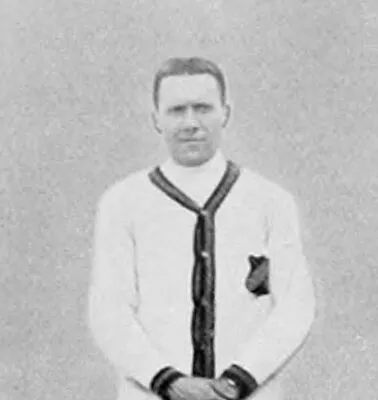
Anspach was captain of the Belgian épée team from 1909 to 1928. At the 1912 Summer Olympics, he captured gold medals in both the individual and team épée competitions.
He won a Bronze medal in team épée at the 1908 Games and Silver in the same event at the 1920 and 1924 Olympics.
He was a member of the noble Anspach family. He died in his sleep in Brussels, Belgium on 28 August 1981 at age 99.
Paul Anspach — Manifesting Generator with Profile 2/4
Manifesting Generator 2/4 — Design at a Glance
Paul Anspach revealed himself as a Hybrid being with consistently available sacral energy. His design combined the endurance of a Generator with the dynamic power to skip steps and quickly bring results into life. This speed allowed for parallel action but carried the risk of frustration if important stages were skipped or multitasking occurred without inner consent.
The strategy of his design lay in responding to impulses rather than initiating them. Paul Anspach needed constant confirmation from his Sacral Center – the 'Yes Signal' – to enter a productive state. Only when he responded to life impulses and his inner authority agreed could he experience deep satisfaction.
Without this alignment, his energy tended towards distraction; the joy of creation quickly turned into frustration in the absence of resonance. However, if the strategy was followed, his actions developed into a 'Play Mode'. In this state, he enjoyed variety and worked happily on several projects simultaneously. The compulsion to finish one thing before starting another hindered him from accessing his natural creative power. Instead, he found satisfaction in diversity and the flowing transition between tasks as long as his inner energy supported it.
Sacral Authority
Paul Anspach was a Generator whose inner authority aligned with his strategy: sacral authority. This configuration greatly simplified his decision-making process since he did not have to distinguish between action pathways and internal confirmation. His orientation occurred through direct physical signals in response to external stimuli, often manifesting as a characteristic gut feeling or powerful impulses expressed as grunts, hums, or loud 'Mhm'. These sounds marked the moment when his sacral motor kicked in, providing him with vital energy and inexhaustible enthusiasm. With his Spleen Center activated, Paul Anspach also had an additional support for speed and spontaneity. This allowed him to react quickly and instinctively and gave him immediate access to his physical well-being. He could reliably orient himself towards this intuitive perception, which complemented his sacral decision-making with rapid adaptability. The combination of the powerful, joy-filled energy of the Sacral Center and the lightning-fast intuition of the Spleen defined his essence as someone who stood in direct contact with life and responded to impulses authentically without hesitation.
The 2/4 Profile — Hermit / Opportunist
Paul Anspach oscillated between a deep need for withdrawal and the urge towards connection. His design created tension: on one hand, he sought solitude for internal processing; on the other, he was drawn to his network of trusted individuals. This dynamic required clear signals to his environment – when he needed company and when he needed to be left alone. In the quiet of his retreat, Paul Anspach found clarity; only after satisfying this inner need did he re-enter the social context. There, he could reflect on insights from his network and distill them into new ideas.
His reactions were often extreme. Persistent interference revealed a Neptunian hardness that seemed justified but left regret in its wake. This force was used to break through boundaries. At the same time, his profile emphasized analyzing opposites rather than open conflict. He waited for the right alliance partners and valued trust as well as individual processes. Aggressive resistance would have undermined his credibility; instead, he used strategic patience to be effective within the network. This cycle of withdrawal for reflection and re-emergence defined his work: he withdrew to clarify and returned to apply what he had learned – always dependent on the quality of his relationships and the protection of his private space.
Split Definition — Defined & Open Centers
Paul Anspach revealed himself as a Generator with an enormous, defined sacral energy base and a stable inner compass. His design inclined towards powerful self-determination, supported by his defined G-Center, which offered clear identity and direction. This combination created someone who was only satisfied when responding to questions rather than initiating them.
His mind was consistently active: The defined Head and Ajna Centers generated constant mental pressure and inspiration. This made him a source of intellectual stimulation for others as his mind worked conceptually and formed questions. However, since these centers are not engines, no energy was available to directly set thoughts into the world; waiting for the right moment was essential to avoid frustration. His defined Throat Center allowed him to reliably and clearly communicate mental processes as well as answers from his sacral source. Additionally, he had a defined Spleen Center, which provided a strong intuitive protective mechanism for health and wellbeing in the present moment.
The challenge lay in distinguishing between this mental process and the necessity of correctly applying his sacral energy. His open centers – Heart, Solar Plexus, and Root – showed specific vulnerability: He did not have constant willpower or emotional stability but rather took these situationally from the environment. The open Heart Center meant that he never had to prove himself; his worth was inherent. Nevertheless, he tended to fall into a cycle of making promises to demonstrate his value, which often led to failure. His open Solar Plexus and Root Centers made him sensitive to foreign emotions and stress. He acted like a barometer amplifying others' moods rather than personalizing them as his own. This openness required conscious distancing from external pressure and emotional waves to avoid overstimulation and maintain his inner authority.
Channels for powerful presence, intuition and mental clarity.
Paul Anspach revealed himself as someone who inspired others simply through his presence and authenticity. His design carried a clear tendency towards self-love and acceptance, helping him not to take criticism personally. This attitude stemmed from the Awakening Channel 10-20, which connected his G-Center with his Throat Center. He expressed the wisdom that one must fulfill their potential as an expression of awakened self-love to thrive. Through the Presence Gate (10) and Now Gate (20), he spoke for himself simply by being who he was. This created a clarity that encouraged others to be themselves without resistance.
This individual leadership was supported by the Exploration Channel 34-10. Here, his Sacral Center connected through the Power Gate (34) with his G-Center at the Self-Behavior Gate (10). This configuration reinforced him in following his own convictions and loving himself independently of external expectations. The sacral energy provided the inner strength to hold these beliefs while behavior was initiated from the deepest within. Thus, he demonstrated through authentic responding the benefit of completed self-love and encouraged his environment to live their unique selves.
Additionally, the Charisma Channel 34-20 worked, which directed the generative power of the Sacral Center (Gate 34) directly into expression in the Throat Center (Gate 20). This gave him a charismatic presence and the ability to maintain activity over longer periods as long as he focused on things that fulfilled him. His energy was not there to be tapped by others but served for self-empowerment.
The Sun in Gate 21 (Control/Material) shaped his way of controlling material things and demanding respect within the community. This connected with the Wavelength Channel 48-16, which united intuitive depth (Gate 48) with technical skill (Gate 16) to perfect talents through repetition. The Abstraction Channel 64-47 provided an active mind that transformed experiences into mental images to find meaning. Further gates like the Doubt Gate (63), Experience Gate (42), and Detail Work Gate (9) rounded out his profile by promoting doubt as motivation, completion processes in the sacral center, and precise focus.
Individual Circuitry — Circuit Signature
Paul Anspach's design inclined towards individual centering. The Centering Circuit connected his Sacral with his Identity Center through the Exploration Channel (10-34). This created an inner strength based on personal power that worked independently of external validation. Since there was no connection to the Throat Center, these strong convictions often remained unspoken, turning his individuality inward.
Parallel to this, a separate piece of the Understanding Circuit showed: The Wavelength (16-48) connected his Spleen with his Throat Center. This allowed him to clearly articulate intuitive perceptions and strategic insights – a skill for precise communication that operated energetically detached from his inner identity.
Another isolated element was the Sense-Making Circuit with the Abstraction Channel (64-47). It linked the Head with the Ajna Center, promoting an ability for abstract thought structuring and pattern recognition from past experiences. However, this cognitive structure did not engage in direct exchange with his emotional or identity-forming centers.
Finally, the Integration Circuit worked through the Awakening Channels (20-10) and Charisma (20-34). They connected the Throat, Sacral, and Identity Centers together. This created a closed loop where inner power was directly translated into present-moment action-capable presence. The split definition meant that these various energetic blocks – identity, communication, thinking – existed parallel without merging into one continuous flow. Paul Anspach thus lived with several autonomous power centers each fulfilling their own tasks.
Right Angle Cross of Tension 1
Paul Anspach's design was characterized by the configuration of the right cross of tension 1. This structure established a fundamental stance aimed at inner stability and clear boundaries. It served as a mechanism to regulate tensions within the system and create a consistent basis for action.
The right cross of tension 1 is not just a collection of points but a cohesive field. It conveyed the ability to withstand pressure without immediately reacting or becoming scattered. Instead, it promoted calm endurance. Paul Anspach lived with an energy that did not seek external validation but was anchored in his own center. This anchoring allowed him to maintain a clear head even in uncertain situations and make decisions from inner conviction rather than being carried away by external currents.
The mechanics of this cross emphasized the importance of self-definition. It was about knowing what one can tolerate and where personal limits lie. This protected against overextension and helped direct energy purposefully. Paul Anspach showed himself to be someone who did not seek his strength in constant motion but rather in the ability to stand firm. This inner resilience was the foundation upon which he built his life, ensuring that despite external changes, he maintained his own direction without straying from the path. The tension here was not experienced as a problem but as a driving force for deep personal integrity.
Saturn Return · Uranus Opposition · Chiron Return · 2nd Saturn Return — Life Cycles
Paul Anspach's athletic career followed a clear pattern of cyclical affirmation expressed through recurring milestones in his Olympic success story. His design inclined towards experiencing life energy not as a linear ascent, but as rhythmic waves where performance and recognition condensed at defined intervals.
This was concretely evident in 1908 when, at the age of 26, he won a bronze medal in the saber team event at the Olympics in London. This marked his first Saturn return. In Human Design mechanics, this cycle is a moment of maturation and structuring; it condenses years of groundwork into a visible, solid result. For Paul Anspach, this was not coincidental but the natural effect of a design seeking stability through proven performance.
The pattern repeated twelve years later in 1920 when, at age 38, he won a silver medal in the saber team event at the Olympics in Antwerp. This fell on his Uranus opposition, a cycle often demanding or enabling profound changes and new perspectives. That this transition was marked by further sporting success underscores the ability of his design to maintain action capability and excellence even during phases of transformation. Both events were not isolated peaks but expressions of life energy affirming and structuring itself at regular intervals.
Manifesting Generator · Sacral Authority — Synthesis
Paul Anspach lived a life profoundly shaped by an inner dynamic: the constant interplay between initiation and reaction. As a Manifestor Generator, he possessed the ability to quickly initiate things, yet his Sacral Center demanded that he wait for impulses before acting, only when there was genuine internal resonance. This combination of potential speed and the need for sacral affirmation formed the red thread of his actions – a pursuit of efficiency always grounded in the wisdom of the body. The connection between Head and Ajna Centers intensified this inner pressure by generating an ongoing search for understanding and inspiration that truly bore fruit only when it aligned with sacral energy. His profile as a natural talent and networker suggests a life marked by phases of withdrawal for internal reflection and intense social interaction.
Central to Paul Anspach's design, however, is a paradox: the tension between his need for individuality and the urge to connect with others. The definition in the G Center points to a strong self-identity, while an open Heart Center made him vulnerable to the emotions and expectations of his environment. This likely led to an internal conflict between the desire for authenticity and conforming to social norms – a balancing act that shaped his lifestyle and continually forced him to redefine himself and find his own path.
5 Defined Channels
Incarnation Cross - Right Angle Cross of Tension 1
Solar Return
The Solar Return shows the moment when the sun returns to its exact birth position - your personal solar year.
Life Cycles
Discover the life cycles with a detailed triple view (birth chart, cycle chart, composite).
Human Design Profile
- Strategy
- To respond - wait for something to respond to
- Authority
- Sacral Authority
- Profile
- 2/4 - Hermit / Opportunist
- Definition
- Split Definition
- Incarnation Cross
- Right Angle Cross of Tension 1
- Date of Birth
- 01.04.1882 01:00
- Place of Birth
- Brussels, Belgium
Frequently Asked Questions
What is Paul Anspach's Human Design type?
What profile did Paul Anspach have in Human Design?
What authority did Paul Anspach possess?
What incarnation cross did Paul Anspach have?
When was Paul Anspach born?
Discover your own Human Design
Are you also a Manifesting Generator? Find out in a personal reading how to unfold your multi-talents and direct your energy wisely.
More Personalities
Back to overviewAldair

Alizée

Angeli

Arletty

Artus
Balthus