
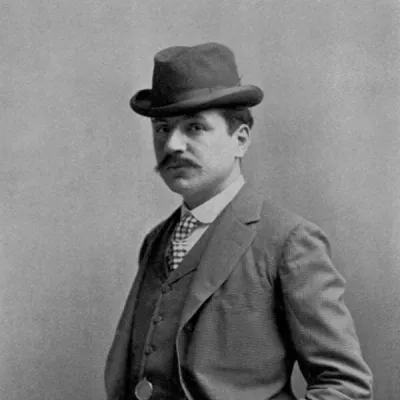
Paul Bourget
Human Design Chart
Biography
After completing his studies in philosophy, Bourget began his career as a poet, and several of his poems were set to music by Claude Debussy. Encouraged and deeply influenced by the critic Hippolyte Taine, he published a series of essays tracing the sources of contemporary pessimism to the works of Stendhal, Gustave Flaubert, Charles Baudelaire, Taine, and Ernest Renan. Fashionable in their day because of their high-society setting, his early novels, such as Cruelle Énigme (1885), Un Crime d’amour (1886), andAndré Cornélis (1887), were careful psychological studies.
Bourget’s most important novel, Le Disciple (1889), heralded a marked change in his intellectual position. Prefaced by an appeal to youth to abide by traditional morality rather than modern scientific theory, the novel portrays the pernicious influence of a highly respected positivist philosopher and teacher (who strongly resembles Taine) on a young man. Applying the philosopher’s teachings to life, the young man plays dangerous games with human emotions that end in a tragic crime. Bourget was converted to Roman Catholicism in 1901. His later novels, such as L’Étape (1902) and Un Divorce (1904), are increasingly didactic theses in support of the church, traditionalism, nationalism, and monarchy.
On 16 March 1914, he was present in the offices of the newspaper, Le Figaro when the newspaper's editor, his friend Gaston Calmette was shot and killed by Henriette Caillaux the wife of a former Prime Minister of France. Her subsequent trial caused an enormous scandal at the time.
He died 25 December 1935, Paris.
The Human Design of Paul Bourget: Projector 5/1
Projector 5/1 — Design at a Glance
Paul Bourget had a dense, focusing aura that acted like a bright flashlight pointing out weaknesses in his surroundings. His design allowed him to immediately spot flaws in other people's systems and shed light on the dark spots. However, this ability came with a risk: direct criticism was often perceived as unpleasant by those around him, akin to a blinding beam of light straight into their faces.
A more effective strategy for him involved not being confrontational but attracting others through his own harmonious glow. By showing balance himself, he invited others to ask about his insights. His Human Design emphasized the necessity of waiting for an honest and respectful invitation before using his leadership skills. This protected him from resistance and ensured a respectful reception of his advice.
Furthermore, Paul Bourget was marked as a projector with an undefined Sacral Center, meaning that he did not have a constant source of intrinsic life energy available to him. Instead, he experienced phases of high activity and rapid workability, which were inevitably followed by necessary rest periods. These pauses served for recovery and prevented burnout. Since societal structures often ignored this need for rhythmic energy distribution, consciously planning these still moments was crucial for his well-being. Living in accordance with this rhythm and his invitation strategy rewarded him with success; resisting his design threatened the experience of bitterness as an expression of non-self.
Emotional Authority
Paul Bourget was subject to an emotional wave characterized by constant ups and downs in feelings. His inner authority lay in a defined Solar Plexus Center, which carried the decision-making power with absolute priority, regardless of other centers defined in his design. The world always appeared colored by his current mood; enthusiasm could suddenly turn into negativity. His immediate feeling was only a snapshot, an initial impression that did not necessarily correspond to his deeper truth. Quick, spontaneous decisions made out of this emotional heat could have negative consequences.
Instead, his mechanism required patience and time for decision maturation. Paul Bourget had to let himself be persuaded, practice multiple nights' sleep, and allow being asked questions. This process allowed the intense feelings to subside. With the gain of emotional distance, clarity and calmness set in. Only then was the decision-making process complete. This strategy primarily applied to long-term decisions that could have a significant impact on his life course. By waiting for the calming of the Solar Plexus, he arrived at his true inner truth beyond fleeting mood swings.
The 5/1 Profile — Heretic / Investigator
Paul Bourget's design featured a tension between an outward magnetic call and a deep private research process. As a 5/1 profile, he exhibited the characteristic that others instinctively sought solutions from him, which without clear boundaries quickly led to overloading. Line 5 acted like a magnet for external questions while line 1 demanded inner humility and reflection.
This configuration described a life task: providing knowledge from his own depth (line 1) for problem-solving for others (line 5), without exhausting himself in the process. The challenge lay in managing the constant demand for answers. Without the ability to say 'No', exhaustion threatened through answering other people's problems, similar to an expert overwhelmed by a flood of inquiries.
The solution involved consciously protecting his knowledge base. By recognizing and utilizing rest periods, Paul Bourget could maintain balance. Line 1 taught him to accept rejection as part of creative progress and use experiences for maturation. Thus, the risk of being determined by others turned into sustainable practice: he used his gifts optimally by aligning service to others with his own inner development and pushing back negative forces through conscious boundaries.
Single Definition — Defined & Open Centers
Paul Bourgets Human-Design profile suggests a tendency towards constant willpower and deep emotional depth, while other areas of life were strongly influenced by the environment. His defined Heart Center provided him with a stable access to willpower and ego; he preferred to determine his own life and keep promises. This formed the pillar of his identity: he knew his worth and sought recognition for his contribution without unnecessarily pressuring others as long as he followed his inner guidance.
This consistency met his emotionally defined nature in the Solar Plexus Center. Here, his internal authority lay in patience. He relied on waiting out the waves of his feelings before making decisions. Spontaneous reactions led to chaos; clarity only emerged after going through the emotional cycle. This combination of firm will and necessary emotional delay created a complex dynamic: he could appear strong but needed time to ensure that his actions aligned with his deep truth.
In contrast, seven centers were open, reflecting the environment back onto him. His open Root Center absorbed stress from the surroundings; under pressure not of his own making, he often sought ways to escape this adrenergic drive field or misused it. Similarly, his open Sacral Center meant that his energy and vitality were situational and dependent on the quality of his environment. He risked overexertion if he did not rely on his authority to set boundaries and take rest periods, as he lacked a constant generative force.
His open Spleen Center made him vulnerable to fears about health and safety. He tended to cling to people or situations that gave a false sense of well-being rather than trusting his own intuition. The open centers G, Throat, Ajna, and Head completed this picture: His identity and direction (G) crystallized only in correct relationships; he did not actively seek a fixed 'Who am I', but was initiated into it. Communication (Throat) and mental concept thinking (Ajna/Head) were flexible and environment-dependent; he adopted ideas without claiming them as his own truth, speaking spontaneously when invited rather than demanding attention. This openness allowed him to adopt various perspectives, yet required continuous mindfulness to avoid falling into environmental conditioning.
Channels for communal cohesion and inner freedom.
Paul Bourget understood relationships as carefully negotiated agreements based on mutual support. His design indicated that he did not act impulsively but needed emotional scrutiny and willpower to seal connections. This was evident in Channel 37-40 (Community), which connects the Solar Plexus Center with the Heart. Through Gate 37, he sought recognition and his place within the whole, while Gate 40 was ready to work and provide support yet demanded reward and breaks. This configuration meant that good deals were not closed impulsively but required time for emotional clarity and willpower formulation. Paul Bourget waited for a personal invitation – often through direct contact or 'touch' – to become part of a community; impersonal addresses were insufficient. He acted as a bridge-builder between individuals and the collective, with his loyalty to the group surpassing his ego. The dynamics of this channel emphasized the transition from survival struggle to liberation through exchange: 'I do this for you if you do that for me.' Additionally, Gate 35, oriented towards change and interaction, and Gate 5, focused on rhythm and habits, promoted readiness to experience new things and develop patterns, supporting his ability to establish structural clarity and sustainable energy flows in communities.
Tribal Circuitry — Circuit Signature
Paul Bourgets design points toward cooperative structures where resources are created through balanced giving and taking. This was concretely seen through Channel 37-40 (Community), which connects the Heart Center with the Solar Plexus. This connection established the dynamic of reciprocal exchange: 'Today I give you, tomorrow you give me.' It involved mutual support within a group rather than individual self-presentation.
The Ego Circuit to which this configuration belongs focuses on collectively creating well-being. Since Paul Bourget had no connection to the Sacral Center – the source of constant life energy – strategic planning of rest periods was essential. Without these breaks, the energy for resource-oriented interaction would have been exhausted. The mechanics thus required a conscious balance: activity in service of the community needed to be offset by phases of regeneration to sustain its effects. This separate structure between Heart and Solar Plexus acted as an independent force, distinct from other energetic flows in his design.
Left Angle Cross of Migration 2
Paul Bourgets Human-Design profile indicated a tendency towards strategic patience, coupled with an inconspicuous yet consistent endurance. His path was not marked by impulsive leaps but rather by continuous progress that overcame obstacles through steadfastness. This attitude stemmed from the mechanics of his Left Moving Cross 2 configuration. According to this setup, it is less about quick reactions and more about a steady movement along one's own path, even when external circumstances suggested diversion or uncertainty.
The energy of this cross acted like an inner compass that encouraged Paul Bourget not to be swayed by short-term pressures. Instead, his design showed a quality of perseverance: a quiet yet unshakable progression based on internal conviction rather than external applause. It was a process of endurance where true strength lay in persistence even when others might have given up or changed course.
This structure described a life task of existing despite resistance. Paul Bourget lived this mechanism through constant progress that often happened quietly and without dramatic gestures. His design promoted the ability to follow his own path without being impressed by the speed or direction of others. It was a quiet power that set its sights on long-term goals, demonstrating that true movement does not always have to be loud but can also exist in patient, strategic continuity.
Saturn Return · Uranus Opposition · Chiron Return · 2nd Saturn Return — Life Cycles
Paul Bourgets life journey was marked by two significant astrological transits that each initiated profound turning points. At the age of 42, in 1894, he experienced a Uranus opposition. This transit often signifies a break with established structures or a sudden liberation from old bonds. For Paul Bourget, this phase culminated in clear confirmation of his position: He was admitted to the Académie française. This was no mere coincidence but aligned with the dynamic power of this transit, which often leads to a reorganization of social or professional status and makes years of work visible anew.
Seven years later, at 49 in 1901, Paul Bourget underwent his Chiron Return. In this cycle, one's incarnation cross unfolds increasingly; meaning and purpose become experiential if lived according to personal strategy. It is a phase of bloom and fulfillment, not healing old wounds. For Paul Bourget, this inner clarity manifested in a fundamental personal decision: He converted to Roman Catholicism. This step marked the peak of his spiritual search and anchored his life in a new, deep framework of faith. Both events underscore how external astrological influences triggered concrete, life-defining decisions for Paul Bourget – first public recognition, then internal certainty.
Projector · Emotional Authority — Synthesis
Paul Bourget lived a life shaped by observation and understanding of human relationships. His design as a Projector, combined with emotional authority and the Profile of Hero/Researcher (5/1), points to a natural ability to recognize patterns in complex systems and make this knowledge accessible to others. The open configuration of many centers – particularly Root, Sacral, Spleen, and Ajna – speaks to a deep sensitivity for the energies around him and an ability to adapt to various contexts. He was not dependent on a constant internal energy source but drew it from interactions with others, making him a skilled observer and mediator. This openness allowed him to perceive nuances of human behavior while also being mindful of not getting lost in the emotional waves of others.
Bourgets life was marked by an inner tension between the need for recognition and the challenge of staying authentic. The defined Heart Center indicates a strong ego and desire to exert personal will, while open centers signal dependence on external stimulation and validation. He sought connections and opportunities for problem-solving for others (Line 5), yet also needed time for research and reflection (Line 1). This duality led to an ongoing interplay between the urge to engage and the necessity of withdrawing to restore his own inner balance.
1 Defined Channel
Incarnation Cross - Left Angle Cross of Migration 2
Solar Return
The Solar Return shows the moment when the sun returns to its exact birth position - your personal solar year.
Life Cycles
Discover the life cycles with a detailed triple view (birth chart, cycle chart, composite).
Human Design Profile
- Type
- Projector
- Strategy
- Wait for the respectful invitation
- Authority
- Emotional Authority
- Profile
- 5/1 - Heretic / Investigator
- Definition
- Single Definition
- Incarnation Cross
- Left Angle Cross of Migration 2
- Date of Birth
- 02.09.1852 10:45
- Place of Birth
- Amiens, France
Frequently Asked Questions
What was Paul Bourget's Human Design type?
What Profile did Paul Bourget have in Human Design?
What Authority did Paul Bourget possess?
What incarnation cross did Paul Bourget have?
When was Paul Bourget born?
Discover your own Human Design
Are you also a Projector? Find out in a personal reading how to unfold your leadership qualities and recognize the right invitations.
More Personalities
Back to overviewSissy Spacek

Alain-Fournier

Anémone

Angeli

Ann-Margret

Bourvil
