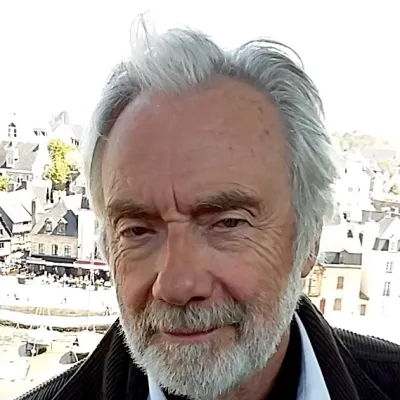
Paul Jorion
Human Design Chart
Biography
Paul was born and raised in Belgium, and has been a Professor at the universities of Brussels, Cambridge, Paris VIII and University of California at Irvine. He was a Visiting Scholar of the "Human Complex Systems" Program at UCLA from 2005 to 2009. He currently lives in France where he runs a popular blog on financial and economic matters. In 2012, the Vrije Universiteit Brussel made him holder of the newly created "Stewardship of Finance" chair.
What does Generator 4/6 mean for Paul Jorion?
Generator 4/6 — Design at a Glance
Paul Jorion's design points to a tendency towards enduring, powerful action based on a specific rhythm: not through constant initiative, but through reacting to external impulses. As a Generator, he had a lot of sacral energy, which made him extremely resilient, like a workhorse, provided he found tasks that stirred his intrinsic motivation. His energy was released primarily when he responded to life signals with a clear 'yes' from within.
However, this mechanism contained two clear pitfalls. If Paul Jorion engaged in things that did not bring him joy, he risked wasting his strength and burning out. Conversely, it led to frustration if he was prevented from working on his heart project, even though he still had plenty of power to continue. The successful use of his energy therefore depended on not initiating but waiting for an impulse to come, to which he then responded with action.
Living according to this design rewarded him with deep satisfaction and a sense of fulfillment. Ignoring this rhythm and instead forcing things out of himself led to persistent frustration and a lack of energy. His path to effectiveness thus lay in reacting from the gut and only applying his immense endurance where the sacral center truly drove him.
Sacral Authority
Paul Jorion's design points to a tendency towards intuitive, body-based reactions. His inner authority is the Sacral Authority, unique to the Generator type. This configuration simplifies the decision-making process, as strategy and inner authority are identical. A prerequisite is an open emotional center, meaning emotional clarity is not immediately present but allows space for the sacral response.
Sacral Authority manifests as a direct physical resonance to external stimuli. It does not manifest as a mental deliberation but as a 'gut feeling' - audible through sounds like grunts, hums, or an affirming 'mm-hm'. When this resonance occurs, Paul Jorion feels a surge of energy and vitality. This state allows him to devote himself to his tasks with great enthusiasm and inexhaustible energy, driven by joy and satisfaction rather than a sense of duty.
Additionally, the Spleen Center acts as a supporting authority. When activated and connected to the Sacral Center, it allows for quick, spontaneous reactions. Paul Jorion had immediate access to instinctive perception and physical well-being. This combination allowed him to make quick decisions and reliably orient himself to his physical signals without falling into excessive cognitive analysis.
The 4/6 Profile — Opportunist / Role Model
Paul Jorion's design is characterized by a dynamic tension between a deep need for connection and a later call for wise distance. In the first three decades of his life, he was experimental, actively sought resonance in relationships and friendships, and learned through direct experience. This phase of exploration was marked by the 3-line energy, which propelled him into social networks.
With maturity, marked by the return of Saturn, his focus shifted. The internal conflict between the heart seeking belonging and the head seeking higher purpose became central. Paul Jorion showed the ability to use this polarity not as a disturbance but as a motor. His communication was strategic and calculated; he knew how to package messages so they would work without unnecessarily exposing himself. The role of storyteller allowed him to make complex ideas accessible while he waited for the right opportunities.
At the same time, he possessed the intuition to recognize when resistance was futile. Instead of fighting unchangeable processes, he learned to surrender to the transformation of life. This surrender to life's mutations helped him avoid depression that arises when life is felt as meaningless. He saw order not as a rigid state but as a continuous process. Ultimately, he turned to self-care, which enabled him to serve as an inspirational role model, inspiring others through cooperation and wise distance without hurting his own heart.
Split Definition — Defined & Open Centers
Paul Jorions Design indicates a deeply rooted, unshakable inner identity, paired with enormous physical endurance. He is someone who clearly senses his direction in life and does not make it negotiable, while at the same time possessing a constant source of vital energy that propels him forward. This configuration describes a person who is not defined by external validation but acts from a firm core.
His defined G Center grants him reliable self-love and a sense of his mission. He tended to show others new perspectives without needing their approval, as his inner authority operates independently of external expectations. At the same time, his defined Sacral Center generated a daily abundance of energy that could only be correctly utilized through reacting to life—not through initiatives from the mind. This created a mechanism where satisfaction only arose from doing what he felt an inner "yes" for. His defined Spleen Center provided intuitive, momentary orientation, allowing him to act in the present and protect his well-being through spontaneous, bodily intelligence.
In contrast, his design revealed specific vulnerabilities. His open Head Center made him susceptible to mental confusion and the pressure to find answers to questions that were not his own. He tended to get stuck in intellectual monologues when he did not trust his inner authority. His open Ajna Center meant that his conceptual thinking was flexible but not steady; he could take in ideas without possessing them as absolute truth but was conditioned to feel certain to be accepted. His open Heart Center led to not being designed to prove willpower or keep promises to demonstrate value; instead, he risked getting caught in a cycle of self-disapproval by trying to keep up. His open Solar Plexus Center allowed him to take on and amplify the emotions of his environment, making him vulnerable to emotional waves that did not originate from him. He had to learn not to personalize these feelings to remain emotionally stable.
Channels for evolutionary change and intuitive life art.
Paul Jorions Design is characterized by a paradoxical tension: on one hand, the driving force to impose evolutionary change, and on the other, the intuitive ability to perfectly adapt to the present moment. This dynamic was particularly evident in the Channel of Mutation 60-3. This channel connects the Root Center with the Sacral Center and brings a pulsating, often melancholic energy with it. It demands the acceptance of limitation (Gate 60) to move beyond the confusion of a new beginning (Gate 3). The change here does not occur linearly but suddenly and unexpectedly, like a musical chord in the pauses. During phases of silence, internal pressure builds, which is felt as melancholy; the challenge lies in not resisting this mood but patiently waiting for the next impulse, which brings innovation and renewal into the world.
At the same time, the Channel of Perfect Form 57-10, which links the Spleen Center with the G Center, provided a rare clarity based on intuitive insight (Gate 57) and the natural behavior of the self (Gate 10). This is the art of survival through spontaneous, appropriate reactions to the immediate environment, separate from thoughts or future anxieties. It is about loving oneself and creating what one loves, leaving the environment unconsciously healthier and more beautiful.
Additionally, other Gates shaped this configuration: Gate 50 ensured awareness and protection through traditional values, while Gate 56 translated mental processes into pictorial narratives. Gate 7 projected leadership patterns and hierarchies, Gate 32 sought material continuity and evaluated situations for their long-term value. Gate 53 drove the initiation of new cycles and pioneering, often accompanied by the fear of unfinished paths. Finally, Gate 18 stood for correcting the collective and distinguishing between essential and non-essential, always focusing on fundamental rights rather than personal conflicts.
Individual Circuitry — Circuit Signature
Paul Jorions Design indicates a tendency towards impulsive, mutating energy outbursts, alongside a parallel intuitive search for perfect form. This split structure meant that two independent energetic systems were at work within him, not directly communicating with each other.
In the Knowledge Circuit, the Channel of Mutation (3-60) connected his Sacral with his Root Center. This created a pulsing, acoustic power aimed at finding new expression through deviation from the known. The energy drove him to carry individual identity outward through emotional waves and transformative impulses, often in moments of sudden inspiration.
At the same time, but energetically isolated from this, the Channel of Perfect Form (10-57) in the Integration Circuit was at work. It connected the Identity Center with the Spleen. Here, survival was about intuitive precision. The power from the reaction to life was guided by proper behavior and intuitive knowledge to find the most individual and fitting form in the present moment.
Thus, Paul Jorion carried two separate focuses: on the one hand, the urgent, mutating power for change and the expression of new paths, and on the other hand, the quiet, intuitive ability to recognize the perfect, life-preserving form in the here and now. These two streams existed side by side without forming a common flow, leading to an internal dynamic where spontaneous transformation and precise intuition met as separate but equally powerful forces.
Right Angle Cross of Laws 2
Paul Jorions Human-Design chart indicates a tendency towards a deep, often painful confrontation with the laws that determine human destiny. His chart shows the so-called right cross of laws, a configuration pointing towards a life task consisting of recognizing and understanding patterns that extend beyond the individual.
This structure does not merely imply intellectual interest but an existential commitment to penetrate the mechanisms of cause and effect. It is about the ability to recognize an underlying order in the seemingly arbitrary events of life. Paul Jorion was led by this design not only to observe surface phenomena but to analyze the deeper, often hidden rules that govern human behavior and societal structures.
The challenge of this cross lies in the necessity of not only keeping these insights to oneself but also shaping them into a form that helps others understand their own position in the larger whole. It is a path of clarification aimed at replacing confusion with precise analysis. Paul Jorions design thus shows someone dedicated to deciphering and making understandable the complex laws governing life to provide orientation for others.
Saturn Return · Uranus Opposition · Chiron Return · 2nd Saturn Return — Life Cycles
Paul Jorions Human-Design chart indicates a tendency towards structural condensation followed by later public manifestation. His first Saturn return marked 1974, at the age of 28, the end of his field studies on the Breton Île-d’Houat. This cycle condensed years of preparatory work into a solid professional result that served as a foundation.
The Uranus opposition, a phase of detachment and reorientation, occurred in 1987, at the age of 41, marking the beginning of his psychoanalysis training with Philippe Julien. Here, the mechanics of necessary detachment from earlier structures were at work to reveal new, deeper levels of understanding.
The Chiron return, a fulfillment cycle where the individual's incarnation cross unfolds and meaning becomes experiential, reached its peak in 1997, at the age of 51. Paul Jorion became a Regents' Lecturer at the University of California, Irvine. This moment marked a blooming phase where the previously established structures and insights found their full effectiveness and public recognition. The sequence of these cycles describes a path from internal condensation through transformative reorientation to the external realization of life's purpose.
Generator · Sacral Authority — Synthesis
A central red thread in this design is the deep connection to one's own, sacral-defined authority and the resulting ability to generate energy when working on the heart project. The configuration of Generator type, defined G Center, and the Channel of Mutation (3-60) points to a person who creates and transforms new knowledge through experimentation and crossing boundaries. This energy is pulsating and melancholic, indicating a deep emotional involvement in the processes, especially when it comes to realizing new possibilities. The profile as a networker/role model underscores the tendency to influence and inspire others through cooperation and sharing these insights.
The central paradox lies in the interplay between heart and head (line 4 versus line 6 in the profile). On one hand, there is a strong desire for belonging and connection, for building networks and joint creation. On the other hand, there is a deep need for autonomy and reflection on fundamental questions of life, for a position beyond everyday life. This tension between social engagement and inner reflection shapes decision-making and the search for meaning that considers both individual identity and community.
2 Defined Channels
Incarnation Cross - Right Angle Cross of Laws 2
Solar Return
The Solar Return shows the moment when the sun returns to its exact birth position - your personal solar year.
Life Cycles
Discover the life cycles with a detailed triple view (birth chart, cycle chart, composite).
Human Design Profile
- Type
- Generator
- Strategy
- To respond - wait for something to respond to
- Authority
- Sacral Authority
- Profile
- 4/6 - Opportunist / Role Model
- Definition
- Split Definition
- Incarnation Cross
- Right Angle Cross of Laws 2
- Date of Birth
- 22.07.1946 22:15
- Place of Birth
- Ixelles, Belgium
Frequently Asked Questions
What is Paul Jorion's Human Design type?
What Profile does Paul Jorion have?
What Authority does Paul Jorion have?
Which incarnation cross is assigned to Paul Jorion?
When was Paul Jorion born?
Discover your own Human Design
Are you also a Generator? Find out in a personal reading how to use your sacral energy correctly and discover deep satisfaction.
More Personalities
Back to overviewAaliyah

Alexia

Angèle

Anne-Marie

Arcángel

Arno