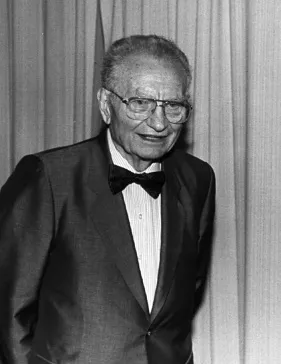
Paul Samuelson
Human Design Chart
Biography
Samuelson was likely the most influential economist of the later 20th century. In 1996, when he was awarded the National Medal of Science, considered to be America's top science-honour, President Bill Clinton commended Samuelson for his "fundamental contributions to economic science" for over 60 years.
Samuelson considered mathematics to be the "natural language" for economists and contributed significantly to the mathematical foundations of economics with his book Foundations of Economic Analysis. He was author of the best-selling economics textbook of all time, Economics: An Introductory Analysis, first published in 1948. It was the second American textbook that attempted to explain the principles of Keynesian economics. It is now in its 19th edition, having sold nearly 4 million copies in 40 languages.
He served as an advisor to Presidents John F. Kennedy and Lyndon B. Johnson, and was a consultant to the United States Treasury, the Bureau of the Budget and the President's Council of Economic Advisers. Samuelson wrote a weekly column for Newsweek magazine along with Chicago School economist Milton Friedman, where they represented opposing sides.
Samuelson died on 13 December 2009, at the age of 94.
Paul Samuelson as a Manifestor 6/2 in Human Design
Manifestor 6/2 — Design at a Glance
Paul Samuelson's design established him as a pioneer and leader whose role was to guide the world into a new future. His inner workings were similar to those of an emperor in ancient Rome: He possessed the vision of a great empire but did not lead the necessary wars himself. Instead, he sent others to conquer foreign lands for him. This style of leadership inevitably polarized people. Not everyone liked his plans, which became one of his biggest pain points: He was misunderstood and strongly polarizing. Because he often thought ahead of others, some loved and followed him because of his grand visions, while others hated or rejected him precisely because of them. To ensure the right followers found him, it was crucial for his design that he informed others timely and accurately about his intentions. This strategy of informing was key to his inner balance. If Paul Samuelson lived according to this strategy, he was rewarded with a feeling of inner peace. When he acted against this pattern, however, he felt an enduring, deep-seated anger within him. His path therefore involved attracting the right people through clear communication and thus minimizing the resistance that accompanied his role as a pioneer.
Emotional Authority
Paul Samuelson exhibited a decision-making stance marked by the necessity of temporal distance. His design included the defined Emotional Center, which automatically determined his inner authority – independent of any other defined centers. This emotional authority was subject to constant waves of mood swings. The world appeared colored by the current mood: A topic could seem highly relevant at one moment and unimportant or negatively assessed in another.
For Paul Samuelson, however, immediate feelings were only a snapshot, not a final judgment. Spontaneous decisions made directly from intense emotions often proved problematic as they did not yet reflect the deeper truth. His mechanism required patience and conscious hesitation when faced with important choices. By letting decisions “sleep” multiple times, he gained the emotional distance needed to find clarity. The strong feelings eventually subsided over time, allowing calmness to set in and revealing the true direction. This process of waiting and maturing was crucial for long-term life decisions as it ensured that not just fleeting moods but a stable inner truth guided the way.
The 6/2 Profile — Role Model / Hermit
Paul Samuelson's design inclined him towards experimental learning in his early years. Before the age of 30, his Line 6/2 functioned like a 3-line: Trial and error characterized this phase, followed by necessary retreats after failures. This was not aimless searching but rather a process of synthesis and communication of individual knowledge.
Around thirty years in, the dynamics changed fundamentally. The activation of Line 6 led Paul Samuelson into an intense period of reflection. He metaphorically retreated into a “cave” to look back at his earlier experiments with distance. This time served for healing and deep self-awareness. The complexity of this integration process required clarity in expression to create individuality.
Emerging from this introspective phase, Paul Samuelson appeared as a wise person. His wisdom became apparent to others; people came to him to partake in his life lessons and learn the ability for deep introspection. Simultaneously, Gate 30 was active in his Line 2, promoting objectivity and pragmatism. It fostered balance between extremes and increased productivity without wastefulness. Selectivity was crucial: Paul Samuelson prepared himself to experience the right thing and transform his inner longing into concrete results.
Single Definition — Defined & Open Centers
Paul Samuelson's Human Design profile established a consistent mental structure coupled with profound emotional authority. His defined Ajna Center sustained continuous conceptual thinking and the ability to develop concepts independently of external pressure. This mental energy flowed directly into his defined Throat Center, enabling him to express his thoughts and theories reliably – not as fleeting whims but as clear communication of what his mind had conceived.
Simultaneously, his defined Solar Plexus Center shaped his decision-making process: He possessed an emotional wave that required time to achieve clarity. Impulsive reactions were less effective; instead, patience fostered deep insights and carefully weighed judgments. His defined Root Center provided a constant adrenaline-driven push, propelling him forward and helping him cope with stress or existential challenges by channeling this pressure into structured action.
In contrast, his Head Center was open. Paul Samuelson tended to absorb mental pressure from outside without having a consistent source of inspiration himself. He could easily get drawn into the questions and doubts of others or be distracted by their mental unrest rather than solving these as his own problems. His open G Center also meant that he did not carry a fixed, unchanging identity; he adapted to environments and often found his direction through interaction with others or by finding the right place.
His Heart Center was also open, making him vulnerable to conditioning regarding willpower. He tended to make promises or try to prove his worth through performance only to later realize that he did not have the consistent energy for it. His open Sacral Center amplified the vital energy of his environment but left him without a constant flow; overexertion was a risk as he needed to learn to set boundaries and rest rather than running on borrowed energy. Finally, his open Spleen Center made him sensitive to well-being and fears in his surroundings, where spontaneous decisions were risky as they often stemmed from conditioned survival fears rather than healthy intuition.
Channels for insight, emotional depth and mystical synthesis.
Paul Samuelson's design inclined towards emotionally guided, individual articulation. The Openness Channel 22-12 connected his Solar Plexus Center with the Throat Center. This connection meant that his social interaction and expression strongly depended on the ebb and flow of his emotional wave. He possessed the ability to achieve an emotional impact on others through the quality of his voice, but only when he was in the right mood for it. Coercion or poor timing would have made him appear harsh; patience allowed him to act as a catalyst for change in others.
Parallel to this, his design showed a deep need for tribal belonging and loyalty through the Synthesis Channel 19-49. This channel connected the Root Center with the Solar Plexus Center and drove him to seek connections based on principles and mutual support. He sought an environment where he was needed and where resources and territory were protected. His emotional frequency served as glue for relationships, distinguishing between acceptance and rejection to maintain the integrity of his tribe – whether family or close circle.
In terms of thinking, the Structuring Channel 23-43 came into play. It connected his Ajna Center with the Throat Center and enabled him to clearly express spontaneous insights (Gate 43) through assimilation (Gate 23). His thinking often felt forward-looking; he had to learn to formulate his innovative perspectives in a way that others could understand without being perceived as outlandish.
Additionally, Gates like the Formulating Gate (4) contributed to developing logical patterns, while the Fulfillment Gate (55) triggered extreme mood swings in his Solar Plexus. The Gate 30 brought a longing for positive feelings and acceptance of limitations. These configurations marked him as someone who carried his unique insights into the world through emotional authenticity and clear structuring, always dependent on the right inner timing.
Individual Circuitry — Circuit Signature
Paul Samuelson's design inclined towards structured, emotional communication. As a Simple Defined individual, he had a coherent energetic flow between Ajna, Throat, Solar Plexus, and Root Centers. This unity created a clear internal logic that shaped his expression.
The Knowledge Circuit in him connected the Ajna with the Throat Center (Structuring) as well as the Solar Plexus with the Ajna Center (Openness). This enabled him to not only form thoughts but also articulate them through emotional waves from the Solar Plexus into clear words. The energy pulsing and acoustically, he sought new ways to express his unique identity and initiate change. Creativity and melancholy accompanied this process of knowledge acquisition and transformation.
Parallelly, the Ego Circuit connected Paul Samuelson's Solar Plexus with the Root Center (Synthesis). This channel promoted cooperation and the joint creation of resources within a group. Without a connection to the Sacral Center, there was no constant life force; instead, his design required periods of rest for energy regeneration for the tribe. The emotional wave here resembled a ratchet – conservative and traditionally oriented.
Centers within this group were directly connected: intellect, emotions, and action impulses flowed into each other. Paul Samuelson thus emerged as someone who synthesized complex connections, emotionally underpinned them, and structured them further, always in service of a larger community that he strengthened through mutual support.
Left Angle Cross of Dedication 1
Paul Samuelson's Human Design profile indicated a tendency towards deep devotion to a specific thing or person. This configuration, known as the left cross of devotion, described a life task that was distinguished not by superficial interests or changing inclinations but rather by an intense, almost obsessive focus on a particular goal or relationship. It was an energy that only reached its full potential when focused on one single point; spreading attention weakened this power significantly.
For Paul Samuelson, this meant that his greatest effectiveness and satisfaction were found in areas to which he devoted himself entirely. Other paths or distractions often felt empty or meaningless because they did not offer the necessary depth to nourish this specific energy. The challenge lay in identifying and maintaining this focus without being distracted by external expectations. Once this anchor point was found, a remarkable endurance and passion could arise that went beyond what mere duty or logical calculation required. This devotion was not a temporary state but a structural component of his design that significantly shaped his actions and decisions.
Saturn Return · Uranus Opposition · Chiron Return · 2nd Saturn Return — Life Cycles
Paul Samuelson's Human Design profile indicated a tendency towards structural confirmation that intensified in later life stages. His second Saturn return occurred at age 55 – the cycle often seen in Human Design as the phase of final anchoring, when earlier achievements prove their full validity and become lasting institutions.
In 1970, he received the Nobel Memorial Prize in Economic Sciences. For his chart, this was not a sudden coincidence but the logical consequence of long-term alignment: The second Saturn return marks the point where years of work condense into an unassailable foundation. What previously existed as theory or practice was now canonized socially and professionally.
This mechanism shows how Paul Samuelson carried his inner structure outward: not through spontaneous impulses, but through the gradual consolidation of his impact within a framework that required constancy. The Nobel Prize served here as visible proof that his design possessed the ability to order complex relationships in such a way that they remained sustainable across generations. Thus, the award was an external reflection of an internal maturity that only reached its full clarity in the second Saturn cycle – a moment when the individual became universal.
Manifestor · Emotional Authority — Synthesis
He was a pioneer who, through his visions and the ability to shape concepts (defined Ajna Center), blazed new trails. This drive for innovation was reinforced by the knowledge circuit – a constant striving for transformation and expression of one's individuality. However, deep emotional authority profoundly shaped this process: Decisions matured slowly, influenced by an emotional wave that both generated creative energy (Channel 22-12) and melancholy. This inner dynamic led to him developing groundbreaking ideas but always presenting them with a consciousness of their potential impact and in consideration of his own emotional world.
A central paradox lay in the combination of his manifesting nature – the desire to change and lead the world – and the deep reflection marked by the profile as an example setter after intense experiments (6/2 Profile). He seemed destined to initiate new concepts while simultaneously feeling a need to withdraw and learn from experiences. This led to a tension between the drive to actively shape things and the wisdom gained through distance and self-awareness – a dynamic that shaped his path and ultimately led him to recognition (Saturn return event).
3 Defined Channels
Incarnation Cross - Left Angle Cross of Dedication 1
Solar Return
The Solar Return shows the moment when the sun returns to its exact birth position - your personal solar year.
Life Cycles
Discover the life cycles with a detailed triple view (birth chart, cycle chart, composite).
Human Design Profile
- Type
- Manifestor
- Strategy
- To inform others before acting
- Authority
- Emotional Authority
- Profile
- 6/2 - Role Model / Hermit
- Definition
- Single Definition
- Incarnation Cross
- Left Angle Cross of Dedication 1
- Date of Birth
- 15.05.1915 06:00
- Place of Birth
- Gary, IN, United States
Frequently Asked Questions
What was Paul Samuelson's Human Design type?
What profile did Paul Samuelson have?
What authority did Paul Samuelson possess?
What incarnation cross did Paul Samuelson have?
When was Paul Samuelson born?
Discover your own Human Design
Are you also a Manifestor? Find out in a personal reading how to use your initiation power peacefully and dissolve resistance.
More Personalities
Back to overviewChristian-Jaque
Kesha

Lucebert
Marilyn

Masaccio

Papus