Paul Scharfe
Human Design Chart
Biography
Scharfe, son of a headmaster, was an officer in the German Army since 1897. He was a comrade of Paul Hausser. After marrying in 1903, Scharfe served in the Reserve of the police. In World War I, he fought briefly on the Polish front during 1914-1915. From 1921 to 1931, he made a career in the Prussian police.
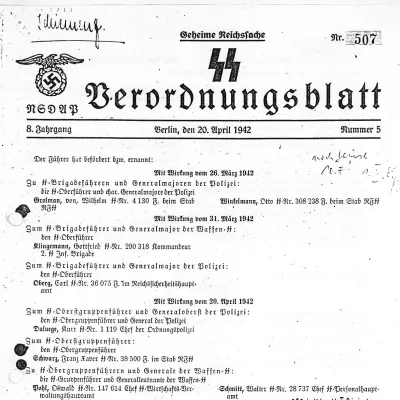
On 1 October 1931, he joined the Nazi Party (member no. 665,697) and the SS (member no. 14,220). On 20 April 1942, he was promoted to SS-Obergruppenführer. On 1 July 1939, he was appointed the first director of the newly formed SS Court Main Office in Munich, the legal department of the SS in Nazi Germany. It was responsible for formulating the laws and codes for the SS and various other groups of the police, conducting its own investigations and trials, as well as administering the SS and Police Courts and penal systems. This legal status meant all SS personnel were only accountable to the SS court. This effectively placed the SS above German law.
Paul Scharfe died of natural causes on 29 July 1942, aged 65, in Starnberg. His successor, from 15 August 1942, was Franz Breithaupt.
What does Manifesting Generator 4/6 mean for Paul Scharfe?
Manifesting Generator 4/6 — Design at a Glance
Paul Scharfe revealed himself as someone who worked with hybrid energy. As an incarnating generator, he combined the constant power of the Sacral Center with the ability to accelerate processes. This did not mean that he initiated; rather, he responded to impulses and then quickly drew results into his life. This speed was a double-edged sword: It allowed him to skip steps and move forward efficiently but also carried the risk of missing important stages. In such cases, he often had to return to fill gaps, which could lead to frustration – a classic sign that his inner authority was not fully integrated.
His nature tended towards pursuing multiple projects simultaneously rather than focusing on one thing at a time. This multitasking ability worked smoothly only when he responded to clear internal signals and regularly checked whether his energy still resonated with current tasks. When this reactive strategy was followed instead of blind action, Paul Scharfe found deep satisfaction in his work. He then lived in a playful mode where variety and the simultaneous handling of different fields were not distractions but sources of creative power. Frustration arose only when he acted against this inner resonance or tried to proceed linearly where his design called for leaps.
Emotional Authority
Paul Scharfe exhibited a fundamental disposition towards emotional delay: He did not make quick, impulsive decisions but let feelings subside first. This resulted from his inner authority located in the defined Emotional Center. In Human Design, the active Emotional Center is always the primary decision-making instance regardless of other defined centers. This configuration followed a wave dynamic of mood. The world often appeared colored by current affect – sometimes highly enthusiastic, sometimes deeply negative. Yet this initial impression was only a snapshot, not the final truth. Spontaneous actions from intense feelings frequently proved disadvantageous. His strategy involved taking time and letting decisions mature. This required patience and consciously sleeping on important questions. Through this waiting period, intense emotions gradually subsided. Only then did he gain emotional distance. Clarity and calm set in once the process was fully run through. This method primarily served long-term life decisions with significant impact. Paul Scharfe learned to hesitate and ask multiple times before reacting immediately. The emotional wave determined his rhythm: Upward and downward movements of feelings were constantly present. Only by enduring this uncertainty did he gain access to his deep, comprehensive insight. His authority thus demanded not quick resolution but trust in the temporal process of emotional condensation.
The 4/6 Profile — Opportunist / Role Model
Paul Scharfe's design tended towards establishing himself as a wise role model later in life. In the first thirty years before the Saturn Return, he acted like an experimenter who tried much in relationships and friendships. This aligned with Line 4 of his Profile 4/6, which emphasizes network and inner certainty through experience. With the activation of Line 6, however, an internal conflict emerged: The desire for community stood against the need to withdraw and reflect on the meaning of life. This contradiction between heart and head shaped his development.
The sixth line in his configuration demanded correction and authenticity. It sought crises consciously to achieve experiential goals, often linked with rigor or resistance against societal norms. Paul Scharfe showed himself as someone who made progress through this self-correction process when absolutely necessary. His role as a model arose not from ambition but from the necessity of transforming confusion into clarity. The great heart of his Line 4 remained cautious to avoid opening up to the wrong people and getting hurt. Only by overcoming this tension between social connection and individual wisdom could he make his inspiration for the network effective.
Triple Split Definition — Defined & Open Centers
Paul Sharp's Human Design shows a tendency towards constant mental pressure to question and develop concepts. With defined Head and Ajna Centers, he was constantly exposed to inspiration – a process of confusion, doubt, and ultimately clarity. Since these centers do not have their own energy for implementation, fighting against this state often led to frustration; instead, he acted as a source that encouraged others to think.
His willpower was shaped by the defined Heart Center: He determined his life himself, kept promises, and sought recognition for his contribution. Simultaneously, he had a reliable self-identity and direction in the defined G Center, which helped him comfort or show new paths without being dependent on others. His communication came from the defined Throat – a consistent way of expressing thoughts (Ajna) or will (Heart).
As a Generator with a defined Sacral Center, he had an enormous vital energy source. His mantra was: “Do not initiate.” He waited for questions or triggers to hear his sacral response (“Yes” or “No”) before acting. Only this way did he avoid resistance and exhaustion. Additionally, he possessed emotional authority in the defined Solar Plexus Center. Here, truth revealed itself over time; he had to wait out the emotional wave to gain clarity rather than react impulsively to highs or lows.
In contrast, his Spleen and Root Centers were open. The open Spleen Center made him vulnerable to survival fears and conditioning by others; he tended to cling to people with defined Spleens for security instead of making spontaneous decisions. The open Root Center absorbed external stress from the environment. He was not designed to withstand this pressure long-term but had to learn to distinguish between his own and foreign adrenaline to prevent burnout. These opennesses challenged him to be guided by his inner authority rather than reacting to external stimuli.
Channels for critical mind, rhythm, change and community.
Paul Sharp's mind constantly filtered patterns and sought consistency. The Logic Channel 63-4 connected Head with Ajna Center; doubt was essential here, as logic could only be flawlessly formulated if practically testable. This skeptical mindset allowed little room for unfounded belief – a response was only considered true when it yielded a consistent pattern. Simultaneously, the Abstraction Channel 64-47 drove him to sift through every experience with mental imagery. Here his mind sought stories and perspectives, even though this temporarily created confusion; the reward lay in uncovering an inspiring clarity later that he could share.
On a physical level, the Rhythm Channel 5-15 determined his life flow. It connected Sacral Center to G Center and held fast to fixed habits while integrating extremes into natural rhythms. This biological pillar ensured internal timing; when Paul Sharp was aligned with this rhythm, everything felt effortless and magnetically drew others into his energy flow.
Emotionally, his design sought depth through experience. The Transience Channel 35-36 connected Solar Plexus to Throat Center; it resisted restrictive patterns and drove him to experience new things, often by creating crises to generate movement. This restless longing served collective progress by generating emotional wisdom. Simultaneously, he searched for his place in the whole via the Community Channel 37-40. It linked Solar Plexus to Heart Center and emphasized the need for good agreements. He waited for personal invitations to become part of an organization where he built bridges between individuals through fair contracts and loyally integrated into a group larger than himself.
Collective Circuitry — Circuit Signature
Paul Sharp's design was characterized by three separate, parallel operating energetic streams. The Understanding Circuit connected his Head and Ajna Centers as well as Identity and Sacral Centers in two isolated blocks. This promoted clear, emotionless logic for future planning, coupled with rhythmic access to inner authority – always as separate functions, not a continuous flow.
Parallel to this, the Meaning Circuit operated. It again connected Head and Ajna Centers but also Throat Center with Solar Plexus in a second group. Here it was about cyclic processing of emotional waves from the past. Paul Sharp reflected on events to grasp their meaning and shared these felt insights with others, while cognitive abstraction and emotional experience remained spatially separate.
The third stream, the Ego Circuit, connected Heart and Solar Plexus Centers. This channel emphasized community and the principle of give-and-take. Since there was no connection to the Sacral Center, this configuration required regular rest pauses for resource regeneration. Cooperation served the common building of material foundations, with emotional support taking precedence.
Overall, these three independent systems shaped Paul Sharp's essence: rational future orientation, emotional past processing, and communal resource creation existed side by side without directly mixing or forming a single continuous path.
Right Angle Cross of Consciousness 3
Paul Sharp's design was marked by the configuration 'The Consciousness Cross 3'. This structure established a specific inner dynamics that were reflected in his way of thinking and acting. In Human Design, this cross describes a particular alignment of energy centers and channels that shape consciousness. It wasn't a random pattern but a fixed mechanical background that structured his perception of the world.
The term 'Consciousness Cross' refers to the fact that this configuration primarily influenced the mental and cognitive domain. Paul Sharp lived with this inner map, which repeatedly called certain themes into his life. The number 3 points to a specific variation that in detail determined his way of learning and processing information. It was a framework within which he made decisions and categorized experiences.
This mechanical given meant that his focus often lay on particular aspects activated by this cross configuration. It shaped his basic attitude and the themes central to him. Without further specific data about events or other chart elements, the description remains at this fundamental architectural fact: His consciousness was structured by this right cross, which had a certain quality of his inner experience and mental orientation as a result. It was the static background of his dynamic life path.
Saturn Return · Uranus Opposition · Chiron Return · 2nd Saturn Return — Life Cycles
Paul Sharp appeared as someone whose life structure was characterized by clear, cyclical consolidations. His design laid out a tendency towards structural solidifications that were particularly evident in Saturn Returns – those approximately 29-year cycles where inner maturity and outer reality meet.
In 1903, at the age of 27, he got married. This marked his first Saturn Return: a time when the foundation for long-term commitments is often laid or existing structures are cemented definitively. For his chart, this was not just coincidence but the beginning of a phase of stabilization in the private domain.
His second Saturn Return occurred in 1933 when he was 57 years old. In that year, he took over leadership of the newly established SS court in Munich by Heinrich Himmler. This career step illustrates the mechanics of the second Saturn cycle: Here professional identity often solidifies into a firm, hard-to-change position. The assumption of this specific authority role shows how his design was aligned towards institutional anchoring and clear hierarchies during this life phase. Both events – marriage and judicial leadership – were not isolated incidents but expressions of the same underlying dynamics: successive hardening of his personal and professional foundation according to Saturn cycles in his Human Design.
Manifesting Generator · Emotional Authority — Synthesis
Paul Sharp lived a path marked by constant oscillation between inner preservation and external action. His design as an Manifesting Generator (MG) with sacral energy pointed towards a natural ability to seize opportunities and push things forward quickly. This dynamic was, however, always modulated by his emotional authority, which required deep reflection and internal clarity before decisions could be made. The defined Head Center (Logic Channel) reinforced this process by creating constant mental pressure for analysis and questioning – a search for stability amidst emotional waves.
A central paradox in his chart lay in the interplay of initiatory impulse and need for inner maturation. As an MG, he possessed the ability to initiate things, yet the profile as Networker/Role Model (4/6) pointed towards a deeper longing for validation by others and responsibility for community welfare. The Saturn Return events – both in a relationship context and professionally – showed how he navigated these tensions between individual drive and collective expectation and continually redefined himself.
5 Defined Channels
Incarnation Cross - Right Angle Cross of Consciousness 3
Solar Return
The Solar Return shows the moment when the sun returns to its exact birth position - your personal solar year.
Life Cycles
Discover the life cycles with a detailed triple view (birth chart, cycle chart, composite).
Human Design Profile
- Strategy
- To respond - wait for something to respond to
- Authority
- Emotional Authority
- Profile
- 4/6 - Opportunist / Role Model
- Definition
- Triple Split
- Incarnation Cross
- Right Angle Cross of Consciousness 3
- Date of Birth
- 06.09.1876 16:00
- Place of Birth
- Danzig, GER
Frequently Asked Questions
What was Paul Scharfe's Human Design type?
What profile did Paul Scharfe have in his Human Design?
What authority determined Paul Scharfe's decisions?
Which incarnation cross characterized Paul Scharfe?
When was Paul Scharfe born?
Discover your own Human Design
Are you also a Manifesting Generator? Find out in a personal reading how to unfold your multi-talents and direct your energy wisely.
More Personalities
Back to overviewAldair

Alizée

Angeli

Arletty

Artus

Balthus