
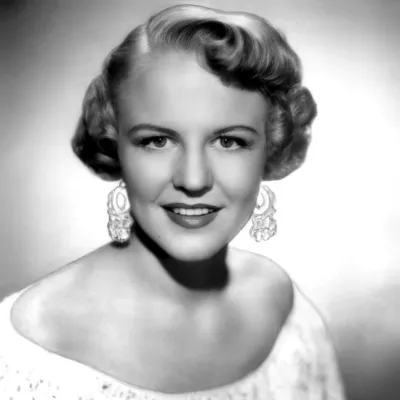
Peggy Lee
Human Design Chart
Biography
Peggy was four when her mother died. Her father, a railroad station-agent, began wandering and she was given over to the care of a stepmother who "poured boiling water on my hands when I did dishes and used the metal end of the razor strap for beatings."
After high school Lee escaped to Fargo, ND where she heard the new sounds on the radio: "race music" from Chicago. The radio program director at WDAY in Fargo auditioned her, changed her name to Peggy Lee and put her on "Hayloft Jamboree" as Freckle-Faced Gertie. After that she toured with bands, worked concessions at a California carnival and landed a job singing in a Palm Springs jazz club, The Doll House. Her career was launched by the tune Benny Goodman arranged for her "Why Don't You Do Right?" but fame almost faded when she married Goodman's handsome guitarist, Dave Barbour, in 1943. She turned down offers to sing in favor of domesticity until Barbour's self-destructive drinking strained the relationship, especially after their daughter Nicki was born.
Three husbands followed, two actors and a bandleader - all were short lived marriages. In 1965, 13 years after their divorce, she was about to get back together with Barbour who'd stayed sober since their break-up, but before it could happen he died of a heart attack.
What does Manifesting Generator 6/2 mean for Peggy Lee?
Manifesting Generator 6/2 — Design at a Glance
Peggy Lee revealed herself as a Hybrid being, combining the constant energy of a Generator with the lightning-fast implementation power of a Manifestor. Her design provided her with an inexhaustible power source through her defined Sacral Center, yet required the strategy of responding to impulses rather than initiating them herself. This configuration allowed her to skip steps and draw things into her life with remarkable speed.
This speed was a double-edged sword. Often, she tended to pursue multiple projects simultaneously, driven by various impulses. If her inner authority was not clearly on board, her initial creative enthusiasm quickly turned into frustration. The risk was that she might overlook important stages and later have to return to fill in gaps – a process that disturbed her inner satisfaction.
The key to her effectiveness lay in constant review: She had to ensure that the Sacral Center gave a clear 'yes' at every step. Only then, when she responded to true resonance and found herself in a playful mode, could she carry out her parallel activities without internal friction. In this state, she drew deep satisfaction from her work, while the compulsion to finish one thing before starting the next was more of a hindrance than a help for her design. Her energy flourished through variety and the feeling of playfully meeting life rather than processing it linearly.
Emotional Authority
Peggy Lee's design inclined towards emotional wave movements that significantly shaped her perception and decision-making. Her inner authority was the Emotional Authority, carried by the defined Emotional Center. In Human Design mechanics, this authority is always considered primary, regardless of which other centers are defined in the chart. This meant for Peggy Lee that her feelings fluctuated in a constant up and down; she saw the world always colored by her current mood. What appeared inspiring in one moment could be perceived as negative in the next. Since such an emotional outburst was merely a snapshot and not a final judgment, spontaneous decisions based on these immediate emotions were often misleading. The mechanics therefore required patience and conscious hesitation. By taking time to let decisions mature – often through multiple nights of reflection – Peggy Lee could even out the intense feelings. With this distance, she gained emotional detachment, leading to clarity and calmness. This process was particularly crucial for long-term, life-changing decisions, as only after the emotional wave had subsided did the true inner truth become visible.
The 6/2 Profile — Role Model / Hermit
Peggy Lee's design inclined towards a two-phase life development. In her youth, before the first Saturn return, her 6/2 line acted like a 3-line. This promoted an attitude of experimentation and learning through trial and error. After setbacks, she withdrew to process experiences.
Around age 30, the 6-line activated. Then Peggy Lee sought distance from her previous life. She metaphorically retreated into a 'cave' to reflect on her past experiments with great distance. This phase of intense introspection served for healing and deep self-awareness. Only after this inner work was completed did she re-emerge as a wise person. Others could recognize her life wisdom and came to her to learn from her ability for deep self-reflection.
Her design also emphasized individual responsibility within an organic community. The 2-line of her configuration projected outward, often leading to a lack of awareness of her actual abilities. She needed spaces where she could remain undisturbed, similar to spiritual communities. Family values were often difficult for her to understand; she had to feel a sense of belonging to access resources. Her wisdom thus developed not through constant action, but through withdrawal and later, authentic participation in societal values.
Split Definition — Defined & Open Centers
Peggy Lee revealed herself through a design that emphasized inner stability and emotional depth. Her defined G Center gave her a clear, reliable identity and a firm sense of direction in life. She knew who she was and could convey this inner security to others without becoming dependent on them. Alongside this, she had a defined Heart Center, which gave her the strength of will and the ability to keep promises. She controlled her resources herself and sought recognition for her achievements, ensuring that she only made commitments she could keep.
Her energy source was her defined Sacral Center. As a Generator, she had a constant vital force that was only effective when she responded to external stimuli rather than initiating herself. Her truth lay in the immediate response of her gut feelings to life's questions. This responsiveness was modified by her defined Solar Plexus Center, which acted as an inner authority. Peggy Lee learned to trust the emotional wave and make decisions only when her feelings had clarified. Patience was not an obstacle for her but the key to emotional clarity.
Her open centers shaped her vulnerabilities. Her open Head and Ajna Centers meant that she did not have a constant mental inspiration. She tended to engage with questions that did not originate from her or sought answers to fill mental voids. Her open Spleen Center made her sensitive to environmental factors; she risked clinging to people or situations that gave her a false sense of security, rather than trusting her own intuition. Finally, her open Root Center absorbed stress from the environment. She was vulnerable to being driven by external pressure, which could lead to exhaustion if she did not recognize that this pressure was not her own.
Channels for powerful manifestation, inspiring expression and community.
Peggy Lee revealed herself as someone who, through her blores existence and authentic presence, drew public attention to herself. Her design inclined her to act as a living example that inspired others to live out their own uniqueness. This effect stems from the Channel of Inspiration 1-8, which connects the G Center with the Throat Center. Through Gate 1, the individual entrance for creative expression, and Gate 8, the Gate of Contribution, her unique identity became a public outlet. She needed no words to convince; her bold, individual life was the message. This channel demands that one stand out from the crowd to make a creative, transformative perspective experiential. Peggy Lee lived this art of the individual, potentially changing the perspective of her environment and encouraging others to be creative.
At the same time, she possessed immense, physiological life force that propelled her to act in the here and now. The Channel of Charisma 34-20 connected her Sacral Center with the Throat Center. Gate 34, the Gate of Power, provided the raw, generative energy that was translated into immediate manifestation through Gate 20, the Gate of Now. This gave her a charismatic presence and the ability to sustain activity over longer periods. However, this energy required that she only respond to things that truly fulfilled her to avoid becoming obsessed or engaging in chaotic actions. Her true vitality was evident when she was self-absorbed in satisfying activities, often making her seem unapproachable to others, but strengthening her inner guidance.
In interpersonal relationships, Peggy Lee sought deep, emotional clarity and fair agreements. The Channel of Community 37-40 connected her Solar Plexus Center with the Heart Center. Gate 37, the Gate of Friendship, sought recognition and belonging, while Gate 40, the Gate of Solitude, emphasized the need for breaks and rewards for work done. This channel taught her that true connection takes time to develop and that a good deal is based on mutual respect and the willingness to work side by side. She understood that community does not have to be hierarchical but is based on the voluntary contribution of each individual to form a group greater than the sum of its parts.
Additionally, gates like 46 (Devotion, Body Love), 59 (Genetic Strategy of Pairing), and 36 (Crisis as Development) were active in her design. Gate 46 promoted her ability to be fully engaged in the process and to care for her body as a temple. Gate 59 drove her to bond and unite, regardless of personal preferences, shaping her role in relationships. Gate 36 allowed her to release emotional energy through crises and develop new experiences from them. This combination of inspiration, charisma, and community building created a complex pattern in which Peggy Lee acted both as an inspiring individual and as a powerful actor in social structures.
Individual Circuitry — Circuit Signature
Peggy Lee's design inclined her to impulsive, inspired expressions that flowed directly from her individual identity. This was evident through the Knowledge Circuit, which in her case connected the Throat Center with the Identity Center. This channel of inspiration promoted the desire to follow her unique path and transform new knowledge through acoustic, pulsating energy.
Parallel to this, there was a separate, unconnected power in the Stem level. The Ego Circuit connected Peggy Lee's Heart Center with the Solar Plexus Center. This created a dynamic of mutual support and giving and taking within communities. Since there was no connection to the Sacral Center, pauses were necessary to regenerate resources for these collaborations.
A third, also isolated aspect was the Integration Circuit, which connected the Throat Center with the Sacral Center. This charisma channel allowed her to draw power from reacting to life and direct it through intuitive knowledge in the present moment.
Due to the divided definition, these three circuits existed as parallel, energetically unconnected systems. Peggy Lee thus lived with divided focuses: individual, inspired expression, cooperative stem dynamics, and reactive, charismatic action. This structure shaped her way of moving in the world by using these different energies not as a single flow but as distinct, complementary forces.
Left Angle Cross of Duality 1
Peggy Lee carried the left Duality Cross 1, a configuration that shaped a profound dedication to life and the world around her. This design promoted an attitude of acceptance and trust in the natural flow of things. Instead of fighting against obstacles, she often showed herself willing to adapt to circumstances and integrate the lessons of existence with a certain ease.
The mechanics of this cross point to a soul that learns through experience and develops an inner stability that is not dependent on external circumstances. It was less about achieving specific goals and more about the quality of presence in the here and now. Peggy Lee lived in a way that reflected this fundamental attitude: she embraced life as it came and sought meaning in everyday encounters and challenges.
This orientation allowed her to maintain a certain calm even in difficult times and to take something from every experience that promoted her inner development. The left Duality Cross 1 underscores the importance of dedication and the willingness to experience life in its entirety, without judging or changing it. For Peggy Lee, this was a central aspect of her personality that significantly influenced how she was and acted.
Saturn Return · Uranus Opposition · Chiron Return · 2nd Saturn Return — Life Cycles
Peggy Lee's design showed a tendency towards cyclic confirmations, where inner development condensed into external recognition. In 1947, at the age of 27, she experienced her first major success with the hit „It’s a Good Day“ with Dave Barbour. This coincided with her first Saturn Return, a life phase where years of hard work often condense into a solid result and strengthen one's own structure.
Later, in 1969, at the age of 49, she received a Grammy Award for the hit „Is That All There Is?“. This marked her Chiron Return, a fulfillment cycle in which one's incarnation cross, if lived according to strategy and authority, increasingly unfolds and becomes meaningful. For Peggy Lee, this was a blooming phase in which her artistic essence found full resonance. Thus, her chart mechanics described not a linear career but a rhythmic deepening: first stabilization through the Saturn influence, later completion and meaningfulness through the Chiron cycle. Both phases confirmed that her life task lay in the authentic expression that became clearer over the years.
Manifesting Generator · Emotional Authority — Synthesis
Peggy Lee lived a life marked by a deep inner dynamism that showed in a constant interplay between the desire for expression and the need for emotional clarity. As a Manifesting Generator (MG), she had the ability to quickly initiate and realize things, driven by sacral energy – yet always filtered through an emotional wave that required decisions to mature and careful consideration. This combination of initiating power and emotional depth shaped her path, with Channel of Inspiration (1-8) helping her to share creative impulses and act as a role model, especially after a phase of intense personal experience and reflection (Line 6/2).
A central paradox in her design lay in the tension between the quick, impulsive action inherent to the MG type and the necessity to fully process emotional processes. The left Duality Cross 1 points to an inner split that manifested in a pendulum swing between the desire for immediate realization and the need for inner certainty. Documented successes, such as the hit in 1947 and the Grammy Award in 1969, testify to her ability to integrate these opposing forces and transform them into creative energy.
3 Defined Channels
Incarnation Cross - Left Angle Cross of Duality 1
Solar Return
The Solar Return shows the moment when the sun returns to its exact birth position - your personal solar year.
Life Cycles
Discover the life cycles with a detailed triple view (birth chart, cycle chart, composite).
Human Design Profile
- Strategy
- To respond - wait for something to respond to
- Authority
- Emotional Authority
- Profile
- 6/2 - Role Model / Hermit
- Definition
- Split Definition
- Incarnation Cross
- Left Angle Cross of Duality 1
- Date of Birth
- 26.05.1920 12:45
- Place of Birth
- Jamestown, ND, United States
Frequently Asked Questions
What was Peggy Lee's Human Design type?
What Profile did Peggy Lee have in Human Design?
What authority did Peggy Lee have?
What incarnation cross did Peggy Lee have?
When was Peggy Lee born?
Discover your own Human Design
Are you also a Manifesting Generator? Find out in a personal reading how to unfold your multi-talents and direct your energy wisely.
More Personalities
Back to overviewSissy Spacek

Aldair

Alizée

Anémone

Angeli

Ann-Margret
