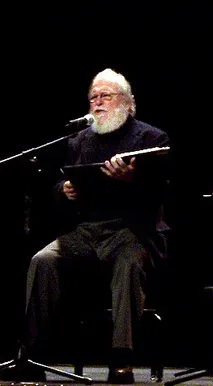
Photo: Wikimedia Commons
Peter Schickele
Human Design Chart
Biography
A Professor of Music at the University of Southern North Dakota, Schickele introduced his inventive composer in 1965, reputedly "the last and least of the many children of Johann Sebastian Bach." The works included, over the years, an opera, The Abduction of Figaro, and early attempts as stylistic fusions such as the bluegrass cantata Blaues Grass, Grune Himmel. It also required the development of instruments such as the left-handed sewer flute, the slide music stand, the windbreaker and more.
Over the years, the works of P.D.Q. Bach were performed by many of the world’s greatest orchestras, often with hilarious results if not uproarious eruptions of joy from the audience. Schickele is internationally recognized as one of the most versatile and imaginative creative artists in the musical world. Over a hundred works are available for symphony orchestras, choral groups, chamber ensembles, voice, movies, and television, giving him a respectable voice in the annals of American music. He toured with a program of original songs, singing some of his works with the poetry written by his wife, Susan Sindall. Annually, he gave an all-Schickele chamber music concert in New York. As a recording artist, he released some dozen LPs and innumerable scores and as a performing artist, his appearances sold-out rapidly.
What does Generator 4/6 mean for Peter Schickele?
Generator 4/6 — Design at a Glance
Peter Schickele revealed himself as someone who could unleash his immense endurance and productivity primarily when responding to external impulses. His Generator design had a lot of sacral energy, making him an extremely strong and enduring 'workhorse'—but only under the condition that he had energy for his task. This energy was not released through self-initiation but through reacting to signals from life. His motto was therefore clear: not to initiate but to react.
When his sacral center sent the inner signal 'Yes! Let's get started!', he responded with action. This was the key to his deep satisfaction and a sense of comprehensive fulfillment. Living in harmony with this strategy, no one could stop him. Conversely, two specific stumbling blocks threatened: either he spent his energy on things that did not bring him joy, often leading to burnout in Generators, or he was prevented from working on his heart project, even though he still wanted to continue working. In such cases, when he acted against his design or continuously initiated himself, he eventually encountered a feeling of persistent frustration and a noticeable lack of energy. His path to effectiveness therefore always lay in responding from the gut, not swimming against the current.
Emotional Authority
Peter Schickele revealed himself as someone who did not make decisions based on the first impulse but consciously let them rest until the initial emotional wave subsided. His design carried emotional authority, meaning his defined emotional center had inner leadership—regardless of which other centers were also defined. This configuration subjected him to a natural emotional wave that consisted of a permanent up and down of feelings. The world always appeared colored by his current mood: the same thing could be totally inspiring one moment and completely negative the next. Since this immediate feeling was only a snapshot and not a sure judgment, he risked negative consequences if he reacted quickly and spontaneously from emotion. His strategy was to gain time. He let decisions mature, often through multiple nights of reflection, to give himself the necessary emotional distance. Over time, the intense feelings subsided, and only then did true clarity and calm set in. This process of patience and deliberation was essential for him, especially in long-term decision-making options that significantly influenced his life course. Only after he had gone through this inner process did he act from a position of calm, not from a temporary emotion.
The 4/6 Profile — Opportunist / Role Model
Peter Schickele's design laid a lifelong tendency to a field of tension: between the deep need for belonging and the later urge for detached wisdom. In the first three decades of his life, he acted like an experimental seeker, trying many relationships and friendships. This phase corresponded to Line 4 of his profile, waiting for the right opportunity to express details and seek harmony. Here, the heart was in the foreground, always cautiously, not opening to the wrong people.
With the activation of Line 6, typically after the first Saturn return, his focus shifted. Peter Schickele now revealed himself as someone who oversaw the process and asked about the meaning. The internal conflict between the desire to be part of a community and the need to stand on the mountain top and reflect characterized his later years. He was expected to act as a role model and allow others to participate in his growth. His mechanics required time for the inner process, undisturbed, before sharing insights. Line 6 urged him to trust and pass on abstract experiences, while Line 4 ensured that this wisdom was anchored through cooperation and human connection. Thus, his design combined the search for hidden connections with the responsibility to make them useful for others.
Split Definition — Defined & Open Centers
Peter Schickele was revealed through a design that combined willpower and vital endurance with emotional depth. His defined Heart Center gave him a clear ego structure and the desire to shape his life and resources autonomously. He possessed the strength to keep promises and maintain his own authority, which helped him establish a foothold in the material world and gain recognition for his contributions. Simultaneously, his defined Sacral Center generated a constant source of vitality. This energy was available to him to engage with tasks that he welcomed with an inner 'yes', thereby finding satisfaction and persistence in his actions.
This physical and volitional foundation was filtered through his defined Solar Plexus Center, which acted as an inner authority. Schickele relied on waiting out the waves of his emotions before making decisions. This patience allowed him to gain emotional clarity and avoid impulses that would later lead to regret. His defined Root Center also provided a steady pressure that propelled him forward and helped him cope with stress in the world without losing inner balance.
At the same time, his chart revealed areas of receptivity. His open Head Center made him vulnerable to mental confusion and the pressure to find answers to questions that were not his. Instead of getting lost in this mental whirlpool, he learned to act as an observer of his thoughts. His open Ajna Center meant that he could not treat concepts and opinions as his own firm truth but rather took them in flexibly and let them go.
Similarly, his open Throat Center showed a tendency to force attention through speaking when he did not wait for the right invitation. He tended to wonder if he was noticed rather than trusting that the opportunity to speak would come from outside. His open G Center revealed a lack of firm identity; he did not actively seek a direction but allowed himself to be initiated by the environment and the right places. Finally, his open Spleen Center revealed a sensitivity to health and well-being. He relied on being surrounded by people with stable Spleen energy to feel secure and had to learn to avoid spontaneous decisions stemming from fear or false well-being.
Channels for evolutionary change and organic community.
Peter Schickele was revealed as someone deeply rooted in the dynamics of change and inner truth. His design was marked by the Channel of Mutation 60-3. This channel connected the Root Center with the Sacral Center and brought a pulsating, often melancholic energy. He had to learn to accept limitations and navigate through the confusion of new beginnings to enable evolutionary change. This energy was unpredictable and created a strong pressure to bring innovation into his life and environment, even if it was felt as internal tension or melancholy during phases of silence.
Alongside this driving force, Peter Schickele sought connection and belonging. The Channel of Community 37-40 connected his Solar Plexus Center with the Heart Center. This was about finding the right place in the whole and entering agreements based on mutual benefit and emotional clarity. He waited for the right invitation to build bridges between individuals and work in a community where everyone had an honorable place. This energy fostered loyalty and the desire to work alongside others rather than enforce hierarchical structures.
Additionally, specific Gates influenced him. Gate 61 brought the pressure of individual, spontaneous insight and the struggle for inner peace. Gate 42 emphasized the importance of experience and completing processes to take on new commitments. Gate 62 demanded patience and logical pattern recognition, while Gate 32 sought continuity and material stability for the tribe. On the personality side, Gate 19 sought security and resources in the community, Gate 27 brought caring warmth, and Gate 21 the desire for control and respect in material life. This constellation formed a person who navigated between deep inner change and the need for stable, communal anchoring.
Individual Circuitry — Circuit Signature
Peter Schickele's design tended towards separate, parallel functioning energetic blocks. Through his split definition, two independent energy fields existed that did not flow directly into each other but rather existed as separate experiences. This shaped his experience as someone navigating between different inner focuses without these automatically forming a single, coherent action impulse.
One of these blocks was the Knowledge Circuit. In Peter Schickele, this specifically connected the Sacral with the Root Center. This connection was reflected in the energy of Mutation: the drive to deviate from the known and create something new. This was not about general creativity or inspiration, which lies in other parts of this circuit, but specifically about the transformative power that comes from the Root and is expressed through the life energy of the Sacral. This showed as pulsating, acoustic energy aimed at initiating change by breaking away from the old.
The second, completely separate block was the Ego Circuit. Here, Peter Schickele connected the Heart with the Solar Plexus Center. This configuration concerned the relationship of giving and taking as well as the emotional evaluation of cooperation. It was about the dynamics of 'I give today, you give tomorrow', where the emotional wave of the Solar Plexus filtered the strategic intentions of the Heart. Since this circuit did not connect to the Sacral Center, this kind of resource creation and support required periods of rest to replenish the energy. Both systems—the transformative mutation and the cooperative resource generation—functioned independently and not directly connected in him.
Right Angle Cross of Maya 2
Peter Schickeles design carried the structure of the right Maya Cross. This configuration established a specific dynamic orientation characterized by a deep connection to collective processes and often paradoxical, dialectical thinking. The right Maya Cross linked certain energetic centers, leading to a tendency to hold and integrate seemingly contradictory aspects of a situation simultaneously. It was not a simple linear logic but the ability to view complex connections from different perspectives and thereby discover one's own, often unconventional truth.
This mechanical foundation created an internal tension between the need for individual authenticity and embedding in larger societal or cultural currents. Peter Schickele emerged in this dynamic as someone who found his own voice by engaging with what surrounded him, but filtering it through his personal, often ironic or questioning lens. The energy of this cross promoted a form of expression that was not direct but captured nuances, ambivalences, and the depth of human experiences. It was a design that tended to break through the surface to reveal the underlying, often contradictory motives and structures without falling into pure opposition but taking a position of integration.
Saturn Return · Uranus Opposition · Chiron Return · 2nd Saturn Return — Life Cycles
Peter Schickele used his first Saturn Return to establish a stable professional identity. In 1965, at the age of 30, he introduced the fictional composer P. D. Q. Bach at the University of Southern North Dakota. This cycle marks the transition from the experimental phase to structural anchoring in Human Design. The energy of Saturn condensed years of groundwork into a concrete, public project. It was not spontaneous inspiration but the conscious creation of a framework that allowed for long-term recognition.
Later, during the Uranus Opposition, Peter Schickele sought new forms of expression that challenged established norms. In 1972, at the age of 37, he released the soundtrack for the film “Silent Running”. The opposition to Uranus often brings a phase of rebellious energy or the urge for innovation, directed against earlier structures. For him, this meant transferring the concept of P. D. Q. Bach into a different medium, thereby expanding his creative reach. This step showed how he used the tension between his established role and the desire for change to advance his career. Both events illustrate how he used the cyclical energies of Saturn for structure and Uranus for renewal to realize his artistic vision.
Generator · Emotional Authority — Synthesis
Peter Schickele was a Generator whose life was marked by a deep, sacral energy. This energy fueled an indefatigable work ethic that was, however, always bound to the quality of the task – genuine engagement was essential to avoid burnout. His emotional nature (emotional authority) required time to let decisions mature, which reflected in an internal oscillation that shaped his perception of the world. The profile as a networker and role model points to a development where he initially experimented a lot before finding a role as a wise mentor, with the balance between community and individual reflection being a central challenge. The Channel of Mutation (3-60) strengthened the ability to create new things and deviate from conventions.
A central paradox in Peter Schickeles design lay in the tension between the need for deep emotional understanding and the pulsating creative energy of the Knowledge Circuit. On one hand, he needed time to process emotions and reach a clear decision, on the other hand, an unstoppable force drove him to create and transform new things. This dynamic was evident in documented events where creative impulses (1965, 1972) arose from a mature emotional foundation. The right Maya Cross 2 underscored this interaction between inner depth and outer expression.
2 Defined Channels
Incarnation Cross - Right Angle Cross of Maya 2
Solar Return
The Solar Return shows the moment when the sun returns to its exact birth position - your personal solar year.
Life Cycles
Discover the life cycles with a detailed triple view (birth chart, cycle chart, composite).
Human Design Profile
- Type
- Generator
- Strategy
- To respond - wait for something to respond to
- Authority
- Emotional Authority
- Profile
- 4/6 - Opportunist / Role Model
- Definition
- Split Definition
- Incarnation Cross
- Right Angle Cross of Maya 2
- Date of Birth
- 17.07.1935 03:00
- Place of Birth
- Ames, IA, United States
Frequently Asked Questions
What was Peter Schickele's Human Design type?
What profile did Peter Schickele have?
What authority did Peter Schickele have?
What incarnation cross did Peter Schickele have?
When was Peter Schickele born?
Discover your own Human Design
Are you also a Generator? Find out in a personal reading how to use your sacral energy correctly and discover deep satisfaction.
More Personalities
Back to overviewAaliyah

Alexia

Alizée

Angèle

Anne-Marie

Arcángel