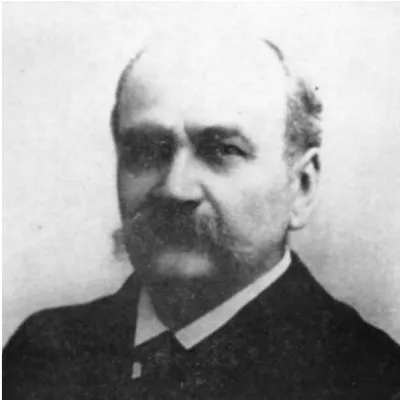
Philippe Barbier
Human Design Chart
Biography
Barbier was Victor Grignard's supervisor during his PhD. A method to prepare reactive Grignard reagents such as allylic magnesium halides is known as the Barbier method, where the Grignard reagent is made in situ with the other reagent.
He died on 18 September 1922, aged 74, in Bandol.
Philippe Barbier as a Manifesting Generator 1/3 in Human Design
Manifesting Generator 1/3 — Design at a Glance
Philippe Barbier revealed himself as someone who combined constant energy with fast carriers of action. His design indicated a tendency to leap quickly over steps and pursue multiple projects simultaneously in a 'play mode'. This configuration described an Manifesting Generator: a hybrid type with a defined sacral energy source like Generators, but augmented by the ability for rapid manifestation.
The mechanics of this type required precise balance. Philippe Barbier had constant life force energy, implying the same advice as pure Generators: not to initiate, but to react to external impulses. At the same time, he possessed the capacity to draw things rapidly into his life by skipping intermediate steps. This speed carried risks. Without inner consent, the design tended to overlook important stages, often leading to a need to backtrack and make up for missed steps – a source of frustration. Additionally, the speed encouraged multitasking; multiple parallel activities could only be satisfying if they were validated through the sacral center.
The critical success factor lay in responding to impulses rather than merely initiating them. Philippe Barbier had to ensure that every project he started received clear inner approval ('Yes!'). Only with this constant validation by his own authority did potential frustration from hasty action or uncontrolled multitasking transform into deep satisfaction. The design thrived on variety and fun, as long as it was in harmony with the inner resonance rather than working against it.
Emotional Authority
Philippe Barbier showed an internal decision-making instance that didn't reveal itself immediately but required time and patience. His Emotional Authority was subject to a permanent wave of ups and downs in feelings. The world appeared colored by his current mood: total enthusiasm at one moment, followed by a negative view of the same thing shortly after. This immediate feeling was merely a snapshot, an initial impression that didn't necessarily represent the truth. Quick, spontaneous decisions arising directly from this emotional heat often proved negative and consequential.
The mechanics of his inner authority demanded delay. The more time Philippe Barbier allowed for a decision, the deeper and broader his understanding became. This meant reconsidering decisions multiple times and taking his time to ask himself repeatedly. Only when intense feelings subsided did he gain the necessary emotional distance. Then clarity and calm set in; the process was complete. This strategy was especially important for long-term decisions as they had a significant impact on his life course. The patience of letting the emotional wave subside formed the foundation of his authentic orientation.
The 1/3 Profile — Investigator / Martyr
Philippe Barbier revealed himself as someone whose life was marked by tension between theoretical knowledge and practical experience. His design indicated a tendency to logically refute doubts to find calm – a characteristic of his Line 1. At the same time, Line 3 drove him to break out of rigid patterns and seek new paths through trial and error. This combination created an inner dynamic: on one hand, he feared not knowing enough to move into action; on the other, it relentlessly pushed him to try things and learn from mistakes.
His authority emerged only through this connection between research and experimentation. When Philippe Barbier made a judgment, it was the result of thorough examination – both theoretically and practically. His insights were self-earned and tested thoroughly. He did not see errors as failures but as necessary data points for his understanding. This mechanism described a life task: uncovering hidden connections through patience and perseverance and transforming them into tangible results. His judgments were trustworthy because they rested on this dual basis of knowledge and experience.
Split Definition — Defined & Open Centers
Philippe Barbier revealed himself as a person with a powerful, directed presence. His design was characterized by immense inner stability: The defined centers Heart (Ego), G Center, and Sacral formed a foundation of willpower, clear identity, and vital energy. The Heart Center gave him the ability to keep promises and use his resources self-determinedly; he did not need external validation for his worth. The G Center ensured that he had a firm sense of direction and attracted others through this clarity without being dependent on them.
This energy was carried into the world by his defined Throat Center. His voice was reliable and direct; he spoke from his identity and will. Driven by the Sacral Motor, he possessed a constant source of life energy that, however, required correct responses – initiatives from outside were necessary to channel this power productively and avoid frustration. The constant pressure of the defined Root Center kept him in motion while the Solar Plexus Center added emotional depth. His decisions needed time; he had to wait for the emotional wave to gain clarity rather than react impulsively to highs or lows.
In contrast, his open centers: Head, Ajna, and Spleen were present. Here, a constant inner source of mental inspiration or spontaneous intuition was missing. The open Head Center made him susceptible to identifying with other people's questions or seeking answers that weren't his business. He tended to take on the mental pressure from his environment and wonder if he needed to understand something that actually didn't concern anyone. His open Ajna Center meant that his thoughts were flexible; he could adopt concepts of others but should not hold them as personal truth. Especially, his open Spleen Center challenged him: Without a spontaneous sense of security, he was prone to cling to people or situations that gave him a false feeling of well-being out of fear of survival. His task was to recognize these conditioned fears and not react impulsively to them but trust in the inner authority of his Solar Plexus and the constancy of his Heart.
Channels for emotional transformation, pioneering spirit and maturation.
Philippe Barbier was marked by pulsating, cyclical energy that combined phases of high activity with times of deep melancholy. His design carried Channel Mutation 60-3, which propelled evolutionary change through an unpredictable on/off frequency. This mechanism required accepting limitations (Gate 60) and waiting for the correct pulse rather than rationalizing the silence between impulses. In these pauses, transformation developed under the surface; trying to force it led instead to frustration.
As an Initiator, he acted through Channel Initiation 51-25, which linked competitive ego energy (Gate 51) with universal love (Gate 25). His task was to provoke others towards individualization – but only by invitation. He brought the necessary 'shock' to guide people from collective consciousness to individual self-awareness, yet he had to learn not to control this process but live authentically so that initiation would work as a natural byproduct of his essence.
Emotionally, he operated through Channel Emotional Release 39-55. Through provocation (Gate 39), he spurred the minds of others while his own emotional wave swung between joy and sadness. This moodiness was not a disturbance but creative alchemy. By accepting his mood and not acting when energy was lacking, Philippe Barbier used this frequency to uncover deeper truths and stimulate the mind of his environment. The combination of these channels created a profile that brought change, initiated individuality, and made emotional depth accessible through authentic provocation.
Individual Circuitry — Circuit Signature
Philippe Barbier revealed himself as marked by a split definition showing two parallel, not directly connected energy systems. One system linked Sacral, Root, and Solar Plexus centers; the other connected Identity with Heart Center. This separation created tension between dynamic change and inner stability.
The Knowledge Circuit worked through Channels 'Mutation' (3-60) and 'Emotional Release' (55-39). It connected Sacral, Root, and Solar Plexus centers into a closed circuit. This promoted the drive for one's unique path through transformative impulses and emotional waves. The energy was pulsing and acoustical, driven by the need to create new forms and emotionally process them.
Parallel to this, the Centering Circuit formed through Channel 'Initiation' (25-51) a tight connection between Identity and Heart Centers. This small circuit strengthened self-worth and reinforced inner convictions. Since there was no link to Throat Center here, these deep certainties often remained unspoken but strongly individualistic and reinforcing of personal identity.
The Meaning Circuit rounded out the picture. With Channels 'Transience' (35-36), 'Maturation' (42-53), and 'Recognition' (30-41) it connected Throat, Solar Plexus, Root, and Sacral Centers. This allowed for emotional reflection on past experiences, drawing meaning from them, and expressing these insights through the Throat Center. The cyclical energy of this circuit helped learn from the past and grow together with others while the split definition ensured that emotional processing and identity-forming confirmation were experienced as separate, parallel processes.
Right Angle Cross of Consciousness 1
Philippe Barbier lived with the internal structure that defines the right cross of consciousness 1. This design element shaped his way of perceiving and orienting himself in the world. It was a specific configuration in his Human Design chart, setting certain perception patterns and energetic tendencies.
The right cross of consciousness 1 is not just a collection of features but a coherent system that influenced how Philippe Barbier received and processed information. It created a framework for his decisions and reactions in everyday life. Those who carry this cross often move within a tension field between individual perception and the necessity to integrate it into a larger context. For Philippe Barbier, this meant that his consciousness was shaped by this specific architecture.
There were no external events or biographical data that could serve as evidence here; rather, the focus is on the pure mechanics of the design itself. The description therefore remains abstract and concentrates on how this configuration works fundamentally. It shows that Philippe Barbier's inner compass was determined by this structure, regardless of the external circumstances surrounding him. The right cross of consciousness 1 acted as a constant companion in his life, significantly influencing his perspective on reality. It is part of his unique design, setting him apart and giving him a specific way to navigate through the world.
Saturn Return · Uranus Opposition · Chiron Return · 2nd Saturn Return — Life Cycles
Philippe Barbier's life followed a clear cyclical structure marked by two decisive turning points. His design suggested that his development was divided into phases of consolidation and later breakthrough. The first Saturn return, a cycle often symbolizing the end of a learning phase and the beginning of serious responsibility, shaped around his 28th year. During this time, his groundwork solidified into a sustainable result: in 1876, he earned his doctorate at the Sorbonne. This was not just an academic achievement but concrete proof of a period of maturation and structuring that defined earlier parts of his life.
Decades later, another deeper cycle came into play: the Chiron return. In Human Design mechanics, this timeframe (around 49-51 years) does not signify healing wounds but rather a blooming time for one's incarnation purpose. Here, the true life work unfolds if one has followed their strategy. For Philippe Barbier, this phase of fulfillment culminated at age 51. In 1899, he synthesized the first organomagnesium compound. This scientific success was the visible expression of his inner design fully unfolding. The connection between early structural consolidation through the Saturn cycle and later creative completion in the Chiron return shows how his mechanical foundations shaped his life: from the discipline of education to significant proficiency in his field.
Manifesting Generator · Emotional Authority — Synthesis
Philippe Barbier lived a life marked by deep internal dynamics: the interplay of creative energy and emotional depth. As an Manifesting Generator, he possessed the ability to quickly initiate things, yet his defined Solar Plexus Center required careful consideration and experiencing emotional waves before decisions truly matured. This combination of initiative and maturity shaped his approach to challenges – a constant oscillation between the desire for progress and the necessity of fully grasping one's emotions. The profile as Researcher/Experimentator underscored this tendency: Barbier was eager to learn through experience and continuously expand his knowledge, not hesitating to venture new paths and take risks.
A central paradox in Barbier's design lies in the tension between his ability for quick initiation and the need for emotional clarity. He was destined to initiate things but simultaneously had to surrender to the rhythm of his emotions to ensure that his actions aligned with his inner core. This interplay between action impulse and emotional waiting led to a life full of dynamism, marked by the search for authentic expression and deep satisfaction – an ongoing navigation between the desire for progress and the need for internal peace.
6 Defined Channels
Incarnation Cross - Right Angle Cross of Consciousness 1
Solar Return
The Solar Return shows the moment when the sun returns to its exact birth position - your personal solar year.
Life Cycles
Discover the life cycles with a detailed triple view (birth chart, cycle chart, composite).
Human Design Profile
- Strategy
- To respond - wait for something to respond to
- Authority
- Emotional Authority
- Profile
- 1/3 - Investigator / Martyr
- Definition
- Split Definition
- Incarnation Cross
- Right Angle Cross of Consciousness 1
- Date of Birth
- 02.03.1848 07:00
- Place of Birth
- Luzy, France
Frequently Asked Questions
What was Philippe Barbier's Human Design type?
What profile did Philippe Barbier have in Human Design?
What authority did Philippe Barbier have?
What incarnation cross did Philippe Barbier have?
When was Philippe Barbier born?
Discover your own Human Design
Are you also a Manifesting Generator? Find out in a personal reading how to unfold your multi-talents and direct your energy wisely.
More Personalities
Back to overviewAldair

Alizée

Angeli

Arletty
Artus

Balthus