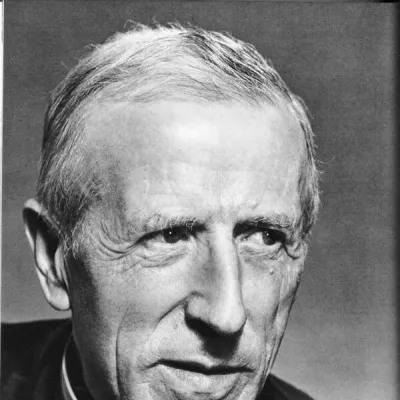
Pierre Teilhard De Chardin
Human Design Chart
Biography
In 1962, the Holy Office issued a warning regarding Teilhard's works, alleging ambiguities and doctrinal errors without specifying them. Some eminent Catholic figures, including Pope Benedict XVI and Pope Francis, have made positive comments on some of his ideas since. The response to his writings by scientists has been divided.
Teilhard served in World War I as a stretcher-bearer. He received several citations, and was awarded the Médaille militaire and the Legion of Honor, the highest French order of merit, both military and civil.
What does Manifestor 4/6 mean for Pierre Teilhard De Chardin?
Manifestor 4/6 — Design at a Glance
Pierre Teilhard De Chardin emerged as someone who wanted to lead the world into a new future. His design showed a tendency towards forward-thinking initiative, comparable to an emperor in ancient Rome who carried the vision of a great empire but did not lead the necessary wars and battles himself, instead inspiring others to do so. This role as a pioneer and visionary, however, came with a specific point of pain: He was often misunderstood because he thought ahead of many of his contemporaries. This led to polarization. Some people loved him for his immense visions and began to follow him, while others disliked or even hated him precisely because of these great dreams. For the right followers to find him, it was crucial for him to inform others about his visions at the right time and in sufficient detail. This was the ideal strategy for his design. If he followed this strategy of informing, he was rewarded with a sense of inner peace. If he lived against his design, he likely felt a persistent, deep-seated anger within him. His path was marked by this tension between the necessity to clearly communicate his visions and the inevitable polarization that came with his role as a leader.
Emotional Authority
Pierre Teilhard De Chardin never made decisions in the first emotional wave. His inner authority lay in his defined Solar Plexus Center. In Human Design mechanics, if the Emotional Center is defined, it always takes on the role of inner authority, regardless of other defined centers. This means that Pierre Teilhard De Chardin was under a constant emotional wave. His feelings swung between enthusiasm and rejection. The world appeared to him colored by his current mood. However, a first impression was not the final truth. Spontaneous actions based on a momentary snapshot would have had negative consequences. Instead, he used time to let decisions mature. He let himself be adorned and slept on important questions multiple times. Over time, the intense feelings subsided. An emotional distance emerged. Clarity and calmness set in. This process was crucial for long-term life decisions. Only when the emotional wave had subsided could he see his true direction. Patience was not an optional characteristic but a mechanical necessity of his design. Pierre Teilhard De Chardin understood that his inner truth did not lie in the first impulse but in the afterglow of the emotion.
The 4/6 Profile — Opportunist / Role Model
Pierre Teilhard De Chardin was someone who stood between a deep need for belonging and a drive for spiritual solitude. His design inclined him to deepen knowledge in silence before sharing it.
This aligned with his 4/6 Profile. In the early years of his life, he experimented with relationships, similar to a Line 3. With the activation of Line 6, however, an inner conflict emerged: the Heart (Line 4) sought community, while the Head (Line 6) questioned higher meaning on the 'mountain'. This interplay shaped his entire life.
The fourth line of Gate 24 demanded absolute solitude to preserve integrity. He expanded his knowledge in retreat and shared it slowly within a trusted network. The sixth line of Gate 19 led him through phases of devotion and experimentation to a final retreat. As a 'hermit', he pondered whether to commit to the tribe but often chose the path of solitude.
His spirituality transcended the material plane. He had to be cautious about whom he opened his heart to, to avoid being hurt. In later years, the expectation arose for him to act as a wise role model. This happened not through loud action but through cooperation with a few chosen ones who recognized his integrity and spiritual path.
Single Definition — Defined & Open Centers
Pierre Teilhard de Chardin's design established a tendency towards a clear, strong-willed expression based on inner identity and emotional depth. His defined centers in the Throat, G Center, Heart, and Solar Plexus created a robust structure: He had a reliable voice, powered by his higher self and willpower. Yet, this clarity was not a static state; it arose from patiently waiting for his emotional wave. His inner authority lay in the Solar Plexus, meaning he did not make decisions in the heat of the moment but only when emotional clarity had set in. This combination allowed him to advocate for his visions with conviction without acting impulsively.
At the same time, he was exposed to constant external influence through his open centers – Head, Ajna, Sacral, and Root. His open Head and Ajna centers made him receptive to inspirations and concepts from the environment, which he did not claim as his own, fixed truth. He tended to take on mental questions of others without solving them as his own problem. His open Sacral center meant he did not have a constant, personal generative energy but reflected the vitality of his environment. This led to him easily overextending himself when he amplified the energy of others rather than respecting his own limits. His open Root center absorbed stress and pressure from his environment, making him vulnerable to burnout when he tried to escape this external adrenaline rush through excessive activity. His strength lay in not blocking these open fields but using them as a mirror for the world around him while relying on his defined inner structure.
Channels for instinctive devotion, emotional depth, reflection and pioneering spirit.
Pierre Teilhard De Chardin showed himself to be someone who strictly tied his social impact to the rhythm of his emotional wave. The Openness Channel 22-12 connected his Solar Plexus Center to the Throat Center. This created a communicative power driven by passion and melancholy, yet regulated by the cautious restraint of Gate 12. He did not speak impulsively but waited for the right emotional moment to have a deep, transformative effect on others with his voice. This patience was crucial, as compulsion led to misunderstandings; in the right mood, however, he could break down barriers and strengthen others.
Parallel to this, he reflected intensively on collected experiences. The Lost Son Channel 13-33 connected his G Center to the Throat Center. Here, Gate 13 acted as a listener, storing information and secrets, while Gate 33 offered the ability to withdraw to sort these memories. Pierre Teilhard De Chardin used this configuration to gather life stories and lessons before sharing them. He did not seek immediate visions of the future but allowed the wisdom of the past to mature to reveal deep truths that created continuity.
His nature was also marked by a competitive energy aimed at individualization. The Initiation Channel 51-25 connected his Heart Center through the Shock Gate (51) to the Self Spirit Gate (25). This gave him the ability to survive initiation shocks through authentic living and encourage others in their uniqueness. He did not actively seek initiation but allowed it to find him, enabling him to master transcendent encounters and serve as an example for others.
Additionally, he had an instinctive sense of what the tribe needed. The Devotion Channel 44-26 connected his Spleen Center to the Heart Center. This allowed him to intuitively recognize threats or improvements through Gate 44 and act with the willpower of Gate 26. He knew how to present his gifts to gain support and understood the balance between work and rest as the foundation of his effectiveness.
Individual Circuitry — Circuit Signature
Pierre Teilhard De Chardin showed himself to be a person whose inner convictions and emotional perception were closely linked to the ability to carry these into the world. His design united the Identity, Heart, Solar Plexus, Throat, and Spleen Centers into a single, continuous energetic structure. This simple definition created a coherent flow that directly connected his individual identity with his emotional intuition and expression.
The Centering Circuit connected his Identity to the Heart Center. This gave him a solid, courageous personality with strong, individual convictions, which were often hard to verbalize, as the Throat Center was not involved here. Parallel to this, the Knowledge Circuit, which connected the Throat to the Solar Plexus Center, allowed him to express new insights and emotional waves openly and creatively, initiating change.
The Meaning Circuit also linked the Throat to the Identity Center. Here, it was about reflecting on past experiences and finding meaning to share these insights with others. Finally, the Ego Circuit connected the Heart to the Spleen Center. This promoted cooperation and the joint creation of resources through devotion and mediation, but also required rest periods, as there was no direct connection to the generative energy of the Sacral Center. Overall, these four circuits shaped a unity of inner strength, emotional reflection, and cooperative expression.
Right Angle Cross of the Four Ways 1
Pierre Teilhard de Chardin's design laid a tendency towards profound, often unspoken transformations. The right cross of the four paths 1 described a life task that was not fulfilled through external control but through inner dedication to a higher purpose. This configuration combined the search for hidden truth with the necessity to integrate these insights into a larger, collective vision. It was a process that required patience and trust in one's own path, as the results were often only visible in retrospect. Pierre Teilhard de Chardin emerged as someone who carried this tension between individual intuition and universal goal. The mechanics of this cross indicated that his influence was less through direct actions but through the radiance of a clear, though complex, message. This shaped his way of interacting with the world: not through dominance, but through a quiet, yet persistent presence that invited others to explore their own deep truths. The challenge lay in not preserving these visions as isolated ideas but placing them in the service of a greater whole without losing one's own integrity.
Saturn Return · Uranus Opposition · Chiron Return · 2nd Saturn Return — Life Cycles
Pierre Teilhard de Chardin showed a developmental line where inner maturity and external recognition condensed at precise intervals. His first Saturn return around the age of 30 marked the phase of structural anchoring. In 1911, at the age of 30, he was ordained as a priest. This step corresponded to the typical Saturn dynamics: years of preparatory work culminated in a firm, socially recognized position that served as a foundation for further life.
The Uranus opposition around the age of 40 often brought a necessary expansion or a break with old structures. In 1920, at the age of 39, Pierre Teilhard de Chardin passed the natural science diploma examination at the Sorbonne. This was not just an academic achievement but a moment of liberation and confirmation of his dual identity, redefined and validated by the Uranus energy.
The Chiron return around the age of 50 is a fulfillment cycle where the life purpose is concretized. In 1929, at the age of 48, the discovery of the Peking Man skull occurred. This event showed the bloom of his work: His incarnation purpose became experiential and visible through this scientific breakthrough.
The second Saturn return around the age of 60 solidified the achieved authority. In 1938, at the age of 57, he was appointed director of the laboratory for applied geology to the origins of man. This appointment was the logical consequence of a life path built on previous structuring and fulfillment experience. The cycles here do not unfold as random events but as coherent steps of self-realization and institutional anchoring.
Manifestor · Emotional Authority — Synthesis
He was a manifestor whose life was marked by an inner dynamic that connected emotional depth with the drive to initiate new things (Channel 22-12, Knowledge Circuit). Emotional authority required a maturation of decisions, while the profile as a networker and role model combined the desire for community with the need for independent reflection (Profile 4/6). This constellation led to a life where he repeatedly grappled with the question of how to share his visions with the world without betraying his own inner truth – a process that was further accentuated by the cycles of Saturn and Uranus.
A central paradox in his design lay in the tension between the need to communicate and transform (defined Throat Center) and the emotional wave that influenced his perception and expression. He was destined to give impulses and initiate changes, yet emotional authority required patience and careful consideration before acting. This led to an internal conflict between the desire for immediate effect and the necessity to find and communicate his own inner truth.
4 Defined Channels
Incarnation Cross - Right Angle Cross of the Four Ways 1
Solar Return
The Solar Return shows the moment when the sun returns to its exact birth position - your personal solar year.
Life Cycles
Discover the life cycles with a detailed triple view (birth chart, cycle chart, composite).
Human Design Profile
- Type
- Manifestor
- Strategy
- To inform others before acting
- Authority
- Emotional Authority
- Profile
- 4/6 - Opportunist / Role Model
- Definition
- Single Definition
- Incarnation Cross
- Right Angle Cross of the Four Ways 1
- Date of Birth
- 01.05.1881 07:00
- Place of Birth
- Orcières, France
Frequently Asked Questions
What was Pierre Teilhard De Chardin's Human Design type?
What Profile did Pierre Teilhard De Chardin have in Human Design?
Which Authority determined Pierre Teilhard De Chardin's decisions?
Which incarnation cross characterized Pierre Teilhard De Chardin?
When was Pierre Teilhard De Chardin born?
Discover your own Human Design
Are you also a Manifestor? Find out in a personal reading how to use your initiation power peacefully and dissolve resistance.
More Personalities
Back to overviewChristian-Jaque
Kesha

Lucebert
Masaccio
Nadar
Papus