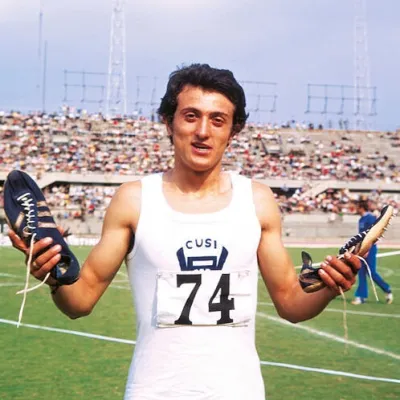
Pietro Mennea
Human Design Chart
Biography
Human Design Analysis: Pietro Mennea as Projector 4/6
Projector 4/6 — Design at a Glance
Pietro Mennea appeared as a Projector with a focusing aura that allowed him to immediately identify weaknesses in other systems. His design tended towards bringing 'light into the dark' by illuminating paths for others. Since his Sacral Center was undefined, he did not have constant intrinsic life energy. Instead, he worked in intense phases followed by necessary rest periods to prevent burnout.
His central strategy involved not actively seeking out or directly criticizing others, as this often felt unpleasant. Rather, he waited strictly for appreciative and honest invitations from others through his own harmony. This approach was crucial: if Pietro Mennea lived according to this design, he was rewarded with success. Ignoring it led sooner or later to bitterness as an expression of his non-self. His ability to identify flaws in other systems only fully manifested when he did not shine light directly into their faces but instead attracted others through his own harmonious glow and left the initiative up to them.
Splenic Authority
Pietro Mennea showed decision-making based on a fine, immediate inner signal. His internal authority lay in his defined Spleen Center, while his Emotional and Sacral Centers were open – a configuration only Projectors or Manifestors can have. The Spleen served as his health and alarm system, equipped with pronounced survival intelligence. This intuition spontaneously signaled whether a situation, environment, or society was right for him.
For Pietro Mennea: the first impulse was the correct one. Decisions had to be made in the moment since they directly served his health. This allowed him to rigorously protect against harmful influences and effectively care for himself. However, this Spleen impulse was very fine and only occurred once momentarily, risking being overlooked or drowned out by other influences. High vigilance was required; a brief retreat could aid decision-making.
Since the right course of action became apparent only in the current moment, his plans could change short-term. Long-term commitments were thus difficult. Instead, Pietro Mennea needed much freedom and flexibility to act spontaneously without unnecessarily committing himself. This structure fundamentally shaped how he dealt with life situations.
The 4/6 Profile — Opportunist / Role Model
Pietro Mennea navigated throughout his life between a deep emotional need for belonging and an intellectual drive towards detached wisdom. His design as Profile 4/6 established a dynamic characterized in the first three decades by experimental behavior; Line 6 still acted like Line 3, leading to promising but often superficial connections in friendships and relationships.
With the activation of Line 6, an inner conflict emerged: The Heart (Line 4) yearned for community while the Head (Line 6) desired isolated reflection on higher questions. This contradiction between heart and mind could be confusing as it required a constant balance between social engagement and spiritual distance.
In his later years, Pietro Mennea was expected to serve as a wise role model. His Line 4, connected with Gate 52, demanded self-discipline and concentration despite the social activity of this line raising doubts. These doubts were valuable for the collective when shared. Simultaneously, his Line 6 in the context of Gate 17 represented complete leadership and succession. Like a Bodhisattva, he often expressed his opinion only upon request, which helped him protect his large heart from false people and avoid injuries. Through cooperation and this cautious openness, he found his place without losing himself.
Triple Split Definition — Defined & Open Centers
Pietro Mennea was marked by a consistent inner logic and identity. His design featured defined Head, Ajna, and Throat Centers, creating a constant mental pressure for inspiration and response. This energy flowed out in a reliable form of communication. Additionally, his stable self-identity, intuitive spontaneity in the present moment, and existential survival drive were shaped by his defined G Center, Spleen Center, and Root Center.
In contrast to this inner structure stood open Heart, Sacral, and Solar Plexus Centers. The lack of a defined Heart Center meant he lacked consistent willpower; he tended to want to prove his worth through promises, which could lead into a cycle of disappointment. His open Sacral Center did not receive its own vital life force but absorbed energy from the environment, leading to the risk of overexertion and exhaustion since he was not designed to manage this "borrowed" power. Similarly, his open Solar Plexus Center absorbed emotional waves from the surroundings. He risked personalizing others' moods as his own and avoiding confrontations out of fear of rejection.
The challenge lay in managing this situational absorption without self-identification. While his defined mental and existential core provided clarity, he had to learn not to interpret the absorbed energies from Heart, Sacral, and Solar Plexus as his own truth or obligation but rather see them as transient information to maintain his inner stability.
Channels for inspiration, critical logic and sharp judgment.
Pietro Mennea revealed himself as someone who combined authentic individuality with analytical precision. His design indicated a tendency towards bold self-expression paired with a mind that constantly questioned and perfected patterns. This tension between inspiring leadership and logical corrective drive shaped his way of perceiving and shaping the world.
Channel 1-8 connected his G Center to the Throat Center through Gate of Self-Expression (1) and Gate of Contribution (8). This configuration acted as a public outlet for creative potential and guidance. Pietro Mennea was designed to gain attention by vividly demonstrating his unique identity rather than just explaining it. His impact arose from exemplary action: he showed others how to be brave, inspiring new directions in his environment. However, this required inner authenticity and patience with timing, as this channel did not offer automatic social adaptation.
Simultaneously, Channel 63-4 between the Head Center and Ajna Center via Gate of Doubt (63) and Gate of Formulation (4). This doubting mind continuously filtered patterns to test consistency. Doubt was essential for logic; an answer only held until a verifiable pattern emerged from it. Pietro Mennea used this skepticism to ask questions and make well-founded predictions, serving the collective beneficially. The pressure to understand patterns served to be useful to others, not his own life.
Channel of Judgment 58-18 connected Root Center with Spleen Center through Gate of Aliveness (58) and Gate of Correction (18). It nurtured an insatiable drive to correct and perfect patterns. Gate 58 spurred the love for life ("better and more"), while Gate 18 restrained by identifying imbalances. This sentry judged whether what was perceived served the collective's well-being. Pietro Mennea found joy when asked for correction; unasked, this urge could appear as fault-finding.
Gate 52 (Concentration) and Gate 17 (Following/Logic) underscored a focus on structured understanding. Gate 52 required intense concentration for pattern correction, often through self-imposed pauses. Gate 17 organized for the future based on genuine understanding and human rights. Gate 28 (Risks Here and Now) complemented this by the courage to make decisions in the moment, potentially triggering abrupt changes.
Collective Circuitry — Circuit Signature
Pietro Mennea was characterized by a Triple Definition, meaning his energy worked in three separate, non-directly connected blocks. This did not create a unified, constant internal drive but led to certain topics being activated situationally and often through external resonance.
An active area was the Knowledge Circuit, yet only the Inspiration Channel (Gates 1-8) was present. This linked the Throat Center with the Identity Center. It was not the full circuit of creation or transformation, but specifically about the ability to express inspired impulses directly. The energy here was pulsing and acoustic, yet without further channels of this circuit there was no continuous structure for long-term creative projects; creativity appeared more as momentary flashes.
The Understanding Circuit consisted of two isolated segments. The first connected the Head Center with the Ajna Center (Logic Channel, Gates 63-4). This allowed focused, visual thought processes and information processing towards the future. The second segment linked the Spleen Center with the Root Center (Judgment Channel, Gates 18-58). Here an instinctive, emotionless ratio worked toward structure and strategy. Since these two groups of the Understanding Circuit were not connected to each other, there was no automatic flow from idea to strategic implementation or vice versa. Logic and Judgment functioned parallel but did not integrate into a closed system. Pietro Mennea had to consciously unify these rational forces; they did not provide him with a single flowing intellectual power.
Right Angle Cross of Service 2
Pietro Mennea carried the Right Service Cross, a configuration that shaped his existence through a deep, often unconscious impulse towards dedication. His inner compass was oriented towards serving others or submitting to a higher cause. This formed the spiritual dimension of his being and defined the 'why' behind his actions more than external circumstances did.
The Right Service Cross does not describe a specific everyday behavior strategy but an archetypal life task. It points to a fundamental motivation that cannot be primarily explained through logical reasoning, but rather arises from a deeper level of dedication. For Pietro Mennea, this meant that his existence was carried by a drive to go beyond the individual and step into service for something greater. This energy worked as a constant background force influencing his decisions and life path without him always having to consciously steer it. It was an inner orientation towards selflessness in the sense of a higher order or the welfare of others. This configuration established that his true potential lay where he did not place himself at the center, but rather functioned as a channel for something greater. The associated energy was subtle and enduring, less explosive than an obvious drive, but more persistent in its effect on his long-term development and self-understanding.
Saturn Return · Uranus Opposition · Chiron Return · 2nd Saturn Return — Life Cycles
Pietro Mennea showed himself to be someone who strengthened his life foundations with increasing maturity and took responsibility. His design indicated a tendency to undergo a decisive turning point around the age of 28: the first Saturn Return cycle. This mechanical transition marked the step from youth to full adult responsibility and served to solidify his personal foundation.
In 1980, exactly at this age, Pietro Mennea won the gold medal in the 200 meters at the Olympic Games in Moscow. This event was no coincidence but a concrete proof of the effectiveness of this cycle. The first Saturn Return condensed years of groundwork into a sustainable result and confirmed his position at the highest level. It was a moment of affirmation, where previous life gained a stable structure. The mechanics here describe not only a biological age but an energetic maturation that allowed achievements to be anchored sustainably. Pietro Mennea used this time to secure his accomplishments and solidify his role in public life. The cycle acted as a catalyst for the transition into a phase of established authority and clear self-awareness.
Projector · Splenic Authority — Synthesis
Pietro Mennea lived a life marked by the search for recognition and the need to contribute. His Projector design led him to recognize the potentials (and often also the deficits – Gate 1) of others and inspire them through his presence and expression (Channel 1-8). This ability to act as 'light in darkness' corresponded with his authority in the Spleen, which gave him a fine sense for the right timing and appropriate environment – an inner security to set boundaries and make healthy decisions. The Profile as Networker/Role Model reinforced this impulse by driving him to form connections and stand out through cooperation (Line 4), while he simultaneously sought internal distance for reflection (Line 6).
A central paradox in his design lay in the tension field between the desire for belonging and the necessity of setting boundaries. The Line 4 in the Profile points to a deep need to be part of a community, while the Line 6 signals a longing for individuality and reflection. This led to an internal conflict between heart and head, forcing him constantly to find balance. His success (eventuated event 1980) could be seen as an expression of how he used his inspiration and knowledge to distinguish himself from others and contribute at the same time – an embodiment of the Knowledge Circuit.
3 Defined Channels
Incarnation Cross - Right Angle Cross of Service 2
Solar Return
The Solar Return shows the moment when the sun returns to its exact birth position - your personal solar year.
Life Cycles
Discover the life cycles with a detailed triple view (birth chart, cycle chart, composite).
Human Design Profile
- Type
- Projector
- Strategy
- Wait for the respectful invitation
- Authority
- Splenic Authority
- Profile
- 4/6 - Opportunist / Role Model
- Definition
- Triple Split
- Incarnation Cross
- Right Angle Cross of Service 2
- Date of Birth
- 28.06.1952 22:00
- Place of Birth
- Barletta, Italy
Frequently Asked Questions
What is the Human Design type of Pietro Mennea?
What Profile did Pietro Mennea have in Human Design?
Which Authority guided Pietro Mennea?
What incarnation cross did Pietro Mennea have?
When was Pietro Mennea born?
Discover your own Human Design
Are you also a Projector? Find out in a personal reading how to unfold your leadership qualities and recognize the right invitations.
More Personalities
Back to overviewSissy Spacek

Alain-Fournier

Aldair
Anémone

Ann-Margret

Bourvil