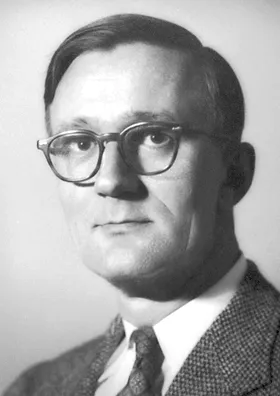
Polykarp Kusch
Human Design Chart
Biography
Kusch was the son of a Lutheran missionary who emigrated to the U.S., where he was educated. He received a Ph.D. at the University of Illinois, then taught for a few years along with military service in WW II. He wrote many science papers and was noted for his contributions to the knowledge of the atom.
Died on 20 March 1993, after a series of strokes at his home in Dallas.
Polykarp Kusch as a Generator 4/6 in Human Design
Generator 4/6 — Design at a Glance
Polykarp Kusch revealed himself as someone who exhibited remarkable endurance once he encountered impulses from his environment. As a Generator, he possessed a fully activated Sacral Center, which endowed him with immense, sustainable energy. However, this power was not unleashed through self-driven initiative but rather through responding to external signals. His strategy was to answer life rather than actively shape it. When a topic or task triggered his inner 'yes', he could work on it with great efficiency and persistence.
This design also carried specific risks. If Polykarp Kusch engaged in activities that did not resonate with his inner harmony, he would unnecessarily deplete his energy, leading to exhaustion. Conversely, it was frustrating for him when he was prevented from pursuing projects he was passionate about. The greatest challenge lay in not anticipating but waiting until life posed a question to which he could respond with his gut feeling. Living by this principle rewarded him with a deep sense of satisfaction. Initiating without prior signal led to frustration and a loss of power. His success thus depended crucially on learning to unleash his enormous energy only in response to a genuine impulse.
Sacral Authority
Polykarp Kusch's decision-making followed a clear, physical logic. As a Generator, his strategy to react was identical to his inner authority, the Sacral Authority. This unity simplified his process: he did not need external analysis but trusted the immediate response of his body to external stimuli.
This authority manifested as a 'gut feeling' or a palpable surge of energy. Polykarp Kusch learned to pay attention to these inner signals – sounds like grunts or hums, affirming 'Mhm' or rejecting 'Hm-hm'. When this reaction occurred, he felt vital and alive. An activated sacral motor provided him with seemingly inexhaustible energy and enabled him to dive into his activities with great enthusiasm. He acted without aimlessness, driven by joy and satisfaction.
Additionally, his activated Spleen Center served as a supporting instance. Perhaps directly connected to the Sacral Center, it allowed for quick, spontaneous reactions. Polykarp Kusch had an immediate access to his physical well-being and instinctive perception. This combination of sacral confirmation and spleen-based intuition enabled him to make decisions swiftly and reliably, guided by a deep, physical security.
The 4/6 Profile — Opportunist / Role Model
Polykarp Kusch revealed himself in his youth as someone who learned through intense experimentation with relationships and friendships. His Profile 4/6 initially appeared as a pure Line 3 in the first three decades of his life, which prompted him to undergo numerous social tests. Only after the return of Saturn, around the age of 30, did the specific conflict of this design become apparent: the tension between the deep desire for belonging (Line 4) and the urge to withdraw to contemplate the meaning of life (Line 6). This created an inner conflict between heart and mind.
The fourth line anchored him strongly in social exchange; for him, experiences were only truly valuable if they were shared and integrated into the collective fabric. Friendships thus formed the foundation of his success, but required a careful selection to avoid being hurt by false bonds. Simultaneously, the sixth line, particularly through Gate 28, fostered an extreme readiness to take risks. It was not just about glory but the question of whether life was worth it. He was willing to take extreme risks to win, driven by the dynamics oscillating between the will for triumph and the acceptance of impermanence. In his later years, he was expected to pass on these experiences as a wise role model, with cooperation with others always at the forefront.
Split Definition — Defined & Open Centers
Polykarp Kusch's design indicated a tendency towards consequent willpower and mental structure. His defined Heart Center provided a constant source of ego energy and the drive to determine his own life, while his defined Ajna Center ensured a reliable, specific form of conceptual thinking. He was able to create concepts and communicate them clearly through his defined Throat Center, allowing him to bring his thoughts and theories directly into the world. This combination of willpower, mental focus, and expressive capacity shaped his way of interacting with the material world.
At the same time, Polykarp Kusch was exposed to certain vulnerabilities through his open centers. His open Head Center made him susceptible to mental pressure and the temptation to engage with questions that were not his own or to seek inspiration where it was not needed. His open G Center meant that he did not have a fixed identity or direction; instead, he tended to blend with his environment and was dependent on others to initiate him in the correct direction rather than seeking it himself. Additionally, his open Solar Plexus absorbed the emotions of his surroundings, making him vulnerable to emotional conditioning and potentially leading him to experience foreign feelings as his own.
Despite these open centers, he possessed strong internal resources. His defined Sacral Center offered a vast source of vitality and energy, which, however, had to be activated through external stimuli to avoid frustration. His defined Spleen Center gave him a reliable instinct for health and well-being, helping him to stay in the moment and make intuitive decisions. Finally, his defined Root Center provided a constant inner pressure that propelled him forward and helped him deal with stress as long as he followed his strategy. This configuration showed someone who used mental clarity and willpower to effectively apply his energy while learning to cope with the uncertainties of his open centers.
Channels for instinctive devotion, structure, care and life purpose.
Polykarp Kusch was someone who developed innovative perspectives that changed collective thinking. This inclination resulted from the Channel of Structuring 43-23, which combined spontaneous insights (Gate 43) with the ability to convey them clearly and efficiently through assimilation (Gate 23). His design required patience: his unique ideas were often only understood when presented at the right time and with the necessary clarity.
Parallel to this, the Channel of Devotion 44-26 influenced his personality. He had an instinctive sense of what was useful to the community and used his willpower (Gate 26) to promote improvements or to 'sell' them. This gave him the ability to convince others and mobilize resources, often before the necessity was generally recognized.
In his design, the Channel of Preservation 27-50 shaped his actions. He felt responsible for the well-being of his environment and defended traditional values (Gate 50) to ensure stability. His care (Gate 27) was evident in his concern for what he had created and ensuring that structures endured.
The Channel of Life Struggle 38-28 propelled him to go his own way and fight for his integrity. He found meaning in overcoming resistance (Gate 38) and instinctively evaluated which struggles were worth it (Gate 28). This determination helped him to disengage from external expectations and preserve his individuality.
Additionally, Gates like Gate 11 (visual memory and analysis) and Gate 62 (logical detail work) contributed to his ability to recognize patterns and organize facts precisely. His design suggested that he worked best when he responded to inner signals rather than planning and shared his insights with patience and clarity.
Tribal Circuitry — Circuit Signature
Polykarp Kusch's design indicated a tendency towards structured expressiveness and instinctive preservation. As a person with split definition, his energetic profile consisted of two separate, parallel streams that did not directly flow into each other.
The Knowledge Circuit presented itself in two isolated segments. One strand connected the Ajna with the Throat Center through the Channel of Structuring (Gates 43-23). This promoted the ability to articulate conceptual thoughts clearly and orderly. The second segment, the Life Struggle Channel (Gates 28-38), linked the Spleen and Root Centers. Here, an instinctive energy acted in the moment of pressure or necessity to ensure security. Both aspects of the Knowledge Circuit remained energetically separate.
Another independent stream formed through the Ego Circuit. The Channel of Devotion (Gates 26-44) connected the Heart with the Spleen Center. This created a connection between willpower and an instinctive sense of value, manifesting in the ability to manage resources through devotion and cooperation.
Parallel to this, the Archer Circuit operated through the Channel of Preservation (Gates 27-50), which linked the Sacral with the Spleen Center. This stream provided a primal energy for preservation and care of the existing, fueled by the constant life force of the Sacral Center. Together with the Heart-Spleen strand, Heart, Sacral, Spleen, and Root formed a second, connected group that united will, instinct, and endurance, while the intellectual structuring in the Ajna-Throat strand remained separate.
Right Angle Cross of the Unexpected 4
Polykarp Kusch's design carried the signature of the right cross of the Unexpected 4. This configuration shaped a fundamental attitude characterized by a deep connection to the unforeseen and the new. In Human Design, this cross marks a specific energetic alignment that enables people to act in situations where the unexpected becomes the driver. It's not about control but about an intuitive adaptability to circumstances that cannot be planned.
For Polykarp Kusch, this meant that his life was marked by moments where paths opened up that were previously unseen. The energy of this cross supports the ability to develop clear impulses from chaos or uncertainty without needing to logically derive them. It is a dynamic often perceived as 'luck' or 'chance', but in the design, it is understood as a structural property that allows operating in new, untested territories.
Polykarp Kusch thus emerged as someone who did not swim against the current but sailed with the waves of the unexpected. His strength lay in not clinging to rigid plans but in utilizing the opportunities of the moment. This openness to the new was not a lack of strategy but the direct result of his energetic configuration, guiding him to find his true alignment in movement and change.
Saturn Return · Uranus Opposition · Chiron Return · 2nd Saturn Return — Life Cycles
Polykarp Kusch's career was marked by a clear structuring and increasing institutional responsibility. His design indicated a tendency towards stable, long-term engagements that crystallized into fixed positions. This was evident as early as 1937, at the age of 26, when he was an Instructor at Columbia University. This first Saturn Return marked his transition into a sustainable professional existence, where years of groundwork condensed into concrete results.
Later, in 1952, at the age of 41, he took on the role of Executive Director of the Radiation Laboratory at Columbia University, a leading position. This period coincided with the Uranus Opposition, a cycle often heralding profound changes and new freedoms within existing structures. Kusch used this phase to solidify his authority in a specialized research field.
The consolidation of his position reached its peak in 1969, at the age of 58, when he was Vice President of the University and Dean of the Faculty. This second Saturn Return confirmed his established role and firmly anchored him in the academic leadership. His career followed a pattern of gradual stabilization and expansion of responsibility, driven by the need to ensure structure and continuity in complex systems.
Generator · Sacral Authority — Synthesis
Polykarp Kusch lived deeply in the experience of sacral energy, driving and shaping him (Generator). This power was not only evident in his endurance but also in his ability to form and communicate new perspectives through the connection of mental clarity (defined Ajna Center) and authentic expression (Channel 61-24). His profile as a Networker/Role Model suggests that he always oscillated between the need for community and the desire for independent thinking – a tension that repeatedly surfaced throughout his life, leading to profound insights. The recurring career peaks (Saturn Return, Uranus Opposition) underscore that he channeled his energy into areas that satisfied his intellectual curiosity and drive for transformation.
A central paradox in his design lay in the combination of the need to generate and structure knowledge (Knowledge Circuit) and the inner tension between heart and head (Profile 4/6). He was a thinker deeply rooted in his emotions, leading to a constant interplay between rational analysis and intuitive wisdom. This tension shaped his ability to develop innovative ideas and communicate them in a way that inspired and changed others.
4 Defined Channels
Incarnation Cross - Right Angle Cross of the Unexpected 4
Solar Return
The Solar Return shows the moment when the sun returns to its exact birth position - your personal solar year.
Life Cycles
Discover the life cycles with a detailed triple view (birth chart, cycle chart, composite).
Human Design Profile
- Type
- Generator
- Strategy
- To respond - wait for something to respond to
- Authority
- Sacral Authority
- Profile
- 4/6 - Opportunist / Role Model
- Definition
- Split Definition
- Incarnation Cross
- Right Angle Cross of the Unexpected 4
- Date of Birth
- 26.01.1911 15:15
- Place of Birth
- Blankenburg, Germany
Frequently Asked Questions
What was Polykarp Kusch's Human Design type?
What Profile did Polykarp Kusch have in Human Design?
Which Authority guided Polykarp Kusch in decision-making?
What incarnation cross was Polykarp Kusch assigned to?
When was Polykarp Kusch born?
Discover your own Human Design
Are you also a Generator? Find out in a personal reading how to use your sacral energy correctly and discover deep satisfaction.
More Personalities
Back to overviewAaliyah

Alexia

Angèle

Anne-Marie

Arcángel

Arno