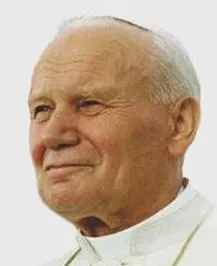
Pope John Paul II
Human Design Chart
Biography
"Lolek" as he was known in childhood, was born in 1920, the second son of Karol Wojtyla (voy TIH wah) Sr., a retired army officer and tailor, and Emilia Kaczorowska Wojtyla, a schoolteacher of Lithuanian descent, strict Catholics. They lived a Spartan lifestyle in a one-room apartment, and his dad was strict with the boy, making him study in a cold room to learn concentration. There was no anti-Semitism in the family and the boy had Jewish playmates. Indeed, Wojtyla became the first pope to visit a synagogue and the first to visit the memorial at Auschwitz to victims of the Holocaust. In ending the Catholic-Jewish estrangement, he called Jews "our elder brothers."
He was an athletic kid who skied, hiked, kayaked and swam in the flooded Skawa River, later becoming goal-keeper in the school soccer team. Death was part of the family history, with an infant sister who died prior to his birth and a month before his 9th birthday, his mother’s death of heart and kidney problems. When he was 12, his older brother, Edmund, 26, died of scarlet fever. Lolek himself had two close brushes with death; once when he was hit by a streetcar and secondly, when he was nearly struck by a truck in 1944.
Human Design Analysis: Pope John Paul II as Manifesting Generator 4/6
Manifesting Generator 4/6 — Design at a Glance
Pope John Paul II revealed himself as someone who possessed a hybrid energy: the constant power of a Generator paired with the lightning-fast action capability of a Manifestor. His design suggested that he could skip steps and quickly draw things into his life. This speed, however, carried the risk of overlooking important phases or getting distracted by parallel projects, which could lead to frustration – the central non-self theme of this type.
The mechanics of the Manifesting Generator require the strategy "React Instead of Initiate." Pope John Paul II had a defined sacral energy source that gave him constant power, provided he waited for external impulses before acting. Success and deep satisfaction came from responding to these life impulses and only proceeding when his inner self signaled a clear “yes.”
By correctly applying this strategy, Pope John Paul II could use his speed without falling into frustration. He found his true creative power in a playful mode that sought variety. Instead of limiting himself to a single task that would bore him, this configuration allowed him to advance multiple projects simultaneously as long as he felt joy and confirmation. This ability to stay in the flow of play while also acting quickly defined his energetic orientation significantly.
Emotional Authority
Pope John Paul II's decision-making process was marked by the necessity of emotional detachment; spontaneous judgments proved deceptive in his design. This resulted from his emotional authority, which was carried by the defined Solar Plexus Center. In this center, a constant wave motion of feelings took place: moods swung between enthusiasm and negativity, with each snapshot only providing a provisional impression, not the ultimate truth. An immediate reaction to this first emotional wave often risked negative consequences, as it had not yet matured.
The mechanics of his inner authority required patience and time. Pope John Paul II needed to "sleep on" decisions in order to gain distance from initial emotional heat. Through this repeated pausing, intense feelings gradually subsided. Only when this emotional wave had died down did the necessary clarity and calmness set in. This process of maturation was essential for recognizing deeper connections and making long-term course adjustments that significantly influenced his life path. Emotional authority always took precedence over other defined centers; it dictated the pace of decision-making. Thus, Pope John Paul II showed himself to be someone who had to consciously take time to arrive at true inner truth rather than being led by fleeting impulses.
The 4/6 Profile — Opportunist / Role Model
Pope John Paul II's Design laid out a tendency that unfolded in two clearly distinguishable life phases. In the first thirty years, he appeared as an experimenting networker who learned through relationships and sought his place in the social fabric. This early phase was marked by the energy of Line 4, which demanded respect within the network and waited for the right moment to make an individual contribution.
With the awakening of Line 6, his focus shifted fundamentally. Pope John Paul II now faced an internal conflict between the Heart seeking belonging and the Head seeking distance and wisdom. He developed into a disciplined role model. Line 6 required him to eliminate negative feelings and cultivate positive experiences with valuable people. It was no longer just about learning from mistakes but about enforcing laws and values.
His task became adopting a high spiritual stance and serving as a wise example for others. Pope John Paul II had to learn to carefully protect his big heart so he wouldn't open up to the wrong people. Instead, he focused on positively supporting weak individuals and reinforcing his role in the collective through cooperation with others. The balance between the desire for community and the need for spiritual clarity profoundly shaped his later life.
Split Definition — Defined & Open Centers
Pope John Paul II's Human Design profile indicated a tendency towards constant, autonomous presence: Thinking, Communication, Identity, Will, and Energy were always active. Six defined centers (Ajna, Throat, G-Center, Heart, Sacral, Solar Plexus) created this self-referentiality. The Ajna Center provided consistent conceptual thinking; the Throat enabled reliable expression. The G-Center gave a firm identity and direction, while the Heart Center supplied willpower and personal responsibility. Energy originated from the Sacral Center, which was dependent on reaction – initiation was avoided to prevent frustration. Emotional decisions required waiting for clarity in the Solar Plexus Center's wave movement.
Three open centers created situational vulnerabilities. The open Head Center made Pope John Paul II susceptible to external mental pressure and the temptation to solve others' questions; he tended to be influenced by doubts of others. The open Spleen Center led to absorption of uncertainty in well-being, posing a risk of unhealthy dependencies through seeking external security. The open Root Center absorbed adrenalized stress from the environment, promoting hyperactivity or exhaustion if this foreign pressure was not recognized and separated. This mechanism described a structure with strong inner substance but challenged by external mental, health-related, and stress-induced influences.
Channel 8-1: Inspiration — Channels & Gates
Pope John Paul II acted as a powerful presence that moved the collective through authentic example and internal direction. His design connected two dominant channels: Channel of Inspiration 1-8 and Channel of the Beat 14-2. The first created the ability to attract attention through bold self-expression; he lived his individual truth in such a way that others were inspired to unfold their own uniqueness. This did not happen merely through words, but through an exemplary life.
Simultaneously, Channel of the Beat 14-2 provided tantric energy for innovation and new directions. Through trust in the Sacral response, he had resources to support transformative impulses materially and lead the collective out of the status quo. This combination generated a leadership energy that worked both through individual charisma as well as deep responsiveness to life.
In his design, Channel of Structuring 43-23 supported this dynamic by translating unique insights into clear concepts that promoted efficiency and enabled new thinking. Additionally, Channel of Community 37-40 shaped his attitude in social contexts; he sought recognition and his place within the whole while also understanding the need for breaks and protection of self. This connection between Heart and Solar Plexus helped him build bridges between individuals and strengthen communities through fair agreements.
Furthermore, gates like Gate 30 (Feeling Recognition) and Gate 29 (Persistence in Sacral Center) contributed to emotional depth and endurance. Pope John Paul II thus used his inner authority to initiate change through inspiration and structured communication, always connected with the awareness of community and individual needs.
Individual Circuitry — Circuit Signature
Pope John Paul II lived with two separate, parallel existing energy fields. His design presented a tension between the drive for personal transformation and the necessity of root-oriented cooperation. As there was no direct connection between these groups, his path required conscious switching of energy back and forth.
The Knowledge Circuit in him connected Ajna, Throat, Identity, and Sacral centers into a cohesive flow. This created a pulsating, innovative force. Through Channel 8-1 (Inspiration), he received creative insights that through structuring (Channel 43-23) and rhythmic confirmation (Channel 2-14, 'The Beat') found expression. This configuration promoted the learning of new knowledge and its emotional transmission to others for initiating change.
Parallel to this existed the Ego Circuit as a separate field connecting Heart and Solar Plexus centers. Here it was not about individual novelty but traditional tribal dynamics: cooperation, resource management, and the give-and-take principle (Channel 37-40). Without connection to the Sacral center, there lacked constant life force; instead, pauses were necessary to regenerate energy for mutual support.
Pope John Paul II thus had to constantly balance between the impulsive, creative creation of new paths in the knowledge field and the conservative, resource-oriented maintenance of existing relationships in the ego field. This divided definition meant that he could not automatically unite these two aspects but experienced them as separate, parallel forces and had to steer them accordingly.
Right Angle Cross of Contagion 2
Pope John Paul II's Human Design shows a tendency towards deep emotional resonance. He was someone who unconsciously absorbed energies and moods from his environment – so-called 'infections' – and transformed them into transformative power. This dynamic came from the Right Infection Cross (Cross 2), which shapes compassion through bearing burdens or intense learning experiences.
The mechanics of this cross do not describe passive weakness, but rather the ability to translate painful or heavy experiences into a healing effect for others. Pope John Paul II lived this structure by not just enduring emotional tensions but using them as catalytic energy. The absorbed impulses were processed and then acted back on his environment, often with a calming or clarifying effect. It was about the alchemical transformation of pain into understanding.
Since no specific events were mentioned in the raw content, the description remains at this fundamental characteristic: Pope John Paul II was programmed through this configuration to be a connecting, transformative presence through personal experience and bearing other people's burdens. His strength lay in not isolating himself but bringing absorbed energies into a form that touched and supported others. This was not an everyday conscious act of assistance, but a deeper existential dynamic defined by Cross 2.
Saturn Return · Uranus Opposition · Chiron Return · 2nd Saturn Return — Life Cycles
Pope John Paul II's Human Design is characterized by a clear, cyclical development in the assumption of responsibility and authority. This structure marked his rise within the church hierarchy as a result of structural maturation processes.
In 1946, at age 26, he received his secret ordination to the priesthood. This marked the first Saturn Return, a cycle where years of groundwork condenses into a binding life structure and initial heavy responsibilities are taken on. Eighteen years later in 1958, at age 38, he was ordained as a bishop. Here the Uranus Opposition came into play: a point of sudden authority shift breaking established structures to create new, often unexpected power dynamics.
The Chiron Return occurred in 1967 when he was elevated to Cardinal Priest at age 47. This cycle signaled not healing old wounds but the blossoming of one's purpose: The unfolding of the incarnation task through service and experiencing deeper meaning in role. His second Saturn Return culminated in 1978 with his election as Pope on October 16th at age 58. This point confirmed the final stabilization of authority and full assumption of highest structural responsibility, as foreseen by his design. Each step followed this mechanical logic of maturation and authority assumption.
Manifesting Generator · Emotional Authority — Synthesis
A central red thread runs through the design: the dynamic connection between initiation and reaction. As a Manifesting Generator (with defined Sacral Center and connection to Throat Center), this person has both the ability to spark things quickly and the necessity to wait on inner impulses (sacral energy). This combination is reinforced by the Knowledge Circuit, which favors creative expression and transformation – an ongoing exploration of new paths and sharing these insights. The profile as Networker/Role Model underscores this tendency to collect experiences and convey them in a way that inspires and influences others (Channel 1-8).
The central paradox lies in the interplay between emotional authority and the manifesting aspect. Emotional waves require time for decisions to gain clarity, while the manifesting part of the design tends towards quick action. This leads to an internal tension between the need for thorough reflection (to find one's truth) and the urge to push things forward quickly – a back-and-forth between heart and head (4/6 Profile), which requires constant negotiation with one's own speed and timing.
4 Defined Channels
Incarnation Cross - Right Angle Cross of Contagion 2
Solar Return
The Solar Return shows the moment when the sun returns to its exact birth position - your personal solar year.
Life Cycles
Discover the life cycles with a detailed triple view (birth chart, cycle chart, composite).
Human Design Profile
- Strategy
- To respond - wait for something to respond to
- Authority
- Emotional Authority
- Profile
- 4/6 - Opportunist / Role Model
- Definition
- Split Definition
- Incarnation Cross
- Right Angle Cross of Contagion 2
- Date of Birth
- 18.05.1920 17:30
- Place of Birth
- Wadowice, POL
Frequently Asked Questions
What was Pope John Paul II's Human Design type?
What Profile did Pope John Paul II have in Human Design?
What authority did Pope John Paul II possess?
Which incarnation cross was active for Pope John Paul II?
When was Pope John Paul II born?
Discover your own Human Design
Are you also a Manifesting Generator? Find out in a personal reading how to unfold your multi-talents and direct your energy wisely.
More Personalities
Back to overviewAldair
Alizée
Angeli
Arletty
Artus
Balthus