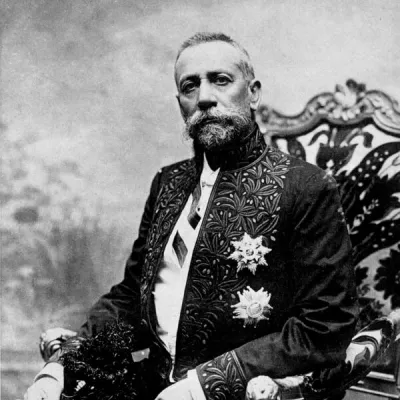
Prince of Monaco Albert I
Human Design Chart
Biography
He was the son of Prince Charles III (1818–1889), and Countess Antoinette de Mérode-Westerloo (1828–1864).
On 21 September 1869 at the Château de Marchais in Champagne, Prince Albert was married to Lady Mary Victoria Hamilton (1850–1922), of Lanarkshire, Scotland. After the couple's only child (Louis) was born, the couple divorced, and the marriage was annulled on 28 July 1880.
On 10 September 1889, Albert ascended the throne of Monaco on the death of his father. That same year in Paris, on 30 October, he married the Dowager Duchess de Richelieu, née Marie Alice Heine (1858–1925), the American daughter of a New Orleans building contractor of German-Jewish descent. In 1902, they separated legally, without issue, though did not divorce.
Prince Albert I of Monaco died on 26 June 1922 at age 73 in Paris, and was succeeded by his son, Louis II.
Prince of Monaco Albert I as a Projector 3/5 in Human Design
Projector 3/5 — Design at a Glance
Prince Albert I of Monaco revealed himself as someone who could see through systems with almost uncomfortable clarity. His design inclined him to immediately identify flaws in the system – he was like a bright flashlight shining directly into dark corners where others only saw chaos. This ability to recognize what is essential and wrong instantly shaped his inner attitude.
As a projector, Prince Albert I of Monaco did not have an intrinsic energy source like the Sacral Center would provide. Instead, he had a dense, focused aura that often felt intense in his environment; it could be perceived as unpleasant when he spoke out his insights directly and unexpectedly. Such direct addressing of others' mistakes quickly provoked defensive reactions – comparable to shining light directly into someone's face.
The most effective strategy for him was not active enforcement of his viewpoint but rather restraint. By appearing harmonious and radiant himself, he attracted others who came to seek advice because of his presence being so appealing. The central rule of his design was to wait for an honest invitation that valued him. Only then could he fully unfold his potential and be rewarded successfully. If he did not live by this principle of patience and waiting, the risk of non-self-experience loomed: bitterness over a system that did not recognize or utilize his clarity.
Splenic Authority
Prince Albert I of Monaco showed a fundamental attitude of radical spontaneity: His decisions arose not from long-term planning but as an immediate reaction to the present moment. This behavior stems from his inner authority in the Spleen – a defined center for health and survival intelligence. This configuration requires that both the emotional and sacral centers be open, structurally identifying him as either a projector or manifestor.
His intuition functioned as a precise alarm system. The first spontaneous impulse was the reliable indicator of whether a situation, environment, or society served his well-being. However, this spleen impulse is extremely subtle and occurs only once in the present moment. It could easily be drowned out by other influences, forcing Prince Albert I of Monaco to maintain high vigilance not to lose sight of this inner compass.
This mechanism allowed him a rigorous demarcation against harmful factors to protect his health. At the same time, it made long-term commitments difficult as the right choice only became apparent in the moment. Instead of rigid plans, he needed flexibility and freedom. A retreat for decision-making could be helpful, yet the essence remained: Only through trust in this fleeting intuitive moment could he optimally organize himself and protect against stress.
The 3/5 Profile — Martyr / Heretic
Prince Albert I of Monaco was characterized by a Profile 3/5: The Experimenter and Hero. His fundamental attitude was one of personal experimentation; he believed little until he had experienced things firsthand. This process of 'trial and error' served the generation of practical knowledge, with adaptability central as well as tolerance for criticism since renewal often provokes it.
Profile 3/5 defines a dynamic of private learning through mistakes (Line 3) and public presentation of this knowledge (Line 5). Prince Albert I of Monaco possessed a rich treasury of life experiences that he presented to others. This attitude was attractive in his environment; people oriented themselves towards him and gave off energy to learn from his insights. This corresponded with the Hero role of Line 5, which entices others to take responsibility or protect themselves from punishment by following the expert.
Simultaneously, this configuration carried the risk of painful public failures. When Prince Albert I tested new paths openly and failed, it was part of the mechanism: Knowledge must first be acquired. The tension lay between the internal learning process and external expectations for heroic problem-solving. His appeal arose precisely from solving problems with self-acquired knowledge, making others eager to learn from his experiences.
Split Definition — Defined & Open Centers
Prince Albert I of Monaco revealed himself through a persistent inner thought process characterized by inspiration and concept formation. His defined Head and Ajna centers generated constant mental pressure to question and understand connections. This state is not an energy source for direct implementation but rather an impulse generator; thoughts need a bridge into the world. This bridge was formed by his defined Throat: It allowed him to clearly and reliably express or delegate what he thought, without having to transform personal pressure into hasty actions.
In addition to this intellectual constitution, Prince Albert I of Monaco possessed stable resources for willpower and intuition. His defined Heart Center endowed him with a natural strength to fulfill promises and represent his own value, while the defined Spleen Center gave him a reliable, spontaneous sense of health and well-being in the present moment. This combination of stable willpower and intuitive clarity provided a solid foundation for decisions, independent of constant mental activity.
Simultaneously, his identity and energy were dynamically adapted to the environment. His open G Center meant that Prince Albert I of Monaco did not carry a fixed, unchanging identity but crystallized this only in correct relationships and environments. He tended to question whether he was in the right place to find his direction. His open Sacral Center made him vulnerable to the energy of others; he had to learn to take breaks as he amplified foreign vitality and could easily become exhausted. Additionally, his open Solar Plexus absorbed emotions from the environment, requiring distance to avoid being swept up by foreign moods. The open Root Center allowed him to absorb external stress without generating it himself, teaching him to recognize adrenalized pressure from outside and not mistake it for personal drive.
Channels for clarity, instinct and mental patterns.
Prince Albert I of Monaco exhibited a fundamental disposition towards innovative thinking that only became effective after an internal condensation phase. His design tended to receive spontaneous insights and initially assimilate them individually before clearly communicating them. This mechanism is characterized by the Channel of Structuring 61-24: The Gate of Insight (43) in the Ajna Center delivers sudden breakthroughs, which must be processed and expressed by the Gate of Assimilation (23) in the Throat Center. Here efficiency requires patience; early speaking leads to rejection, while proper timing enables evolutionary change. Prince Albert I of Monaco had to learn to let go of control so that his genius was not perceived as outsider thinking but accepted as a valuable perspective.
Additionally, the Channel of Devotion 44-26 connects instinctive vigilance (Gate 44) with willpower and ego strength (Gate 26), giving him the ability to intuitively assess the tribe or market and offer appropriate solutions, often acting entrepreneurially or as a promoter. The Channel of Abstraction 47-64 adds that experiences are filtered through kaleidoscopic mental images (Gate 64) to ultimately gain a clear, narratable perspective (Gate 47). This mental power seeks meaning in the past and present, revealing inspiring stories or new perspectives.
Individual Gates emphasize this dynamic: Gate 49 demands adherence to principles in emotional flow, while Gate 4 develops logical formulas for future security. Gate 45 bundles energy for the expression of hierarchy and possession, Gate 51 brings strong willpower without social bonds, and Gate 31 enables energetic transmission of leadership to others. Prince Albert I of Monaco utilized these configurations to achieve impact through patient structuring and instinctive intuition, with the timing of expression crucial for the acceptance of his innovative approaches.
Individual Circuitry — Circuit Signature
Prince Albert I of Monaco revealed himself through a pulsating, acoustic energy aimed at structuring and expressing innate knowledge. This tendency results from the Knowledge Circuit that connects his Ajna and Throat Centers. The Channel of Structuring (43-23) enabled him to bring new insights into tangible form and make his unique identity visible through language. Parallel to this, the ability for abstraction, connecting Head and Ajna Centers, promoted understanding complex connections and sharing past knowledge to learn collectively.
Separately but coexisting, another aspect of his mechanics was presented: cooperation in social contexts. The Ego Circuit connected Prince Albert I of Monaco's Heart and Spleen Centers through the Channel of Devotion (26-44). This emphasized the ability for mediation, giving and taking, and managing resources for the tribe. Since this circuit does not connect to the Sacral Center, there was no constant life force drive; instead, this dynamic required necessary rest periods to regenerate energy. The shared definition between these two groups created a tension: On one hand, the urgent expression of individual identity and new knowledge, on the other, need-based cooperation and waiting in social structures. This configuration described a personality that went its own way to initiate change while simultaneously nurturing relationships through devotion – yet always with an awareness of the necessity for recovery between active phases of resource creation and expression.
Right Angle Cross of Explanation 4
Prince Albert I of Monaco was marked by a deep need to translate complex truths into clear and tangible language. His Human Design shows a specific orientation towards not just possessing knowledge but preparing it in such a way that others can actually understand it. This structure corresponds to the 'Right Cross of Explanation 4'.
This configuration describes the mechanics of a translator or teacher. The focus is less on merely accumulating abstract theories and more on the ability to create clarity from complexity. It's about actively 'explaining' – making the incomprehensible accessible and usable. Prince Albert I of Monaco carried the role of someone who builds bridges between hard-to-grasp concepts and everyday understanding. The drive was not to keep information to himself but to shape it into a form that others can receive and process. This characterizes his way of interacting with his environment: through mediation, simplification, and creating transparency where confusion might otherwise reign. The energy of this cross acts as a catalyst for understanding by transforming abstract content into concrete, understandable explanations.
Saturn Return · Uranus Opposition · Chiron Return · 2nd Saturn Return — Life Cycles
Prince Albert I of Monaco was under the pressure of external planetary cycles that forced fundamental life turning points. His Human Design shows no continuous inner stability in these areas but situational activations through Uranus and Saturn transits, generating adaptation or rupture as a reaction to external pressure.
In 1889 at age 41, the first critical point occurred: The opposition of Uranus catalyzed a sudden change in his role. With the death of his father, he ascended to the throne of Monaco. This transit acted as an external trigger that forced him to adapt – not out of inner drive but through unavoidable confrontation with a new reality that immediately redefined structure and status.
Twenty-three years later, in 1902 at age 54, the second Saturn return served as another catalyst for structural change. This cycle often brings final clarification or separation. In this case, it resulted in the legal separation from Marie Alice Heine without offspring. The Saturn pressure demanded the dissolution of an existing binding structure, experienced as a crisis but mechanically seen as necessary adaptation to a new life phase. Both events underscore how Prince Albert I was pushed into central positions or released from old structures through these specific planetary influences, with the focus on reacting to external pressures.
Projector · Splenic Authority — Synthesis
A central red thread runs through his design: the ability to recognize patterns and structure knowledge (Channel 43-23), coupled with a deep sensitivity for the energy of others (open Root, Solar Plexus, and G Centers). This combination allows him to perceive subtle changes, mentally process them, and offer insights or solutions. The defined mental authority (Head, Ajna, and Throat Centers) strengthens this process while the open configuration makes him receptive to external influences – a constant intake and processing of information from the environment. The focus is on recognizing potential in others and providing clear structures to unfold it.
The central paradox lies in the interplay between mental clarity and emotional openness. Defined mental centers enable precise thinking and formulation of complex ideas, while open Solar Plexus Centers mean a continuous uptake of other people's emotions. This leads to tension between the need for objective analysis and vulnerability to emotional conditioning. The challenge is to distinguish one's inner truth from external influences and generate authentic insights without being overwhelmed by others' feelings.
3 Defined Channels
Incarnation Cross - Right Angle Cross of Explanation 4
Solar Return
The Solar Return shows the moment when the sun returns to its exact birth position - your personal solar year.
Life Cycles
Discover the life cycles with a detailed triple view (birth chart, cycle chart, composite).
Human Design Profile
- Type
- Projector
- Strategy
- Wait for the respectful invitation
- Authority
- Splenic Authority
- Profile
- 3/5 - Martyr / Heretic
- Definition
- Split Definition
- Incarnation Cross
- Right Angle Cross of Explanation 4
- Date of Birth
- 13.11.1848 03:00
- Place of Birth
- Paris, France
Frequently Asked Questions
What is Prince Albert I of Monaco's Human Design type?
What Profile does Prince of Monaco Albert I have?
What authority does Prince of Monaco Albert I possess?
What incarnation cross is assigned to Prince Albert I of Monaco?
When was Prince Albert I of Monaco born?
Discover your own Human Design
Are you also a Projector? Find out in a personal reading how to unfold your leadership qualities and recognize the right invitations.
More Personalities
Back to overviewSissy Spacek

Alain-Fournier

Anémone

Ann-Margret

Bourvil
Hergé