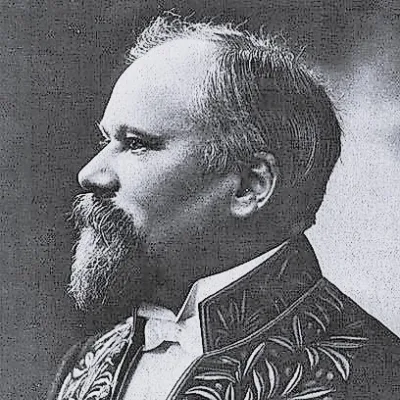
Raymond Poincaré
Human Design Chart
Biography
An expert financier and ardent nationalist, he was called a "Savior of the franc" for his measures to stabilize the economy.
Poincaré died on 15 October 1934, Paris, France.
Human Design Analysis: Raymond Poincaré as Projector 4/6
Projector 4/6 — Design at a Glance
Raymond Poincaré acted as a Projector, whose design was characterized by a specific, focused projection. His aura functioned like a bright flashlight, directing its light precisely at weaknesses in his surroundings. He possessed the ability to immediately recognize systemic flaws in others and to "shed light into the dark." This direct confrontation with flaws could be perceived as unpleasant or aggressive in his environment, similar to a light beam shining directly into someone's face.
The optimal strategy for his design was to wait for a respectful and honest invitation before giving advice. Through this passive approach, he could utilize his natural charisma, allowing others to seek his leadership on their own. Since his Sacral Center was undefined, Raymond Poincaré did not have constant, intrinsic life energy. Instead, he worked in phases of high intensity, followed by necessary rest periods for regeneration to prevent burnout. Living in harmony with this structure led to successful rewards. If he deviated from this strategy and acted without an invitation or without sufficient rest, bitterness, his non-self theme, would manifest. His design therefore required a balance between sharp observational skills and patient restraint to sustainably fulfill his leadership role.
Emotional Authority
Raymond Poincaré's Human Design reveals a tendency towards emotional depth and wave-like decision-making. He appeared as someone who did not find his inner truth in the first impulse but rather through the process of cycling through emotional phases. His inner authority was Emotional Authority, carried by the defined Emotional Center. This mechanism meant that he was subject to a constant wave of ups and downs; his perception of the world was always colored by his current mood. What excited him in one moment could appear negative in the next. His immediate feeling was merely a snapshot, not yet his final truth. Quick, spontaneous decisions from such an emotional state could have negative consequences for him. Instead, his design required patience: he needed to take time to let decisions ripen, often by sleeping on them multiple times. Only when the intense feelings subsided and emotional distance was gained did clarity and calmness set in. This process was especially essential for long-term, life-defining decisions, as only then did the deeper, more comprehensive understanding become accessible.
The 4/6 Profile — Opportunist / Role Model
Raymond Poincaré revealed himself as someone who in his early life was experimental and acted directly, before shifting his focus to a deeper, collective responsibility. His design as a 4/6 Profile, the "Networker/Role Model," shaped this development. In the first thirty years, before the return of Saturn, the sixth line still acted like a third line. This led him to intensively test relationships and friendships, driven by the simplicity and directness of the fourth line, which sought the simplest path to solutions and brought optimism through experiences already made.
Once the sixth line became active, an internal conflict arose between the desire for belonging (Line 4) and the need for wise distance and meaning (Line 6). This tension between heart and head was characteristic of his later work. He was expected to function as a wise role model and stand out through cooperation with others. The sixth line demanded authenticity and the right timing to bring mutations into the social fabric. In doing so, he had to learn to protect his open-heartedness of the fourth line from opening up to the wrong people and getting hurt. His life revolved around integrating these dual demands: the direct experience of youth and the authentic, collective wisdom of maturity.
Split Definition — Defined & Open Centers
Raymond Poincaré's Human Design shows a tendency towards constant mental pressure to question and form concepts. His defined Head and Ajna Centers created a perpetual inspiration, but this could not be directly converted into energy. This often led to inner worry or confusion, as he had to learn to accept the pressure rather than release it through hasty actions. His inner authority lay in his defined Solar Plexus Center. Here, the truth only revealed itself over time. Poincaré was challenged to wait out the emotional wave before acting. Impulsive decisions at the highs or lows of this wave would have created chaos; only through patience did he achieve emotional clarity. Additionally, his defined Root Center propelled him forward with set stress, nourishing existential awareness and emotional intelligence.
In contrast, his open Centers shaped his vulnerabilities. His open Throat Center tended to feel pressured to demand attention or speak up to avoid being overlooked, rather than waiting for the natural invitation. His open G Center lacked a fixed identity; he could easily blend into the directions and identities of his surroundings, making him vulnerable to false relationships or places. His open Heart Center lacked consistent willpower; he tended to prove himself through promises, often ending in a cycle of overextension and self-doubt. Furthermore, his open Sacral Center was vulnerable to "borrowed" energy, leading to exhaustion if he did not set boundaries. Finally, his open Spleen Center was marked by the fear of not surviving, leading him to cling to unhealthy situations to gain a false sense of security.
Channels for mental clarity and felt impulses.
Raymond Poincaré revealed himself as someone whose mind was marked by sudden, unbidden insights. His design indicated a tendency towards spontaneous knowledge that arose not through logical deduction but through a kind of mental mutation. This quality was determined by the Channel of Awareness 61-24. It connected the Head Center with the Ajna Center, through which inspiration from the Gate of Secrets (61) flowed into the Gate of Rationalizing (24). Poincaré did not control this thinking; he had to surrender to the happy coincidence of inner truth that emerged in its own time. His mind was occupied with the "white noise" of inspiration and often sought silence to endure the constant mental pressure.
Parallel to this, he was driven by an intense desire for new experiences. The Channel of Recognition 41-30 connected the Root Center with the Solar Plexus Center. The pressure from the Gate of Limitation (41) created restlessness and heated the emotions of the Gate of Feeling Recognition (30). This resulted in a strong desire to immerse himself in new situations, where the emotional wave had to be waited out to gain clarity before making decisions.
Additionally, individual Gates influenced his design: Gate 29 (Sacral Center) emphasized saying yes and persistence, while Gate 8 (Contribution) focused on individual engagement for group goals. Gate 14 provided for skillful power application and direction finding. In his personality, Gate 60 (Acceptance of Limitations), Gate 53 (Freedom for New Cycles), and Gate 54 (Connection of Secular Success and Mysticism) played a role. In his design, Gate 39 (Provocation for Mutation) and Gate 4 (Logical Formulation for Future Security) supported his inner structure.
Individual Circuitry — Circuit Signature
Raymond Poincaré's Design set a tendency towards innovative, creative flashes of insight, which, however, worked as two separate, parallel existing forces. As a person with split definition, he did not have a continuous energetic connection between these areas; they operated independently of each other.
The Knowledge Circuit connected his Head and Ajna Centers. This created a pulsating, acoustic energy based on the development of a unique identity and the acquisition of new knowledge. Through the Awareness Channel (Gates 24-61), specific creative ideas and deviations from the known emerged.
At the same time, but energetically isolated from it, the Meaning Circuit was active. It connected the Solar Plexus with the Root Center. Here, it was about the cyclical, wave-like processing of emotions and experiences from the past. The Recognition Channel (Gates 30-41) allowed for sharing felt insights and learning together with others from past events. This emotional wave followed its own rhythm of beginning, middle, and end.
Since both circuits were not connected to each other, these different energies – the creative impulse of the future and the emotional reflection of the past – had to be lived as separate experiences. There was no automatic flow from the creative idea to the emotional processing or vice versa; each side of the design acted according to its own laws and requirements.
Right Angle Cross of Contagion 3
Raymond Poincaré had the right infection cross 3 in Human Design. This specific configuration established an inner structure characterized by a deep, often unconscious connection to collective patterns and historical repetitions. It was not about actively seeking knowledge but rather passively absorbing information from the social environment or general atmosphere.
The infection cross describes a mechanism where external influences—whether through words, moods, or events—penetrate one's system and are processed there. With the variant "right" and number 3, this process was particularly marked by the dynamics of communication and interaction with other people. Raymond Poincaré thus showed himself to be someone who strongly reacted to the resonance of his environment. His perception was significantly influenced by what he picked up in his social circle.
This mechanism meant that his reactions and behavior often mirrored what he observed in his environment. He functioned as a receiver and further processor of collective energies. The challenge lay in distinguishing between his own essence and the absorbed "noise." His design called on him to consciously use this infection to understand deeper connections in society rather than being blindly carried away by it. This shaped his way of handling information and interpersonal dynamics.
Saturn Return · Uranus Opposition · Chiron Return · 2nd Saturn Return — Life Cycles
Raymond Poincaré's Human Design profile indicates a tendency towards strategic endurance and the ability to create structure over longer cycles. His career progression reflects this mechanical imprint, with his positions solidifying during phases of planetary maturation.
In 1903, at the age of 43, he was elected to the Senate as a representative of the Meuse department. This step occurred during the Uranus opposition period, often marked by the breaking of old structures and the assumption of new, higher responsibilities. It was a transitional moment when his political role was redefined.
Six years later, in 1909 at the age of 49, he became a member of the Académie française. This corresponded to the Chiron return, a fulfillment cycle in which one's incarnation cross unfolds and the meaning of life becomes tangible. This admission marked a blooming period when his intellectual and cultural achievements reached their full effect.
The second Saturn return appeared in 1919, when he was 59 years old and was elected to the American Academy of Arts and Sciences. This cycle often demands the consolidation of life's work and the recognition of accomplishments. The election confirmed the long-term stability and lasting influence that his design exerted during this life phase.
Projector · Emotional Authority — Synthesis
Raymond Poincaré spent a large part of his life recognising patterns and bringing them into understandable forms. His Projector design, combined with a defined Head and Ajna Center (Channel of Awareness), gave him the ability to quickly grasp the key points of a situation and shed light on the unknown for others. This tendency towards analysis and uncovering inconsistencies was reinforced by emotional authority, which allowed for a deeper, though delayed, evaluation. The Profile as a Networker/Role Model indicates that he did not keep these insights to himself but brought them into relationships and communities to foster connections and promote understanding. His recurring career successes (1903, 1909, 1919) attest to the impact of his ability to recognise and communicate patterns.
Yet this quest for clarity and understanding was always accompanied by an inner tension. The Line 4 in the Profile points to a desire for belonging and deep connections, while Line 6 emphasises a need for reflection and detachment. Poincaré seemed to oscillate between the desire to immerse himself in networks and serve as a role model and the urge to withdraw and ponder fundamental questions – a conflict between heart and mind that shaped his entire life.
2 Defined Channels
Incarnation Cross - Right Angle Cross of Contagion 3
Solar Return
The Solar Return shows the moment when the sun returns to its exact birth position - your personal solar year.
Life Cycles
Discover the life cycles with a detailed triple view (birth chart, cycle chart, composite).
Human Design Profile
- Type
- Projector
- Strategy
- Wait for the respectful invitation
- Authority
- Emotional Authority
- Profile
- 4/6 - Opportunist / Role Model
- Definition
- Split Definition
- Incarnation Cross
- Right Angle Cross of Contagion 3
- Date of Birth
- 20.08.1860 17:00
- Place of Birth
- Bar le Duc, France
Frequently Asked Questions
What Human Design type was Raymond Poincaré?
What Profile did Raymond Poincaré have in Human Design?
What Authority did Raymond Poincaré have?
What incarnation cross was Raymond Poincaré assigned?
When was Raymond Poincaré born?
Discover your own Human Design
Are you also a Projector? Find out in a personal reading how to unfold your leadership qualities and recognize the right invitations.
More Personalities
Back to overviewSissy Spacek

Alain-Fournier

Anémone

Ann-Margret

Bourvil
Christian-Jaque