
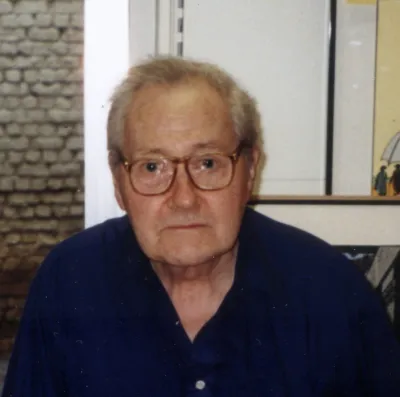
Raymond Reding
Human Design Chart
Biography
In 1950 he joined the team of the Journal Tintin team.
He designed the cover of the 29 September 1955 French edition of Tintin.
In 1957, he began the Jari series in the Journal Tintin, narrating the adventures of a tennis professional (Jimmy Torrent) and his young pupil Jari.
In 1963, he created, again in the Journal of Tintin, Vincent Larcher, his first soccer center forward of AC Milan. A few episodes later, his friend Olympio, endowed with telepathic powers, joined Vincent Larcher.
In 1971, Reding created "Section R" for the Journal Tintin, consisting of two former athletes operating as journalists-investigators who solve sports-themed puzzles.
In 1979, he left Journal Tintin for "Footy," a football magazine, taking "Section R" and his female hero "Sophie Ravenna" with him.
Reding died on 26 April 1999 in Anderlecht, Belgium.
The Human Design of Raymond Reding: Manifesting Generator 4/6
Manifesting Generator 4/6 — Design at a Glance
Raymond Reding revealed himself as someone who possessed a hybrid energy: the constant power of a Generator paired with the lightning-fast alignment of a Manifestor. His design suggested that he was capable of skipping steps and quickly pulling things into his life. However, this speed brought specific challenges. Often, he found himself at risk of overlooking important stages, which could lead to having to go back later to make up for missing foundations—a process that quickly led to frustration, as this emotion represented his non-self theme.
Furthermore, his configuration tended to react simultaneously to various impulses and pursue multiple projects in parallel. Without strictly applying his strategy—namely waiting and responding to life rather than initiating himself—this creative drive could quickly turn into its opposite. Crucial for him was the confirmation of his sacral center; only when this gave a clear "yes" was his energy sustainably effective. With proper alignment, he found deep satisfaction in his work, especially in what is called the Play Mode, which promoted variety and fun. Instead of focusing on one single thing, his design benefited from working on various tasks simultaneously, as long as his inner authority always consented and did not overwhelm him.
Sacral Authority
Raymond Reding possessed as a Generator the unique ability to unite Strategy and inner authority in one source. This fundamentally simplified his decision-making process: He did not need to weigh complex considerations between different internal voices but could directly listen to his sacral authority. This was not shown through intellectual analysis, but rather as an immediate physical reaction to external stimuli – a kind of gut feeling or a palpable surge of energy.
His inner truth spoke through sounds like grunts, hums, or simple affirmations like "Mhm". When his sacral motor engaged with something, he felt vital and alive. In these moments, he had access to an almost inexhaustible supply of energy that allowed him to perform his work with great enthusiasm. He was born to carry out tasks with joy and satisfaction, fully immersed in what he did without necessarily having an external purpose in mind.
Furthermore, his activated Spleen Center acted as a supportive authority to the Sacral Center. This gave him the ability to react particularly quickly and spontaneously. He had immediate access to his physical well-being and instinctive perception. This combination allowed Raymond Reding to make decisions not only with energy but also with a reliable, quick intuition that he could rely on in practice.
The 4/6 Profile — Opportunist / Role Model
Raymond Reding's design featured the Profile 4/6, which granted him the role of a networker and role model. In his first thirty years, before Saturn returned, Line 6 still functioned like Line 3. Raymond Reding experimented intensively during this phase, particularly in the areas of relationships and friendships, driven by Gate 55. This gate highlighted being fixed and aligning with stronger forces; his happiness depended heavily on others. The fourth line always saw both sides of a matter, was transpersonal, yet the big heart remained cautious to avoid injuries from false people.
Once Line 6 became active, an internal conflict emerged between the desire for community (Line 4) and the need to think distantly about the meaning of life (Line 6). This contradiction of heart versus head could be confusing. The sixth line, represented by Gate 34, brought common sense and integration. Raymond Reding learned early on that pure power was not enough; authenticity without constant displays of power became his path. In his later years, he fulfilled the expectation to live up to a wise role model by standing out through cooperation with others while integrating common sense into his circuitry.
Single Definition — Defined & Open Centers
Raymond Reding's Human Design profile points towards a clear, identity-defining communication style that flows directly from his inner direction and vital energy. His defined G Center gave him a reliable sense of self-identity and purpose; he knew who he was and where he was headed. This internal security translated into his defined Throat Center: He spoke not out of confusion or impulse but articulated his truth with ease and honesty, serving as a focal point to translate messages from his essence into the world.
This expression was supported by his defined Sacral Center, which provided him with an enormous source of vital energy. As a Generator, he was designed to react to life rather than initiate it. When asked or faced with a task, his Sacral responded with a clear tone—a 'Yes' or 'No'—signaling the availability of his power. This responsiveness aligned with his defined Spleen Center, which gave him sharp, momentary intuition. He sensed what was healthy and correct in the present moment and acted spontaneously from this intuitive knowledge without needing to rationalize it.
At the same time, his chart revealed specific vulnerabilities through his open centers. His open Head Center made him susceptible to mental pressure; he tended to be overwhelmed by doubts or irrelevant inspiration from others rather than trusting his inner authority. The open Ajna Center amplified this mental flexibility but also put him at risk of adopting foreign concepts as his own truth. His open Heart Center lacked consistent willpower, leading him into cycles of promises and disappointments to prove his worth, though he did not need to do so. Additionally, his open Solar Plexus absorbed the emotions of his environment, causing him to experience others' moods as his own instability. Finally, his open Root Center took on the stress of the world, leaving him under adrenal pressure that was not his own.
Channels for inspired intuition, powerful expression and reflection.
Raymond Reding's presence encouraged others to live their unique essence. This effect stems from Channel Inspiration 1-8, which connects the G Center with the Throat Center. Through Gate 1 (Self-expression) and Gate 8 (Contribution), he lived out his individual direction without explanation; his example inspired others to courageously express their own truth.
His energy was marked by a deep, rhythmic power that enabled new directions. Channel Beat 14-2 connected the Sacral Center with the G Center. Gate 14 (Power Competence) provided access to resources while Gate 2 (Higher Knowledge) directed movement through space and time. This gave him the ability to transform innovative impulses into material realities simply by trusting his sacral response.
Simultaneously, Raymond Reding possessed a sharp intuition in the present moment. Channel Brainwave 57-20 channeled insights from the Spleen Center (Gate 57) directly to the voice (Gate 20). This allowed him to articulate spontaneous truths based on ancient instincts at any given moment. His intuition was further strengthened by Channel Power 34-57, which connected the Spleen Center with the Sacral Center. Gates 34 and 57 created a survival archetype that kept him alert and physically vital, ready to react swiftly to dangers or opportunities.
His communicative power showed in Channel Charisma 20-34. Here, his generative life force (Gate 34) met the expression of the moment (Gate 20). This gave him a charismatic presence that only worked correctly when he responded to his inner guidance rather than being led by reason.
Retreat and reflection provided balance. Channel Lost Son 13-33 connected Gate 13 (Listener) in the G Center with Gate 33 (Withdrawal) in the Throat Center. Raymond Reding gathered experiences and secrets, then withdrew to process them before sharing his wisdom after careful consideration. This gave depth and continuity to his contributions.
Additionally, Gates like 59 (genetic strategy of bonding), 28 (readiness for risk now), 5 (rhythm), 46 (dedication to the process), and 7 (leadership perspectives) in his design supported his ability to connect, set his pace, and maintain a future-oriented outlook.
Individual Circuitry — Circuit Signature
Raymond Reding's Human Design profile points towards an impulsive, creative expression strength. Simply put, he had a continuous energetic flow between Throat, Identity, Sacral, and Spleen Centers. This connection shaped him as someone who directly translated inner intuition into external expression.
The Knowledge Circuit connected these centers through channels of Lightning Flash, Inspiration, and Beat. This promoted the emergence of new knowledge, supported by intuitive insights from the Spleen Center and the vital energy of the Sacral. Emotional waves from the Solar Plexus were used to initiate transformation. Parallel to this, his Meaning Finding Circuit linked Throat with Identity Centers. The channel 'The Lost Son' directed energy towards reflecting on past experiences and emotionally understanding their meaning before sharing them.
Additionally, he integrated forces through the Integration Circuit. Channels Charisma and Power further connected Throat, Sacral, and Spleen Centers. Here it was about drawing power from reacting to life, guiding it with intuitive knowledge, and making an immediate impact in the present moment. Overall, Raymond Reding appeared as a person who strengthened individual identity through creative impulses, made sense of past emotions, and always aimed for direct, authentic effect here and now.
Right Angle Cross of the Sleeping Phoenix 1
Raymond Reding's design carried the signature of the right cross of the sleeping phoenix. This configuration was characterized by a specific tension: deep knowledge of one's often untapped potential stood in contrast to the difficulty of making this manifest in reality. It wasn't about lacking ability, but rather structural obstacles in implementation.
In Human Design, this Cross describes a connection between the emotional center and the root center, symbolized by the right leg of the phoenix. The "sleeping" aspect indicates that this energy was not always active or consciously directed. Instead, it could exist as latent potential waiting for the right trigger. Raymond Reding lived with the challenge of translating inner visions and emotional depth into concrete actions. Often, this led to a feeling of waiting or holding back, as the direct connection to the outer world was filtered through this configuration.
The mechanics of this design demanded patience. It wasn't about fighting against resistance but understanding that certain talents only came to fruition under specific conditions. Raymond Reding's path was marked by searching for these moments of clarity where inner truth aligned with external demands. Without this alignment, the potential of the "phoenix" often remained unused in the background, leading to a certain internal detachment. The task was to bridge the gap between knowledge and action without forcing himself.
Saturn Return · Uranus Opposition · Chiron Return · 2nd Saturn Return — Life Cycles
Raymond Reding's design was marked by clear, cyclical phases of professional anchoring and reorientation. In 1950, at age 30, he joined the team of Journal Tintin. This marked his first Saturn Return, a time when years of groundwork often condenses into a stable structure marking the beginning of a new life phase.
Sixteen years later in 1971, at age 51, he created "Section R" for Journal Tintin. This moment fell on his Chiron Return. In Human Design mechanics, this is not a healing process but an accomplishment cycle: one's life task unfolds increasingly and purpose becomes experiential in daily life. Here the bloom of his creative work was realized as concrete manifestation of his design.
In 1979 at age 59, he left Journal Tintin for "Footy", a football magazine. This corresponded to his second Saturn Return. This cycle often demands a deep revision of existing structures and can be experienced as crisis or necessary change. Reding's transition illustrates the mechanical necessity to break old forms to meet new requirements. His career thus followed not arbitrarily but rhythmically according to planetary cycles: building up, fulfillment, and structural change shaped his professional journey.
Manifesting Generator · Sacral Authority — Synthesis
Raymond Reding lived a life path marked by an inner dynamic between creative energy and the need for authenticity. His design as a Manifestor (with defined sacral authority) points to someone who could set impulses quickly – pulling things into their life swiftly – but was also sustained by a constant flow of life energy reacting to external stimuli. This combination of initiating power and reactive energy showed in his work, where he both ventured new paths (like the creation of "Section R") as well as went through phases of upheaval and realignment (the move to "Footy"). The defined communication and manifestation area enabled him to express his inner impulses and bring them into the world.
Central to Raymond Reding's life was a tension field between the desire for community and the longing for individual unfoldment. His profile as Networker/Role Model (4/6) points to someone who sought connections and experimented in relationships, but also felt compelled to reflect on themselves and their perspectives – a "conflict of heart against head". This internal contradiction shaped his path marked equally by successes (like creating for Journal Tintin) and crises (leaving the journal), while he always tried to live out and transform his unique identity.
6 Defined Channels
Incarnation Cross - Right Angle Cross of the Sleeping Phoenix 1
Solar Return
The Solar Return shows the moment when the sun returns to its exact birth position - your personal solar year.
Life Cycles
Discover the life cycles with a detailed triple view (birth chart, cycle chart, composite).
Human Design Profile
- Strategy
- To respond - wait for something to respond to
- Authority
- Sacral Authority
- Profile
- 4/6 - Opportunist / Role Model
- Definition
- Single Definition
- Incarnation Cross
- Right Angle Cross of the Sleeping Phoenix 1
- Date of Birth
- 23.02.1920 15:00
- Place of Birth
- Louviers, France
Frequently Asked Questions
What was Raymond Reding's Human Design type?
What Profile did Raymond Reding have in Human Design?
Which Authority guided Raymond Reding?
What incarnation cross did Raymond Reding have?
When was Raymond Reding born?
Discover your own Human Design
Are you also a Manifesting Generator? Find out in a personal reading how to unfold your multi-talents and direct your energy wisely.
More Personalities
Back to overviewAlain-Fournier

Aldair

Alizée

Angeli

Arletty

Artus
