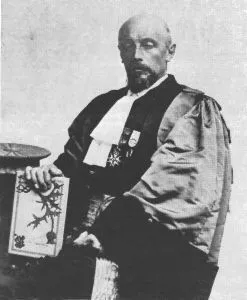
René Blondlot
Human Design Chart
Biography
In 1903, Blondlot announced that he had discovered N rays, a new species of radiation. The "discovery" attracted much attention over the following year until Robert W. Wood showed that the phenomena were purely subjective with no physical origin. The French Academy of Sciences awarded the Prix Leconte (₣50,000) for 1904 to Blondlot, although they hedged on the reason, citing the totality of his work rather than the discovery of N-rays.
He died, aged 81, on 24 November 1930 in Nancy.
What does Projector 3/5 mean for René Blondlot?
Projector 3/5 — Design at a Glance
René Blondlot was characterized by a focusing aura that acted like a bright flashlight, making system errors in his environment immediately apparent. His design marked him as someone who intuitively understood the functioning or failure of structures in others. This perception was intense; however, directly addressing these deficits often triggered defensive reactions, akin to shining a bright light into someone's face.
The mechanics of his Projector type suggested that he should not impose his insights forcefully. Instead, he was most effective when living harmoniously himself and thereby developing an attractive aura. Other people were automatically drawn to this glowing example and sought his advice. His strategy involved waiting for value-based invitations before taking on a leadership role.
Furthermore, due to his undefined Sacral Center, René Blondlot did not have a constant intrinsic energy source. His design was characterized by phases of high activity that had to be followed by necessary rest periods to avoid exhaustion. Living in harmony with this rhythm and the strategy of waiting for invitations rewarded him with success. Deviations from this tended towards the Non-Self theme of bitterness, as his specific way of projecting energy was then not respected.
Emotional Authority
René Blondlot exhibited a decision-making structure that did not rely on spontaneous impulses but rather on penetrating emotional waves. His design determined that his defined Solar Plexus Center carried his inner authority. This configuration was subject to constant ups and downs in emotions; perception was always colored by the current mood. What appeared inspiring at one moment could be negative in the next. However, this emotional fluctuation did not mean that the first impression was the truth. Rather, it was a snapshot that had yet to offer final clarity. Quick reactions based on this fleeting mood were therefore risky and often misleading.
The mechanics required patience and time. René Blondlot needed to let decisions mature, ideally through multiple nights of reflection. Only when intense feelings subsided and emotional distance was gained did calmness set in. This process of running the emotional wave was essential for recognizing the true nature of a situation. Especially with long-term decisions that influenced life's course, this strategy of waiting was indispensable. Only then could he ensure that his actions were based on deeper insight rather than temporary mood swings. The necessity of this delay shaped his approach to important life steps.
The 3/5 Profile — Martyr / Heretic
René Blondlot's design was marked by a tension between personal learning from mistakes and the public role as an example. As a 3/5er, the Explorer and Hero, he primarily learned through trial and error. Line 3 of the Explorer drove him to try things out himself because initially, he had little faith until he experienced it personally. This process was often characterized by self-sacrifice; he accepted responsibility for the mutation process and saw failures as a necessary part of his development.
These practical experiences formed the basis for his Line 5, the Hero's line. Here, he acted objectively and impartially, especially in crisis situations. René Blondlot used his acquired wealth of experience to guide others and solve problems. His attractiveness to his surroundings stemmed from this rich fund of lived knowledge; others looked up to him as a competent rescuer or cool storyteller.
However, this configuration also contained a painful component: If he failed in public experiments, he suffered under the pressure of the Hero role. Line 5 demanded objectivity and emotional distance in crisis management while Line 3 pushed him into his personal learning process with all its risks. Thus, René Blondlot was someone who grew through his own mistakes to later serve as an unerring example for others - a dynamic that both fascinated and could suffer under the weight of public expectations.
Split Definition — Defined & Open Centers
René Blondlot's design established a foundational structure of constant mental pressure and emotional depth, driven by a defined Root Center. This center provided the continuous adrenaline-fueled stress for survival and forward movement in the material world. Parallel to this, his defined Head and Ajna Centers shaped his internal landscape: They generated a permanent, specific mental process of questioning and concept formation. However, this pressure was not coupled with direct action capability; energy for implementation was not available. Instead, his system required patience. His emotional authority in the defined Solar Plexus Center dictated that truth would only reveal itself at the end of an emotional wave. Impulsive actions on the highs or lows of these waves led to confusion; clarity emerged only through waiting.
This internal dynamic contrasted with his open centers, which meant situational receptivity. His open G Center implied no fixed identity or direction but rather adaptation to the right place and fitting environment. Identity was not held internally but reflected by correct environments. Similarly, his open Heart Center lacked consistent willpower for self-assertion or competition. The risk lay in proving oneself through promises, often ending in a spiral of disappointment due to unsustainable energy availability.
His open Sacral Center showed another weakness: It did not have its own constant generative energy. René Blondlot tended to borrow energy from the environment, which led to exhaustion when overused. He could not rely on a stable yes-no feeling about work or availability. His open Spleen Center made him vulnerable to conditioned fears and spontaneous decisions often driven by insecurity about being unprepared for life. And his open Throat Center meant that communication could not be controlled; attention came only through waiting for the right invitation, not through active pursuit of visibility. Thus, his design was a balance between internal mental and emotional processes and external adaptability requiring calmness and patience.
Channels for logical clarity and emotional release.
René Blondlot's design established a fundamental tension between the pressing need for logical confirmation and deep emotional unpredictability. This constellation shaped his essence through a constant oscillation between skeptical analytical drive and impulsive emotional states.
The Logic Channel 63-4 connects the Head Center to the Ajna Center via Gate of Doubt (63) and Gate of Formulation (4). This mechanism drives a mind that constantly filters patterns to test their stability. Here, doubt was not weakness but an essential prerequisite for any logical conclusion. The pressure arose where a pattern was recognized as unstable and demanded verifiable answers. This served less personal certainty than the creation of collective security through rational predictions.
Simultaneously, the Channel of Emotional Release 39-55 connects the Root Center to the Solar Plexus via Gate of Provocation (39) and Gate of Mind (55), setting a pulsating wave of moods in motion. This was not a rational mood change but a mutative force oscillating between ecstatic joy and melancholic uncertainty. René Blondlot was marked by the Sun in Gate 39: Provocation and emotional wave movement formed his dominant, constant feature. This intense emotional energy often overshadowed the cool skepticism of the logical channel.
While the logic channel sought to establish order through question and answer, the emotional channel demanded an authentic embrace of this inner alchemy. The challenge lay in not rationalizing moods but living them as a source of individual truth and creative mutation. Thus emerged a profile that on one hand sought verifiable facts while also affecting others through its own emotional intensity and provocation – regardless of whether these could be logically grasped or not.
Individual Circuitry — Circuit Signature
René Blondlot's design established a tendency towards emotional transformation and the expression of unique identity. His driving force came from the Knowledge Circuit, specifically via the Channel 'Emotional Release' (Gates 55-39). This connects the Solar Plexus Center to the Root Center. Emotional waves and pulsations in the Solar Plexus were directly translated into the expressive energy of the Throat. It was not about rational analysis but transforming new insights through one's own feelings and carrying them outward. This energy was pulsing and acoustically marked, driven by the need to make one's individuality visible.
Parallel to this, there existed a separate second power structure: The Understanding Circuit. Here, the Channel 'Logic' (Gates 63-4) connects the Head Center with the Ajna Center, generating an area of focused visual logic and strategic structure. As René Blondlot had a split definition, these two circuits – emotional transformation in Knowledge and rational clarity in Understanding – were not directly energetically connected. They existed as two parallel systems. The emotional wave of Solar Plexus did not automatically flow into the logical structure of Ajna. Instead, they worked parallel: on one side, the pressing, emotionally-based expression of new identity; on the other, the ability for clear, unconditioned analysis. The driving dynamic lay clearly in the emotional realm while logic served as a supportive but separate instrument.
Right Angle Cross of Tension 2
René Blondlot's Human Design configuration featured a fundamental structure where internal tension was not seen as a disturbance but rather as a constitutive element of his being. This configuration, the right cross of tension 2, suggested that pressure and friction were not states to be avoided but rather the driving force shaping his existence.
In this pattern, tension is not a pathological symptom but a structural principle. It served as a motor propelling actions and giving life a certain density. Without this internal dissonance or the urge towards resolution, the characteristic dynamics of his design would not have been fully effective. The tension was thus an integral part of his functioning; it shaped how he engaged in situations and responded to challenges.
René Blondlot lived within a system that utilized this energetic charge to move forward. It wasn't about reducing tension to find peace but understanding it as the source of movement and formation. This mechanism described a way of living where conflicts or internal pressure were seen as necessary prerequisites for development and expression. His design indicated that the feeling of tension was a central building block of his personal architecture, helping him fulfill his role in the world by knowing and using the pressure rather than ignoring or fighting it.
Saturn Return · Uranus Opposition · Chiron Return · 2nd Saturn Return — Life Cycles
René Blondlot's Human Design showed a tendency towards integrating personal authority and social responsibility, particularly during the second half of life. This phase was marked by the second Saturn return, a cycle often bringing long-term work into solid structures. In 1904, at age 55, René Blondlot received the Prix Leconte for his overall body of work – an acknowledgment not explicitly tied to the N-rays but recognizing his scientific achievements in general. This event marked a peak in his career and underscores how his design matured during this life phase. The second Saturn return promoted in him the ability to integrate earlier experiences and direct them into a clear path. His life task was to find balance between inner truth and outer expression through consistent work and self-reflection. The award highlighted that his influence extended beyond individual discoveries, manifesting in broader scientific recognition – without simplifying the complexity of his character. His journey demonstrated how someone with their specific Human Design can unfold their potential by relying on their inner authority while respecting external demands.
Projector · Emotional Authority — Synthesis
René Blondlot was a Projector whose life was marked by a profound ability to recognize potential and flaws in others (Gate 63/4). This sharp perception, fueled by an activated mental center (Head & Ajna), led him to focus on subtle patterns and inconsistencies. His profile as an experimenter/heroes (Line 3/5) suggests that he gained knowledge through personal experimentation and wanted to make it available to others – a process requiring emotional maturation due to his emotional authority. The combination of mental pressure and emotional wave led to a deep engagement with his insights, which could not be shared immediately but required an internal clarification process.
A central paradox in his design lies in the tension between his projection ability and undefined Root and Heart Centers. He was destined to inspire others and point out errors, yet he lacked the consistent energy to actively shape or forcefully implement his visions himself. Instead, his success depended on the right environment and people (open G Center) who could pick up and realize his impulses. This dependence on external forces created internal tension as he recognized potential but did not always have the means to actualize it.
2 Defined Channels
Incarnation Cross - Right Angle Cross of Tension 2
Solar Return
The Solar Return shows the moment when the sun returns to its exact birth position - your personal solar year.
Life Cycles
Discover the life cycles with a detailed triple view (birth chart, cycle chart, composite).
Human Design Profile
- Type
- Projector
- Strategy
- Wait for the respectful invitation
- Authority
- Emotional Authority
- Profile
- 3/5 - Martyr / Heretic
- Definition
- Split Definition
- Incarnation Cross
- Right Angle Cross of Tension 2
- Date of Birth
- 03.07.1849 19:00
- Place of Birth
- Nancy, France
Frequently Asked Questions
What was René Blondlot's Human Design type?
What Profile did René Blondlot have?
What Authority did René Blondlot have?
What incarnation cross did René Blondlot have?
When was René Blondlot born?
Discover your own Human Design
Are you also a Projector? Find out in a personal reading how to unfold your leadership qualities and recognize the right invitations.
More Personalities
Back to overviewSissy Spacek

Alain-Fournier
Anémone

Ann-Margret

Bourvil
Hergé